

Chapter 9: Measurement and Evaluation
Original notes — ready CBSE (NCERT, English Medium) • Class 11 • Physical Education • Book: Health and Physical Education
Chapter 9: Measurement and Evaluation — EG's own notes, in simple words
Book: Health and Physical Education (CBSE, Class 11) | Chapter 9 | Medium: English
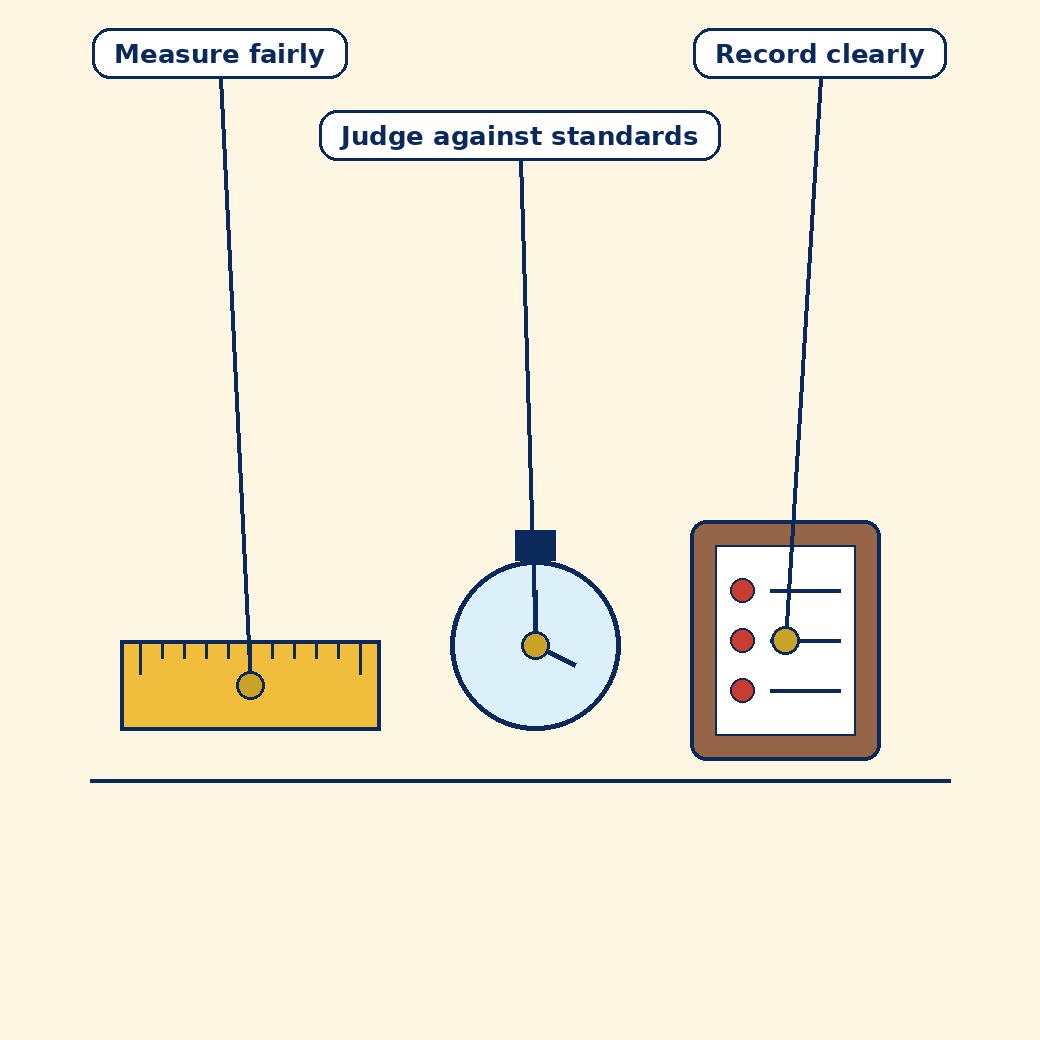
Diagram (labels on the image): Schematic (labels on the image): measure fairly with the ruler, judge against standards with the stopwatch, and record clearly on the clipboard.

Same procedure every time: only then can scores be compared.
What you should learn
- Distinguish test, measurement and evaluation.
- Name the strength tests and what each assesses.
- Explain the endurance test and the flexibility test.
- Calculate BMI and read its categories.
- Explain waist-to-hip ratio and the three somatotypes.
1. 1. Why measure in physical education
Measurement assigns numbers to performance: a time, a distance, a count of repetitions. Evaluation judges the worth of those numbers against a standard: is this time good for this age group? Without measurement, progress is guesswork; without evaluation, numbers have no meaning.
Teachers measure to group students fairly, track progress, spot talent, plan training, and motivate students with visible improvement.
2. 2. Tests for fitness and skill
Fitness tests include: sit-and-reach (flexibility), push-ups or sit-ups in a minute (strength/endurance), a 12-minute run (cardiovascular endurance), and BMI for body composition. Skill tests are game-specific: a basketball free-throw count, a football dribbling time through cones, or a badminton serve-accuracy count.
A test must be administered the same way every time — same warm-up, same instructions, same counting — or its results cannot be compared.
3. 3. Good tests: validity, reliability, objectivity
A good test is valid (it measures what it claims: a flexibility test must measure flexibility, not strength), reliable (it gives similar results when repeated under the same conditions), and objective (different testers get the same score from the same performance).
A test can be reliable without being valid: a bathroom scale reliably measures weight, but it is not a valid test of fitness. Validity is the harder, more important quality.
4. 4. Recording and using results
Results are recorded in a standard table (name, test, score, date) and compared with norms — typical scores for an age and gender group — to judge levels. Progress is judged by comparing a student's later score with her own earlier score, not only with others'.
Records also guide teaching: if a whole class scores low on flexibility, the programme adds stretching; if one student excels in speed, she may be guided towards sprinting.
5. 5. Test, measurement and evaluation
A test is the instrument or activity used to collect information, such as a push-up test or a run. Measurement is the score the test gives, a number that can be recorded and compared. Evaluation is the judgement made from that score against a standard: whether the result is good, average or poor, and what should be done next.
The three steps belong together. A test without measurement gives no record, measurement without evaluation gives no meaning, and evaluation without a fair test gives no justice. Good tests must therefore be valid, reliable and objective, as the earlier page explains.
6. 6. Tests related to muscular strength
Tests related to muscular strength measure the strength of different muscle groups. The push-up helps in identifying and assessing muscular strength of the arms and shoulders, as the individual lifts the body again and again. The abdominal curl tests the strength of the abdominal muscles, and the squat thrust tests strength and coordination of the legs and whole body in a quick, repeated movement.
Each test has a set procedure and a counting rule, so that two testers get the same score for the same performance. Strength tests are used to set training targets and to check whether a programme is working.
7. 7. Endurance and flexibility tests
Muscular endurance is tested by the 1000 metre run or walk test, which has a set procedure: the individual covers 1000 metres by running or walking as fast as possible, and the time taken is the score. A shorter time means better endurance, because the heart, lungs and muscles sustain effort longer.
Flexibility is tested by the sit and reach test, which helps in the measurement of flexibility of the lower back muscles and the back of the legs. The individual sits with legs straight and reaches forward as far as possible, and the distance reached is the score. The difference between measurements, taken before and after training, shows improvement.
8. 8. Body Mass Index (BMI)
Body Mass Index relates weight to height: BMI equals weight in kilograms divided by height in metres squared. Measurement of height must be accurate, taken standing straight without shoes, because a small height error changes the BMI noticeably.
BMI categories in the chapter are: very severely underweight below 15, severely underweight from 15 to 16, underweight from 16 to 18.5, normal or healthy weight from 18.5 to 24, overweight from 25.0 to 29.9, and obesity at 30 and above. BMI for children aged between 2 to 20 years is calculated and read differently, using age-based charts.
9. 9. Waist-to-hip ratio and somatotypes
Waist-to-hip ratio (WHR) compares the waist measurement with the hip measurement, and its measurement procedure divides the waist value by the hip value. The chapter gives health risk levels for men and women, because fat carried around the waist carries more risk than fat carried elsewhere.
Somatotypes describe body build in three types: endomorphy, mesomorphy and ectomorphy. An endomorph typically has a rounded, softer build; a mesomorph has a muscular, sturdy build; and an ectomorph has a lean, light build. A somatotype describes tendency, not destiny: training and food still change what the body can do.
At a glance — chart / table
| Quality | Meaning | Test of the quality |
|---|---|---|
| Validity | Measures what it claims | Does the flexibility test measure flexibility? |
| Reliability | Similar results on repeat | Same score when retested tomorrow? |
| Objectivity | Same score by different testers | Do two teachers score alike? |
Key Terms / Important Terms
- Measurement — Assigning numbers to performance (time, distance, count).
- Evaluation — Judging measured results against a standard.
- Test — A standard procedure measuring one ability.
- Validity — A test measuring what it claims to measure.
- Reliability — A test giving consistent results on repetition.
- Objectivity — Different testers obtaining the same score.
- Norm — Typical scores for an age/gender group, used for comparison.
- Sit-and-reach test — A flexibility test of the lower back and back of the legs, scored by the distance reached forward.
- Somatotype — A body-build type: endomorph, mesomorph or ectomorph.
- Waist-to-hip ratio — Waist measurement divided by hip measurement, used to judge health risk.
Remember
- Measurement = numbers; evaluation = judgement against a standard.
- Good test = valid + reliable + objective.
- Reliable without valid is possible; valid is the harder quality.
- Compare a student with her own earlier score, not only with others.
- BMI = weight (kg) / height (m) squared; normal = 18.5 to 24.
Exam Tip / Common Mistake
Common mistake: calling a repeatable test “valid”. Repeatability is reliability; validity asks whether the test measures the right thing at all. State both separately.
Practice set — try it yourself
- A test gives the same score every day but measures the wrong ability. Is it valid? Reliable? Explain. Hint: Hint: Repeatability and rightness are different qualities.
- Distinguish measurement from evaluation with a running example. Hint: Hint: The time is measurement; judging it good is evaluation.
- Two teachers score the same performance differently. Which quality is missing? Hint: Hint: Different testers, different scores.
- Design a simple skill test for basketball free throws. Hint: Hint: Fixed attempts, same distance, count successes.
- Why compare a student with her own past score, not only with class norms? Hint: Hint: Personal progress matters as much as ranking.
Questions with Answers
- Distinguish measurement from evaluation. Answer: Answer: Measurement assigns numbers to performance, such as a 100 m time of 14 seconds. Evaluation judges that number against a standard, such as deciding whether 14 seconds is good for the student's age group.
- What are validity, reliability and objectivity in a test? Answer: Answer: Validity means the test measures what it claims to measure. Reliability means it gives similar results when repeated under the same conditions. Objectivity means different testers obtain the same score from the same performance.
- Can a test be reliable but not valid? Explain with an example. Answer: Answer: Yes. A bathroom scale reliably gives the same weight every day, but weight alone is not a valid measure of overall fitness. Repeatability does not guarantee the test measures the right thing.
- Give one fitness test for each: flexibility, cardiovascular endurance, muscular endurance. Answer: Answer: Sit-and-reach for flexibility, a 12-minute run for cardiovascular endurance, and sit-ups in one minute for muscular endurance.
- How should test records be used by a teacher? Answer: Answer: Records are compared with norms to judge levels, compared with each student's own earlier scores to track progress, and used to plan teaching — e.g. adding stretching if a class scores low on flexibility.
Extension Questions with Answers
- Why is a test without evaluation useless? Answer: Answer: Because a test only gives a score. Without evaluation against a standard, the score has no meaning and no action follows from it.
- Why must two testers get the same score? Answer: Answer: Because a good test is objective and reliable: the same performance must give the same score whoever counts it, or the result cannot be trusted.
- How does the 1000 m test show endurance rather than speed? Answer: Answer: Because the score is the time to sustain running or walking over 1000 metres; a shorter time means the heart, lungs and muscles sustained effort longer, which is endurance.
- A student is 1.6 m tall and weighs 64 kg. What is the BMI category? Answer: Answer: BMI = 64 / (1.6 x 1.6) = 64 / 2.56 = 25.0, which is the start of the overweight category (25.0 to 29.9).
- Why is somatotype only a tendency? Answer: Answer: Because an endomorph, mesomorph or ectomorph describes build, but training and food still change strength, endurance and what the body can do.
Board-pattern Questions with Answers
- Distinguish test, measurement and evaluation. Answer: Answer: Test is the instrument used to collect information. Measurement is the score it gives. Evaluation is the judgement of that score against a standard.
- Name the three muscular strength tests in the chapter. Answer: Answer: Push-up, abdominal curl and squat thrust.
- What does the sit and reach test measure? Answer: Answer: Flexibility of the lower back muscles and the back of the legs, scored by the distance reached forward.
- Calculate BMI for 70 kg and 1.75 m, and state the category. Answer: Answer: BMI = 70 / (1.75 x 1.75) = 70 / 3.0625 = about 22.9, which is in the normal (healthy weight) category of 18.5 to 24.
- Name the three somatotypes. Answer: Answer: Endomorph, mesomorph and ectomorph.
Recap
- Test = instrument, measurement = score, evaluation = judgement.
- Strength: push-up, abdominal curl, squat thrust. Endurance: 1000 m run/walk.
- Flexibility: sit and reach. BMI = kg / m squared; normal 18.5–24.
- WHR = waist / hip. Somatotypes: endomorph, mesomorph, ectomorph.