

Chapter 8: Health Related Physical Fitness
Original notes — ready CBSE (NCERT, English Medium) • Class 11 • Physical Education • Book: Health and Physical Education
Chapter 8: Health Related Physical Fitness — EG's own notes, in simple words
Book: Health and Physical Education (CBSE, Class 11) | Chapter 8 | Medium: English
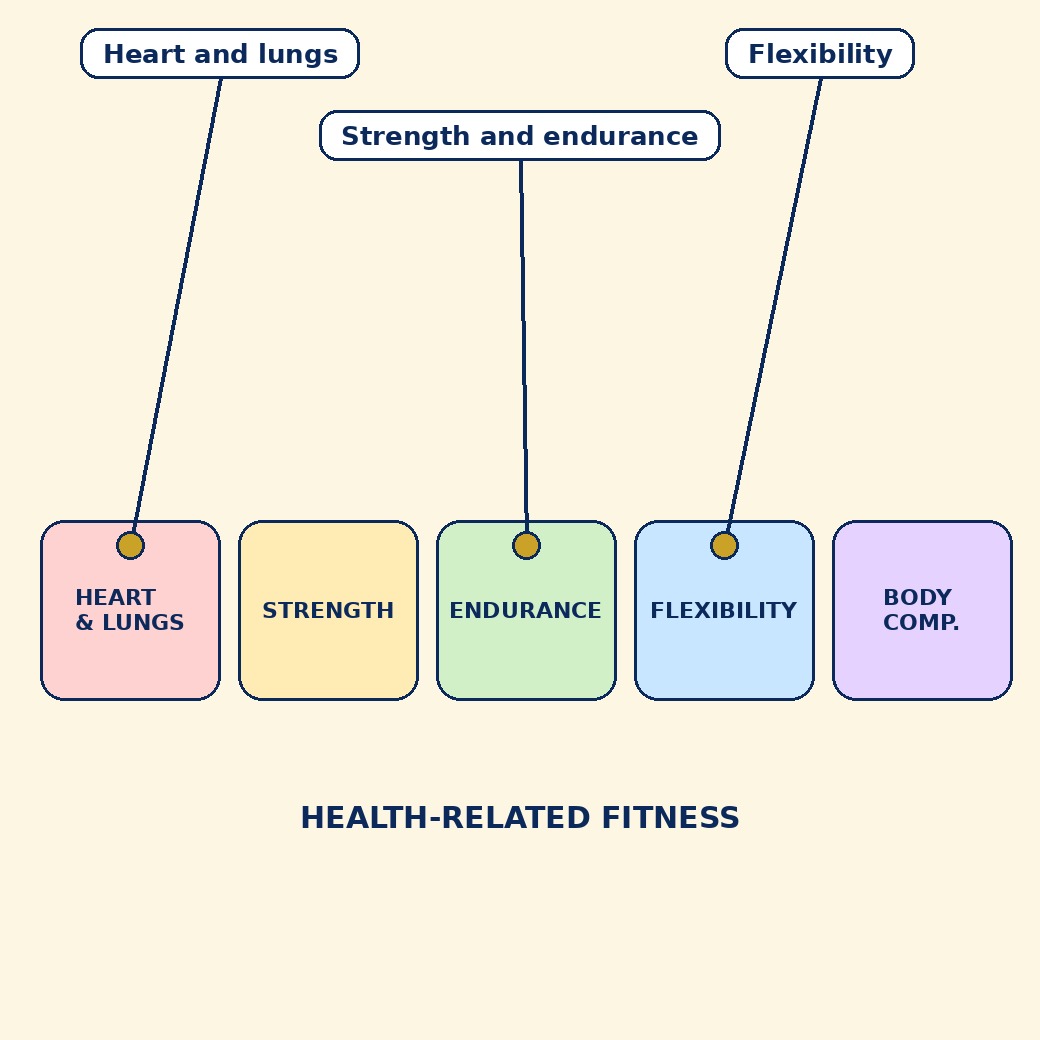
Diagram (labels on the image): Schematic (labels on the image): heart and lungs, strength and endurance, and flexibility.

A balanced week trains every component, not just one.
What you should learn
- Define health-related physical fitness and its five components.
- Explain muscular strength and its methods of improvement.
- Explain endurance, its factors and its improvement.
- Explain flexibility, its factors and its improvement methods.
- Explain body composition and cardio-vascular endurance.
1. 1. Fitness for health, not only sport
Health-related physical fitness is the fitness needed for everyday health and active living, as opposed to skill-related fitness for competitive performance. Its components are cardiovascular endurance, muscular strength, muscular endurance, flexibility and body composition.
A fit student can climb stairs without breathlessness, carry a bag without strain, sit with good posture, and recover quickly after effort. These are health outcomes, not medals.
2. 2. The five components in detail
Cardiovascular endurance is the heart and lungs sustaining activity (running, cycling, swimming). Muscular strength is the maximum force a muscle can exert (lifting, pushing). Muscular endurance is sustaining repeated effort (many repetitions, long holds). Flexibility is the range of movement at joints (stretching, yoga). Body composition is the proportion of fat to lean tissue (muscle, bone, water).
Balance matters: strength without flexibility causes stiffness; endurance without strength causes weakness. A good programme trains all five.
3. 3. Measuring fitness simply
Simple school tests estimate each component: a 12-minute run or step test for cardiovascular endurance, push-ups or sit-ups for strength and endurance, sit-and-reach for flexibility, and height–weight measures (body mass index, BMI) as a rough guide to body composition.
BMI = weight in kilograms divided by height in metres squared. It is a screening guide, not a complete health verdict: muscular students can score high without excess fat, so results are read with other signs.
4. 4. Building fitness safely
The FITT principle guides programmes: Frequency (how often), Intensity (how hard), Time (how long) and Type (which activity). A beginner might walk briskly 3 days a week for 20 minutes, then progress gradually — increasing only one FITT factor at a time.
A balanced week mixes aerobic activity (running, cycling), strength work (bodyweight exercises), flexibility (stretching, yoga) and rest days, because rest is when the body adapts and grows stronger.
5. 5. Muscular strength and its improvement
Muscular strength is the force a muscle can exert, and the chapter distinguishes maximum strength, the greatest force in a single contraction, from explosive strength, the force applied quickly, as in a jump or throw. Both depend on muscle fibres: slow-twitch fibres (red) work for endurance, while fast fibres work for power.
Methods of strength improvement use our own body weight as resistance, with sit-ups, lunges, bicycle crunches, leg raises, high knees, turning kicks, chin-ups and the full arch, and use external weight as resistance, with the seated row, dumbbell shoulder press, lat pull down, twist abs, incline sit-up and calf raise. Strength grows when resistance rises gradually.
6. 6. Endurance and its improvement
Endurance is the ability to sustain activity without early fatigue, and it depends on the heart, lungs, blood and muscles working together to take oxygen from the atmosphere with the help of the nose and airways and deliver it to working muscles. Factors determining endurance include aerobic capacity, training, nutrition and the efficiency of movement.
Improvement of endurance uses the continuous method, in which the person goes for long activity without breaks, often with slow pace at first. The slow-pace continuous method builds the base on which faster work is later added, and it helps in checking performance and deciding progress.
7. 7. Flexibility and its improvement
Flexibility is the range of movement around a joint. Passive flexibility is the movement possible when an outside force moves the joint, while active flexibility is the movement the person's own muscles produce. A static position, in which the individual executes movement and holds it, is one way flexibility is practised.
Factors determining flexibility include joint structure, muscle length, age and temperature. Improvement of flexibility uses the ballistic method, in which movements are done with swinging momentum, with examples such as the sky reach, toe touch and neck roll; the post-isometric stretch, in which the muscle is first tensed and then stretched; and proprioceptive neuromuscular facilitation (PNF), in which a partner assists the stretch.
8. 8. Body composition
Body composition is the proportion of fat and lean tissue in the body. Two people of the same weight can have very different body compositions, and therefore very different health and fitness: one may carry more muscle and less fat, while the other carries more fat and less muscle.
Body composition matters because excess fat is linked with health risks, while adequate muscle supports strength, posture and daily activity. It is improved by regular activity plus balanced food, not by starving, which loses muscle along with fat.
9. 9. Cardio-vascular endurance
Cardio-vascular endurance is the ability of the heart, blood vessels and lungs to supply oxygen during sustained activity. It is the fitness component that decides whether a person can run, cycle or swim for a long time without stopping, and it is closely related to general endurance.
It improves with the same continuous methods as endurance: long, steady activity that trains the heart to pump more with each beat and the muscles to use oxygen better. A person with good cardio-vascular endurance recovers faster after effort, because the heart and lungs return to rest more quickly.
At a glance — chart / table
| Component | Simple test | Activity building it |
|---|---|---|
| Cardiovascular endurance | 12-minute run / step test | Running, cycling, swimming |
| Muscular strength | Push-ups (max effort) | Push-ups, lifting |
| Muscular endurance | Sit-ups in a minute | Repeated bodyweight work |
| Flexibility | Sit-and-reach | Stretching, yoga |
| Body composition | BMI + waist measures | Balanced diet + activity |
Key Terms / Important Terms
- Health-related fitness — Fitness for everyday health and active living.
- Cardiovascular endurance — Heart and lungs sustaining activity.
- Muscular strength — Maximum force a muscle can exert.
- Muscular endurance — Sustained repeated muscle effort.
- Flexibility — Range of movement at joints.
- Body composition — Proportion of fat to lean tissue.
- BMI — Body mass index: weight (kg) / height (m) squared.
- FITT — Frequency, Intensity, Time, Type — programme design factors.
- Maximum strength — The greatest force a muscle can exert in a single contraction.
- Slow-twitch fibre — A red muscle fibre that works for endurance activity over a long time.
- PNF — Proprioceptive neuromuscular facilitation: a partner-assisted stretch method for improving flexibility.
Remember
- Five health components: cardio endurance, strength, muscular endurance, flexibility, body composition.
- FITT = Frequency, Intensity, Time, Type.
- BMI = kg / (metres squared); a screening guide, not a full verdict.
- Progress one FITT factor at a time; rest days are part of training.
- Five components: muscular strength, endurance, flexibility, body composition, cardio-vascular endurance.
Exam Tip / Common Mistake
Common mistake: listing skill components (speed, agility) when asked for health-related fitness. The health set is exactly five: cardio endurance, strength, muscular endurance, flexibility, body composition.
Practice set — try it yourself
- List the five health-related fitness components with one test each. Hint: Hint: Cardio, strength, muscular endurance, flexibility, body composition.
- A student weighs 50 kg and is 1.6 m tall. Calculate BMI and explain what it can and cannot say. Hint: Hint: BMI = 50 / (1.6 × 1.6).
- Expand FITT and design a beginner week using it. Hint: Hint: Frequency, Intensity, Time, Type — change only one at a time.
- Why are rest days part of a fitness programme, not laziness? Hint: Hint: Adaptation and strengthening happen during recovery.
- Distinguish muscular strength from muscular endurance. Hint: Hint: Maximum force once vs sustained repeated effort.
Questions with Answers
- Name the five health-related fitness components. Answer: Answer: Cardiovascular endurance, muscular strength, muscular endurance, flexibility and body composition.
- What is BMI, and why is it only a screening guide? Answer: Answer: BMI = weight in kilograms divided by height in metres squared. It is only a screening guide because it does not distinguish fat from muscle, so a muscular student can score high without excess fat.
- Expand FITT and explain each factor. Answer: Answer: Frequency is how often activity happens; Intensity is how hard it is; Time is how long each session lasts; Type is which activity is chosen. Together they design and progress a fitness programme.
- Distinguish muscular strength from muscular endurance. Answer: Answer: Muscular strength is the maximum force a muscle can exert in one effort, e.g. a heaviest lift. Muscular endurance is sustaining repeated or prolonged effort, e.g. many sit-ups without tiring.
- Design a balanced beginner fitness week in brief. Answer: Answer: Three days of brisk walking or cycling for 20–30 minutes (aerobic), two days of bodyweight strength and stretching or yoga (strength and flexibility), with rest days between hard sessions so the body adapts.
Extension Questions with Answers
- Why is explosive strength different from maximum strength? Answer: Answer: Maximum strength is the greatest force in one slow contraction. Explosive strength is force applied quickly, as in a jump or throw, so it needs speed as well as force.
- Why does the continuous method start with slow pace? Answer: Answer: Because slow, long activity builds the aerobic base safely: the heart, lungs and muscles adapt without overload, and faster work can be added later on that base.
- Why is ballistic stretching risky for beginners? Answer: Answer: Because ballistic movements use swinging momentum, which can overstretch a cold or tight muscle; beginners should prefer controlled static or partner-assisted methods.
- Why can two people of the same weight have different fitness? Answer: Answer: Because body composition differs: one may carry more muscle and less fat, while the other carries more fat and less muscle, and muscle supports strength and activity while excess fat adds risk.
- How does cardio-vascular endurance show in recovery? Answer: Answer: A person with good cardio-vascular endurance recovers faster after effort, because the heart and lungs return to rest more quickly.
Board-pattern Questions with Answers
- Name the five health-related fitness components. Answer: Answer: Muscular strength, endurance, flexibility, body composition and cardio-vascular endurance.
- Give two body-weight and two external-weight strength exercises. Answer: Answer: Body weight: sit-ups and lunges (also bicycle crunches, leg raises, high knees, chin-ups). External weight: seated row and dumbbell shoulder press (also lat pull down, calf raise).
- What is the continuous method of improving endurance? Answer: Answer: Long activity without breaks, often starting with slow pace, which builds the aerobic base and helps check performance and progress.
- Name three methods of improving flexibility. Answer: Answer: Ballistic method, post-isometric stretch, and proprioceptive neuromuscular facilitation (PNF).
- What is body composition? Answer: Answer: The proportion of fat and lean tissue in the body; it matters because excess fat adds health risk while muscle supports strength and activity.
Going deeper — Chapter 8: Health Related Physical Fitness
At the centre of this chapter are a few ideas that everything else hangs on: Health-related fitness, Cardiovascular endurance, Muscular strength, Muscular endurance. If you can explain those ideas in your own words without looking at the notes, you already hold the chapter's spine. Everything else on this page — the examples, the tables and the questions — is there to help you practise using those ideas, not to be memorised as separate facts.
Read the chapter in this order. First, read the summary slowly and ask yourself what question the chapter is answering. Then work through each section one at a time and, after each one, close the page and say its main point in two lines. The sections of this chapter are: 1. 1. Fitness for health, not only sport; 2. 2. The five components in detail; 3. 3. Measuring fitness simply; 4. 4. Building fitness safely; 5. 5. Muscular strength and its improvement; 6. 6. Endurance and its improvement. Each section adds one layer: an earlier section gives you the words and tools, and a later section shows you where those tools are used. When you revise, do not re-read passively — explain each section aloud as if you were teaching a classmate who missed the lesson.
In physical education answers, name the concept or procedure first, then give its steps or components in order, then its benefit or application. For fitness and training questions, give the correct term, the method, and one precaution or example.
Important Questions with Answers — deepening set
These questions go beyond the sets above. Try each one without looking, then check your answer against the notes.
- What does 'Health-related fitness' mean? Explain it in your own words and say how it is used in this chapter.
Fitness for everyday health and active living. In this chapter, Health-related fitness is one of the ideas you must be able to use, not just define. When a question mentions Health-related fitness, first write its meaning in one line, then apply it to the situation in the question. That two-step habit — meaning first, application second — is what turns a definition into marks. - What does 'Cardiovascular endurance' mean? Explain it in your own words and say how it is used in this chapter.
Heart and lungs sustaining activity. In this chapter, Cardiovascular endurance is one of the ideas you must be able to use, not just define. When a question mentions Cardiovascular endurance, first write its meaning in one line, then apply it to the situation in the question. That two-step habit — meaning first, application second — is what turns a definition into marks. - What does 'Muscular strength' mean? Explain it in your own words and say how it is used in this chapter.
Maximum force a muscle can exert. In this chapter, Muscular strength is one of the ideas you must be able to use, not just define. When a question mentions Muscular strength, first write its meaning in one line, then apply it to the situation in the question. That two-step habit — meaning first, application second — is what turns a definition into marks. - What does 'Muscular endurance' mean? Explain it in your own words and say how it is used in this chapter.
Sustained repeated muscle effort. In this chapter, Muscular endurance is one of the ideas you must be able to use, not just define. When a question mentions Muscular endurance, first write its meaning in one line, then apply it to the situation in the question. That two-step habit — meaning first, application second — is what turns a definition into marks. - What does 'Flexibility' mean? Explain it in your own words and say how it is used in this chapter.
Range of movement at joints. In this chapter, Flexibility is one of the ideas you must be able to use, not just define. When a question mentions Flexibility, first write its meaning in one line, then apply it to the situation in the question. That two-step habit — meaning first, application second — is what turns a definition into marks. - What does 'Body composition' mean? Explain it in your own words and say how it is used in this chapter.
Proportion of fat to lean tissue. In this chapter, Body composition is one of the ideas you must be able to use, not just define. When a question mentions Body composition, first write its meaning in one line, then apply it to the situation in the question. That two-step habit — meaning first, application second — is what turns a definition into marks.
Revision checklist and exam writing guide
Use this checklist the night before a test. Tick a point only if you can do it without opening the notes.
- I can explain '1. 1. Fitness for health, not only sport' in two lines without looking.
- I can explain '2. 2. The five components in detail' in two lines without looking.
- I can explain '3. 3. Measuring fitness simply' in two lines without looking.
- I can explain '4. 4. Building fitness safely' in two lines without looking.
- I can explain '5. 5. Muscular strength and its improvement' in two lines without looking.
- I can explain '6. 6. Endurance and its improvement' in two lines without looking.
- I can explain '7. 7. Flexibility and its improvement' in two lines without looking.
- I can explain '8. 8. Body composition' in two lines without looking.
- I can write the chapter's key terms from memory, with one example for each.
- I can answer one long question from this chapter in five ordered paragraphs.
In physical education answers, name the concept or procedure first, then give its steps or components in order, then its benefit or application. For fitness and training questions, give the correct term, the method, and one precaution or example.
Common mistake to avoid: writing everything you remember about the chapter instead of answering the question asked. Read the question twice, underline its command word — explain, compare, why, what happens — and let that word decide the shape of your answer.
Recap
- Five components: strength, endurance, flexibility, body composition, cardio-vascular endurance.
- Strength: body weight + external weight, raised gradually.
- Endurance: continuous method, slow pace first. Flexibility: ballistic, post-isometric, PNF.
- Same weight, different composition = different fitness.