

Chapter 10: Tournaments and Competitions
Original notes — ready CBSE (NCERT, English Medium) • Class 11 • Physical Education • Book: Health and Physical Education
Chapter 10: Tournaments and Competitions — EG's own notes, in simple words
Book: Health and Physical Education (CBSE, Class 11) | Chapter 10 | Medium: English
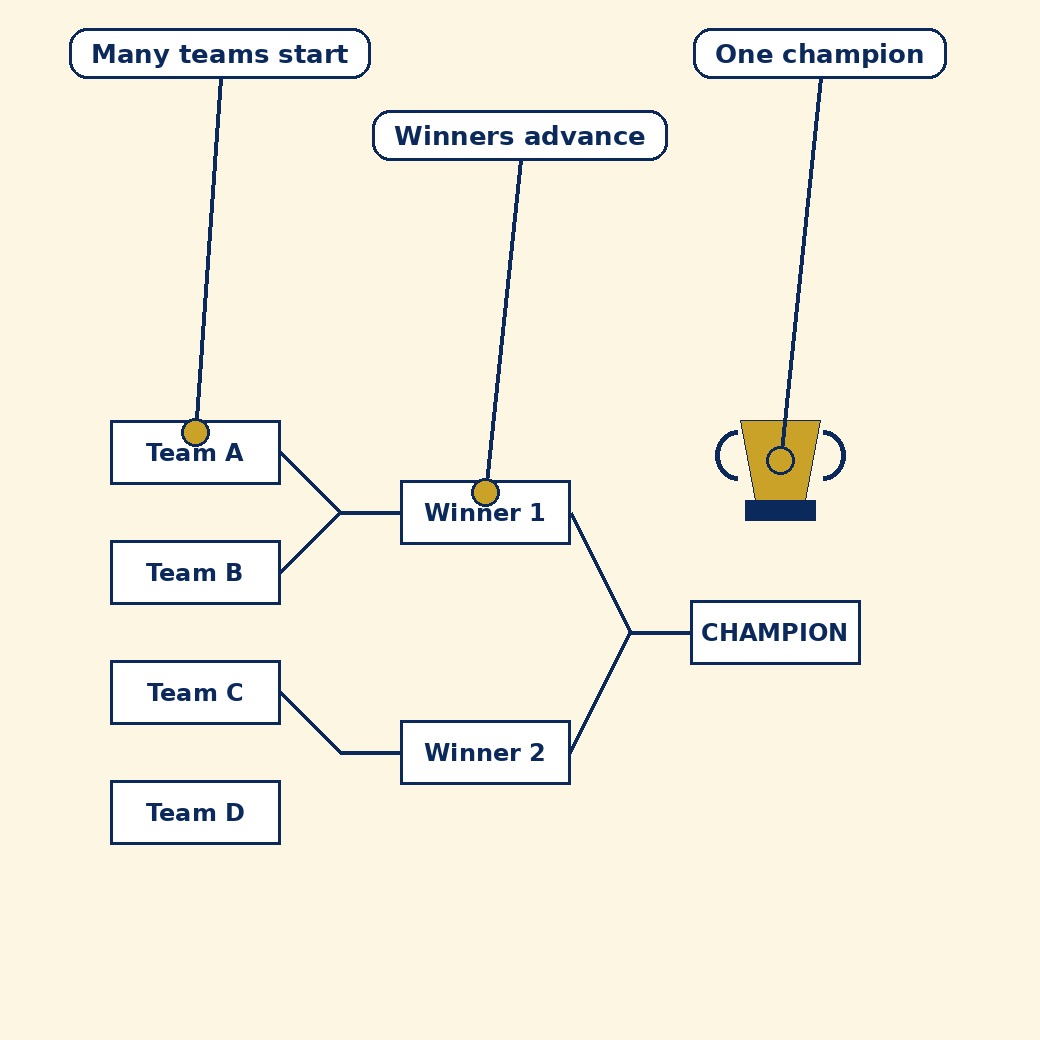
Diagram (labels on the image): Schematic (labels on the image): many teams start, winners advance, and one champion remains.
The fixture board: every match, venue and time fixed before play begins.
What you should learn
- State the knock-out formula and explain fixtures and seeding.
- Explain consolation tournaments, including Bagnall-Wild.
- Distinguish league from knock-out and explain combination tournaments.
- Explain challenge (pyramid) tournaments.
- Name the major competitions: Olympic, Paralympic, Commonwealth, Asian, National.
1. 1. What tournaments are
A tournament is an organised series of matches deciding a winner among many players or teams. Tournaments give structure to competition: fixed rules, fixtures (schedules of who plays whom), officials, venues and results. Without them, school sport would be scattered friendly matches with no champion and no records.
Note: organising tournaments is practical work. This page teaches the study content — types, fixtures and planning — while the actual running of a tournament is learned by doing it in school.
2. 2. Types of tournaments
In a knockout tournament, a team that loses once is out; winners advance until one champion remains. It needs few matches and little time, but one bad day ends a good team's run, and weaker teams may meet strong ones immediately.
In a league (round-robin) tournament, every team plays every other team. It is fairer and gives more matches, but needs much more time and venues. Combination tournaments mix both: a league stage followed by knockout finals, as in many major events.
3. 3. Fixtures: planning who plays whom
A fixture is the schedule of matches. For a knockout with 8 teams, 7 matches decide the winner (in general, matches = teams − 1). Byes (free passes to a later round) are given when the team count is not a power of 2: with 11 teams, 5 byes bring the second round to 8 teams.
Seeding places strong teams apart in the draw so they do not meet in the first round, making later rounds more competitive. Fixtures must also fix dates, venues, officials and rest gaps fairly.
4. 4. Running a competition well
Good organisation covers: a committee (organising, officials, finance, publicity, transport), rules and eligibility, fixtures, venue and equipment checks, first aid, refreshments, result recording, and prizes. Sportsmanship is part of organisation: clear rules, respected officials and graceful conduct make the event a success even for teams that lose.
5. 5. Knock-out tournaments, fixtures and seeding
In a knock-out or elimination tournament, a team that loses once is out, and the winner is the team that never loses. The total number of matches in the tournament equals N minus 1, where N is the number of teams: for 8 teams, N minus 1 equals 8 minus 1, which is 7 matches.
The method of drawing fixtures decides who meets whom in each round, and seeding places the strongest teams apart in the draw so that they do not meet in the first round. Seeding protects the standard of later rounds: the best teams should meet in the final, not in the opening match.
6. 6. Consolation tournaments
A consolation tournament gives a second chance to teams that lose early. In the first type of consolation tournament, first-round losers play among themselves for a consolation prize, while the main tournament continues. In the second type, losers from every round enter a separate consolation draw.
The Bagnall-Wild elimination tournament is a form of consolation tournament in which a team must lose twice to be fully out, so that one bad day does not end a good team's tournament. Consolation tournaments keep more teams playing longer, which is their main merit.
7. 7. League tournaments and combination tournaments
In a league or round robin tournament, every team plays every other team, and the winner is decided by points over the whole league. Its merit is fairness: one unlucky match cannot end a team's chances. Its demerit is time and cost, because many matches are needed.
A combination tournament mixes formats. In an inter-zonal or group knock-out, zones first play knock-out matches and the zonal winners meet in a final knock-out. In an inter-zonal or group league, zones first play leagues and the zonal winners meet in a league. The zonal or group league and the inter-zonal knock-out are combined in different ways to suit the number of teams and the time available.
8. 8. Challenge tournaments
In a challenge tournament, players or teams are ranked in a ladder, and a lower-ranked player challenges the player above. The pyramid tournament is the best-known form: the ladder is drawn as a pyramid, and a challenger who wins moves up, while the loser moves down.
Challenge tournaments suit individual games with many players of different standards, because every player can challenge upwards at any time without waiting for a fixed tournament date. They keep competition going all season rather than in one week.
9. 9. Competitions: Olympic, Paralympic, Commonwealth, Asian and National
The ancient Olympic Games were held in Greece, and the modern or summer Olympic Games revived that tradition for the whole world, with winter Olympic Games for snow and ice sports. The Paralympic Games are the games for athletes with disabilities, held alongside the Olympic movement.
The Commonwealth Games bring together the countries of the Commonwealth, with host cities in the chapter including Gold Coast, Glasgow, Melbourne and Edinburgh. The Asian Games bring together Asia, with host cities including Bangkok, Manila and New Delhi. In India, the national games, national championships, inter-university tournaments and SGFI games form the ladder from school to national level.
At a glance — chart / table
| Tournament type | How it works | Main advantage / drawback |
|---|---|---|
| Knockout | Lose once and you are out | Fast / one bad day ends a run |
| League / round-robin | Everyone plays everyone | Fairest / needs most time |
| Combination | League stage, then knockouts | Fair + exciting finals |
Key Terms / Important Terms
- Tournament — An organised series of matches deciding a winner.
- Fixture — The schedule of who plays whom, when and where.
- Knockout — A format where one loss eliminates a team.
- League — A format where every team plays every other team.
- Bye — A free pass to a later round when team numbers are uneven.
- Seeding — Placing strong teams apart in the draw.
- Organising committee — The group planning and running a competition.
- Round robin — A league format in which every team plays every other team.
- Consolation tournament — A second-chance tournament for teams that lose early in the main draw.
- SGFI — School Games Federation of India, which organises school-level games in India.
Remember
- Knockout matches = teams − 1 (8 teams → 7 matches).
- Byes fill the draw to a power of 2 (11 teams → 5 byes → 8 in round two).
- Seeding keeps strong teams apart early.
- League = fairest but slowest; knockout = fastest but harshest.
- Knock-out matches = N − 1. League = everyone plays everyone.
Exam Tip / Common Mistake
Common mistake: saying knockout matches equal the number of teams. One match eliminates exactly one team, so matches are always teams minus one — the champion is the last team standing.
Practice set — try it yourself
- How many matches are needed in a knockout with 16 teams? Explain. Hint: Hint: Each match eliminates exactly one team.
- With 11 teams in a knockout, how many byes are needed, and why? Hint: Hint: Fill up to the next power of 2, which is 16.
- Distinguish knockout from league tournaments in two points. Hint: Hint: Matches needed and fairness are two.
- Why is seeding used in a draw? Hint: Hint: Strong teams meeting in round one spoils later rounds.
- List four jobs of a tournament organising committee. Hint: Hint: Fixtures, officials, venues and finance are four.
Questions with Answers
- What is a tournament, and why are fixtures needed? Answer: Answer: A tournament is an organised series of matches deciding a winner among many players or teams. Fixtures are needed to schedule who plays whom, when and where, with officials and venues fixed fairly.
- How many matches does a knockout tournament with 12 teams need? Explain. Answer: Answer: 11 matches. Each match eliminates exactly one team, and 11 teams must be eliminated to leave one champion, so matches = teams − 1 = 11.
- What is a bye, and when is it used? Answer: Answer: A bye is a free pass to a later round, used when the number of teams is not a power of 2. With 11 teams, 5 byes bring the second round to 8 teams, a power of 2, so the draw works evenly.
- Distinguish knockout from league tournaments. Answer: Answer: In a knockout, one loss eliminates a team, so the tournament is fast but harsh. In a league, every team plays every other team, so it is fairer and gives more matches but needs much more time and many venues.
- What is seeding? Answer: Answer: Seeding is placing strong teams apart in the draw so they do not meet in the early rounds. This keeps early matches balanced and later rounds more competitive.
Extension Questions with Answers
- Why is seeding used in a knock-out draw? Answer: Answer: So that the strongest teams do not meet in the first round. Seeding spreads them across the draw, protecting the standard of later rounds and the final.
- A knock-out tournament has 16 teams. How many matches are played? Answer: Answer: N minus 1 = 16 minus 1 = 15 matches, because every match eliminates exactly one team and 15 teams must be eliminated to leave one winner.
- Why would an organiser choose a consolation tournament? Answer: Answer: To keep early losers playing and interested. One bad day should not end a team's whole tournament, and more matches mean more experience for more players.
- Why does a league take more time than a knock-out? Answer: Answer: Because every team plays every other team, so the number of matches is far larger than N minus 1, and more time, grounds and money are needed.
- How does a pyramid tournament keep competition going all season? Answer: Answer: Because any lower-ranked player may challenge the player above at any time, so matches happen through the season instead of only in one tournament week.
Board-pattern Questions with Answers
- How many matches are played in a knock-out tournament of 12 teams? Answer: Answer: N minus 1 = 12 minus 1 = 11 matches.
- What is seeding? Answer: Answer: Seeding places the strongest teams apart in the draw so that they do not meet in the early rounds.
- What is a consolation tournament? Answer: Answer: A tournament that gives a second chance to teams that lose early in the main tournament.
- Distinguish league from knock-out. Answer: Answer: In a league (round robin), every team plays every other team and the winner is decided by points. In a knock-out, one loss eliminates a team and the winner never loses.
- Name two international and two national competitions from the chapter. Answer: Answer: International: Olympic Games and Commonwealth Games (also Paralympic, Asian Games). National: National Games and National Championships (also Inter-University Tournaments, SGFI Games).
Recap
- Knock-out: N − 1 matches; seeding keeps strong teams apart.
- Consolation: second chance; Bagnall-Wild needs two losses to be out.
- League: everyone plays everyone. Combination: zonal + final formats mixed.
- Challenge: pyramid ladder. Competitions: Olympic, Paralympic, Commonwealth, Asian, National.