

Chapter 7: Safety and Security
Original notes — ready CBSE (NCERT, English Medium) • Class 11 • Physical Education • Book: Health and Physical Education
Chapter 7: Safety and Security — EG's own notes, in simple words
Book: Health and Physical Education (CBSE, Class 11) | Chapter 7 | Medium: English
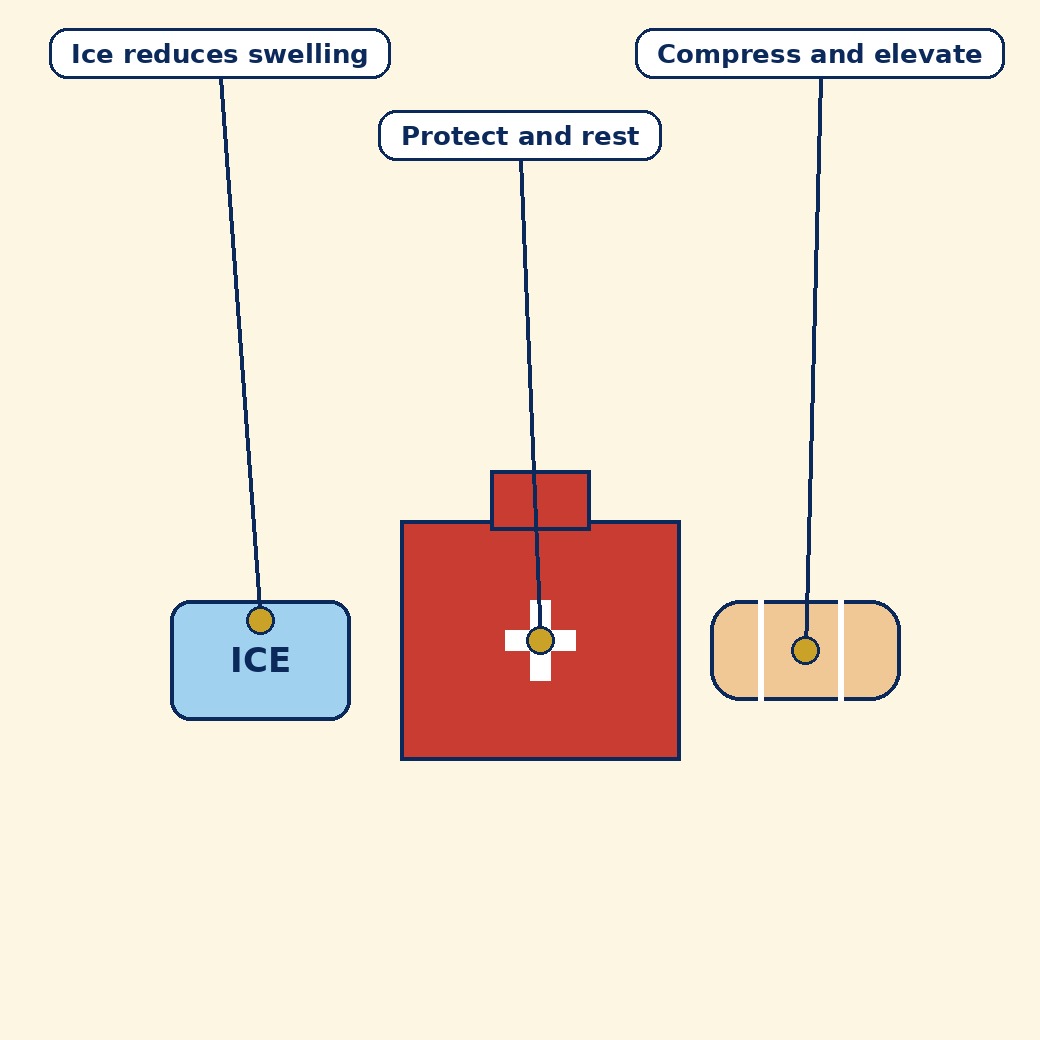
Diagram (labels on the image): Schematic (labels on the image): ice reduces swelling, protect and rest, and compress and elevate.
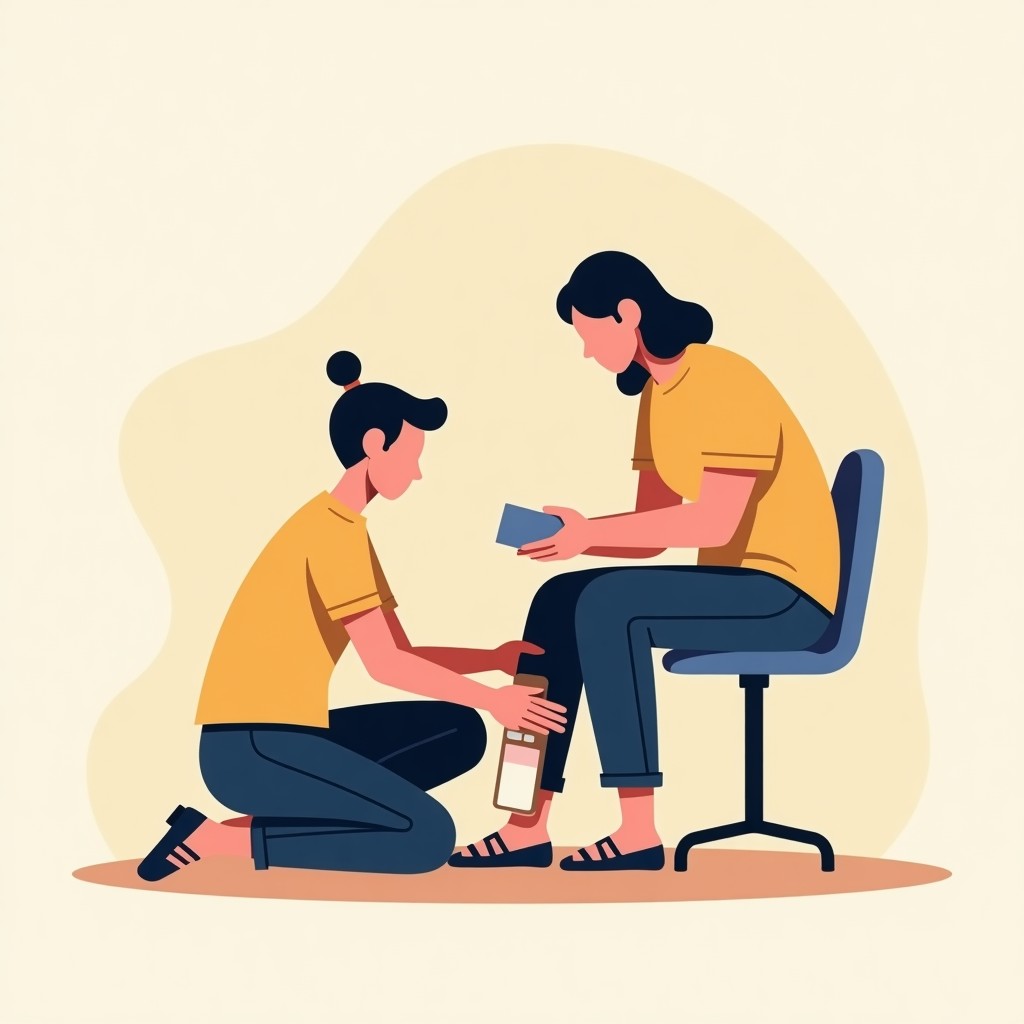
Calm, quick PRICE care on the sideline prevents a small injury becoming a big one.
What you should learn
- List safety measures for grounds, gymnasium and swimming pool.
- Explain why sports injuries occur and how they are prevented.
- Describe tobacco and alcohol harms and the myths about drugs.
- State precautions for using common medicines.
- Explain doping, its types, harms and control procedure.
1. 1. Why safety comes first
Every physical activity carries some risk, and safety planning reduces that risk to a minimum. Safety means preventing injury; security means protecting people and property from harm, including safe venues, equipment checks, first aid readiness and supervision.
The teacher or coach is responsible for checking the ground, equipment, weather and students' health before activity begins. A cracked bat, a wet court or a student with fever are all reasons to pause or adapt the session.
2. 2. Common sports injuries
Common injuries include sprains (ligament injury at a joint), strains (muscle or tendon injury), bruises, cuts, fractures (broken bones), cramps and blisters. Overuse injuries build gradually from too much training without rest; acute injuries happen suddenly, such as a fall or collision.
Prevention beats treatment: warm-up, correct technique, right footwear, protective gear, suitable surfaces, and gradual increases in training load.
3. 3. First aid: the PRICE principle
For soft-tissue injuries, PRICE is the standard immediate response: Protection (stop further harm), Rest (stop using the injured part), Ice (cold pack to reduce swelling), Compression (firm bandage) and Elevation (raise the injured part above heart level).
General first-aid rules: stay calm, do not move a seriously injured person unless in danger, stop heavy bleeding with pressure and a clean cloth, call for medical help early for head injuries, fractures or unconsciousness, and never give food or drink to an unconscious person.
4. 4. Safety planning for events
Event safety includes a venue check, weather plan, first-aid kit and trained first-aider, drinking water, emergency contacts and a clear route for an ambulance. Crowd control, safe storage of equipment and supervision of changing areas are part of security, not afterthoughts.
5. 5. Safety measures in playgrounds, gymnasium and swimming pool
Safety regarding sports facilities begins with the sports ground and field: the surface must be even and clean, dangerous objects must be removed, and the field must be marked and maintained. Safety regarding sports instruments means checking equipment before use, and safety regarding uniforms means wearing suitable shoes and clothing, since unsuitable shoes may be painful and cause injury.
Safety measures in relation to the gymnasium include clean, uncluttered floors, safe apparatus and supervision, while safety measures in relation to the swimming pool include smooth finishing of the pool surface, clean water, supervision and rules that every swimmer follows. Safety is a system, not a single rule.
6. 6. Why sports injuries occur and how to prevent them
Sports injuries occur when facilities are poor, equipment is faulty, technique is wrong, warm-up is skipped, or the body is tired, ill or overloaded. A player who trains too hard too soon, or who plays without proper shoes or supervision, invites injury even in a simple game.
Prevention works at the same points: prevention of injury related to sports facilities, technical measures for prevention of injuries such as correct technique and gradual training, and proper nutrition, which also helps to avoid sports injuries. Note: the PRICE first-aid summary in section 3 of this page is a standard first-aid memory aid retained from the earlier page; the chapter itself concentrates on safety measures and prevention.
7. 7. Adolescence, tobacco and alcohol
Adolescence is a stage of rapid change, and tobacco use in this stage is unhealthy because cigarette smoke contains harmful constituents including nicotine and tar. Smokeless tobacco is also harmful, and the chapter notes the effect of tobacco abuse among women, who are increasingly targeted by marketing campaigns.
Alcohol and substance abuse can be identified by symptoms such as a new friend circle, secrecy from family, and falling school performance. Reasons for consumption include peer pressure, stress and curiosity. A common myth is that drugs sharpen the mind; the fact is that drugs induce dullness and adversely affect the body and mind.
8. 8. Common medicines and their safe use
Common medicines are part of every home, but the chapter advises that it is always advisable to seek the advice of a doctor and to follow the prescription. Self-medication can hide a disease, cause side effects, or interact with other medicines.
Precautions before taking a medicine include checking the name, dose, timings and expiry date, and keeping a record of name, dose, timings, expiry date and remarks. A medicine past its expiry date, or taken in the wrong dose or at the wrong time, may harm instead of healing.
9. 9. Doping in sports
Doping means using prohibited substances or methods to improve performance. Athletes may dope to cope with the pressure and stress associated with competition, but doping breaks the rules and harms the body. Classifications of doping include dietary supplements, hormones and drugs, and the hormone testosterone is known to produce strength effects that tempt misuse.
Basic doping drugs used in sports include narcotics and steroids, and newer forms are gene doping and blood doping, which alter the body's own systems. Harms of prohibited substances spread throughout the body. Testing in-competition and the doping control procedure catch offenders: a selected athlete gives a sample under supervision, and a positive result brings penalties.
At a glance — chart / table
| Injury | What is damaged | PRICE action |
|---|---|---|
| Sprain | Ligament at a joint | Rest, ice, compression, elevation |
| Strain | Muscle or tendon | Rest, ice, compression, elevation |
| Fracture | Bone broken | Immobilise, call medical help |
| Bruise / cut | Skin and small vessels | Clean, pressure, cover |
Key Terms / Important Terms
- Safety — Preventing injury during physical activity.
- Security — Protecting people, venues and property from harm.
- Sprain — Injury to a ligament at a joint.
- Strain — Injury to a muscle or tendon.
- Fracture — A broken bone.
- PRICE — Protection, Rest, Ice, Compression, Elevation — immediate soft-tissue care.
- First aid — Immediate care given before full medical help arrives.
- Doping — Using prohibited substances or methods to improve sports performance.
- Gene doping — Altering the body's own genes or gene expression to gain a sporting advantage.
- Blood doping — Increasing the blood's oxygen-carrying capacity by prohibited means to gain endurance advantage.
Remember
- PRICE = Protection, Rest, Ice, Compression, Elevation.
- Sprain = ligament; strain = muscle/tendon; fracture = bone.
- Prevention: warm-up, technique, gear, surface, gradual load.
- Head injury, fracture, unconsciousness → medical help early, do not delay.
- Doping control = in-competition testing + control procedure under supervision.
Exam Tip / Common Mistake
Common mistake: swapping sprain and strain. Sprain has an “a” for “ankle ligament” thinking aid is weak — better: sprain = joint ligament, strain = muscle/tendon, and say both in the answer to be safe.
Practice set — try it yourself
- Expand PRICE and give the purpose of each step. Hint: Hint: Protection, Rest, Ice, Compression, Elevation.
- A player twists an ankle in a match. What immediate steps should follow? Hint: Hint: Apply PRICE and stop play for that player.
- Distinguish a sprain from a strain from a fracture. Hint: Hint: Ligament, muscle/tendon, bone.
- List four pre-session safety checks a teacher should make. Hint: Hint: Ground, equipment, weather, students' health.
- Why must an unconscious person never be given food or drink? Hint: Hint: It can block the airway.
Questions with Answers
- What does PRICE stand for, and when is it used? Answer: Answer: PRICE stands for Protection, Rest, Ice, Compression and Elevation. It is the immediate response for soft-tissue injuries such as sprains and strains, to limit swelling and further damage.
- Distinguish a sprain from a strain. Answer: Answer: A sprain is an injury to a ligament at a joint, e.g. a twisted ankle. A strain is an injury to a muscle or tendon, e.g. a pulled hamstring.
- What first-aid steps follow a suspected fracture? Answer: Answer: Keep the injured part still (immobilise it), do not try to straighten it, support it, and call for medical help promptly. Treat for shock if needed and do not move the person unnecessarily.
- Give four ways to prevent sports injuries. Answer: Answer: Proper warm-up, correct technique, suitable footwear and protective gear, and gradual increases in training load with adequate rest.
- Why is a venue and equipment check part of safety planning? Answer: Answer: Because hazards such as a wet court, broken equipment or an unsafe surface cause preventable injuries. Checking before play, with first aid and emergency plans ready, reduces risk to a minimum.
Extension Questions with Answers
- Why are suitable shoes a safety measure, not a comfort choice? Answer: Answer: Because unsuitable shoes may be painful and cause injury: they change how the foot lands and moves, and a wrong shoe on a wrong surface invites sprains and falls.
- How does proper nutrition help prevent sports injuries? Answer: Answer: Proper nutrition builds and repairs tissues, keeps bones and muscles strong, and supports recovery, so a well-fed body withstands training load better than a poorly fed one.
- Why is smokeless tobacco not a safe alternative to smoking? Answer: Answer: Because smokeless tobacco is also harmful: it contains the same kind of harmful substances, and the chapter notes its abuse among women as well as men.
- What should a student check before taking a common medicine? Answer: Answer: The name, dose, timings and expiry date, and whether a doctor advised it; and the record of name, dose, timings, expiry date and remarks should be kept.
- Why do athletes dope despite the harms? Answer: Answer: To cope with the pressure and stress associated with competition and to gain strength or endurance advantage, but doping breaks rules, harms the whole body, and is caught by in-competition testing and the control procedure.
Board-pattern Questions with Answers
- What is meant by safety measures? Answer: Answer: Safety measures are the planned steps for facilities, equipment, uniforms, gymnasium and swimming pool that prevent accidents and injuries in play.
- Give two causes of sports injuries and two prevention measures. Answer: Answer: Causes: poor facilities and wrong technique (also faulty equipment, skipped warm-up, overload). Prevention: maintain facilities and use correct technique with gradual training (also proper nutrition and supervision).
- Name two harmful constituents of cigarette smoke. Answer: Answer: Nicotine and tar.
- What precautions should be taken before taking a medicine? Answer: Answer: Seek a doctor's advice, follow the prescription, and check the name, dose, timings and expiry date.
- What is doping? Name two types and one control step. Answer: Answer: Doping is using prohibited substances or methods to improve performance. Types: steroids and blood doping (also narcotics, gene doping). Control: in-competition testing with a supervised sample under the doping control procedure.
Recap
- Safety = facilities + instruments + uniforms + gymnasium + pool, all checked.
- Injuries come from poor facilities, wrong technique, overload; prevention matches each cause.
- Tobacco: nicotine and tar. Drugs dull, they do not sharpen.
- Medicines: doctor's advice, dose, timings, expiry. Doping: tested and penalised.