

Chapter 5: Team Games
Original notes — ready CBSE (NCERT, English Medium) • Class 11 • Physical Education • Book: Health and Physical Education
Chapter 5: Team Games — EG's own notes, in simple words
Book: Health and Physical Education (CBSE, Class 11) | Chapter 5 | Medium: English
Activity note: Activity-based chapter: this page teaches the study content for team games — their types, roles, tactics and values. The games themselves are learned by playing them in teams under a teacher's guidance on the field or court, not from reading alone.
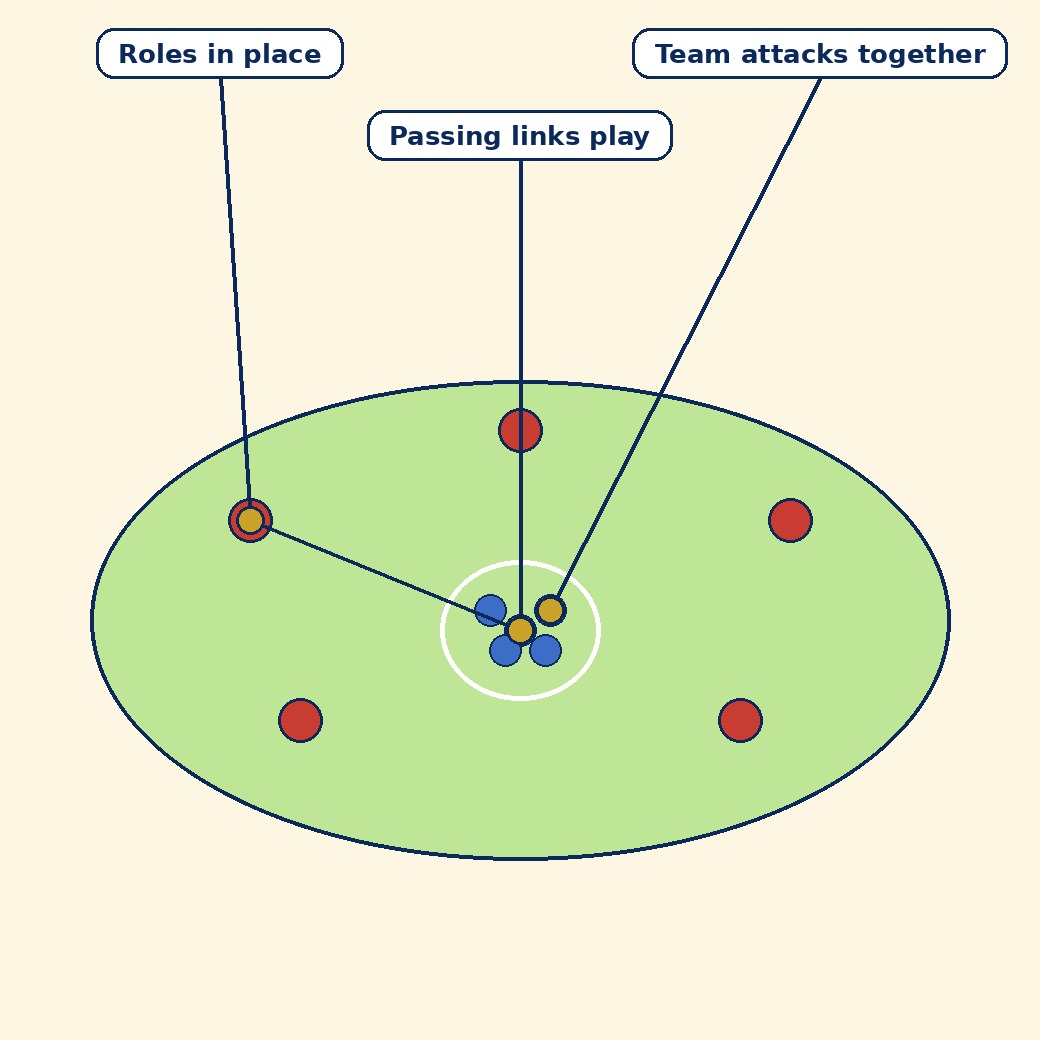
Diagram (labels on the image): Schematic (labels on the image): roles in place, passing links play, and the team attacks together.

No star wins alone: passes, roles and communication make the team.
What you should learn
- Name the eight team games in the chapter.
- State the on-court or on-field team numbers for basketball, handball, volleyball, kho-kho, cricket and football.
- Explain the basic rules and skills of each game in one paragraph.
- Give the holds and offensive skills of kabaddi.
- Name the officials and equipment of at least two games.
1. 1. What team games are
Team games are played by groups working together against another group: football, hockey, basketball, volleyball, cricket and kabaddi are examples. Each player has a role, and the team's result depends on cooperation, not only on individual brilliance.
Team games divide into invasion games (football, hockey: invade the opponent's area to score), net games (volleyball, badminton doubles: send the ball where opponents cannot return it) and striking games (cricket: score runs while defending wickets).
2. 2. Roles and tactics
Roles give structure: in football, goalkeeper, defenders, midfielders and forwards each have jobs; in cricket, batters, bowlers, fielders and the wicketkeeper. Tactics are team plans: attack (creating scoring chances), defence (protecting one's goal or wicket) and transition (switching quickly between the two).
Set plays — a free kick, a corner, a planned volleyball serve — show tactics in action: practised moves used at the right moment.
3. 3. Skills and fitness developed
Team games develop passing, receiving, dribbling, shooting, catching and positional sense, plus fitness: endurance to last the match, speed for breaks, and agility for direction changes. They also develop communication: calling for a pass, warning of danger, and encouraging teammates are skills, not extras.
Leadership appears naturally: captains organise, motivate and decide under pressure, while every player practises following plans and trusting teammates.
4. 4. Rules, officials and fair play
Officials (referee, umpires) apply rules and keep play safe and fair; their decisions must be respected even when disputed. Fair play in team games means no cheating, no deliberate fouling, respect for opponents, and accepting results with grace — values that transfer directly to classroom and community life.
5. 5. Basketball
Basketball began in December 1891 at Springfield, where the first game was played among physical education students with nine players on each side. In India the game grew through schools and colleges, and today it is played on a court with a backboard, with a team of not more than 12 members entitled to play, of whom five players from each team are on the court during playing time.
Functional rules cover the team, uniforms, officials and table officials, playing time and extra periods for a tied score, how the ball is played, goals, time-outs, substitutions, and games lost by forfeit or default. Violations and fouls are penalised, and basic skills are dribbling, passing and receiving, rebounding and defence. Awards in basketball and famous Indian players close the section.
6. 6. Cricket
Cricket, with its history in India from early clubs to national fame, is played by a team of 11 playing members plus 5 extras, making 16 in all. Officials are 3 umpires, 1 match referee and 2 scorers. The bat is 38 inches long and 4.25 inches wide, and the ball weighs 155.9 to 163 grams with a circumference of 22.4 to 22.9 centimetres.
Functional rules govern batting, bowling, fielding and dismissals, and the section explains how to play cricket through field positions such as extra cover and the roles of batsmen, bowlers and fielders. Cricket rewards patience, placement and teamwork: a single batsman cannot win a match without bowlers taking wickets and fielders saving runs.
7. 7. Football
Football is played by two teams, each of not more than 11 players during the match, one of whom acts as goalkeeper, and a match may not start if either team has fewer than seven players. In official competitions organised under FIFA or member associations, up to three substitutes may be used, while other competitions state their own substitute numbers before the tournament.
The history of the game and the history of football in India show how a simple game of kicking a ball became the world's most popular team game. Players' equipment, the laws of play, and the roles of defenders, midfielders, forwards and the goalkeeper are covered, and famous Indian football players are noted as examples for students.
8. 8. Handball
Handball is played by a team of 16 players and substitutes, with seven playing members on each team: six court players and one goalkeeper. A substitute may enter repeatedly through the team's own substitution area, as long as the player being replaced has left the court, so handball is a fast game of constant fresh legs.
Functional rules cover the playing area, team time-out, throw-off, throw-in, scoring, playing the ball, defending the opponent, passive play and the free-throw. Player positions for attack and defence are shown in diagrams, and handball tournaments and championships give the game its competitive structure.
9. 9. Hockey
Hockey is played on a field with field equipment including goals and sticks, by teams whose positions include forwards, midfielders, defenders and the goal keeper. The coin toss starts the match, and handling the hockey stick, hitting the ball, dribbling and passing are the basic skills every player learns first.
Rules covered are the foot foul, the air ball, scoring, free hits, obstruction and match time, and umpires control the game with set calls for each offence. Hockey rewards stick control and team movement: a team that passes quickly and keeps its shape creates the space in which goals are scored.
10. 10. Kabaddi
Kabaddi is played on a court marked with end lines and a baulk line. Rules cover the duration of the match, rules for the raider, rules and regulations of play, the system of scoring, time out, substitution, the bonus point, which needs a minimum of six players on court, the result, a tie in a knockout match, and the golden raid that decides it.
Fundamental skills are holds and offensive skills. Holds are the ankle hold, thigh hold, knee hold, waist hold, wrist hold and arm hold, used by defenders to stop the raider. Offensive skills are the toe touch, side kick, front kick and mule or back kick, used by the raider to score while staying safe from holds.
11. 11. Kho-Kho
Kho-Kho is played by teams of 12 players, of whom nine players play on the field at a time. The playground is measured and marked, equipment is simple, and general rules and regulations govern chasing, touching, turning and the roles of chasers and runners.
Fundamental skills of kho-kho are the quick turns, dodges and touches that make the game fast and exciting, and important tournaments at international and national level give players a path from school to higher competition. Kho-Kho is one of India's own games, and its speed comes from teamwork between chasers.
12. 12. Volleyball
Volleyball is played by a team of 12 players, with a starting line-up of six players on the court. The court has set dimensions, a net with antennae and side bands, and a ball of standard size and weight. Court positions and the direction of rotation decide where each player stands and how the team rotates after winning the serve.
The section explains how to play volleyball: serve, pass, set, attack and block, with fundamental skills for each, and it closes with awards in volleyball. Volleyball rewards the set-up: a good pass makes a good set possible, and a good set makes the attack possible.
At a glance — chart / table
| Game type | Examples | How scoring works |
|---|---|---|
| Invasion games | Football, hockey, basketball | Score in the opponent's goal/basket |
| Net games | Volleyball, badminton doubles | Land the ball where opponents cannot return it |
| Striking games | Cricket, baseball | Score runs while defending wickets |
Key Terms / Important Terms
- Team game — A game played by groups cooperating against another group.
- Invasion game — A game won by invading the opponent's area to score.
- Tactics — Team plans for attack, defence and transition.
- Set play — A practised move used at a planned moment.
- Captain — The player who leads and organises a team.
- Fair play — Honest, respectful conduct in competition.
- Dribbling — Moving with the ball under control, bouncing it in basketball or running with it in hockey and football.
- Rebounding — Winning the ball after a missed shot, especially in basketball.
- Golden raid — The deciding raid that settles a tied kabaddi match in a knockout tie.
Remember
- Team result = cooperation + roles + tactics, not individual brilliance alone.
- Invasion (football), net (volleyball), striking (cricket) — three families.
- Tactics: attack, defence, transition; set plays are practised moves.
- Officials' decisions are respected even when disputed.
- On court: basketball 5, handball 7, volleyball 6, kho-kho 9 of 12; cricket 11 + 5 extras; football max 11, min 7.
Exam Tip / Common Mistake
Common mistake: naming only star players when asked how a team wins. Examiners want roles, tactics and communication — the team systems behind the result.
Practice set — try it yourself
- Classify football, volleyball and cricket by game family, with a reason each. Hint: Hint: Invasion, net and striking are the three families.
- Name three football roles and one job for each. Hint: Hint: Goalkeeper, defender and forward are three.
- What is a set play? Give one example from any team game. Hint: Hint: A practised move used at a planned moment.
- How does a team game teach communication? Hint: Hint: Calls, warnings and encouragement are all communication.
- Why must players respect an official's decision they disagree with? Hint: Hint: Without accepted authority, fair play collapses.
Questions with Answers
- What is a team game? Give three examples. Answer: Answer: A team game is played by groups working together against another group, with each player in a role and the result depending on cooperation. Examples are football, volleyball and cricket.
- Distinguish invasion, net and striking games with one example each. Answer: Answer: Invasion games score by entering the opponent's area, e.g. football. Net games score by landing the ball where opponents cannot return it, e.g. volleyball. Striking games score runs while defending wickets, e.g. cricket.
- Name three roles in a football team and one job for each. Answer: Answer: Goalkeeper guards the goal; defenders protect the team's half; forwards create and take scoring chances. Midfielders link defence and attack.
- What are tactics in a team game? Give one attack and one defence example. Answer: Answer: Tactics are team plans. An attack example is a fast counter-attack to create a scoring chance; a defence example is marking opponents tightly to protect the goal.
- Why is fair play important in team games? Answer: Answer: Because it keeps competition honest and safe: no cheating or deliberate fouling, respect for opponents and officials, and graceful acceptance of results — values that transfer to life beyond sport.
Extension Questions with Answers
- Why did early basketball use nine players a side? Answer: Answer: The first game at Springfield in December 1891 was played among physical education students with nine players on each side; the modern game later settled on five players on court from a squad of 12.
- Why are cricket officials counted as 3 umpires, 1 referee and 2 scorers? Answer: Answer: Because each job is separate: umpires judge play on the field, the match referee controls conduct, and scorers record every run, wicket and ball.
- How does handball substitution keep the game fast? Answer: Answer: A substitute may enter repeatedly through the team's own substitution area once the replaced player has left the court, so tired players are constantly replaced by fresh legs.
- Distinguish a kabaddi hold from an offensive skill. Answer: Answer: A hold (ankle, thigh, knee, waist, wrist or arm) is a defender's skill to stop the raider. An offensive skill (toe touch, side kick, front kick, mule kick) is the raider's skill to score.
- Why does volleyball rotation matter? Answer: Answer: Because court positions and rotation direction decide where each player stands, and the team rotates after winning the serve, so every player must play every position in turn.
Board-pattern Questions with Answers
- State the team numbers for basketball, handball and volleyball. Answer: Answer: Basketball: 12 members, 5 on court. Handball: 16 in the team, 7 playing (6 court players + 1 goalkeeper). Volleyball: 12 in the team, 6 in the starting line-up.
- Give the cricket team and officials numbers from the chapter. Answer: Answer: 11 playing members + 5 extras = 16. Officials: 3 umpires, 1 match referee, 2 scorers.
- When may a football match not start? Answer: Answer: A match may not start if either team consists of fewer than seven players, although a team may have up to 11 players during the match.
- Name three kabaddi holds and three offensive skills. Answer: Answer: Holds: ankle hold, thigh hold, waist hold (also knee, wrist, arm). Offensive skills: toe touch, side kick, front kick (also mule or back kick).
- How many kho-kho players play at a time? Answer: Answer: Nine players play at a time, from teams of 12 players.
Recap
- Team games: basketball, cricket, football, handball, hockey, kabaddi, kho-kho, volleyball.
- Numbers: basketball 5, handball 7, volleyball 6, kho-kho 9 of 12, cricket 11+5, football max 11/min 7.
- Kabaddi: holds stop the raider; kicks and touches score.
- Every game = court/field + rules + officials + skills.