

Chapter 4: Individual Games
Original notes — ready CBSE (NCERT, English Medium) • Class 11 • Physical Education • Book: Health and Physical Education
Chapter 4: Individual Games — EG's own notes, in simple words
Book: Health and Physical Education (CBSE, Class 11) | Chapter 4 | Medium: English
Activity note: Activity-based chapter: this page teaches the study content for individual games — their types, skills, rules and fitness value. The games themselves are learned by playing them under a teacher's guidance on the field or court, not from reading alone.
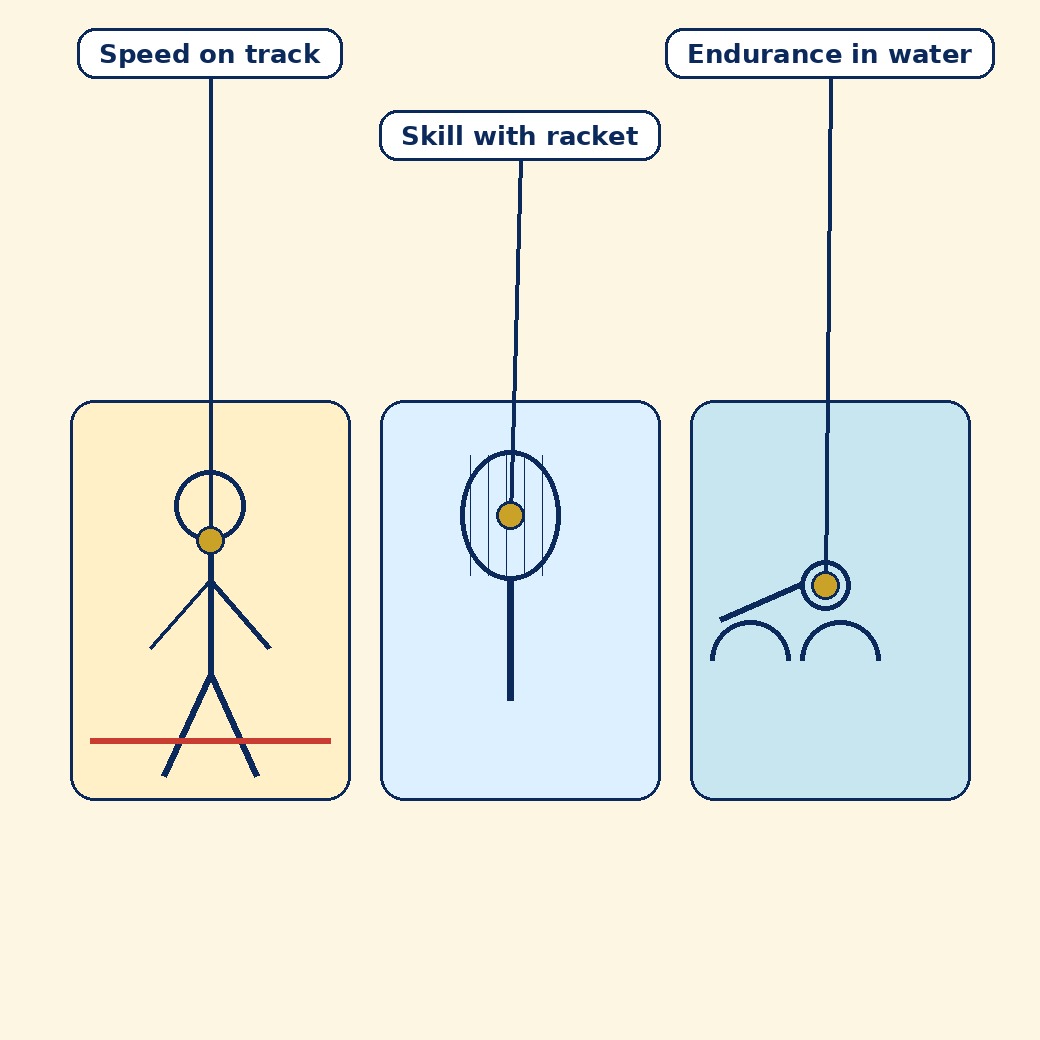
Diagram (labels on the image): Schematic (labels on the image): speed on the track, skill with the racket, and endurance in the water.

Practice alone, progress measurably: every serve and sprint has a score.
What you should learn
- Name the six individual games in the chapter.
- Explain the classification of athletics events.
- State the key rules and skills of badminton and gymnastics.
- Describe judo, swimming and wrestling basics from the chapter.
- Name the national sports awards mentioned in the chapter.
1. 1. What individual games are
Individual games are played by one person against others or against a standard, rather than as a team: athletics (running, jumping, throwing), badminton singles, table tennis singles, wrestling, boxing, gymnastics and swimming races are examples. Success depends mainly on the individual's skill, fitness and tactics.
They differ from team games in responsibility: there is no teammate to cover a mistake, so self-reliance, concentration and personal discipline matter more.
2. 2. Types and examples
Track and field athletics divides into sprints, middle- and long-distance runs, jumps (long jump, high jump) and throws (shot put, javelin). Racket games (badminton, table tennis, squash) demand speed, wrist control and anticipation. Combat sports (wrestling, judo, boxing) demand strength, balance and controlled aggression within strict rules.
Each game has its own court or field, equipment and scoring: badminton is scored in rallies to 21 points, table tennis to 11, and athletics by time, distance or height.
3. 3. Skills and fitness developed
Individual games develop specific skills: a sprinter's start and stride, a shuttler's footwork and smash, a swimmer's stroke and breathing. They also build general fitness: speed, agility, coordination, endurance and mental toughness — the ability to stay focused when the contest is close.
Because feedback is direct (your time, your score), individual games teach honest self-assessment: progress is measurable and personal.
4. 4. Rules, safety and sportsmanship
Rules protect fairness and safety: correct equipment, proper warm-up, officials' decisions respected, and banned techniques avoided. In combat sports, weight categories and protective gear exist for safety. Sportsmanship means respecting opponents and officials, accepting results, and never using unfair means — the same values team games teach, practised alone.
5. 5. Athletics
Athletics, the oldest of individual games, covers track events, field events and combined events. Track events are classified as short distance, middle distance and long distance races, from sprints to the 5000 m. Races begin with a crouch start from starting blocks, with set positions and a gun shot, and finishes and baton exchanges, such as the push pass in relays, decide close races.
Field events are jumping events and throwing events. Long jump and high jump test take-off, flight and landing, with a landing pit for long jump and techniques of high jump for clearance. Throwing events are shot put, discus throw, javelin throw and hammer, each with its own circle or runway, centre line and rules. Combined events are the decathlon for men and the heptathlon for women, testing all-round athletes.
6. 6. Badminton
Badminton is played on a court marked with a short service line, long service lines for singles and doubles, and a back boundary line; the singles play area is narrower than the doubles area. In singles, one player covers the whole court, so footwork, placement and stamina matter as much as power.
The scoring system rewards every rally, and fundamental skills are built on basic strokes: midcourt strokes, rear court strokes, and serves such as the backhand low serve, high serve, flick serve and low serve. A player who varies serve and stroke, and who recovers to the centre after each shot, controls the rally.
7. 7. Gymnastics
Gymnastics in India is practised on apparatus for men and women. The chapter covers the uneven bars, horizontal bar, pommel horse, roman rings, balancing beam, floor and parallel bar, each with its own specifications for size and construction.
Advanced skills show how basics combine: the kip technique on uneven bars lifts the gymnast to support, and the forward scissor on pommel horse swings the legs in a scissor action over the horse. Gymnastics therefore trains strength, flexibility, balance and courage together, and every skill is judged on control and form.
8. 8. Judo
Judo, which emerged in India as a modern combat sport, is fought on a contest area of tatami mats with a safety area and platform, under referees and judges, with scorers and timers recording the contest. Contestants wear a dress with belts that show grade, from coloured belts up to first dan, black, and red or black for the highest grades.
Basic techniques are throws and holds learned step by step, and basic rules decide scoring and penalties. A contest can be decided before full time, and the golden score decides a tied contest in extra time. Judo has weight categories so that contestants of similar size meet, and important tournaments give players a ladder from local to national level.
9. 9. Swimming
Swimming in India is taught in stages, and the chapter begins with teaching in early stages: entry into the pool, movement at the shallow end, getting the feet off the bottom, floating, and pushing off, gliding and standing up again. The teacher's role is central, because confidence in water must come before speed.
Fundamental techniques are strokes, starts and turns, with starting platforms and a backstroke turn indicator among the facilities. Fundamental rules cover swimwear, starts, turns and finishes, and facilities and equipment must be safe and standard. Swimming is both a survival skill and a racing sport, so safety rules are part of the game itself.
10. 10. Wrestling
Wrestling in India has a long tradition and is governed by a national body. Its types are free style and Greco-Roman: free style allows holds on the whole body, while Greco-Roman forbids holds below the waist. Fundamentals are stance, holds, escapes and control, practised with a singlet, ear protectors and wrestling shoes.
The wrestling arena has a central wrestling area and a passivity zone, and bouts are decided by classification of points, with cautions for a wrestler and points for technical violations. Duration of the bout, criteria to win, and match officials all follow set rules, so a wrestler must win by skill within the rules, not by force alone.
11. 11. Types of sports awards
The chapter closes with the types of sports awards that honour players, coaches and contributors. The Arjuna Award recognises outstanding performance in sports, and the Rajiv Gandhi Khel Ratna Award, as named in the chapter, is the highest sporting honour for the most outstanding performance.
Dhyan Chand Award winners in athletics are also noted in the chapter, honouring lifetime contribution to sport. These awards matter for students because they show what sustained performance, discipline and service to a game can earn, and they connect school sport to the national sporting system.
At a glance — chart / table
| Game type | Examples | Main demands |
|---|---|---|
| Athletics | Sprints, jumps, throws | Speed, power, technique |
| Racket games | Badminton, table tennis | Agility, wrist control, anticipation |
| Combat sports | Wrestling, judo, boxing | Strength, balance, discipline |
| Gymnastics | Floor, beam, vault | Flexibility, balance, courage |
Key Terms / Important Terms
- Individual game — A game played by one person against others or a standard.
- Athletics — Track and field events: runs, jumps and throws.
- Rally — A continuous exchange of shots in a racket game.
- Footwork — Skilled movement of the feet to reach the right position.
- Sportsmanship — Fair, respectful conduct towards opponents and officials.
- Decathlon — A combined athletics event of ten events for men, testing all-round ability.
- Heptathlon — A combined athletics event of seven events for women, testing all-round ability.
- Tatami — The mat surface of a judo contest area, with a safety area around it.
Remember
- Individual games = one person responsible; team games = shared responsibility.
- Badminton games go to 21 points; table tennis games to 11.
- Direct feedback (time, score) makes progress measurable and personal.
- Rules + protective gear + warm-up = safety in every individual game.
- Chapter games: athletics, badminton, gymnastics, judo, swimming, wrestling.
Exam Tip / Common Mistake
Common mistake: describing individual games as “games without opponents”. Most have opponents — the difference is that one person, not a team, bears responsibility for the result.
Practice set — try it yourself
- Distinguish individual games from team games in one paragraph. Hint: Hint: Focus on who bears responsibility for the result.
- Name two athletics events from each group: runs, jumps, throws. Hint: Hint: Sprints, long jump and shot put are one set.
- Why does a badminton player need footwork more than arm strength? Hint: Hint: Reaching the shuttle in time decides most rallies.
- Give two safety rules for combat sports. Hint: Hint: Weight categories and protective gear are two.
- How do individual games teach honest self-assessment? Hint: Hint: Times and scores are personal and measurable.
Questions with Answers
- What is an individual game? Give three examples. Answer: Answer: An individual game is played by one person against others or against a standard, with success depending mainly on that person's skill and fitness. Examples are badminton singles, a 100 m sprint and table tennis singles.
- How do individual games differ from team games? Answer: Answer: In individual games one person bears full responsibility for the result, with no teammate to cover mistakes, so self-reliance, concentration and personal discipline matter more. In team games responsibility and roles are shared.
- Name the three groups of track and field athletics with one event each. Answer: Answer: Runs, e.g. 100 m sprint; jumps, e.g. long jump; throws, e.g. shot put.
- What scoring is used in badminton and table tennis games? Answer: Answer: A badminton game is won at 21 points (rally scoring) and a table tennis game at 11 points, each normally requiring a two-point lead.
- Why are rules and protective gear especially important in combat sports? Answer: Answer: Because combat sports involve direct physical contact and force. Weight categories, protective gear and banned techniques keep contests fair and reduce injury risk.
Extension Questions with Answers
- Why does athletics need both a crouch start and a baton exchange? Answer: Answer: The crouch start gives a fast, balanced start from blocks in sprints, while the baton exchange keeps relay speed without stopping; both are team-timed skills, one for starting and one for passing on.
- How do singles court markings change badminton play? Answer: Answer: The singles play area is narrower, so one player must cover the whole court; footwork, placement and recovery to the centre matter more than in doubles.
- What does the kip on uneven bars show about gymnastics? Answer: Answer: It shows basics combining into a controlled skill: strength and timing lift the gymnast to support, and the skill is judged on control and form, not on force alone.
- Why does judo use weight categories and a golden score? Answer: Answer: Weight categories match contestants of similar size so contests are fair. The golden score decides a tied contest in extra time so that a contest has a clear winner.
- Why is floating taught before speed in swimming? Answer: Answer: Because confidence in water must come before speed: a swimmer who can float, glide and stand up again is safe, and only then can strokes, starts and turns be learned well.
Board-pattern Questions with Answers
- Classify athletics events. Answer: Answer: Track events (short, middle and long distance), field events (jumping and throwing), and combined events (decathlon for men, heptathlon for women).
- Name the apparatus covered in the gymnastics section. Answer: Answer: Uneven bars, horizontal bar, pommel horse, roman rings, balancing beam, floor and parallel bar.
- What is the golden score in judo? Answer: Answer: The golden score decides a tied judo contest in extra time, giving a clear winner.
- State two fundamental rules of swimming from the chapter. Answer: Answer: Rules cover swimwear and starts, turns and finishes; facilities and equipment must be safe and standard.
- Distinguish free style from Greco-Roman wrestling. Answer: Answer: Free style allows holds on the whole body. Greco-Roman forbids holds below the waist.
Going deeper — Chapter 4: Individual Games
At the centre of this chapter are a few ideas that everything else hangs on: Individual game, Athletics, Rally, Footwork. If you can explain those ideas in your own words without looking at the notes, you already hold the chapter's spine. Everything else on this page — the examples, the tables and the questions — is there to help you practise using those ideas, not to be memorised as separate facts.
Read the chapter in this order. First, read the summary slowly and ask yourself what question the chapter is answering. Then work through each section one at a time and, after each one, close the page and say its main point in two lines. The sections of this chapter are: 1. 1. What individual games are; 2. 2. Types and examples; 3. 3. Skills and fitness developed; 4. 4. Rules, safety and sportsmanship; 5. 5. Athletics; 6. 6. Badminton. Each section adds one layer: an earlier section gives you the words and tools, and a later section shows you where those tools are used. When you revise, do not re-read passively — explain each section aloud as if you were teaching a classmate who missed the lesson.
In physical education answers, name the concept or procedure first, then give its steps or components in order, then its benefit or application. For fitness and training questions, give the correct term, the method, and one precaution or example.
Important Questions with Answers — deepening set
These questions go beyond the sets above. Try each one without looking, then check your answer against the notes.
- What does 'Individual game' mean? Explain it in your own words and say how it is used in this chapter.
A game played by one person against others or a standard. In this chapter, Individual game is one of the ideas you must be able to use, not just define. When a question mentions Individual game, first write its meaning in one line, then apply it to the situation in the question. That two-step habit — meaning first, application second — is what turns a definition into marks. - What does 'Athletics' mean? Explain it in your own words and say how it is used in this chapter.
Track and field events: runs, jumps and throws. In this chapter, Athletics is one of the ideas you must be able to use, not just define. When a question mentions Athletics, first write its meaning in one line, then apply it to the situation in the question. That two-step habit — meaning first, application second — is what turns a definition into marks. - What does 'Rally' mean? Explain it in your own words and say how it is used in this chapter.
A continuous exchange of shots in a racket game. In this chapter, Rally is one of the ideas you must be able to use, not just define. When a question mentions Rally, first write its meaning in one line, then apply it to the situation in the question. That two-step habit — meaning first, application second — is what turns a definition into marks. - What does 'Footwork' mean? Explain it in your own words and say how it is used in this chapter.
Skilled movement of the feet to reach the right position. In this chapter, Footwork is one of the ideas you must be able to use, not just define. When a question mentions Footwork, first write its meaning in one line, then apply it to the situation in the question. That two-step habit — meaning first, application second — is what turns a definition into marks. - What does 'Sportsmanship' mean? Explain it in your own words and say how it is used in this chapter.
Fair, respectful conduct towards opponents and officials. In this chapter, Sportsmanship is one of the ideas you must be able to use, not just define. When a question mentions Sportsmanship, first write its meaning in one line, then apply it to the situation in the question. That two-step habit — meaning first, application second — is what turns a definition into marks. - What does 'Decathlon' mean? Explain it in your own words and say how it is used in this chapter.
A combined athletics event of ten events for men, testing all-round ability. In this chapter, Decathlon is one of the ideas you must be able to use, not just define. When a question mentions Decathlon, first write its meaning in one line, then apply it to the situation in the question. That two-step habit — meaning first, application second — is what turns a definition into marks.
Revision checklist and exam writing guide
Use this checklist the night before a test. Tick a point only if you can do it without opening the notes.
- I can explain '1. 1. What individual games are' in two lines without looking.
- I can explain '2. 2. Types and examples' in two lines without looking.
- I can explain '3. 3. Skills and fitness developed' in two lines without looking.
- I can explain '4. 4. Rules, safety and sportsmanship' in two lines without looking.
- I can explain '5. 5. Athletics' in two lines without looking.
- I can explain '6. 6. Badminton' in two lines without looking.
- I can explain '7. 7. Gymnastics' in two lines without looking.
- I can explain '8. 8. Judo' in two lines without looking.
- I can write the chapter's key terms from memory, with one example for each.
- I can answer one long question from this chapter in five ordered paragraphs.
In physical education answers, name the concept or procedure first, then give its steps or components in order, then its benefit or application. For fitness and training questions, give the correct term, the method, and one precaution or example.
Common mistake to avoid: writing everything you remember about the chapter instead of answering the question asked. Read the question twice, underline its command word — explain, compare, why, what happens — and let that word decide the shape of your answer.
Recap
- Individual games: athletics, badminton, gymnastics, judo, swimming, wrestling.
- Athletics = track + field + combined (decathlon / heptathlon).
- Judo: tatami, weight categories, golden score. Wrestling: free style vs Greco-Roman.
- Awards: Arjuna Award, Khel Ratna (as named in the chapter), Dhyan Chand Award.