

Chapter 3: Physical and Physiological Aspects of Physical Education and Sports
Original notes — ready CBSE (NCERT, English Medium) • Class 11 • Physical Education • Book: Health and Physical Education
Chapter 3: Physical and Physiological Aspects of Physical Education and Sports — EG's own notes, in simple words
Book: Health and Physical Education (CBSE, Class 11) | Chapter 3 | Medium: English
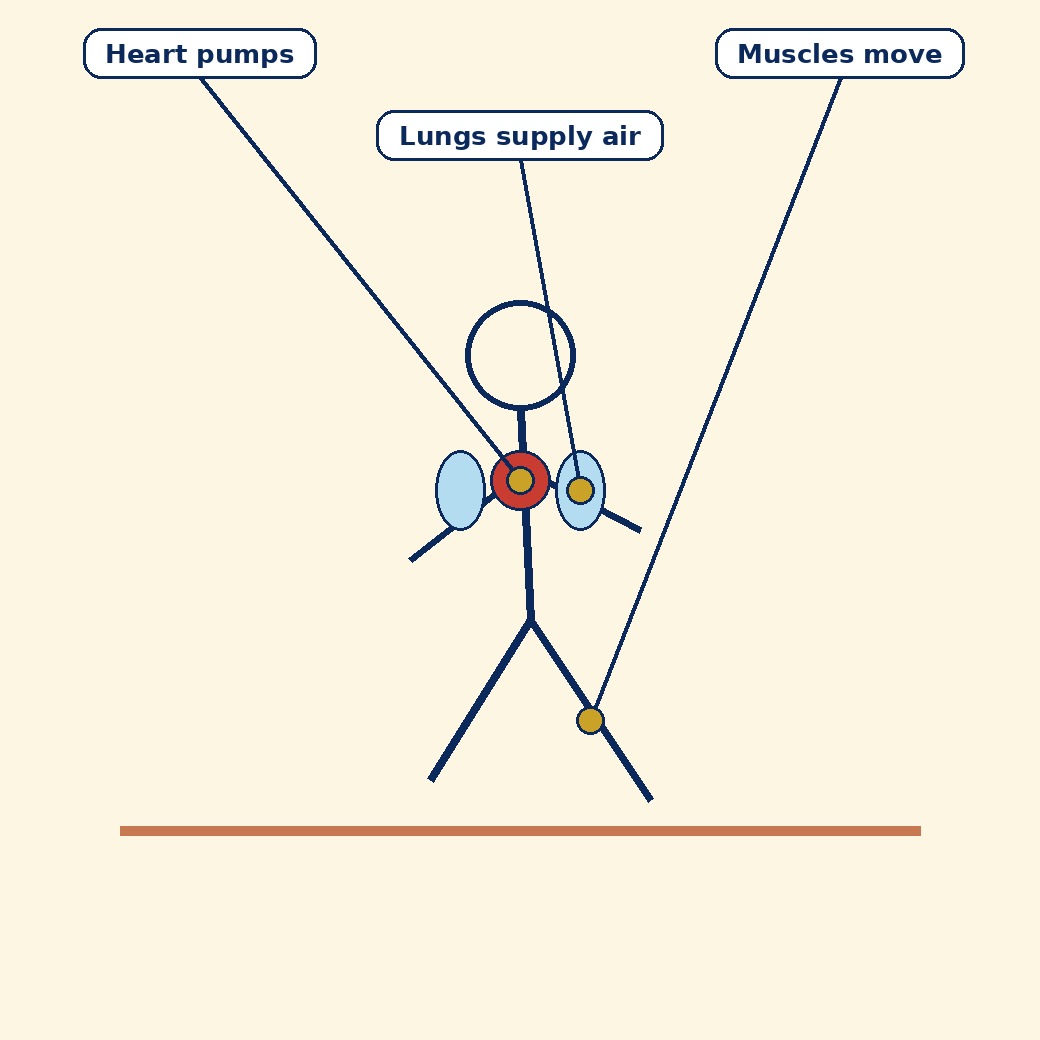
Diagram (labels on the image): Schematic (labels on the image): the heart pumps, the lungs supply air, and the muscles move the body.

Warm-up first: light activity and stretching prepare every system for effort.
What you should learn
- Distinguish growth from development.
- List the factors affecting growth and development.
- Explain general and specific warm-up and its methods.
- Explain cooling down and its effects.
- State the effects of exercise on the heart, muscles and other systems.
1. 1. The body systems at work
Sport uses the whole body, but four systems matter most. The skeletal system gives shape and protection; the muscular system produces movement; the respiratory system supplies oxygen and removes carbon dioxide; the circulatory system carries oxygen and nutrients to muscles and removes waste.
During exercise, heart rate and breathing rate rise to meet muscles' oxygen demand, and body temperature rises, controlled by sweating. Training improves all of these responses: a trained heart pumps more blood per beat, so it beats slower at rest.
2. 2. Muscles, bones and movement
Muscles work in pairs: when one contracts, its partner relaxes (for example, biceps and triceps at the elbow). Bones meet at joints — hinge joints (elbow, knee) bend one way, ball-and-socket joints (shoulder, hip) move in many directions. Ligaments join bone to bone; tendons join muscle to bone.
Movement terms examiners use: flexion (bending a joint), extension (straightening), abduction (moving away from the body's midline) and adduction (moving towards it).
3. 3. Fitness components
Health-related fitness components are muscular strength (force a muscle can exert), muscular endurance (sustained effort), cardiovascular endurance (heart and lungs sustaining activity), flexibility (range of movement) and body composition (proportion of fat and lean tissue).
Skill-related components are speed, agility (quick direction change), balance, coordination, power and reaction time. A sprinter needs speed and power; a gymnast needs balance and flexibility; a footballer needs most of them together.
4. 4. Warming up and cooling down
Warming up gradually prepares body and mind: light activity, stretching and sport-specific moves raise temperature, loosen joints and focus attention, reducing injury risk. Cooling down reverses the process: gentle activity and stretching return heart rate and breathing towards normal and reduce stiffness.
Skipping either stage is a common cause of avoidable injury, especially in cold weather or after long inactivity.
5. 5. Growth and development
Growth is the tangible, visible biological process in which the body gains in size: height, weight and measurements increase, and growth can be measured. Development is the wider process of gaining in function and ability: skills, understanding and maturity improve, and development is observed rather than simply measured.
Growth and development go together but are not the same. A child may grow taller quickly yet develop coordination slowly, or develop skills early while growing slowly. Teachers and coaches must therefore watch both: size alone never tells whether a child is developing well.
6. 6. Factors affecting growth and development
Heredity sets the basic pattern a child inherits from parents, while environment means everything on and around the child: home, school, food, air and care. Gender affects the timing and pattern of growth, and nutrition decides whether the body has the material to grow. Exercise stimulates growth and development, and hormones direct many growth processes.
Learning and reinforcement shape behaviour and skills, pollution harms growing bodies because harmful substances enter them, and socio-economic status affects food, care, facilities and opportunities. No single factor decides a child's growth; the factors work together, which is why the same care helps every child differently.
7. 7. Warming up: general, specific and methods
Warming up prepares the body for activity. A general warm-up uses whole-body movements such as walking, jogging, stationary cycling, skipping or easy running, which raise temperature and circulation. A specific warm-up practises the actual movements of the coming activity, so the muscles and joints used most are prepared for their exact work.
Methods of warming up include exercise itself, massage, a hot water bath, a hot beverage, and sports conditioning. Each method aims at the same result: warm muscles, mobile joints and a body ready for effort, so that performance improves and injury risk falls.
8. 8. Cooling down (limber down) and its effects
Cooling down, also called limber down, is easy exercise done after a harder session, such as slow walking or gentle stretching. It lets the body return gradually to its resting state instead of stopping suddenly after effort.
Its effects include a gradual fall in heart rate and circulation to resting levels, removal of waste products from muscles, and less stiffness and soreness afterwards. A player who skips cooling down stops abruptly, so the body adjusts poorly; a few minutes of easy movement protect recovery.
9. 9. Effects of exercise on body systems
On the heart and circulation, regular exercise increases stroke volume, the amount of blood pumped out by the heart in one beat, and therefore increases cardiac output, the total blood pumped per minute. Cardiac output is heart rate multiplied by stroke volume, and training improves both sides of that equation.
On muscles, regular exercise causes muscular hypertrophy, the growth of muscle fibres, so muscles become stronger and larger. On other systems, exercise improves lung capacity and oxygen use, strengthens bones, and improves coordination and endurance. These are the physiological reasons why activity is prescribed, not just enjoyed.
At a glance — chart / table
| Component | Kind | Sport example |
|---|---|---|
| Muscular strength | Health-related | Weightlifting |
| Cardiovascular endurance | Health-related | Long-distance running |
| Flexibility | Health-related | Gymnastics |
| Speed | Skill-related | Sprinting |
| Agility | Skill-related | Football dodging |
| Balance | Skill-related | Beam gymnastics |
Key Terms / Important Terms
- Skeletal system — Bones giving shape, support and protection.
- Muscular system — Muscles producing movement by contraction.
- Cardiovascular endurance — Heart and lungs sustaining activity over time.
- Flexibility — Range of movement available at a joint.
- Agility — Ability to change direction quickly and accurately.
- Warm-up — Gradual preparation of body and mind before activity.
- Cool-down — Gradual return to rest after activity.
- Stroke volume — The amount of blood pumped out by the heart in one beat.
- Cardiac output — The total blood pumped by the heart per minute: heart rate multiplied by stroke volume.
- Muscular hypertrophy — Growth of muscle fibres with regular exercise, making muscles stronger and larger.
Remember
- Four key systems: skeletal, muscular, respiratory, circulatory.
- Muscles work in pairs; ligaments join bone to bone, tendons join muscle to bone.
- Health-related: strength, endurance, flexibility, body composition. Skill-related: speed, agility, balance, coordination, power, reaction time.
- Warm up before, cool down after — skipping either invites injury.
- Cardiac output = heart rate × stroke volume; training improves both.
Exam Tip / Common Mistake
Common mistake: swapping ligaments and tendons. Ligament = bone to bone (both start with letters near each other in the alphabet is a weak trick — better: “ligament links”); tendon = muscle to bone.
Practice set — try it yourself
- Why do heart rate and breathing rate rise during exercise? Hint: Hint: Muscles need more oxygen and produce more waste.
- Distinguish a ligament from a tendon. Hint: Hint: One joins bone to bone, the other muscle to bone.
- Classify: speed, flexibility, agility, cardiovascular endurance. Hint: Hint: Two are health-related, two skill-related.
- Give two purposes of warming up and two of cooling down. Hint: Hint: Warm-up prepares; cool-down returns to normal.
- A gymnast and a sprinter need different fitness profiles. Explain with two components each. Hint: Hint: Balance and flexibility vs speed and power.
Questions with Answers
- Name the four body systems most involved in sport and one job of each. Answer: Answer: Skeletal system gives shape and protection; muscular system produces movement; respiratory system supplies oxygen and removes carbon dioxide; circulatory system carries oxygen and nutrients to muscles and removes waste.
- Why does a trained athlete have a lower resting heart rate? Answer: Answer: Because training strengthens the heart so it pumps more blood per beat. The body therefore needs fewer beats per minute at rest to supply the same blood flow.
- Distinguish health-related from skill-related fitness, with two components each. Answer: Answer: Health-related fitness supports general health: muscular strength and flexibility. Skill-related fitness supports sport performance: speed and agility.
- What is the difference between flexion and extension? Answer: Answer: Flexion is bending a joint, reducing the angle between bones, e.g. bending the elbow. Extension is straightening a joint, increasing the angle, e.g. straightening the elbow.
- Why are warming up and cooling down both necessary? Answer: Answer: Warming up gradually raises temperature, loosens joints and focuses attention, reducing injury risk. Cooling down gradually returns heart rate and breathing towards normal and reduces stiffness after activity.
Extension Questions with Answers
- Why can a tall child still be weak in coordination? Answer: Answer: Because growth (size) and development (function) are different processes. Height is growth; coordination is development, and the two do not always advance at the same speed.
- How does pollution affect growth? Answer: Answer: Harmful substances in polluted air, water and surroundings enter growing bodies and interfere with healthy growth and development.
- Why is a specific warm-up needed after a general warm-up? Answer: Answer: A general warm-up raises temperature and circulation for the whole body, but a specific warm-up prepares the exact muscles and joints the coming activity will use.
- What happens if a player stops suddenly after hard exercise? Answer: Answer: The body must adjust abruptly instead of returning gradually to rest, so recovery is poorer and stiffness and soreness are more likely.
- How does training improve cardiac output? Answer: Answer: Training increases stroke volume and improves heart rate control, and since cardiac output equals heart rate multiplied by stroke volume, both improvements raise output.
Board-pattern Questions with Answers
- Distinguish growth from development. Answer: Answer: Growth is the visible increase in body size that can be measured. Development is the wider gain in function, skill and maturity that is observed rather than measured.
- Name four factors affecting growth and development. Answer: Answer: Heredity, environment, nutrition and exercise are four; gender, hormones, learning and reinforcement, pollution and socio-economic status are others.
- What is the difference between general and specific warm-up? Answer: Answer: General warm-up uses whole-body movements such as jogging or skipping to raise temperature and circulation. Specific warm-up practises the actual movements of the coming activity.
- What is cooling down? State two of its effects. Answer: Answer: Cooling down is easy exercise after a hard session. Two effects: heart rate and circulation return gradually to resting levels, and muscles clear waste products, reducing later stiffness.
- Define stroke volume and cardiac output. Answer: Answer: Stroke volume is the blood pumped out in one beat. Cardiac output is the total blood pumped per minute, equal to heart rate multiplied by stroke volume.
Recap
- Growth = size (measured); development = function (observed).
- Factors: heredity, environment, gender, nutrition, exercise, hormones, learning, pollution, status.
- Warm up general then specific; cool down easy after effort.
- Cardiac output = heart rate × stroke volume; exercise builds hypertrophy.