

Chapter 2: Understanding Health
Original notes — ready CBSE (NCERT, English Medium) • Class 11 • Physical Education • Book: Health and Physical Education
Chapter 2: Understanding Health — EG's own notes, in simple words
Book: Health and Physical Education (CBSE, Class 11) | Chapter 2 | Medium: English
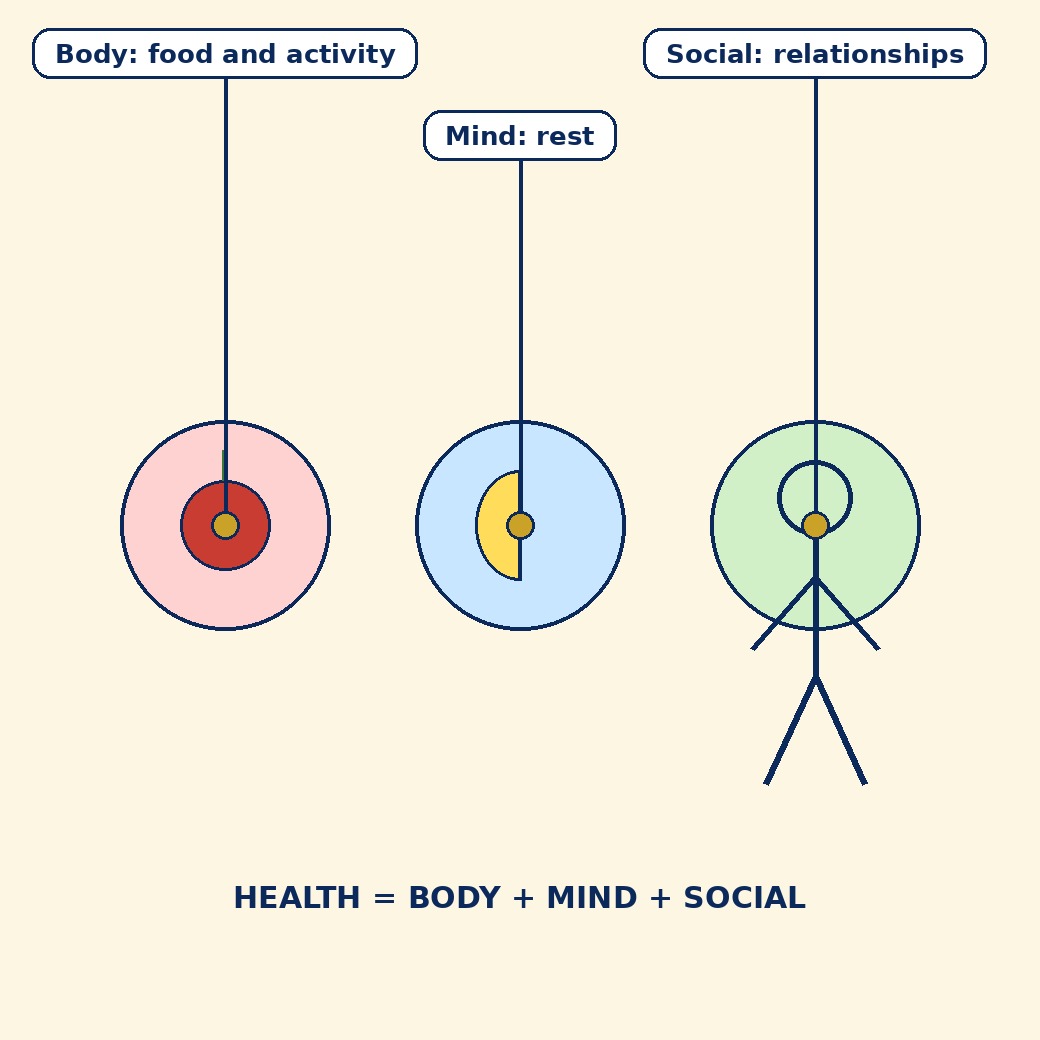
Diagram (labels on the image): Schematic (labels on the image): health joins body, mind and social life together.

A balanced plate: grains, vegetables, protein and milk in proportion.
What you should learn
- Name the six dimensions of health.
- Explain the health needs of children, adolescents and the differently abled.
- Describe the role of adolescent-friendly services and peer educators.
- List tips for meeting health goals and living a healthy lifestyle.
- State the global goals for health and the WHO activity recommendation.
1. 1. What health means
Health is not merely the absence of disease. The World Health Organization defines it as complete physical, mental and social well-being. A student can be free of illness yet unhealthy if stress, poor sleep or isolation dominate daily life — and a student managing a condition can still live healthily with good habits and support.
Health has dimensions: physical (body fitness), mental (thoughts and emotions), social (relationships) and spiritual (purpose and values). Good health needs attention to all four.
2. 2. Factors affecting health
Health is shaped by heredity, environment, lifestyle and healthcare. Heredity sets tendencies; environment includes clean air, water, housing and school surroundings; lifestyle covers diet, activity, sleep and habits such as tobacco use; healthcare covers prevention, treatment and check-ups.
Of these, lifestyle is the factor students control most directly: regular activity, balanced food, enough sleep and avoiding harmful substances improve health more reliably than any single medicine.
3. 3. Balanced diet and hygiene
A balanced diet gives carbohydrates for energy, proteins for growth and repair, fats in moderation, plus vitamins, minerals, water and roughage. Deficiencies cause disease: lack of iron causes anaemia, lack of vitamin C causes scurvy, lack of vitamin D weakens bones.
Personal hygiene — clean hands, bathing, oral care, clean clothes — blocks many infections at low cost. Handwashing alone prevents a large share of stomach and respiratory infections.
4. 4. Mental health and well-being
Mental health means handling normal stresses, working productively and contributing to one's community. Warning signs include lasting sadness, withdrawal, sharp sleep or appetite changes, and inability to concentrate. Seeking help from a trusted adult or counsellor is a sign of strength, not weakness, and early help works best.
5. 5. Six dimensions of health
Health is more than the absence of disease. Its physical dimension is a healthy body kept by proper nutrition, activity, rest and hygiene. Its mental dimension is a calm, focused mind that can handle stress, and its social dimension is good relations with family, friends and community.
Its emotional dimension is understanding and managing feelings with a positive mindset. Its spiritual dimension is a sense of purpose and values, and its environmental dimension is living in surroundings that support health, since daily habits affect the air, water and surroundings we all share. All six dimensions together make complete health.
6. 6. Health needs of children, adolescents and the differently abled
Children need nutrition, immunisation, safe play, hygiene and a caring home and school so that growth is not held back. Adolescents need guidance for rapid physical and emotional change, and they need help against tension, stress and risky habits, because pressures at this age can push them towards tobacco, alcohol or other harmful behaviour.
Differently abled children need the same care plus access: suitable facilities, trained teachers, assistive support and attitudes that include rather than exclude. The chapter stresses that every age group has health needs, and that education and health services must work together to meet them.
7. 7. Meeting health needs: services and peer educators
Health needs of children are addressed by families, schools and health services together: regular check-ups, clean surroundings, safe food and water, and quick care when a child is ill. Adolescent-friendly health services matter because young people use a service only when it respects privacy, listens without judgement and gives correct information.
A peer educator or peer facilitator is a trained young person who helps classmates with health information and activities, and who can help the teacher organise health activities in school. Young people often listen to a peer first, so peer educators bridge the gap between students and services.
8. 8. Lifestyle, wellness and health goals
Lifestyle is the pattern of daily habits: what we eat, how much we move, how we rest, and what we avoid. A healthy lifestyle is built from early childhood and adolescence, when habits form: regular activity, balanced food, enough sleep, hygiene, and staying away from tobacco and alcohol.
A few tips for meeting health goals are: set small, clear goals; make activity a daily habit rather than a rare effort; eat balanced food; rest well; and review progress with family or teachers. Goals work best when they are target-based and time-bound, so that progress can be checked.
9. 9. Global goals and the contribution of physical education
The world's Sustainable Development Goals include the third goal: ensure healthy lives and promote well-being for all ages. Physical activity is a key determinant of energy, balance and health, so physical education directly supports that goal in schools.
The World Health Organization recommends that young people do at least 60 minutes of moderate to vigorous physical activity daily, and that more than 60 minutes daily gives additional benefits. Muscle-strengthening activities should also be included regularly. A school that gives daily activity is therefore meeting a global health goal, not just filling a timetable.
At a glance — chart / table
| Nutrient | Main job | Good sources |
|---|---|---|
| Carbohydrates | Energy | Rice, wheat, potatoes |
| Proteins | Growth and repair | Pulses, milk, eggs |
| Fats | Energy, protection (in moderation) | Oil, ghee, nuts |
| Vitamins and minerals | Body regulation, immunity | Fruits, vegetables |
| Water | Transport, temperature control | Drinking water, fluids |
| Roughage | Healthy digestion | Whole grains, vegetables |
Key Terms / Important Terms
- Health — Complete physical, mental and social well-being, not merely absence of disease.
- Balanced diet — A diet giving all nutrients in the right proportions.
- Hygiene — Practices keeping body and surroundings clean to prevent disease.
- Anaemia — A condition from lack of iron, reducing healthy red blood cells.
- Mental health — Emotional and psychological well-being and coping ability.
- Lifestyle — Daily habits of diet, activity, sleep and substance use.
- Adolescent-friendly health services — Health services that young people trust and use because they respect privacy, listen without judgement and give correct information.
- Peer educator — A trained young person who shares health information and helps organise health activities among classmates.
- Sustainable Development Goal (SDG) — A global goal agreed by the world's countries; Goal 3 is healthy lives and well-being for all ages.
Remember
- Health = physical + mental + social well-being (WHO definition).
- Lifestyle is the most controllable health factor for students.
- Balanced diet: carbs, proteins, fats, vitamins, minerals, water, roughage.
- Handwashing is one of the cheapest, most effective health habits.
- WHO: at least 60 minutes of moderate-to-vigorous activity daily for young people.
Exam Tip / Common Mistake
Common mistake: defining health as “absence of disease”. The WHO definition adds complete physical, mental and social well-being — examiners award the fuller definition.
Practice set — try it yourself
- State the WHO definition of health and explain why it goes beyond “no disease”. Hint: Hint: Think about a person free of illness but stressed and isolated.
- Name the four dimensions of health and give one example for each. Hint: Hint: Physical, mental, social and spiritual.
- Which nutrient is missing in anaemia, and which foods supply it? Hint: Hint: Iron is the missing mineral.
- Give three lifestyle choices a student controls that most affect health. Hint: Hint: Food, activity and sleep are three.
- List three warning signs for mental-health help and the right response. Hint: Hint: Lasting sadness, withdrawal and sleep changes; talk to a trusted adult.
Questions with Answers
- Define health according to the WHO. Answer: Answer: Health is a state of complete physical, mental and social well-being and not merely the absence of disease or infirmity.
- Name four factors affecting health, and identify the most controllable one for students. Answer: Answer: Heredity, environment, lifestyle and healthcare. Lifestyle — diet, activity, sleep and habits — is the most directly controllable factor for students.
- What is a balanced diet? Name its components. Answer: Answer: A balanced diet provides all nutrients in the right proportions: carbohydrates, proteins, fats, vitamins, minerals, water and roughage.
- Why is personal hygiene important? Give two examples. Answer: Answer: Hygiene prevents infection at low cost. Examples are handwashing, which blocks many stomach and respiratory infections, and oral care, which prevents tooth decay.
- What is mental health, and when should help be sought? Answer: Answer: Mental health is emotional and psychological well-being: handling normal stresses, working productively and relating well. Help should be sought when warning signs such as lasting sadness, withdrawal or sharp sleep changes persist, by talking to a trusted adult or counsellor.
Extension Questions with Answers
- Why is health more than the absence of disease? Answer: Answer: Because health has six dimensions — physical, mental, social, emotional, spiritual and environmental — and a person can be free of disease yet weak in one dimension, such as social relations or surroundings.
- Why do adolescents need special health attention? Answer: Answer: Because adolescence brings rapid physical and emotional change plus new pressures, and without guidance, tension and stress can push young people towards risky habits such as tobacco or alcohol use.
- How does a peer educator help a school health programme? Answer: Answer: A peer educator shares correct health information in language classmates trust, encourages healthy habits, and helps the teacher organise health activities, bridging students and services.
- Give three tips for meeting a health goal. Answer: Answer: Set a small, clear, time-bound goal; make activity a daily habit; and review progress regularly with family or teachers, adjusting the plan when needed.
- How does physical education support Sustainable Development Goal 3? Answer: Answer: Goal 3 is healthy lives and well-being for all ages. Physical education gives daily activity, which is a key determinant of energy, balance and health, and so it directly serves that goal.
Board-pattern Questions with Answers
- Name the six dimensions of health. Answer: Answer: Physical, mental, social, emotional, spiritual and environmental dimensions.
- What are the health needs of adolescents? Answer: Answer: Guidance for rapid physical and emotional change, support against tension and stress, protection from risky habits, and adolescent-friendly services that give correct information with privacy and without judgement.
- What is the role of a peer educator? Answer: Answer: A peer educator shares health information among classmates, encourages healthy habits, and helps the teacher organise health activities in school.
- State the WHO recommendation on physical activity for young people. Answer: Answer: At least 60 minutes of moderate to vigorous physical activity daily, with more than 60 minutes giving additional benefits, and muscle-strengthening activities included regularly.
- What is Sustainable Development Goal 3? Answer: Answer: Ensure healthy lives and promote well-being for all at all ages.
Recap
- Health has six dimensions: physical, mental, social, emotional, spiritual, environmental.
- Every age group has needs; adolescents need guidance plus friendly services.
- Peer educators bridge students and health services.
- WHO: 60 minutes daily; SDG 3: healthy lives for all ages.