

Chapter 11: Adventure Sports
Original notes — ready CBSE (NCERT, English Medium) • Class 11 • Physical Education • Book: Health and Physical Education
Chapter 11: Adventure Sports — EG's own notes, in simple words
Book: Health and Physical Education (CBSE, Class 11) | Chapter 11 | Medium: English
Activity note: Activity-based chapter: this page teaches the study content for adventure sports — their types, benefits, risks and safety. Adventure activities themselves are done outdoors under trained instructors with proper equipment, never from reading alone and never without supervision.
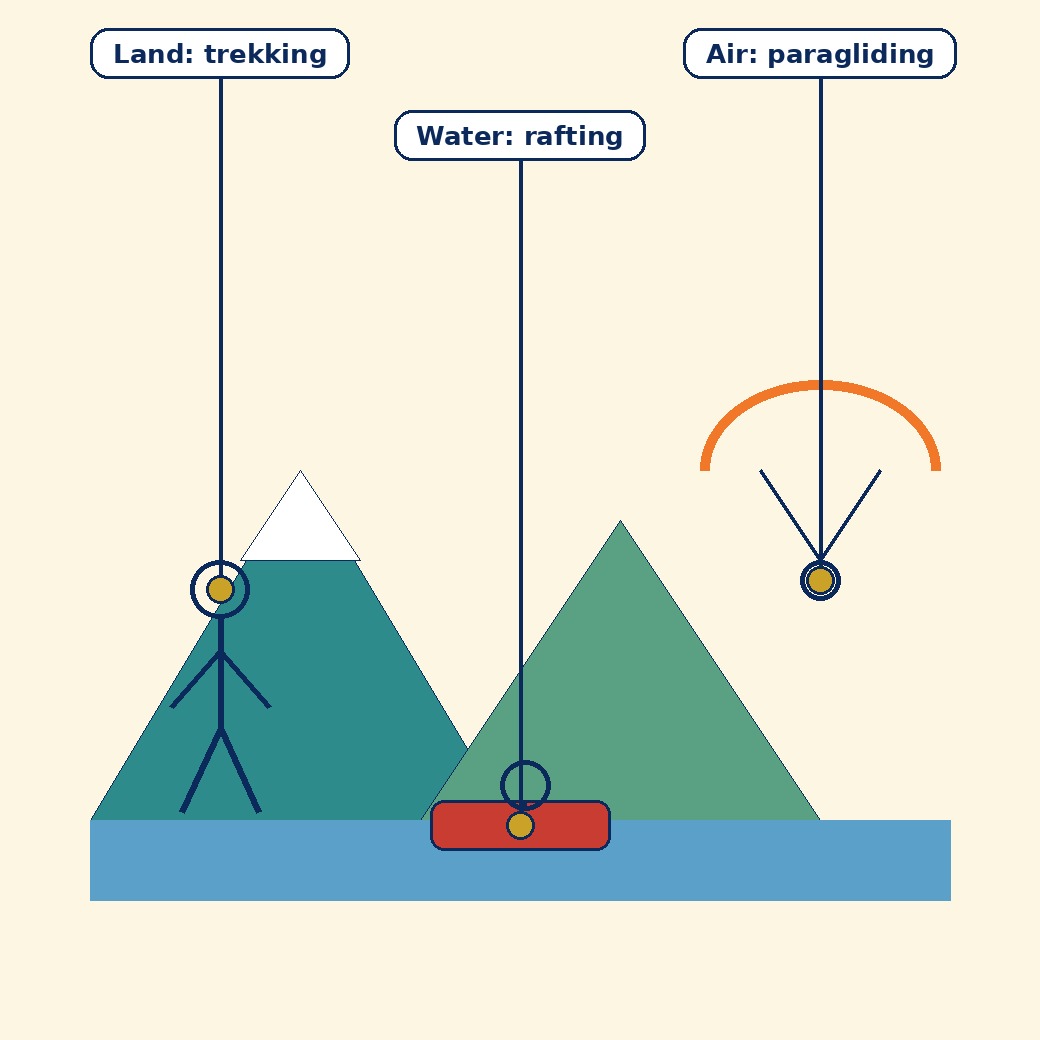
Diagram (labels on the image): Schematic (labels on the image): land trekking, water rafting, and air paragliding.

Guided and equipped: adventure is learned outdoors with trained instructors.
What you should learn
- Describe paragliding: history, classification, structure and instruments.
- Explain paragliding flying techniques, landing and speed-bar control.
- Describe surfing: history, governing body, types and surfboards.
- List the dangers of surfing and surfing-related sports.
- State the safety and security rules for paragliding and surfing.
1. 1. What adventure sports are
Adventure sports are outdoor activities combining physical challenge, risk and nature: trekking, mountaineering, rock climbing, river rafting, paragliding, skiing, surfing and camping. Their appeal is thrill, self-reliance and closeness to nature — and their defining feature is managed risk: excitement with safety systems, not recklessness.
They divide into land (trekking, climbing, cycling), water (rafting, kayaking, surfing) and air (paragliding, skydiving) adventures.
2. 2. Benefits of adventure
Adventure builds fitness, courage, decision-making under pressure, teamwork and leadership. A trek teaches pacing and endurance; a raft crew learns instant cooperation; a climb teaches focus and trust in equipment and partners.
Adventure also builds environmental respect: participants learn to leave camps clean, follow trails, and protect fragile landscapes — values examiners increasingly ask about.
3. 3. Risks and safety systems
Risks include falls, drowning, weather changes, altitude sickness and equipment failure. Safety systems answer each: trained instructors, checked equipment (harness, helmet, life jacket), weather checks, medical screening, group size limits, emergency plans and communication devices.
Altitude sickness deserves special note: above about 2,500 metres, climbers ascend slowly, hydrate, and descend if headache, nausea or breathlessness worsens. Ignoring these signs can be fatal.
4. 4. Adventure in India and responsible practice
India offers Himalayan treks, Rishikesh rafting, Goa surfing, and desert and coastal camps. Responsible practice means: go with recognised operators, never alone in remote areas, carry permits and identification, respect local communities and wildlife, and leave no trace — carry out all waste.
5. 5. Paragliding: history, classification and structure
Paragliding is an adventure sport in which the pilot flies a soft wing, sitting in a harness below it, using rising air to stay up and travel. Its historical development led to the first world championship in Austria in 1989, after which paragliding spread as a competitive and recreational sport.
Classification of paragliding includes the sitting position of the pilot, and the strength of the paraglider structure, the speed of paragliders, and their carrying capacity and storage decide which wing suits which pilot. A wing must be strong enough for its load, fast enough for its purpose, and packed small enough to carry to a take-off point.
6. 6. Paragliding instruments, techniques and landing
Instruments help the pilot fly safely: an altimeter shows height, a variometer shows whether the wing is rising or sinking, and a GPS track of a flight can be used to analyse the flying afterwards and to prove a route in competition. A pilot who cannot read instruments flies blind.
Flying techniques include launching, turning and controlling speed, and landing is a skill of its own: the pilot approaches against the wind and flares the wing to touch down gently. Control through the speed bar mechanism lets the pilot increase speed by pulling the bar with the feet, which changes the wing's angle and is used to escape sinking air or to reach a landing field.
7. 7. Paragliding competitions
Types of competitions in paragliding include cross-country races, in which pilots fly the longest or fastest route, and aerobatic competitions, which demand that participants perform precise manoeuvres in the air. Aerobatic flying needs the highest skill, because a mistake leaves little height for recovery.
Competitions are judged on the route flown, the manoeuvres performed, and safety: a pilot who flies beyond skill or weather limits is penalised or grounded. Competition therefore tests judgement as much as flying skill.
8. 8. Surfing: history, types and equipment
Surfing is riding waves on a surfboard, and its historical development runs from traditional wave-riding to the modern sport with a governing body that sets rules and organises events. Types of surfing include stand-up surfing, which is the modern-day definition of surfing: standing on the board and riding the wave to the shore.
Types of surfboard differ in length, width and shape for different waves and riders, and the right board matters: a long, stable board suits a beginner, while a short board suits fast turns. Surfing-related sports use similar boards and waves in different forms, such as bodyboarding and wind-powered boards.
9. 9. Dangers of surfing; safety and security in paragliding and surfing
Dangers during surfing include the seabed, which can injure a falling surfer in shallow water, strong currents, collisions with other surfers or boards, and exhaustion far from the shore. A surfer must know the break, the depth and the exit before entering the water.
Safety and security in paragliding and surfing rest on the same principles: a paraglider should keep all types of safety instruments, check the wing and harness before flight, and never fly in weather beyond skill. Surfers should use a leash, surf with others, and respect local rules. In both sports, safety checks come before thrill.
At a glance — chart / table
| Adventure family | Examples | Key safety item |
|---|---|---|
| Land | Trekking, rock climbing | Helmet, harness, guide |
| Water | Rafting, kayaking | Life jacket, trained guide |
| Air | Paragliding, skydiving | Certified instructor, checked canopy |
Key Terms / Important Terms
- Adventure sport — An outdoor activity combining challenge, risk and nature.
- Trekking — Long-distance walking, often in hills or mountains.
- Altitude sickness — Illness from low oxygen at high altitude.
- Life jacket — A flotation device worn in water adventure.
- Harness — Safety straps securing a climber.
- Leave no trace — The principle of leaving nature as found, carrying out all waste.
- Paraglider — The soft wing flown by a paragliding pilot, sitting in a harness below it.
- Aerobatic competition — A paragliding competition demanding precise manoeuvres in the air.
- Surfboard — The board ridden in surfing, differing in length and shape for different waves and riders.
Remember
- Land / water / air: three adventure families.
- Managed risk, not recklessness, defines adventure sport.
- Altitude sickness: ascend slowly, hydrate, descend if symptoms worsen.
- Leave no trace: carry out all waste, respect trails and communities.
- First paragliding world championship: Austria, 1989.
Exam Tip / Common Mistake
Common mistake: praising adventure's thrill without its safety systems. Examiners want both: the benefit AND the matching safety measure (life jacket, guide, weather check).
Practice set — try it yourself
- Classify trekking, rafting and paragliding by family, with one safety item each. Hint: Hint: Land, water and air each need different gear.
- Why is adventure sport described as managed risk? Hint: Hint: Thrill exists, but safety systems control it.
- A trekker develops headache and nausea at high altitude. What should happen? Hint: Hint: Symptoms worsening means descend, not push on.
- Give three benefits of adventure sports beyond fitness. Hint: Hint: Courage, teamwork and environmental respect are three.
- Explain “leave no trace” with two examples. Hint: Hint: Carry out waste and stay on trails.
Questions with Answers
- What is an adventure sport? Give one example from each family. Answer: Answer: An adventure sport is an outdoor activity combining physical challenge, risk and nature, with managed risk. Land: trekking; water: river rafting; air: paragliding.
- Why is risk called “managed” in adventure sports? Answer: Answer: Because safety systems control the risk: trained instructors, checked equipment, weather checks, medical screening and emergency plans. The thrill remains, but recklessness is removed.
- What is altitude sickness, and what should a sufferer do? Answer: Answer: Altitude sickness is illness from low oxygen at high altitude, with headache, nausea and breathlessness. Sufferers should stop ascending, hydrate and rest, and descend if symptoms worsen.
- Name three safety measures for river rafting. Answer: Answer: Wearing a life jacket, going with a trained guide, and checking weather and river conditions before starting, with a safety briefing and rescue plan ready.
- What does “leave no trace” mean in adventure practice? Answer: Answer: It means leaving nature as found: carrying out all waste, staying on trails, not disturbing wildlife, and respecting local communities.
Extension Questions with Answers
- Why does a paraglider need instruments? Answer: Answer: Because the pilot must know height, rising or sinking air, and the route flown. An altimeter, a variometer and a GPS track give that information; without them the pilot flies blind.
- How does the speed bar help a paraglider? Answer: Answer: Pulling the speed bar with the feet changes the wing's angle and increases speed, which helps the pilot escape sinking air or reach a landing field.
- Why is landing a separate skill in paragliding? Answer: Answer: Because the pilot must approach against the wind and flare the wing at the right moment to touch down gently; a fast or misjudged landing causes injury.
- Why does surfboard choice matter? Answer: Answer: Because boards differ in length, width and shape for different waves and riders: a long, stable board suits a beginner, while a short board suits fast turns.
- Why must a surfer know the seabed before entering? Answer: Answer: Because in shallow water a falling surfer can hit the seabed and be injured; knowing the break, depth and exit is part of safety.
Board-pattern Questions with Answers
- When and where was the first paragliding world championship held? Answer: Answer: In Austria, in 1989.
- Name three paragliding instruments and their uses. Answer: Answer: Altimeter: height. Variometer: whether the wing is rising or sinking. GPS: track of the flight for analysis and route proof.
- What is stand-up surfing? Answer: Answer: The modern-day definition of surfing: standing on the board and riding the wave to the shore.
- Name two dangers during surfing. Answer: Answer: The seabed in shallow water and strong currents (also collisions and exhaustion far from shore).
- State two safety rules for paragliding. Answer: Answer: Keep all types of safety instruments, and check the wing and harness before flight; never fly in weather beyond skill.
Going deeper — Chapter 11: Adventure Sports
At the centre of this chapter are a few ideas that everything else hangs on: Adventure sport, Trekking, Altitude sickness, Life jacket. If you can explain those ideas in your own words without looking at the notes, you already hold the chapter's spine. Everything else on this page — the examples, the tables and the questions — is there to help you practise using those ideas, not to be memorised as separate facts.
Read the chapter in this order. First, read the summary slowly and ask yourself what question the chapter is answering. Then work through each section one at a time and, after each one, close the page and say its main point in two lines. The sections of this chapter are: 1. 1. What adventure sports are; 2. 2. Benefits of adventure; 3. 3. Risks and safety systems; 5. 5. Paragliding: history, classification and structure; 6. 6. Paragliding instruments, techniques and landing; 7. 7. Paragliding competitions. Each section adds one layer: an earlier section gives you the words and tools, and a later section shows you where those tools are used. When you revise, do not re-read passively — explain each section aloud as if you were teaching a classmate who missed the lesson.
In physical education answers, name the concept or procedure first, then give its steps or components in order, then its benefit or application. For fitness and training questions, give the correct term, the method, and one precaution or example.
Important Questions with Answers — deepening set
These questions go beyond the sets above. Try each one without looking, then check your answer against the notes.
- What does 'Adventure sport' mean? Explain it in your own words and say how it is used in this chapter.
An outdoor activity combining challenge, risk and nature. In this chapter, Adventure sport is one of the ideas you must be able to use, not just define. When a question mentions Adventure sport, first write its meaning in one line, then apply it to the situation in the question. That two-step habit — meaning first, application second — is what turns a definition into marks. - What does 'Trekking' mean? Explain it in your own words and say how it is used in this chapter.
Long-distance walking, often in hills or mountains. In this chapter, Trekking is one of the ideas you must be able to use, not just define. When a question mentions Trekking, first write its meaning in one line, then apply it to the situation in the question. That two-step habit — meaning first, application second — is what turns a definition into marks. - What does 'Altitude sickness' mean? Explain it in your own words and say how it is used in this chapter.
Illness from low oxygen at high altitude. In this chapter, Altitude sickness is one of the ideas you must be able to use, not just define. When a question mentions Altitude sickness, first write its meaning in one line, then apply it to the situation in the question. That two-step habit — meaning first, application second — is what turns a definition into marks. - What does 'Life jacket' mean? Explain it in your own words and say how it is used in this chapter.
A flotation device worn in water adventure. In this chapter, Life jacket is one of the ideas you must be able to use, not just define. When a question mentions Life jacket, first write its meaning in one line, then apply it to the situation in the question. That two-step habit — meaning first, application second — is what turns a definition into marks. - What does 'Harness' mean? Explain it in your own words and say how it is used in this chapter.
Safety straps securing a climber. In this chapter, Harness is one of the ideas you must be able to use, not just define. When a question mentions Harness, first write its meaning in one line, then apply it to the situation in the question. That two-step habit — meaning first, application second — is what turns a definition into marks. - What does 'Leave no trace' mean? Explain it in your own words and say how it is used in this chapter.
The principle of leaving nature as found, carrying out all waste. In this chapter, Leave no trace is one of the ideas you must be able to use, not just define. When a question mentions Leave no trace, first write its meaning in one line, then apply it to the situation in the question. That two-step habit — meaning first, application second — is what turns a definition into marks.
Revision checklist and exam writing guide
Use this checklist the night before a test. Tick a point only if you can do it without opening the notes.
- I can explain '1. 1. What adventure sports are' in two lines without looking.
- I can explain '2. 2. Benefits of adventure' in two lines without looking.
- I can explain '3. 3. Risks and safety systems' in two lines without looking.
- I can explain '5. 5. Paragliding: history, classification and structure' in two lines without looking.
- I can explain '6. 6. Paragliding instruments, techniques and landing' in two lines without looking.
- I can explain '7. 7. Paragliding competitions' in two lines without looking.
- I can explain '8. 8. Surfing: history, types and equipment' in two lines without looking.
- I can explain '9. 9. Dangers of surfing; safety and security in paragliding and surfing' in two lines without looking.
- I can write the chapter's key terms from memory, with one example for each.
- I can answer one long question from this chapter in five ordered paragraphs.
In physical education answers, name the concept or procedure first, then give its steps or components in order, then its benefit or application. For fitness and training questions, give the correct term, the method, and one precaution or example.
Common mistake to avoid: writing everything you remember about the chapter instead of answering the question asked. Read the question twice, underline its command word — explain, compare, why, what happens — and let that word decide the shape of your answer.
Recap
- Paragliding: first world championship Austria 1989; wing + harness + rising air.
- Instruments: altimeter, variometer, GPS. Speed bar increases speed.
- Surfing: stand-up surfing; boards differ by wave and rider.
- Safety first: checks, instruments, weather limits, leash, surf with others.