

Chapter 12: Sports and Inclusivity
Sport for everyone: what inclusion means, what blocks it, and how to build it.
Original notes — ready CBSE (NCERT, English Medium) • Class 9 • Physical Education • Book: Khel Praveen
Chapter 12: Sports and Inclusivity — EG's own notes, in simple words
Book: Khel Praveen (CBSE, Class 9) | Chapter 12 | Section: Unit 4: Sports for All | Medium: English
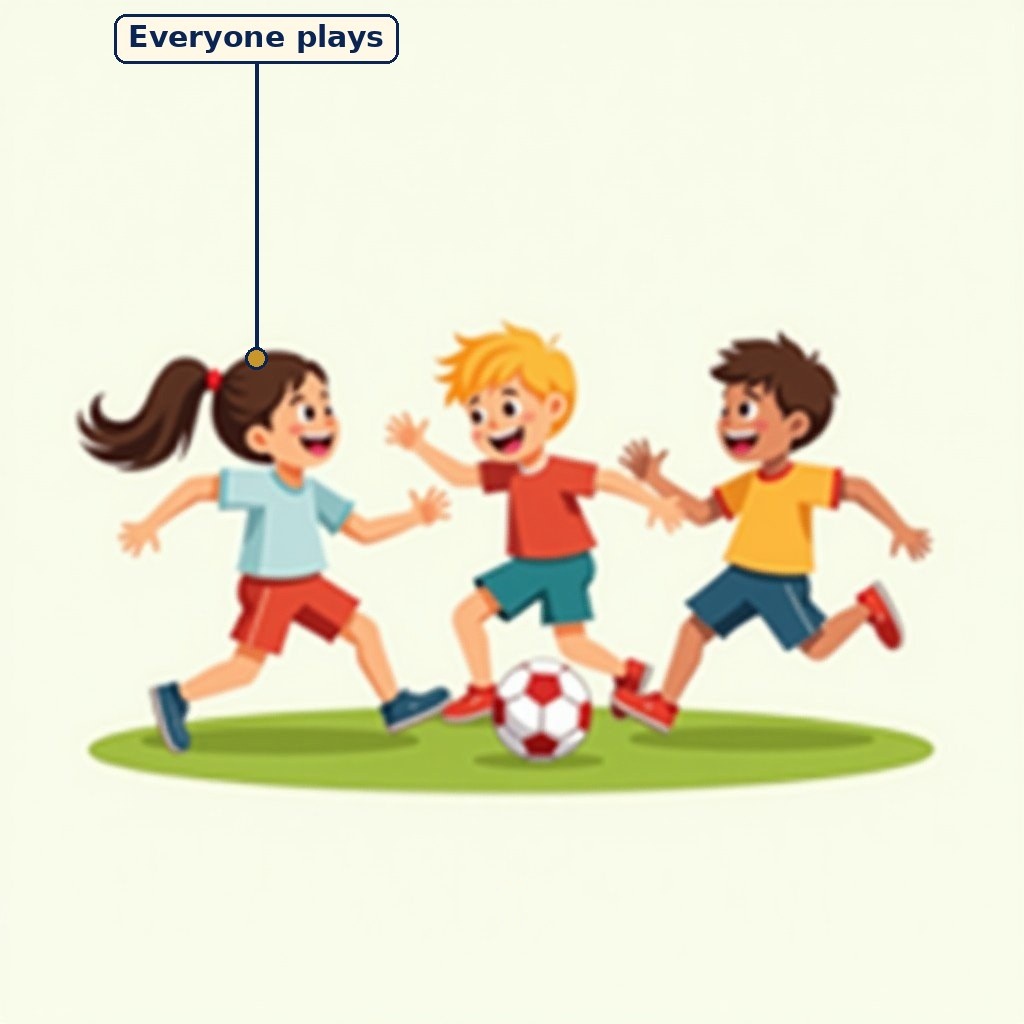
Diagram (labels are printed on the image): Children of different abilities playing together with fair rules. A general picture about inclusive sport; it is not a scene from the book.
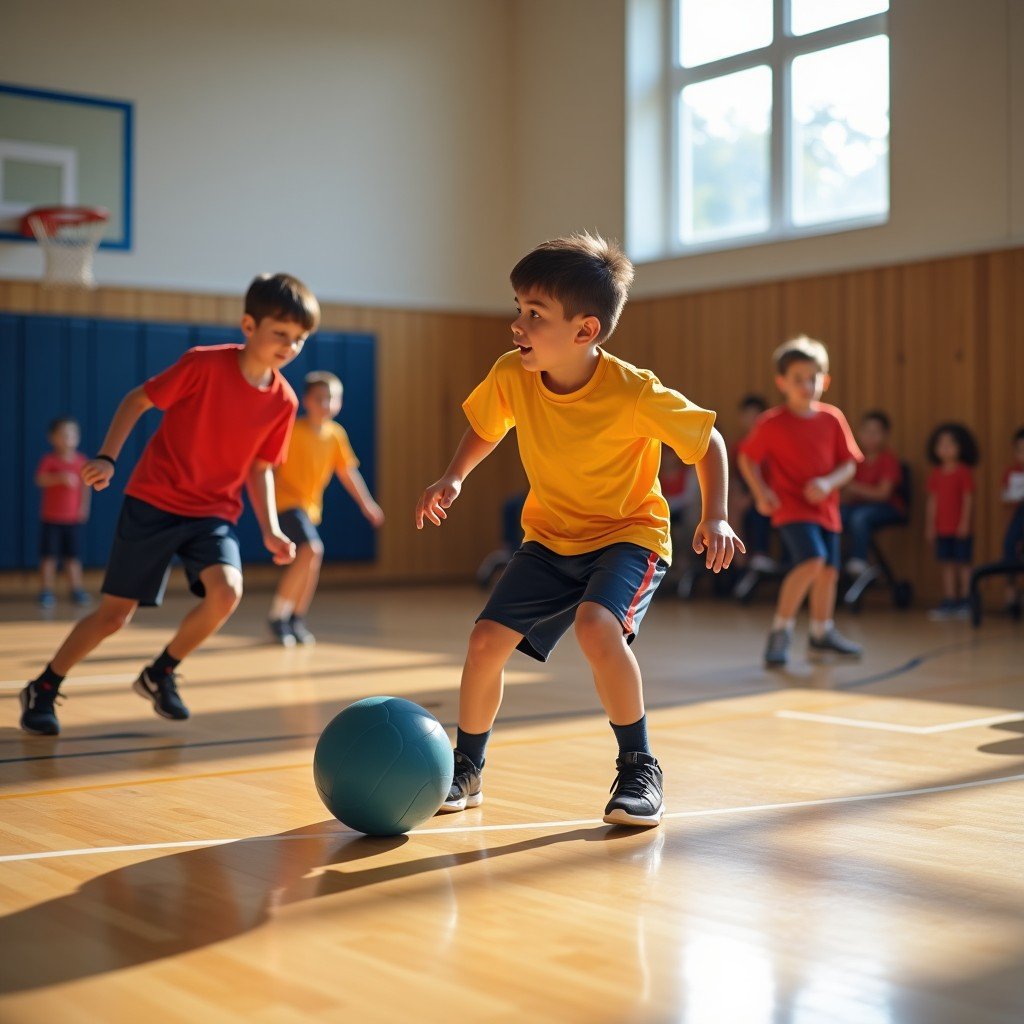
An inclusive games class where every student takes part.
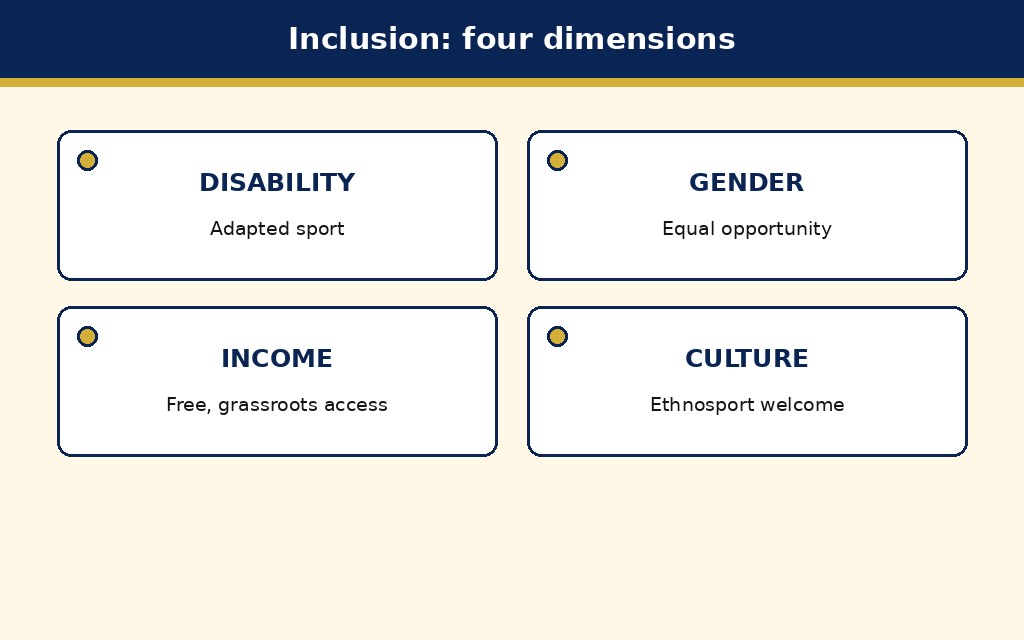
New labelled schematic (labels and gold dots are printed on the image): Four inclusion dimensions
What the chapter is about
Sport is for all. Inclusivity means every student — whatever their body, background, gender or ability — gets a real chance to play, learn and belong. It is not enough to let everyone watch; everyone should take part.
Inclusive games change rules so all can play: smaller balls, shorter distances, mixed teams, or roles for every ability. When rules are adapted fairly, the game stays fun and challenging for everyone, not only for the strongest.
Inclusion also changes attitudes. Playing together teaches students that difference is normal and valuable. A team that welcomes everyone is stronger, kinder and more fun than a team that picks only stars.
Meaning and foundation
Sports and inclusivity starts from a right, not a favour. According to the 2015 UNESCO International Charter of Physical Education, Physical Activity and Sport, the practice of physical education and sport is a fundamental right for all. The United Nations declared 6 April the International Day of Sport for Development and Peace, and India's Khelo India initiative aims to take sport to the grassroots — the same idea at three levels: world, nation and neighbourhood.
Inclusion transforms sport from a privilege of the few into a vehicle for well-being, togetherness, personal growth and community connection that goes beyond competition. An inclusive game is not a lesser game: adapted rules, mixed teams and shared roles keep the contest real while letting everyone actually play.
Dimensions, challenges and solutions
The chapter names key dimensions of inclusiveness. Disability inclusion uses adapted sports, with the Paralympic Games and Special Olympics as the highest stages. Socio-economic inclusion removes cost barriers — free grounds, shared equipment, school programmes. Cultural and ethnic inclusion welcomes traditional and regional games (ethnosport) and players from every background.
Challenges are honest: cost, distance and lack of facilities; cultural attitudes that discourage women or persons with disabilities; and low awareness of adapted options. The solutions match them: grassroots programmes, accessible playgrounds, trained teachers, and extempore and classroom discussion that change attitudes. The chapter's exercise asks whether grassroots programmes matter — and the answer is yes, because inclusion fails at the top if it never reaches the school ground.
What you should learn
Inclusive sport adapts rules and roles so every student, whatever their ability or background, truly plays and belongs.
Key Terms
- Inclusivity — Making sure everyone can take part and belong.
- Adapted game — A game whose rules or equipment are changed so all can play.
- Belonging — Feeling accepted as a real member of the group.
- Mixed teams — Teams mixing abilities, genders and backgrounds.
- Fair rules — Rules changed to give everyone a genuine chance.
Remember
- Sport is for all, not only for stars.
- Adapt rules, balls and distances so all can play.
- Watching is not participating.
- Inclusive teams are kinder and stronger.
Exam Tip / Common Mistake
Common mistake: picking teams by letting captains choose best players first. Mixed, teacher-formed teams include everyone and avoid embarrassment.
Chart / Table: Making a game inclusive
| Point | Detail |
|---|---|
| Smaller ball | Easier to catch and control |
| Shorter distance | Less running, more success |
| Mixed teams | All abilities together |
| Many roles | Scorer, passer, defender — all matter |
| Everyone rotates | No one sits out the whole game |
Going deeper — Chapter 12: Sports and Inclusivity
At the centre of this chapter are a few ideas that everything else hangs on: Inclusivity, Adapted game, Belonging, Mixed teams. If you can explain those ideas in your own words without looking at the notes, you already hold the chapter's spine. Everything else on this page — the examples, the tables and the questions — is there to help you practise using those ideas, not to be memorised as separate facts.
Read the chapter in this order. First, read the summary slowly and ask yourself what question the chapter is answering. Then work through each section one at a time and, after each one, close the page and say its main point in two lines. The sections of this chapter are: What the chapter is about; Meaning and foundation; Dimensions, challenges and solutions. Each section adds one layer: an earlier section gives you the words and tools, and a later section shows you where those tools are used. When you revise, do not re-read passively — explain each section aloud as if you were teaching a classmate who missed the lesson.
In physical education answers, name the concept or procedure first, then give its steps or components in order, then its benefit or application. For fitness and training questions, give the correct term, the method, and one precaution or example.
Important Questions with Answers — deepening set
These questions go beyond the sets above. Try each one without looking, then check your answer against the notes.
- What does 'Inclusivity' mean? Explain it in your own words and say how it is used in this chapter.
Making sure everyone can take part and belong. In this chapter, Inclusivity is one of the ideas you must be able to use, not just define. When a question mentions Inclusivity, first write its meaning in one line, then apply it to the situation in the question. That two-step habit — meaning first, application second — is what turns a definition into marks. - What does 'Adapted game' mean? Explain it in your own words and say how it is used in this chapter.
A game whose rules or equipment are changed so all can play. In this chapter, Adapted game is one of the ideas you must be able to use, not just define. When a question mentions Adapted game, first write its meaning in one line, then apply it to the situation in the question. That two-step habit — meaning first, application second — is what turns a definition into marks. - What does 'Belonging' mean? Explain it in your own words and say how it is used in this chapter.
Feeling accepted as a real member of the group. In this chapter, Belonging is one of the ideas you must be able to use, not just define. When a question mentions Belonging, first write its meaning in one line, then apply it to the situation in the question. That two-step habit — meaning first, application second — is what turns a definition into marks. - What does 'Mixed teams' mean? Explain it in your own words and say how it is used in this chapter.
Teams mixing abilities, genders and backgrounds. In this chapter, Mixed teams is one of the ideas you must be able to use, not just define. When a question mentions Mixed teams, first write its meaning in one line, then apply it to the situation in the question. That two-step habit — meaning first, application second — is what turns a definition into marks. - What does 'Fair rules' mean? Explain it in your own words and say how it is used in this chapter.
Rules changed to give everyone a genuine chance. In this chapter, Fair rules is one of the ideas you must be able to use, not just define. When a question mentions Fair rules, first write its meaning in one line, then apply it to the situation in the question. That two-step habit — meaning first, application second — is what turns a definition into marks. - What does 'Smaller ball' mean? Explain it in your own words and say how it is used in this chapter.
Easier to catch and control In this chapter, Smaller ball is one of the ideas you must be able to use, not just define. When a question mentions Smaller ball, first write its meaning in one line, then apply it to the situation in the question. That two-step habit — meaning first, application second — is what turns a definition into marks.
Revision checklist and exam writing guide
Use this checklist the night before a test. Tick a point only if you can do it without opening the notes.
- I can explain 'What the chapter is about' in two lines without looking.
- I can explain 'Meaning and foundation' in two lines without looking.
- I can explain 'Dimensions, challenges and solutions' in two lines without looking.
- I can write the chapter's key terms from memory, with one example for each.
- I can answer one long question from this chapter in five ordered paragraphs.
In physical education answers, name the concept or procedure first, then give its steps or components in order, then its benefit or application. For fitness and training questions, give the correct term, the method, and one precaution or example.
Common mistake to avoid: writing everything you remember about the chapter instead of answering the question asked. Read the question twice, underline its command word — explain, compare, why, what happens — and let that word decide the shape of your answer.
Important Questions with Answers — deepening set
These questions go beyond the sets above. Try each one without looking, then check your answer against the notes.
- What does 'Shorter distance' mean? Explain it in your own words and say how it is used in this chapter.
Less running, more success In this chapter, Shorter distance is one of the ideas you must be able to use, not just define. When a question mentions Shorter distance, first write its meaning in one line, then apply it to the situation in the question. That two-step habit — meaning first, application second — is what turns a definition into marks. - What does 'Many roles' mean? Explain it in your own words and say how it is used in this chapter.
Scorer, passer, defender — all matter In this chapter, Many roles is one of the ideas you must be able to use, not just define. When a question mentions Many roles, first write its meaning in one line, then apply it to the situation in the question. That two-step habit — meaning first, application second — is what turns a definition into marks. - What does 'Everyone rotates' mean? Explain it in your own words and say how it is used in this chapter.
No one sits out the whole game In this chapter, Everyone rotates is one of the ideas you must be able to use, not just define. When a question mentions Everyone rotates, first write its meaning in one line, then apply it to the situation in the question. That two-step habit — meaning first, application second — is what turns a definition into marks. - What is the main point of the section 'What the chapter is about', and why does it come at that place in the chapter?
Work through the section slowly and write its main point in two lines of your own: what new idea it introduces, and how it follows from the section before it. In revision, if you cannot state that point without looking, re-read the section once, say it aloud, and only then move on. A section you can summarise is a section you have understood; a section you can only recognise is not yet ready for the exam.
Important Questions with Answers — deepening set
These questions go beyond the sets above. Try each one without looking, then check your answer against the notes.
- What is the main point of the section 'Meaning and foundation', and why does it come at that place in the chapter?
Work through the section slowly and write its main point in two lines of your own: what new idea it introduces, and how it follows from the section before it. In revision, if you cannot state that point without looking, re-read the section once, say it aloud, and only then move on. A section you can summarise is a section you have understood; a section you can only recognise is not yet ready for the exam. - What is the main point of the section 'Dimensions, challenges and solutions', and why does it come at that place in the chapter?
Work through the section slowly and write its main point in two lines of your own: what new idea it introduces, and how it follows from the section before it. In revision, if you cannot state that point without looking, re-read the section once, say it aloud, and only then move on. A section you can summarise is a section you have understood; a section you can only recognise is not yet ready for the exam. - What is the one message or conclusion of Chapter 12: Sports and Inclusivity that you should never forget?
Every chapter in this book has one idea that ties its sections together. For this chapter, find that idea in the summary above and write it as a single sentence in your notebook. In the exam, when a long question feels confusing, that one sentence is your compass: start from it, add two supporting points from the sections, and close by repeating it in different words. - How would you answer a five-mark question from this chapter?
Start with a one-line introduction that names the topic. Then write three clear points, each in two or three lines, in a sensible order. Add one example, one term used correctly, or one short reason wherever the question allows it. End with a one-line conclusion. Five short, ordered paragraphs with correct terms score far better than one long, unordered paragraph.
Inclusion means sport as a right for all — across disability, gender, income and culture — and it is built at the grassroots, with adapted rules and open doors, not only at elite events.
Practice set — try it yourself
- Adapt kabaddi so a slower player can succeed. What changes?
Hint: Hint: Smaller court, extra lives, team help. - Why is watching from the side not inclusion?
Hint: Hint: Think belonging and practice. - Plan a mixed-team game for your class.
Hint: Hint: Balance abilities deliberately. - How does inclusion change attitudes?
Hint: Hint: Think friendship and respect. - What would you do if a classmate was always left out?
Hint: Hint: Think speaking up and inviting.
Questions with Answers
- What is inclusivity in sport?
Ensuring every student, whatever their ability, gender or background, gets a real chance to play, learn and belong in sport. - How can rules be adapted for inclusion?
By using smaller balls, shorter distances, mixed teams, extra roles and rotation, so every player can succeed and contribute. - Why are teacher-formed mixed teams better than captain picks?
Because captain picks often leave the same students last, causing embarrassment. Mixed teams include everyone fairly. - Is inclusion only about disability?
No. It covers ability, gender, size, background and confidence. Any student can be excluded, and inclusion welcomes all. - How does inclusive sport help everyone, not only excluded students?
It builds empathy, teamwork and kindness, and makes games more fun and fair for the whole class.
Questions with Answers — Extension
- Why does the chapter call sport a right rather than a favour?
Because the 2015 UNESCO Charter states it as a fundamental right for all — so excluding someone is a denial of a right, not just unkindness. - Give two examples of ethnosport gaining popularity, and explain why they matter for inclusion.
For example, regional traditional games revived through Khelo India and school festivals: they matter because players see their own culture valued in sport, not only mainstream games. - A school has one playground and no budget. Give three low-cost steps towards inclusion.
Shared equipment rota, mixed-ability teams with adapted rules, and free after-school play slots — none needs new building, all remove a barrier. - How do the Paralympic Games and Special Olympics serve inclusion differently?
The Paralympics showcase elite adapted competition; Special Olympics focus on participation and personal achievement for athletes with intellectual disabilities — excellence and belonging, both needed. - Are grassroots programmes important? Argue with one reason and one example.
Yes: talent and habit form at the grassroots. Example: a free school-level adapted game reaches children who would never enter a city-level trial, so inclusion starts where children actually are.
How to use this page: Read the summary, say the Key Terms in your own words, then try the practice set without looking. Use the Questions with Answers to check yourself afterwards. Ask your teacher or parent to check your answers.