

Chapter 11: The Modern Olympic Games
Paris 1894 to the world stage: the IOC, the rings, the motto, the creed and India's journey.
Original notes — ready CBSE (NCERT, English Medium) • Class 9 • Physical Education • Book: Khel Praveen
Chapter 11: The Modern Olympic Games — EG's own notes, in simple words
Book: Khel Praveen (CBSE, Class 9) | Chapter 11 | Section: Unit 3: Olympism | Medium: English

Diagram (labels are printed on the image): Torch flame, five rings and the Olympic motto of the modern Games. A general picture about the modern Olympics; it is not a scene from the book.

Students discussing the Olympic torch, rings and motto.
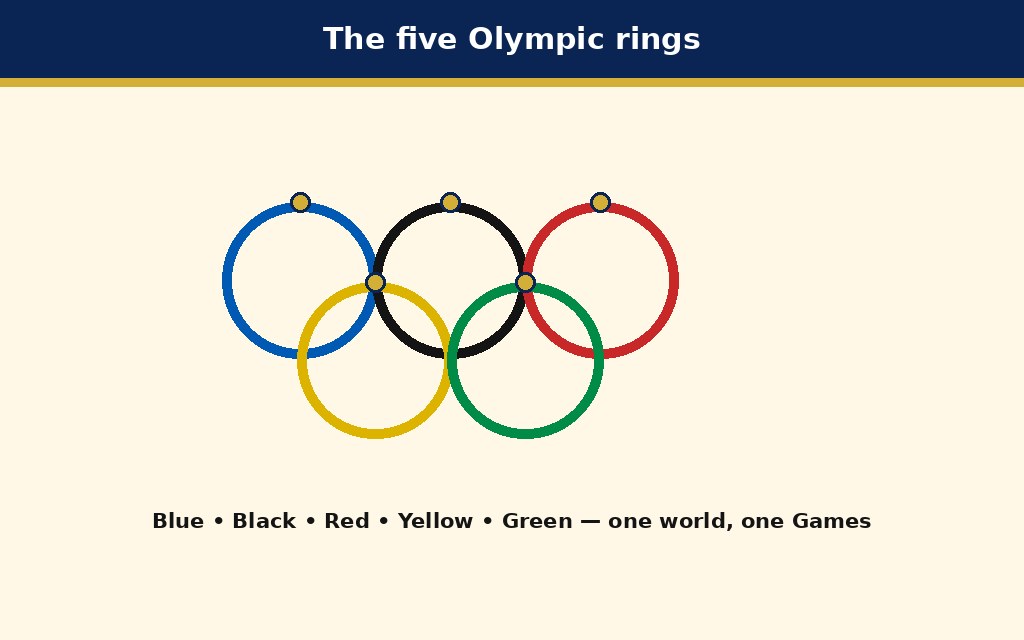
New labelled schematic (labels and gold dots are printed on the image): Five Olympic rings
What the chapter is about
The modern Olympic Games began in Athens in 1896, revived by Pierre de Coubertin, who believed sport could build peace and character. Today the Summer and Winter Games bring thousands of athletes from nearly every country together.
The symbols carry meaning. The five rings stand for the continents and the meeting of athletes worldwide. The flame is lit at Olympia and carried by relay to the host city. The motto — Faster, Higher, Stronger, Together — now adds togetherness to the old call for excellence.
India's Olympic story includes hockey golds, and in 2008 Abhinav Bindra won India's first individual gold in shooting. The Paralympics, held after the Olympics, celebrate athletes with disabilities at the same elite level.
Birth and growth of the modern Games
In 1894, at a meeting in Paris, Coubertin and delegates from twelve countries decided to establish the International Olympic Committee (IOC). Two years later, in April 1896, the dream became reality with the first modern Olympic Games in Athens. The second Games followed in Paris in 1900, then St. Louis in 1904, and gradually more nations joined.
Women gained recognition through their first participation in the 1900 Paris Olympics, in sports such as tennis and golf. Later additions broadened the movement further: the Youth Olympic Games gave young athletes their own world stage, and the Paralympic movement, the Commonwealth Games and the Asian Games extended the Olympic idea beyond a single event. India's own journey runs through this growth: after early participation, India formed its own National Olympic Committee, and Indian athletes have carried the flag in every era since.
The identity of the movement: symbol, motto, creed and oath
The Olympic symbol is five interlocking rings, standing for the unity of the world's continents and athletes. The Olympic flag carries those rings, and the Olympic motto reads Citius, Altius, Fortius — Communiter: Faster, Higher, Stronger — Together. The added word Communiter (Together) is recent and deliberate: it says excellence is a shared pursuit, not a lonely one.
The Olympic Creed says the important thing is not winning but taking part, and that the essential thing is not conquering but fighting well. The Olympic Oath, taken by athletes, judges and coaches, binds them to fair play — and it has been expanded over time to cover coaches and to stress inclusion. For exams, fix these four: rings = unity, motto = Faster, Higher, Stronger — Together, creed = taking part and fighting well, oath = fair play.
What you should learn
The modern Games began in 1896, use rings, flame and motto as symbols, and include the Paralympics for athletes with disabilities.
Key Terms
- IOC — International Olympic Committee, which runs the Olympic Movement.
- Olympic flame — Fire lit at Olympia and relayed to the host city.
- Five rings — Symbol of the continents and athletes meeting worldwide.
- Motto — Faster, Higher, Stronger — Together.
- Paralympics — Elite Games for athletes with disabilities.
Remember
- Modern Games began in Athens, 1896.
- Coubertin revived the Games for peace and character.
- Five rings = world athletes meeting together.
- Flame travels from Olympia by torch relay.
Exam Tip / Common Mistake
Common mistake: saying the rings stand for five coloured continents. They stand for the meeting of athletes worldwide; the colours were chosen for flags, not continents.
Chart / Table: Modern Olympic symbols
| Point | Detail |
|---|---|
| Five rings | Athletes of the world meeting together |
| Flame | Lit at Olympia, relayed to host city |
| Motto | Faster, Higher, Stronger — Together |
| Flag | White flag with five rings |
| Anthem and oath | Played and sworn at opening ceremony |
Going deeper — Chapter 11: The Modern Olympic Games
At the centre of this chapter are a few ideas that everything else hangs on: IOC, Olympic flame, Five rings, Motto. If you can explain those ideas in your own words without looking at the notes, you already hold the chapter's spine. Everything else on this page — the examples, the tables and the questions — is there to help you practise using those ideas, not to be memorised as separate facts.
Read the chapter in this order. First, read the summary slowly and ask yourself what question the chapter is answering. Then work through each section one at a time and, after each one, close the page and say its main point in two lines. The sections of this chapter are: What the chapter is about; Birth and growth of the modern Games; The identity of the movement: symbol, motto, creed and oath. Each section adds one layer: an earlier section gives you the words and tools, and a later section shows you where those tools are used. When you revise, do not re-read passively — explain each section aloud as if you were teaching a classmate who missed the lesson.
In physical education answers, name the concept or procedure first, then give its steps or components in order, then its benefit or application. For fitness and training questions, give the correct term, the method, and one precaution or example.
Important Questions with Answers — deepening set
These questions go beyond the sets above. Try each one without looking, then check your answer against the notes.
- What does 'IOC' mean? Explain it in your own words and say how it is used in this chapter.
International Olympic Committee, which runs the Olympic Movement. In this chapter, IOC is one of the ideas you must be able to use, not just define. When a question mentions IOC, first write its meaning in one line, then apply it to the situation in the question. That two-step habit — meaning first, application second — is what turns a definition into marks. - What does 'Olympic flame' mean? Explain it in your own words and say how it is used in this chapter.
Fire lit at Olympia and relayed to the host city. In this chapter, Olympic flame is one of the ideas you must be able to use, not just define. When a question mentions Olympic flame, first write its meaning in one line, then apply it to the situation in the question. That two-step habit — meaning first, application second — is what turns a definition into marks. - What does 'Five rings' mean? Explain it in your own words and say how it is used in this chapter.
Symbol of the continents and athletes meeting worldwide. In this chapter, Five rings is one of the ideas you must be able to use, not just define. When a question mentions Five rings, first write its meaning in one line, then apply it to the situation in the question. That two-step habit — meaning first, application second — is what turns a definition into marks. - What does 'Motto' mean? Explain it in your own words and say how it is used in this chapter.
Faster, Higher, Stronger — Together. In this chapter, Motto is one of the ideas you must be able to use, not just define. When a question mentions Motto, first write its meaning in one line, then apply it to the situation in the question. That two-step habit — meaning first, application second — is what turns a definition into marks. - What does 'Paralympics' mean? Explain it in your own words and say how it is used in this chapter.
Elite Games for athletes with disabilities. In this chapter, Paralympics is one of the ideas you must be able to use, not just define. When a question mentions Paralympics, first write its meaning in one line, then apply it to the situation in the question. That two-step habit — meaning first, application second — is what turns a definition into marks. - What does 'Flame' mean? Explain it in your own words and say how it is used in this chapter.
Lit at Olympia, relayed to host city In this chapter, Flame is one of the ideas you must be able to use, not just define. When a question mentions Flame, first write its meaning in one line, then apply it to the situation in the question. That two-step habit — meaning first, application second — is what turns a definition into marks.
Revision checklist and exam writing guide
Use this checklist the night before a test. Tick a point only if you can do it without opening the notes.
- I can explain 'What the chapter is about' in two lines without looking.
- I can explain 'Birth and growth of the modern Games' in two lines without looking.
- I can explain 'The identity of the movement: symbol, motto, creed and oath' in two lines without looking.
- I can write the chapter's key terms from memory, with one example for each.
- I can answer one long question from this chapter in five ordered paragraphs.
In physical education answers, name the concept or procedure first, then give its steps or components in order, then its benefit or application. For fitness and training questions, give the correct term, the method, and one precaution or example.
Common mistake to avoid: writing everything you remember about the chapter instead of answering the question asked. Read the question twice, underline its command word — explain, compare, why, what happens — and let that word decide the shape of your answer.
Important Questions with Answers — deepening set
These questions go beyond the sets above. Try each one without looking, then check your answer against the notes.
- What does 'Flag' mean? Explain it in your own words and say how it is used in this chapter.
White flag with five rings In this chapter, Flag is one of the ideas you must be able to use, not just define. When a question mentions Flag, first write its meaning in one line, then apply it to the situation in the question. That two-step habit — meaning first, application second — is what turns a definition into marks. - What does 'Anthem and oath' mean? Explain it in your own words and say how it is used in this chapter.
Played and sworn at opening ceremony In this chapter, Anthem and oath is one of the ideas you must be able to use, not just define. When a question mentions Anthem and oath, first write its meaning in one line, then apply it to the situation in the question. That two-step habit — meaning first, application second — is what turns a definition into marks. - What is the main point of the section 'What the chapter is about', and why does it come at that place in the chapter?
Work through the section slowly and write its main point in two lines of your own: what new idea it introduces, and how it follows from the section before it. In revision, if you cannot state that point without looking, re-read the section once, say it aloud, and only then move on. A section you can summarise is a section you have understood; a section you can only recognise is not yet ready for the exam. - What is the main point of the section 'Birth and growth of the modern Games', and why does it come at that place in the chapter?
Work through the section slowly and write its main point in two lines of your own: what new idea it introduces, and how it follows from the section before it. In revision, if you cannot state that point without looking, re-read the section once, say it aloud, and only then move on. A section you can summarise is a section you have understood; a section you can only recognise is not yet ready for the exam.
Important Questions with Answers — deepening set
These questions go beyond the sets above. Try each one without looking, then check your answer against the notes.
- What is the main point of the section 'The identity of the movement: symbol, motto, creed and oath', and why does it come at that place in the chapter?
Work through the section slowly and write its main point in two lines of your own: what new idea it introduces, and how it follows from the section before it. In revision, if you cannot state that point without looking, re-read the section once, say it aloud, and only then move on. A section you can summarise is a section you have understood; a section you can only recognise is not yet ready for the exam. - What is the one message or conclusion of Chapter 11: The Modern Olympic Games that you should never forget?
Every chapter in this book has one idea that ties its sections together. For this chapter, find that idea in the summary above and write it as a single sentence in your notebook. In the exam, when a long question feels confusing, that one sentence is your compass: start from it, add two supporting points from the sections, and close by repeating it in different words. - How would you answer a five-mark question from this chapter?
Start with a one-line introduction that names the topic. Then write three clear points, each in two or three lines, in a sensible order. Add one example, one term used correctly, or one short reason wherever the question allows it. End with a one-line conclusion. Five short, ordered paragraphs with correct terms score far better than one long, unordered paragraph. - What is the hardest part of this chapter, and how do you master it?
The hardest part is usually the part you keep skipping. Find it — the section you re-read most, or the term you always forget — and give it ten focused minutes: read it, cover it, write its three key points from memory, and check. Repeat that cycle the next day. Two short recalls beat one long re-reading, and they show you honestly what is still weak.
From twelve countries in Paris in 1894 to a worldwide movement, the modern Games kept the ancient ideals and gave them new symbols: five rings, a motto of shared striving, a creed about taking part, and an oath of fair play.
Practice set — try it yourself
- Draw the five rings and explain what they mean.
Hint: Hint: Meeting of athletes, not coloured continents. - Trace a torch relay route from Olympia to a host city.
Hint: Hint: Use a map and mark stops. - Why add 'Together' to the motto?
Hint: Hint: Think teamwork and inclusion. - Name one Indian Olympic hero and their sport.
Hint: Hint: Hockey teams, Bindra, Neeraj Chopra. - How are the Paralympics different from the Olympics?
Hint: Hint: Same elite level, athletes with disabilities.
Questions with Answers
- When and where did the modern Olympics begin?
In Athens, Greece, in 1896, revived by Pierre de Coubertin. - What do the five Olympic rings symbolise?
The meeting of athletes from around the world. The rings are interlocked to show unity, not five coloured continents. - How does the Olympic flame reach the host city?
It is lit at Olympia in Greece and carried by a torch relay of runners to the host city's stadium. - What is the Olympic motto?
Faster, Higher, Stronger — Together. 'Together' was added to stress unity and teamwork. - Who was Abhinav Bindra?
India's first individual Olympic gold medallist, winning shooting gold at Beijing 2008 through calm focus and mental training.
Questions with Answers — Extension
- Why was the 1894 Paris meeting decisive, and what happened two years later?
Twelve countries' delegates founded the IOC there; in April 1896 the first modern Games were held in Athens, turning Coubertin's plan into reality. - How did women's participation begin, and why does the chapter mention tennis and golf?
Women first competed at Paris 1900, in tennis and golf — the chapter names them because they were the opening sports for women, marking the start of inclusion. - What does adding 'Communiter' (Together) change about the motto's meaning?
It changes excellence from a solo race to a shared pursuit: faster, higher and stronger are achieved together, with solidarity, not at others' expense. - Explain the creed in your own words, and apply it to a student who finishes last in a race.
Taking part and fighting well matter more than winning; a last-place student who trained honestly and finished with effort has lived the creed. - How do the IOC and National Olympic Committees together keep the Games running?
The IOC governs the movement worldwide and awards the Games; each National Olympic Committee selects and sends its country's team, so global rules and national participation fit together.
How to use this page: Read the summary, say the Key Terms in your own words, then try the practice set without looking. Use the Questions with Answers to check yourself afterwards. Ask your teacher or parent to check your answers.