

Chapter 10: The Ancient Olympic Games
Olympia, the olive wreath and arête — the ancient Games and why they still matter.
Original notes — ready CBSE (NCERT, English Medium) • Class 9 • Physical Education • Book: Khel Praveen
Chapter 10: The Ancient Olympic Games — EG's own notes, in simple words
Book: Khel Praveen (CBSE, Class 9) | Chapter 10 | Section: Unit 3: Olympism | Medium: English

Diagram (labels are printed on the image): Athletes racing in the ancient stadium at Olympia, where winners received an olive wreath. A general picture about the ancient Games; it is not a scene from the book.

Students studying pictures of the ancient stadium at Olympia.
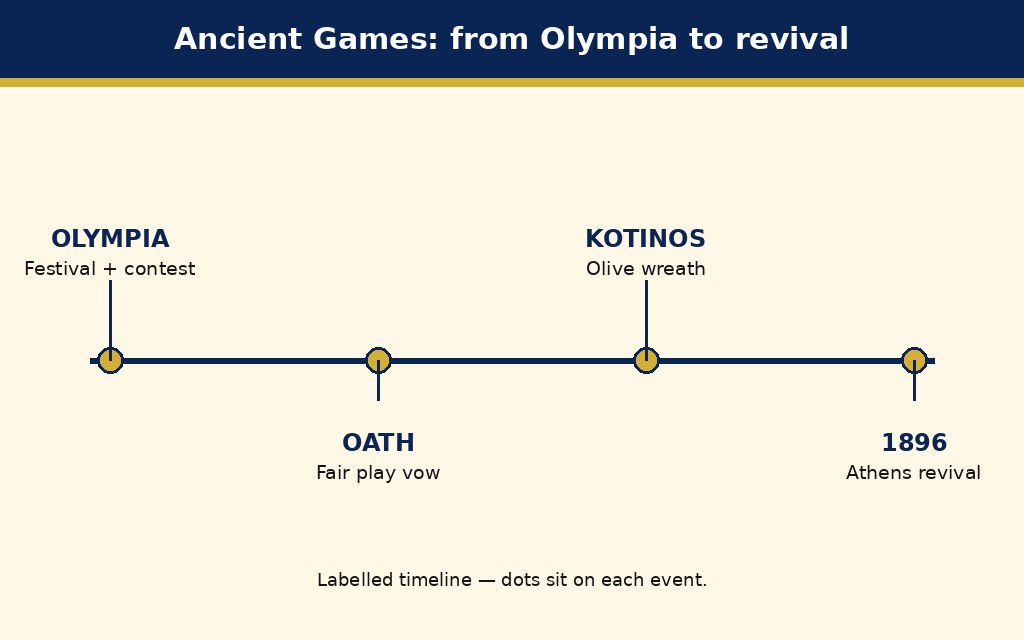
New labelled schematic (labels and gold dots are printed on the image): Ancient Games timeline
What the chapter is about
The ancient Olympic Games began in Olympia, Greece, nearly 3,000 years ago, in honour of Zeus. They were held every four years, and during the Games, wars were paused so athletes and visitors could travel safely — the Olympic truce.
Early Games had only one event: a short sprint in the stadium. Over centuries, wrestling, boxing, chariot racing, long jump and discus were added. Winners received no medals — only an olive wreath and great honour in their home city.
The ancient Games lasted almost 12 centuries before ending. Their spirit — peaceful competition, honour and excellence — inspired the modern Games that began in 1896.
Origin, purpose and organisation
The ancient Olympic Games were held at Olympia in Greece as both a religious festival and a celebration of human strength and skill. Ancient writers like Pausanias and Herodotus described Games that honoured the gods while testing the body — so the Games were never only sport; they were worship, festival and contest together. Athletes trained for months, took an oath to compete fairly and follow the rules, and the oath mattered because the Games' honour depended on honest contest.
Events included running races, wrestling, boxing, chariot racing and the pentathlon, and races for young women showed that physical activity was valued beyond the main men's contests. Winners received the kotinos, a simple wreath of olive leaves — no money, no medal — and that simplicity is the point: the wreath symbolised honour and the Greek ideal of arête, excellence of character as well as body.
Decline, legacy and the modern link
The ancient Games eventually declined and were ended under the Roman emperor Theodosius I, and the festival was lost for centuries. But the idea survived in writing and memory, and Pierre de Coubertin's vision revived it as the modern Games in Athens in 1896. The link is still honoured literally: in 2004, Indian shooter Rajyavardhan Singh Rathore was honoured with an olive wreath after winning silver at the Athens Olympics, echoing the ancient prize.
The legacy question is the chapter's best long answer. What survived: the ideals of fair contest, honour in victory and dignity in defeat — losing with dignity was respected because it showed humility and discipline. What changed: the scale, the inclusion of women and many nations, and professional organisation. The ancient Games are the foundation, not a curiosity: modern Olympism quotes their values directly.
What you should learn
The ancient Games at Olympia honoured Zeus, paused wars by truce, and rewarded winners with olive wreaths and honour.
Key Terms
- Olympia — The Greek sanctuary where the ancient Games were held.
- Olympic truce — A pause in wars so athletes could travel safely to the Games.
- Stadium — The running track and arena; also the sprint race itself.
- Olive wreath — The crown of olive leaves given to ancient winners.
- Zeus — The chief Greek god honoured by the ancient Games.
Remember
- Ancient Games began at Olympia, Greece.
- They were held every four years.
- Wars paused during the Games — the truce.
- Winners got olive wreaths, not medals.
Exam Tip / Common Mistake
Common mistake: saying ancient winners won gold medals. Medals came with the modern Games; ancient honour was the olive wreath.
Chart / Table: Ancient Games at a glance
| Point | Detail |
|---|---|
| Where | Olympia, Greece |
| Held for | Zeus, king of Greek gods |
| How often | Every four years |
| Famous events | Sprint, wrestling, boxing, discus, chariot race |
| Winner's prize | Olive wreath and honour |
Going deeper — Chapter 10: The Ancient Olympic Games
At the centre of this chapter are a few ideas that everything else hangs on: Olympia, Olympic truce, Stadium, Olive wreath. If you can explain those ideas in your own words without looking at the notes, you already hold the chapter's spine. Everything else on this page — the examples, the tables and the questions — is there to help you practise using those ideas, not to be memorised as separate facts.
Read the chapter in this order. First, read the summary slowly and ask yourself what question the chapter is answering. Then work through each section one at a time and, after each one, close the page and say its main point in two lines. The sections of this chapter are: What the chapter is about; Origin, purpose and organisation; Decline, legacy and the modern link. Each section adds one layer: an earlier section gives you the words and tools, and a later section shows you where those tools are used. When you revise, do not re-read passively — explain each section aloud as if you were teaching a classmate who missed the lesson.
In physical education answers, name the concept or procedure first, then give its steps or components in order, then its benefit or application. For fitness and training questions, give the correct term, the method, and one precaution or example.
Important Questions with Answers — deepening set
These questions go beyond the sets above. Try each one without looking, then check your answer against the notes.
- What does 'Olympia' mean? Explain it in your own words and say how it is used in this chapter.
The Greek sanctuary where the ancient Games were held. In this chapter, Olympia is one of the ideas you must be able to use, not just define. When a question mentions Olympia, first write its meaning in one line, then apply it to the situation in the question. That two-step habit — meaning first, application second — is what turns a definition into marks. - What does 'Olympic truce' mean? Explain it in your own words and say how it is used in this chapter.
A pause in wars so athletes could travel safely to the Games. In this chapter, Olympic truce is one of the ideas you must be able to use, not just define. When a question mentions Olympic truce, first write its meaning in one line, then apply it to the situation in the question. That two-step habit — meaning first, application second — is what turns a definition into marks. - What does 'Stadium' mean? Explain it in your own words and say how it is used in this chapter.
The running track and arena; also the sprint race itself. In this chapter, Stadium is one of the ideas you must be able to use, not just define. When a question mentions Stadium, first write its meaning in one line, then apply it to the situation in the question. That two-step habit — meaning first, application second — is what turns a definition into marks. - What does 'Olive wreath' mean? Explain it in your own words and say how it is used in this chapter.
The crown of olive leaves given to ancient winners. In this chapter, Olive wreath is one of the ideas you must be able to use, not just define. When a question mentions Olive wreath, first write its meaning in one line, then apply it to the situation in the question. That two-step habit — meaning first, application second — is what turns a definition into marks. - What does 'Zeus' mean? Explain it in your own words and say how it is used in this chapter.
The chief Greek god honoured by the ancient Games. In this chapter, Zeus is one of the ideas you must be able to use, not just define. When a question mentions Zeus, first write its meaning in one line, then apply it to the situation in the question. That two-step habit — meaning first, application second — is what turns a definition into marks. - What does 'Where' mean? Explain it in your own words and say how it is used in this chapter.
Olympia, Greece In this chapter, Where is one of the ideas you must be able to use, not just define. When a question mentions Where, first write its meaning in one line, then apply it to the situation in the question. That two-step habit — meaning first, application second — is what turns a definition into marks.
Revision checklist and exam writing guide
Use this checklist the night before a test. Tick a point only if you can do it without opening the notes.
- I can explain 'What the chapter is about' in two lines without looking.
- I can explain 'Origin, purpose and organisation' in two lines without looking.
- I can explain 'Decline, legacy and the modern link' in two lines without looking.
- I can write the chapter's key terms from memory, with one example for each.
- I can answer one long question from this chapter in five ordered paragraphs.
In physical education answers, name the concept or procedure first, then give its steps or components in order, then its benefit or application. For fitness and training questions, give the correct term, the method, and one precaution or example.
Common mistake to avoid: writing everything you remember about the chapter instead of answering the question asked. Read the question twice, underline its command word — explain, compare, why, what happens — and let that word decide the shape of your answer.
Important Questions with Answers — deepening set
These questions go beyond the sets above. Try each one without looking, then check your answer against the notes.
- What does 'Held for' mean? Explain it in your own words and say how it is used in this chapter.
Zeus, king of Greek gods In this chapter, Held for is one of the ideas you must be able to use, not just define. When a question mentions Held for, first write its meaning in one line, then apply it to the situation in the question. That two-step habit — meaning first, application second — is what turns a definition into marks. - What does 'How often' mean? Explain it in your own words and say how it is used in this chapter.
Every four years In this chapter, How often is one of the ideas you must be able to use, not just define. When a question mentions How often, first write its meaning in one line, then apply it to the situation in the question. That two-step habit — meaning first, application second — is what turns a definition into marks. - What does 'Famous events' mean? Explain it in your own words and say how it is used in this chapter.
Sprint, wrestling, boxing, discus, chariot race In this chapter, Famous events is one of the ideas you must be able to use, not just define. When a question mentions Famous events, first write its meaning in one line, then apply it to the situation in the question. That two-step habit — meaning first, application second — is what turns a definition into marks. - What does 'Winner's prize' mean? Explain it in your own words and say how it is used in this chapter.
Olive wreath and honour In this chapter, Winner's prize is one of the ideas you must be able to use, not just define. When a question mentions Winner's prize, first write its meaning in one line, then apply it to the situation in the question. That two-step habit — meaning first, application second — is what turns a definition into marks.
Important Questions with Answers — deepening set
These questions go beyond the sets above. Try each one without looking, then check your answer against the notes.
- What is the main point of the section 'What the chapter is about', and why does it come at that place in the chapter?
Work through the section slowly and write its main point in two lines of your own: what new idea it introduces, and how it follows from the section before it. In revision, if you cannot state that point without looking, re-read the section once, say it aloud, and only then move on. A section you can summarise is a section you have understood; a section you can only recognise is not yet ready for the exam. - What is the main point of the section 'Origin, purpose and organisation', and why does it come at that place in the chapter?
Work through the section slowly and write its main point in two lines of your own: what new idea it introduces, and how it follows from the section before it. In revision, if you cannot state that point without looking, re-read the section once, say it aloud, and only then move on. A section you can summarise is a section you have understood; a section you can only recognise is not yet ready for the exam. - What is the main point of the section 'Decline, legacy and the modern link', and why does it come at that place in the chapter?
Work through the section slowly and write its main point in two lines of your own: what new idea it introduces, and how it follows from the section before it. In revision, if you cannot state that point without looking, re-read the section once, say it aloud, and only then move on. A section you can summarise is a section you have understood; a section you can only recognise is not yet ready for the exam. - What is the one message or conclusion of Chapter 10: The Ancient Olympic Games that you should never forget?
Every chapter in this book has one idea that ties its sections together. For this chapter, find that idea in the summary above and write it as a single sentence in your notebook. In the exam, when a long question feels confusing, that one sentence is your compass: start from it, add two supporting points from the sections, and close by repeating it in different words.
The ancient Games at Olympia joined religion, festival and contest; their olive wreath and the ideal of arête still define what an Olympic victory is supposed to mean.
Practice set — try it yourself
- Why was the Olympic truce important?
Hint: Hint: Think travel and war. - How did ancient prizes differ from modern medals?
Hint: Hint: Wreath versus medal, honour versus money. - Name three ancient events still seen in modern sport.
Hint: Hint: Running, wrestling, throwing. - Why were the Games held in honour of Zeus?
Hint: Hint: Think religion and festivals. - If you won at Olympia, what would your city do?
Hint: Hint: Think honour, statues, free meals.
Questions with Answers
- Where and why were the ancient Olympic Games held?
At Olympia in Greece, as a religious festival honouring Zeus, held every four years. - What was the Olympic truce?
A pause in wars during the Games, so athletes and visitors could travel to Olympia safely. - What was the first Olympic event?
A short sprint in the stadium, about 192 metres. Other events were added over later centuries. - What did ancient winners receive?
An olive wreath and great honour in their home city — no gold, silver or bronze medals. - How long did the ancient Games last?
Nearly 12 centuries, from 776 BCE until they were ended in the late 4th century CE.
Questions with Answers — Extension
- Name four events of the ancient Games and say what kind of ability each tested.
Running races (speed and endurance), wrestling (strength and technique), boxing (power and courage), chariot racing (skill, nerve and horsemanship). - What was the kotinos, and why was a leaf wreath a fitting prize?
An olive-leaf wreath; it symbolised honour and arête rather than wealth, so victory meant character and excellence, not payment. - What does arête mean, and how would it look in a school match today?
Excellence of body and character together — training honestly, competing fairly, and accepting defeat with dignity. - Why did athletes take an oath before competing?
To bind themselves to fair play and the rules, because the Games' religious and public honour depended on honest contest. - Compare ancient and modern winners' rewards in one paragraph.
Ancient winners received only the kotinos olive wreath and civic honour; modern winners receive medals, and often sponsorship and state honours — the reward changed from symbolic honour to material and commercial recognition, while the ideal of excellence stayed.
How to use this page: Read the summary, say the Key Terms in your own words, then try the practice set without looking. Use the Questions with Answers to check yourself afterwards. Ask your teacher or parent to check your answers.