

Chapter 9: Olympic Values
Olympism is a philosophy of life — excellence, respect and friendship, practised through sport.
Original notes — ready CBSE (NCERT, English Medium) • Class 9 • Physical Education • Book: Khel Praveen
Chapter 9: Olympic Values — EG's own notes, in simple words
Book: Khel Praveen (CBSE, Class 9) | Chapter 9 | Section: Unit 3: Olympism | Medium: English

Diagram (labels are printed on the image): Five rings and athletes in friendship — excellence, friendship and respect. A general picture about Olympic values; it is not a scene from the book.

Students discussing fair play around the Olympic rings.
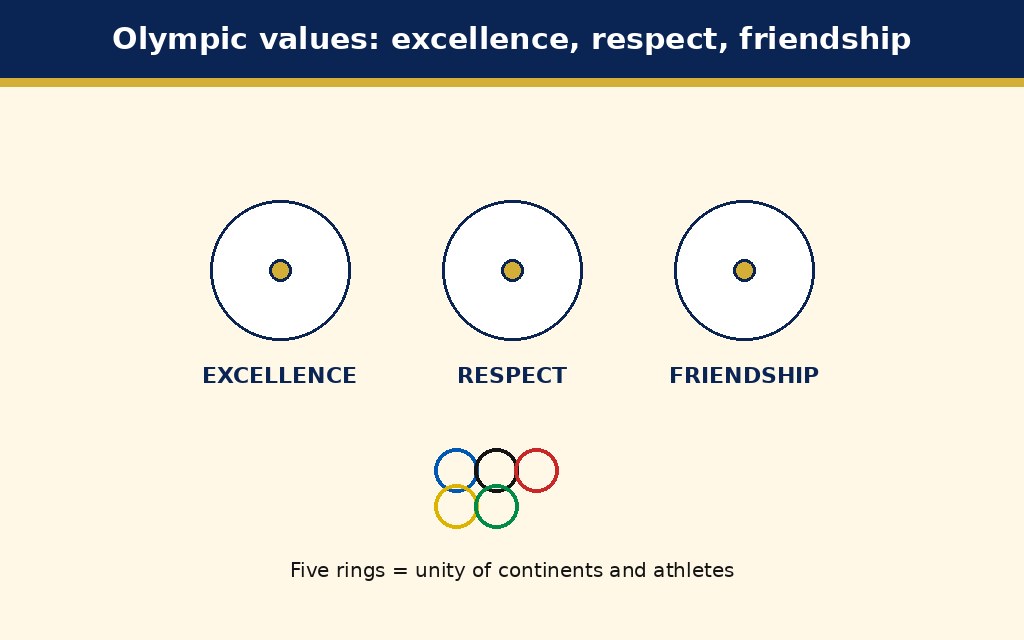
New labelled schematic (labels and gold dots are printed on the image): Three Olympic values
What the chapter is about
The Olympic Movement is built on three core values: excellence, friendship and respect. Excellence means giving your best, not necessarily winning. Friendship means building bonds across countries. Respect means honouring rules, opponents, officials and yourself.
Around these core values sit others: joy of effort, fair play, and balance of body, mind and willpower. Together they say sport is not only about medals — it is about becoming a better person through effort.
These values apply far beyond the Games. In a school match, excellence is trying hard, friendship is shaking hands after defeat, and respect is accepting the referee's decision gracefully.
What Olympism means
Olympism is presented in the chapter as a philosophy of life that combines sport, culture and education. Its goal is not medals alone but harmony, cooperation and personal excellence: sport becomes a way to build a better person and, through people, a more peaceful world. Pierre de Coubertin, founder of the modern Olympics, called sport the fourth branch of education, alongside science, art and morality — a line worth quoting in long answers.
The Olympic Movement works through three core values. Excellence means giving your best and improving yourself, not only beating others. Respect means fair play, respect for rules, opponents, officials and yourself. Friendship means building understanding across nations and cultures through shared sport. Around them sit supporting ideas the chapter names: solidarity, diversity, autonomy, good governance and sustainability — the 2025 edition of the movement's outlook stresses sustainability and equality strongly.
Values in real moments
The chapter proves values with moments, not slogans. In the 1936 Olympics, Jesse Owens, an African-American sprinter, won four gold medals despite facing racial discrimination at home and abroad — excellence and dignity under pressure. At the 2018 Winter Olympics, athletes from North and South Korea marched together under one flag — friendship and solidarity made visible.
The Olympic flag itself carries the message: five rings, first introduced in 1914 by Coubertin, stand for the unity of the world's continents and athletes. When a question asks how the three core values can be achieved by playing games, the answer is practical: train hard (excellence), follow rules and accept decisions (respect), and mix with players from other teams and cultures (friendship).
What you should learn
Olympism rests on excellence, friendship and respect, with fair play and joy of effort, and these values guide school sport too.
Key Terms
- Olympism — The philosophy of the Olympic Movement: sport for human development.
- Excellence — Giving your personal best.
- Friendship — Building bonds across teams and nations through sport.
- Respect — Honouring rules, opponents, officials and self.
- Fair play — Playing honestly, without cheating or bad behaviour.
Remember
- Core values: excellence, friendship, respect.
- Excellence means personal best, not only gold.
- Fair play and joy of effort support the core values.
- Olympic values apply to school games too.
Exam Tip / Common Mistake
Common mistake: thinking excellence means winning. An athlete who gives her best and loses still shows excellence.
Chart / Table: Olympic values in action
| Point | Detail |
|---|---|
| Excellence | Train hard, give your best |
| Friendship | Shake hands, learn from rivals |
| Respect | Accept decisions, honour opponents |
| Fair play | No cheating, no foul tricks |
| Joy of effort | Enjoy trying, not only winning |
Olympism uses sport to teach a way of life: strive for excellence, practise respect, build friendship — and the flag's five rings remind every athlete that the contest is shared by the whole world.
Practice set — try it yourself
- Give one school-match example for each core value.
Hint: Hint: Best effort, handshake, accepting a decision. - Why is respect for opponents important?
Hint: Hint: Think about what sport without opponents would be. - Is a player who cheats and wins excellent? Why not?
Hint: Hint: Think fair play. - Make an 'Olympic values tree' poster for your class.
Hint: Hint: Trunk Olympism, branches values. - How can you show joy of effort after losing?
Hint: Hint: Think about what you learned and enjoyed.
Questions with Answers
- What are the three core Olympic values?
Excellence, friendship and respect. They are the heart of Olympism, the philosophy behind the Olympic Games. - What does excellence mean in Olympism?
Giving your personal best and striving to improve, not necessarily winning a medal. - How is friendship shown through sport?
When athletes from different countries compete, share and respect one another, sport builds friendships across borders. - What is fair play?
Playing honestly by the rules, without cheating, foul play or disrespect toward opponents and officials. - Give a school example of respect in sport.
Accepting a referee's decision without arguing, and congratulating the winning team after a match.
Questions with Answers — Extension
- How is excellence different from winning?
Excellence is giving your personal best and improving; winning depends on others too. An athlete can lose yet show excellence, and win without it. - What did Jesse Owens' four gold medals in 1936 demonstrate beyond speed?
Excellence and dignity under racial discrimination — the Olympic value that performance and character answer prejudice better than words. - Why did the joint Korean march at the 2018 Winter Olympics matter to Olympism?
Because it showed friendship and solidarity in action: athletes from hostile states sharing one flag, which is exactly what the movement claims sport can do. - A player argues with every referee decision. Which value is missing, and what behaviour would show it?
Respect: accepting decisions gracefully, following rules and respecting officials and opponents would show it. - What do the five rings symbolise, and when were they introduced?
The unity of the world's continents and athletes, coming together in sport; introduced in 1914 by Pierre de Coubertin.
How to use this page: Read the summary, say the Key Terms in your own words, then try the practice set without looking. Use the Questions with Answers to check yourself afterwards. Ask your teacher or parent to check your answers.