

Chapter 4: The Colonial Era in India
European powers came for wealth — and stayed to rule. How did they do it, and how did Indians resist?
Original notes — ready CBSE (NCERT, English Medium) • Class 8 • Social Science • Book: Exploring Society: India and Beyond • Part I
Chapter 4: The Colonial Era in India — EG's own notes, in simple words
Book: Exploring Society: India and Beyond (CBSE, Class 8) | Chapter 4 | Part I | Medium: English
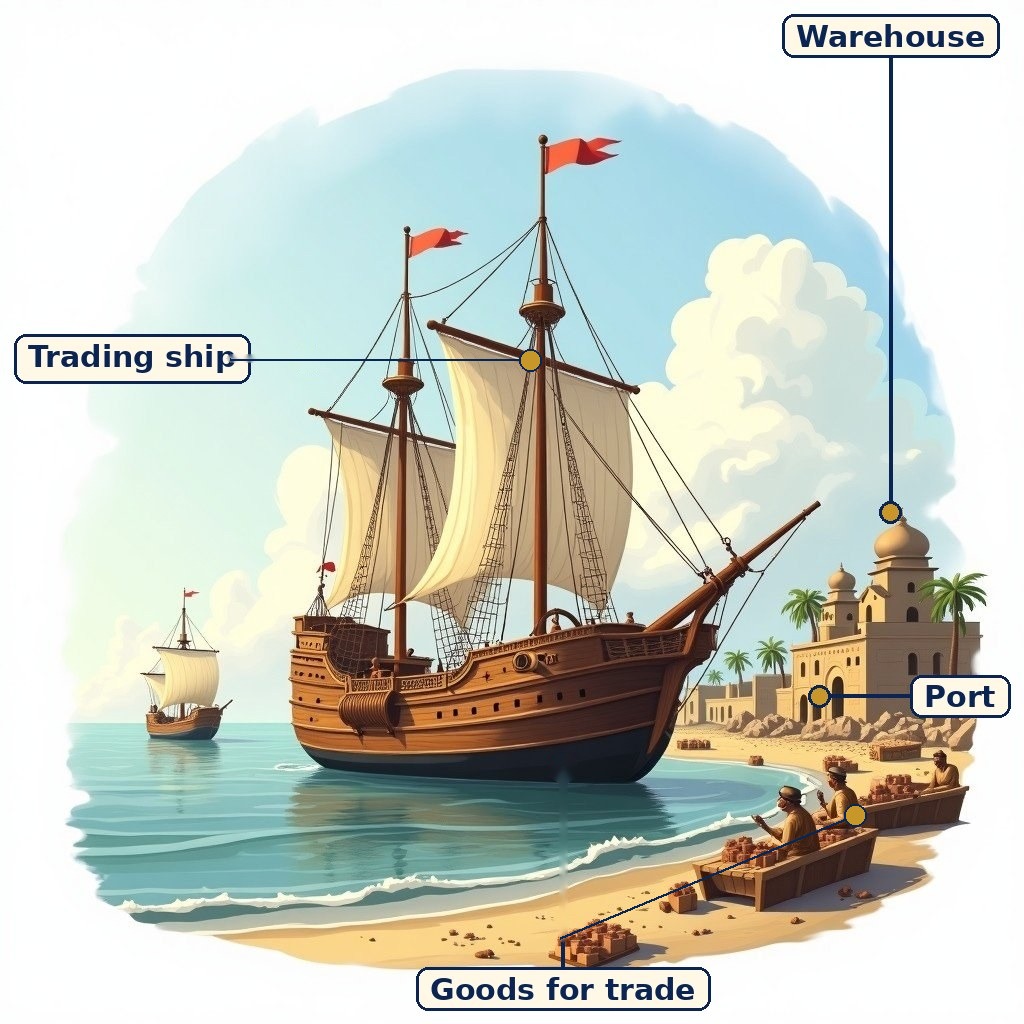
Diagram (labels are printed on the image): European trading ships at an Indian port. A general picture of early trade, not one particular event.
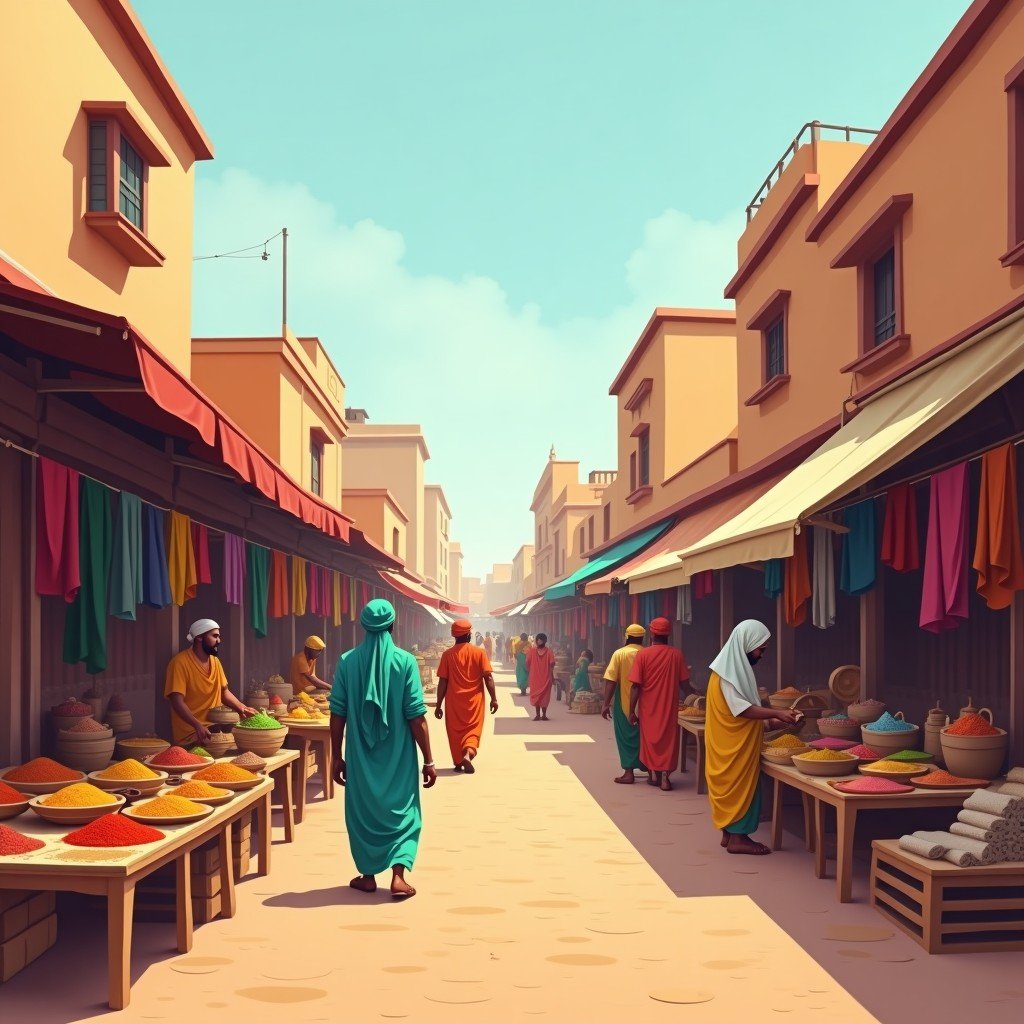
Indian weavers and traders made goods that were wanted all over the world.
What the chapter is about
The age of colonialism: who came, and why
The Portuguese, the Dutch, the French and the British were attracted to India primarily because of her great wealth. They came first as traders, then fought among themselves for dominance of the subcontinent, and the British eventually gained the upper hand. Colonialism, in this chapter's sense, means not just trading with a place but controlling its politics, economy and society for the benefit of the colonising power.
The Portuguese and the French: different styles
The Portuguese focused on religious conversion and cultural transformation in Goa, which created long-lasting social divisions there. The French policy of assimilation in Pondicherry created a small elite of culturally French Indians. These different styles matter for comparison: the British approach — large-scale territorial rule through a trading company that became a government — differed from both.
How British rule hurt India: tax, famine and deindustrialisation
British ruthless taxation policy inflicted great misery on the people, causing severe famines in particular and millions of deaths. At the same time, the deliberate deindustrialisation of India devastated her once-thriving manufacturing sector: Indian weavers and artisans, whose goods had been wanted across the world, lost markets to machine-made imports. Gradually, the British also imposed their administrative structures, legal systems and educational institutions to ensure total colonial control over Indian society.
'Indians funded their own subjugation' — and divide and rule
The chapter uses a sharp phrase: Indians funded their own subjugation. It means that projects like the railways and telegraph — built with Indian taxes and Indian labour — mainly served British control, troop movement and trade, while Indians paid for them. 'Divide and rule' worked alongside this: by favouring some communities over others and playing groups against each other, the British made united resistance harder. The chapter's exercise asks you to find examples of divide and rule in British India and explain them.
Education transformed — and culture flowed back west
India had diverse educational traditions — pathshalas, madrasas and other local institutions — before colonial rule. The British transformed education to serve their administration, teaching in English and creating a class of Indians trained for government jobs. Yet influence also flowed the other way: in the 19th century, India's classical culture — in particular through translated Sanskrit texts — reached the West and left a lasting influence there.
Resistance: from early uprisings to 1857
Resistance did not begin in 1857. Several uprisings took place from the late 18th century onward, including the Sannyasi–Fakir rebellion, tribal and peasant movements, and princely resistance. The Great Rebellion of 1857 threatened colonial rule for a while, with leaders such as Rani Lakshmibai at Jhansi at its centre, but most uprisings were brutally repressed. The chapter also names Dadabhai Naoroji, whose work exposed how wealth was drained from India, as a figure to discuss against a British official in role-play.
What you should learn
European powers came for India's wealth; the British won the contest among them, taxed heavily, deindustrialised Indian manufacturing, imposed their administration, law and education, and faced resistance from the late 1700s through the Great Rebellion of 1857.
Key Terms
- Colonialism — Control of one country by another for the coloniser's benefit — through politics, economy, law and culture, not just trade.
- Deindustrialisation — The deliberate destruction of a country's manufacturing sector — in India, the ruin of once-thriving weaving and crafts under colonial imports and policy.
- Divide and rule — A colonial tactic of favouring some communities over others so that united opposition becomes harder.
- Assimilation — The French policy (notably in Pondicherry) of turning a small elite of Indians culturally French.
- Great Rebellion of 1857 — The large uprising against British rule that threatened colonial control for a while before being brutally repressed.
- Drain of wealth — The transfer of India's wealth to Britain, analysed by Dadabhai Naoroji among others.
Remember
- Four European powers competed; the British gained the upper hand.
- Taxation caused misery and famines; deindustrialisation ruined manufacturing.
- Railways and telegraphs were paid for largely by Indians but served British control.
- Portuguese Goa: conversion and cultural transformation; French Pondicherry: assimilation.
- Resistance ran from the late 1700s to 1857 — it was not a single event.
Exam Tip / Common Mistake
Common mistake: saying the British 'developed' India by building railways, without asking who paid and who benefited. A strong answer names both sides: the infrastructure existed, but it was funded by Indian taxes and labour and served colonial control and trade first.
The chapter's first exercise asks for three definitions from the chapter or your own knowledge. Try: (1) political control by a foreign power, (2) economic exploitation for the coloniser's benefit, (3) cultural domination through law, education and administration. One definition alone is too thin.
Colonial rulers claimed they came to 'civilise' the people they ruled. Test that claim against the chapter's evidence — taxation, famines, deindustrialisation, repression of uprisings — and judge it, rather than repeating the claim.
Chart / Table: European powers in India — different approaches
| Point | Detail |
|---|---|
| Portuguese | Came for wealth and trade; in Goa, focused on religious conversion and cultural transformation, creating long-lasting social divisions. |
| Dutch | Traded and competed for dominance; lost ground to the British. |
| French | Colonial ambitions in India; policy of assimilation created a small culturally French elite in Pondicherry. |
| British | Won the contest; territorial rule through the Company, then the Crown; heavy taxation, deindustrialisation, imposed administration, law and education. |
| Indian response | Uprisings from the late 18th century onward; the Great Rebellion of 1857; thinkers like Dadabhai Naoroji exposed the drain of wealth. |
| Cultural flow back | Translated Sanskrit texts carried India's classical culture to the West in the 19th century, with lasting influence. |
Practice set — try it yourself
- What is colonialism? Give three different definitions.
Hint: Think about political, economic and cultural control — not just trade. - Did the British 'civilising mission' hold true in India? Use chapter evidence.
Hint: Weigh taxation, famines, deindustrialisation and repression against any benefits claimed. - How was the British approach different from the Portuguese or French approach?
Hint: Compare scale (territorial rule vs coastal/assimilation policies) and methods. - What does 'Indians funded their own subjugation' mean for railways and telegraphs?
Hint: Think about who paid, who built, and who benefited most. - Choose one area of Indian life (agriculture, education, trade or village life) and trace colonial change into today.
Hint: Look for signs that still survive — in language, law, markets or schooling.
Questions with Answers
- Why were European powers attracted to India?
Primarily because of India's great wealth — its manufactures, especially textiles, its trade goods and its markets. They fought among themselves for dominance, and the British eventually gained the upper hand. - How did British taxation and economic policy harm India?
Ruthless taxation inflicted great misery and caused severe famines with millions of deaths. Deliberate deindustrialisation devastated once-thriving manufacturing, as Indian weavers and artisans lost their markets to machine-made imports. - What does 'divide and rule' mean, with an Indian example?
It means a ruler keeps control by favouring some communities over others and setting groups against each other, so united resistance becomes harder. In British India this appeared in policies that treated communities differently and rewarded loyalty to the rulers over unity among Indians. - How did the British ensure total colonial control?
Beyond armies and taxes, they imposed their own administrative structures, legal systems and educational institutions on Indian society, reshaping how India was governed, judged and schooled. - Was resistance to colonial rule limited to 1857?
No. Several uprisings took place from the late 18th century onward — including the Sannyasi–Fakir rebellion and tribal, peasant and princely movements — and the Great Rebellion of 1857, with leaders like Rani Lakshmibai at Jhansi, threatened colonial rule for a while before most uprisings were brutally repressed.
Extension Questions with Answers
- Timeline question: arrange — European traders arrive, British gain the upper hand among Europeans, Sannyasi–Fakir rebellion, Great Rebellion of 1857.
Order: traders arrive first, then the contest among Europeans with the British gaining the upper hand, then late-18th-century uprisings such as the Sannyasi–Fakir rebellion, then the Great Rebellion of 1857. - Case-based: you are a reporter in 1857 covering Rani Lakshmibai's resistance at Jhansi. What would your timeline include?
How the rebellion began, how it spread, who led it, how the British responded, and how it ended — plus, as the chapter asks, how the event is remembered today in songs, monuments or local memory. - What signs of colonial change can still be seen today?
In education (English-medium schooling and examination systems), in law and administration (structures introduced under colonial rule), and in trade patterns — the chapter's exercise asks you to find one such sign and present it as an essay, poem, drawing or painting. - Role-play preparation: a British official debates Dadabhai Naoroji. What would each side argue?
The official would argue that British rule brought order, railways and modern institutions; Naoroji would argue that wealth was being drained from India and that Indians paid for their own subjugation. The debate tests evidence, not slogans. - Assertion–Reason: Assertion — The railways developed India. Reason — Railways were built with Indian taxes and labour mainly to serve British control and trade. Judge both and the link.
The first statement is incomplete rather than simply true or false: railways did create transport, but the reason shows whose interests they served first and who paid — so 'development for Indians' cannot be asserted without that qualification. - Why did India's classical culture influence the West in the 19th century?
Because translated Sanskrit texts carried Indian philosophy, literature and knowledge to European readers, creating a lasting influence even while India itself was under colonial rule — influence flowed both ways. - How did Portuguese rule in Goa differ from French rule in Pondicherry?
The Portuguese stressed religious conversion and cultural transformation, creating long-lasting social divisions; the French stressed assimilation, creating a small elite of culturally French Indians. - If India had never been colonised, how might it have developed? (Imagination task — do not present as fact)
The chapter asks for a short story of about 300 words imagining India's own path. A good answer keeps what India already had — manufacturing, trade, learning traditions — and imagines them developing without colonial extraction, while admitting this is imagination, not history.
- Wealth drew the Portuguese, Dutch, French and British; the British won.
- Taxation → misery and famines; deindustrialisation → ruined manufactures.
- Indians paid for railways and telegraphs that served British control.
- Divide and rule made united resistance harder.
- Resistance ran from the late 1700s to 1857; culture also flowed west.
How to use this page: Read the summary, say the Key Terms in your own words, then try the practice set without looking. Use the Questions with Answers to check yourself afterwards. Ask your teacher or parent to check your answers.