

Chapter 5: Universal Franchise and India's Electoral System
Every adult citizen's vote counts equally — how did India achieve that, and how do its elections actually work?
Original notes — ready CBSE (NCERT, English Medium) • Class 8 • Social Science • Book: Exploring Society: India and Beyond • Part I
Chapter 5: Universal Franchise and India's Electoral System — EG's own notes, in simple words
Book: Exploring Society: India and Beyond (CBSE, Class 8) | Chapter 5 | Part I | Medium: English
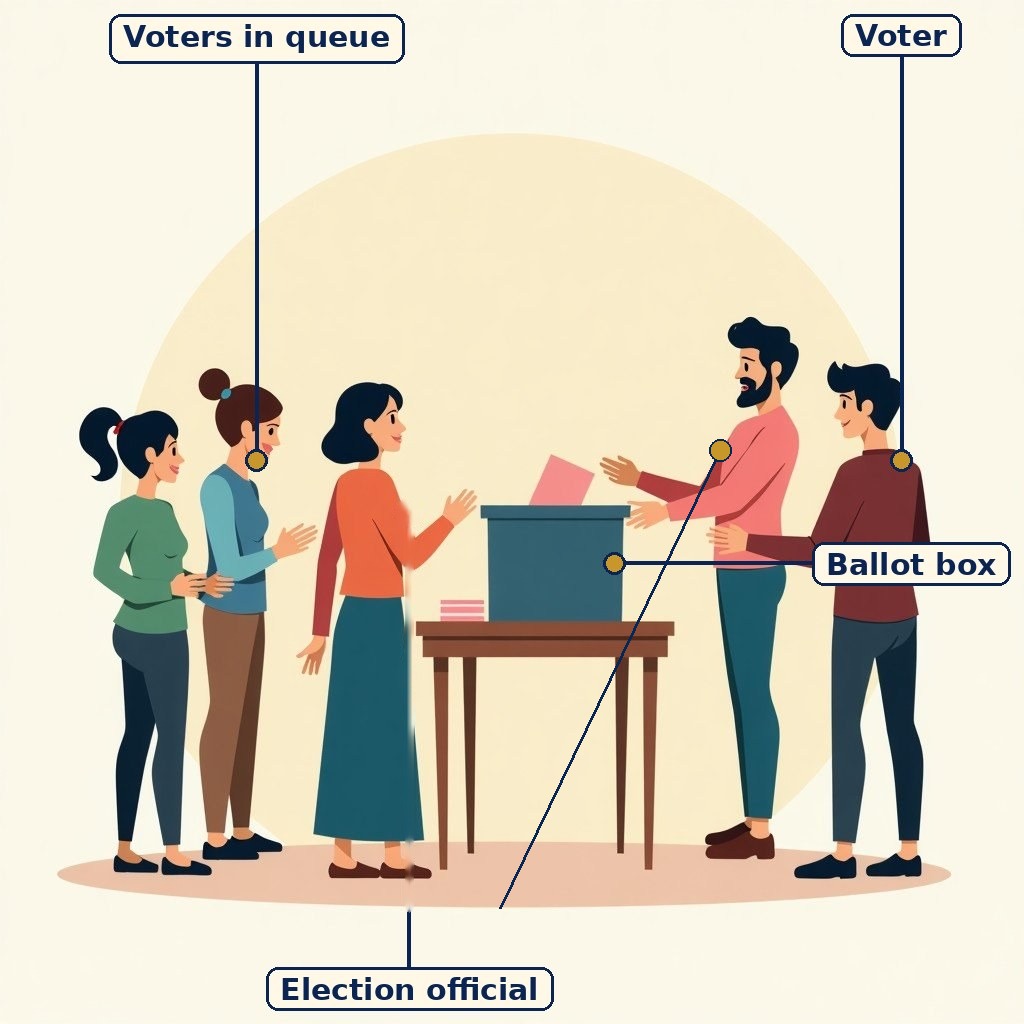
Diagram (labels are printed on the image): A polling station on election day. A general picture of voting in India, not one particular election.
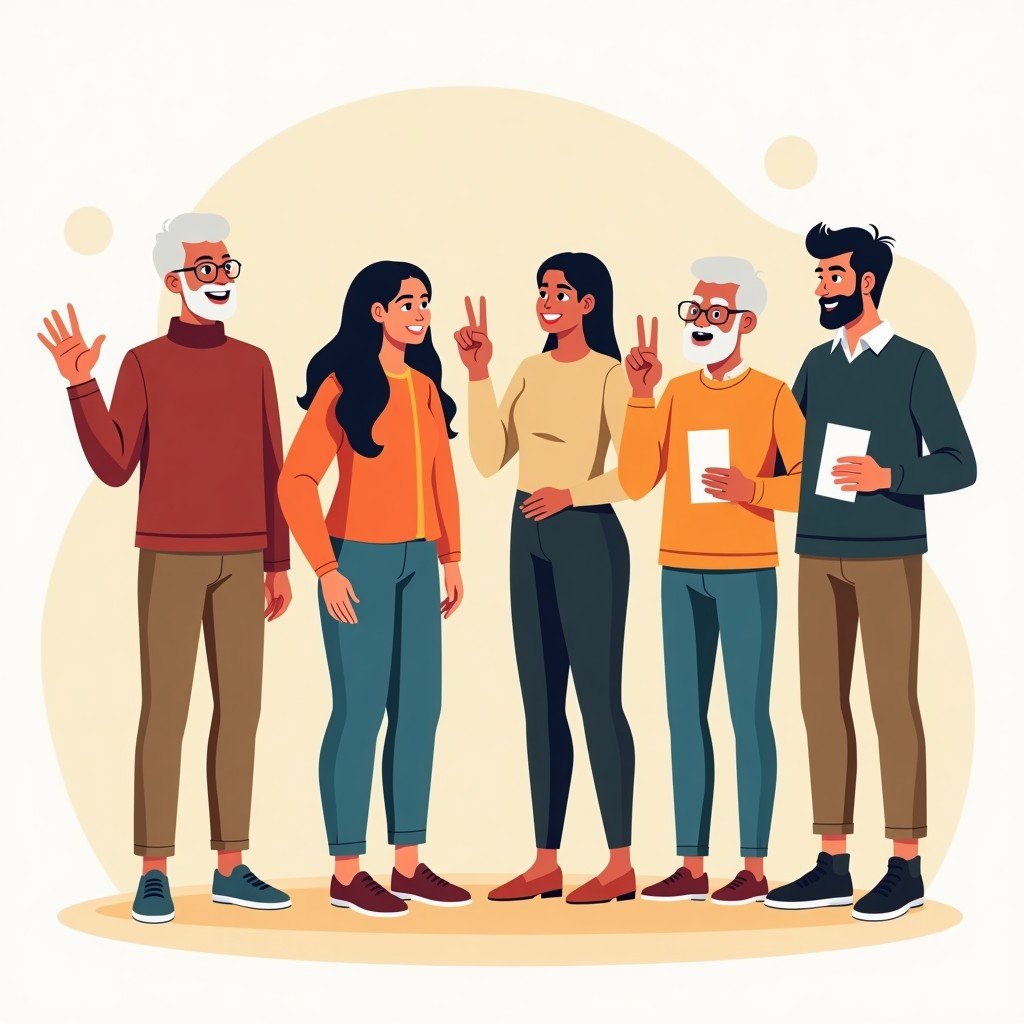
Every adult citizen's vote counts equally, whatever their background.
What the chapter is about
Universal adult franchise: a bold experiment
Universal adult franchise means every adult citizen can vote, whatever their caste, religion, gender, wealth or education. Before independence, only 13 per cent of Indians were entitled to vote. When independent India adopted adult franchise, it was, in the words of Alladi Krishnaswami Ayyar in the Constituent Assembly debates of November 1949, an experiment undertaken 'with an abundant faith in the common man' — never before had so large a population been given the vote at once. Elsewhere the struggle was long: women in the United States marched for suffrage in 1913, and Switzerland gave women the vote only in 1971.
Why franchise matters
Franchise is the cornerstone of Indian democracy because it makes government answerable to all, not only to the rich or powerful. It gives every citizen an equal say, encourages leaders to seek support across communities, and makes the right to vote also a responsibility: voters need awareness to use it well, and the chapter stresses that participation of all eligible voters must be facilitated, not just declared.
The Election Commission of India
The Election Commission of India (ECI) is the constitutional body that conducts elections in the country. It was established in 1950 and oversees elections to the Lok Sabha, Rajya Sabha, State Legislative Assemblies, and the offices of the President and Vice President. Under Chief Election Commissioner T. N. Seshan, who took office in 1990, the Commission became far more assertive in enforcing rules. The Model Code of Conduct — rules for fair campaigning — was first adopted in Kerala in 1960, circulated to parties during the 1962 general elections, and from 1991 the ECI enforced it proactively.
How voting works: Lok Sabha, Rajya Sabha, President
India follows a parliamentary system, so elections work at several levels. Members of the Lok Sabha are elected directly by the people. Members of the Rajya Sabha are elected indirectly, by the elected members of State Legislative Assemblies. The President is elected indirectly by an electoral college of MPs and MLAs, and the Vice President similarly. Voting is by secret ballot, so no one can be forced to reveal their choice — a protection that matters precisely because voters may face pressure from family, employers or local strongmen. Electronic Voting Machines (EVMs) have replaced paper ballots in most elections; the chapter asks you to weigh their advantages, such as speed, accuracy and reduced invalid votes, against concerns you can discuss.
The scale of Indian elections — and their challenges
Indian elections are celebrated as the world's largest democratic exercise. The 2024 Lok Sabha elections showed the scale: crores of voters, lakhs of polling stations, and, for the first time, home voting for the elderly and people with disabilities, with postal voting for specific categories. The first voter of independent India's 1951 general election was Shyam Saran Negi, a schoolteacher in Himachal Pradesh, who cast his vote again in 2017 at the age of 100. Challenges remain, and the chapter names them plainly: the growing influence of money in elections, a significant proportion of candidates with criminal records, and voter apathy, particularly in urban areas, where turnout has been declining.
What you should learn
Universal adult franchise gives every adult Indian an equal vote; the Election Commission (established 1950) runs elections at all levels; Lok Sabha members are elected directly, Rajya Sabha members and the President indirectly; and money, criminal candidates and urban apathy are live challenges.
Key Terms
- Universal adult franchise — The right of every adult citizen to vote, regardless of caste, religion, gender, wealth or education.
- Secret ballot — A voting method in which no one can see how an individual voted, protecting voters from pressure.
- Direct election — An election in which voters choose the representative themselves, as for the Lok Sabha.
- Indirect election — An election in which elected representatives choose the office-holder, as for the Rajya Sabha and the President.
- Election Commission of India (ECI) — The constitutional body, established in 1950, that conducts elections in India.
- Model Code of Conduct — Rules for fair campaigning, first adopted in Kerala in 1960 and enforced proactively by the ECI from 1991.
- Voter apathy — Lack of interest in voting, seen in declining turnout in some urban areas.
Remember
- Before independence only 13% of Indians could vote; independent India gave the vote to all adults at once.
- ECI established 1950; oversees Lok Sabha, Rajya Sabha, Assembly, President and Vice President elections.
- Lok Sabha: direct election. Rajya Sabha: indirect, by MLAs. President: indirect, by MPs and MLAs.
- Secret ballot protects voters from pressure.
- First voter 1951: Shyam Saran Negi; he voted again in 2017 aged 100.
- Challenges: money power, candidates with criminal records, urban voter apathy.
Exam Tip / Common Mistake
Common mistake: saying Rajya Sabha members are elected directly by the people, or that the ECI only conducts Lok Sabha elections. In answers, list the levels separately: direct for Lok Sabha, indirect for Rajya Sabha and President, and ECI for all of them.
A proportion of Lok Sabha seats is reserved for Scheduled Castes and Scheduled Tribes. The chapter asks you to write a short note on why: because groups historically denied power need guaranteed representation for democracy to be genuinely equal, not only formally equal.
If turnout falls in cities, the voices that decide elections skew away from city residents. The chapter asks for reasons (busy lives, migration, belief that one vote does not matter) and steps (awareness drives, easier voting, home voting for those who need it).
Chart / Table: Elections in India — who elects whom
| Point | Detail |
|---|---|
| Lok Sabha | Direct election by all adult voters in each constituency. |
| Rajya Sabha | Indirect election by elected members of State Legislative Assemblies. |
| State Legislative Assembly | Direct election by voters of the state. |
| President of India | Indirect election by an electoral college of MPs and MLAs. |
| Vice President | Indirect election by members of both Houses of Parliament. |
| Conducted by | Election Commission of India (established 1950), enforcing the Model Code of Conduct. |
Practice set — try it yourself
- Why is universal adult franchise important for a healthy democracy?
Hint: Think about equality, accountability and whose interests leaders must serve. - What is a secret ballot, and why does it matter?
Hint: Think about pressure from family, employers or local strongmen. - Give examples of direct and indirect elections in India.
Hint: Think Lok Sabha vs Rajya Sabha and President. - How is election to the Lok Sabha different from election to the Rajya Sabha?
Hint: Think about who votes, and for how long members serve. - What, in your view, are the advantages of the EVM over paper ballots?
Hint: Think about speed, counting accuracy and invalid votes — and note any concern honestly.
Questions with Answers
- What is universal adult franchise?
It is the right of every adult citizen to vote, regardless of caste, religion, gender, wealth or education. India adopted it at independence, when only 13 per cent of Indians had previously been entitled to vote. - Why is the secret ballot important?
Because it lets each voter choose freely without anyone knowing their choice. Without secrecy, voters could face pressure from family, employers or powerful local people, and the vote would stop being truly free. - How does the Election Commission ensure free and fair elections?
As a constitutional body established in 1950, the ECI conducts elections at every level and enforces rules such as the Model Code of Conduct, which it has applied proactively since 1991, so that campaigning stays fair. - How is the Lok Sabha election different from the Rajya Sabha election?
Lok Sabha members are elected directly by the people in each constituency. Rajya Sabha members are elected indirectly by the elected members of State Legislative Assemblies, so voters choose them through their MLAs, not directly. - What challenges does Indian democracy face in elections?
The chapter names three: the growing influence of money, a significant proportion of candidates with criminal records, and voter apathy, especially declining turnout in urban areas. All three call for voter vigilance and awareness.
Extension Questions with Answers
- Case-based: in 2024, elderly voters and people with disabilities could vote from home for the first time. Why does this matter for franchise?
Because franchise is only real if every eligible voter can actually reach the vote. Home voting removes a physical barrier, turning a formal right into a usable one — the same logic as the chapter's point that participation must be facilitated. - Assertion–Reason: Assertion — Universal franchise makes India a democracy. Reason — Every adult can vote. Judge both and the link.
Both are true, and the reason supports the assertion, but only partly: voting alone does not complete democracy — free campaigning, an independent Election Commission, and the secret ballot are also needed, which is why the chapter discusses them together. - Why are some Lok Sabha seats reserved for Scheduled Castes and Scheduled Tribes?
Because formal equality of the vote does not by itself guarantee that historically disadvantaged groups win representation. Reservation guarantees their presence in the legislature, making representation genuinely inclusive. - Why has urban voter turnout been declining, and what steps could raise it?
Reasons discussed in the chapter's exercise include busy urban lives, migration (voters living away from their registered constituency) and the feeling that one vote changes little. Steps: awareness campaigns, easier registration and voting, and facilities like home voting for those who need it. - How is social media changing elections — strengthening or confusing democracy?
Both, as the chapter's discussion question suggests: reels, live speeches and debates reach more voters quickly, but misinformation and noise can confuse them. The answer should weigh benefits against challenges, not pick one side blindly. - What did Shyam Saran Negi's story show about Indian democracy?
That the vote belonged to ordinary citizens from the start: a schoolteacher in Himachal Pradesh was independent India's first voter in 1951, and he kept voting into his hundredth year, in 2017. - What was the significance of T. N. Seshan's tenure from 1990?
Under Seshan the Election Commission became assertive in enforcing the Model Code of Conduct and election rules, showing that an independent constitutional body can strengthen democracy when it acts firmly. - Task — do not invent numbers: choose a parliamentary constituency and an assembly constituency in your state and compare their election results over two elections.
Use the results you actually find (the chapter suggests a results website and your teacher's help). Report what you found — turnout, winning margins, parties — and what changed between the two elections, without guessing figures.
- Universal adult franchise: every adult votes, equally.
- ECI (1950) runs all major elections and enforces the Model Code.
- Lok Sabha direct; Rajya Sabha and President indirect; secret ballot protects choice.
- 2024: home voting for elderly and disabled voters, first time.
- Challenges: money, criminal candidates, urban apathy — vigilance needed.
How to use this page: Read the summary, say the Key Terms in your own words, then try the practice set without looking. Use the Questions with Answers to check yourself afterwards. Ask your teacher or parent to check your answers.