

Chapter 3: The Rise of the Marathas
From a hill kingdom to a power that shaped India — forts, cavalry, navy and leaders who inspired confidence.
Original notes — ready CBSE (NCERT, English Medium) • Class 8 • Social Science • Book: Exploring Society: India and Beyond • Part I
Chapter 3: The Rise of the Marathas — EG's own notes, in simple words
Book: Exploring Society: India and Beyond (CBSE, Class 8) | Chapter 3 | Part I | Medium: English
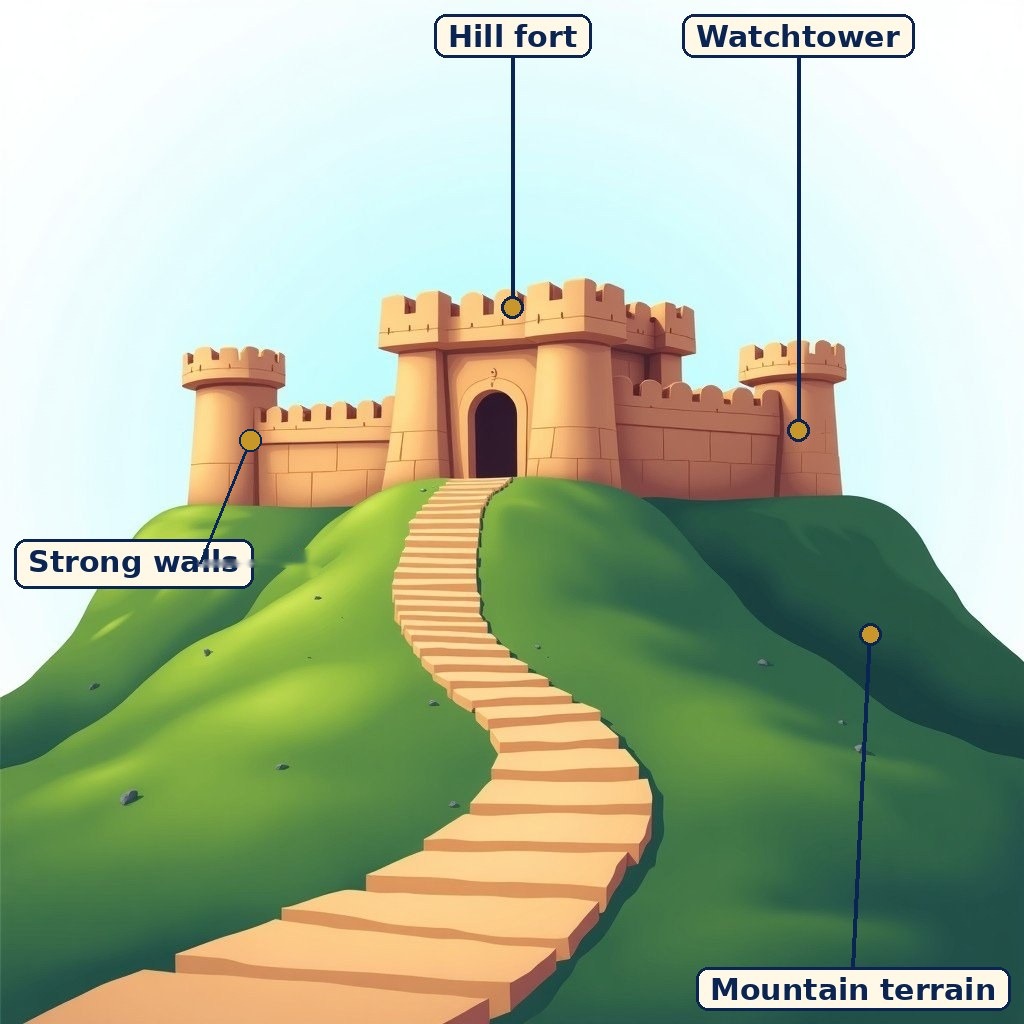
Diagram (labels are printed on the image): A hill fort of the kind the Marathas used for defence in the mountains. A general picture, not one particular fort.
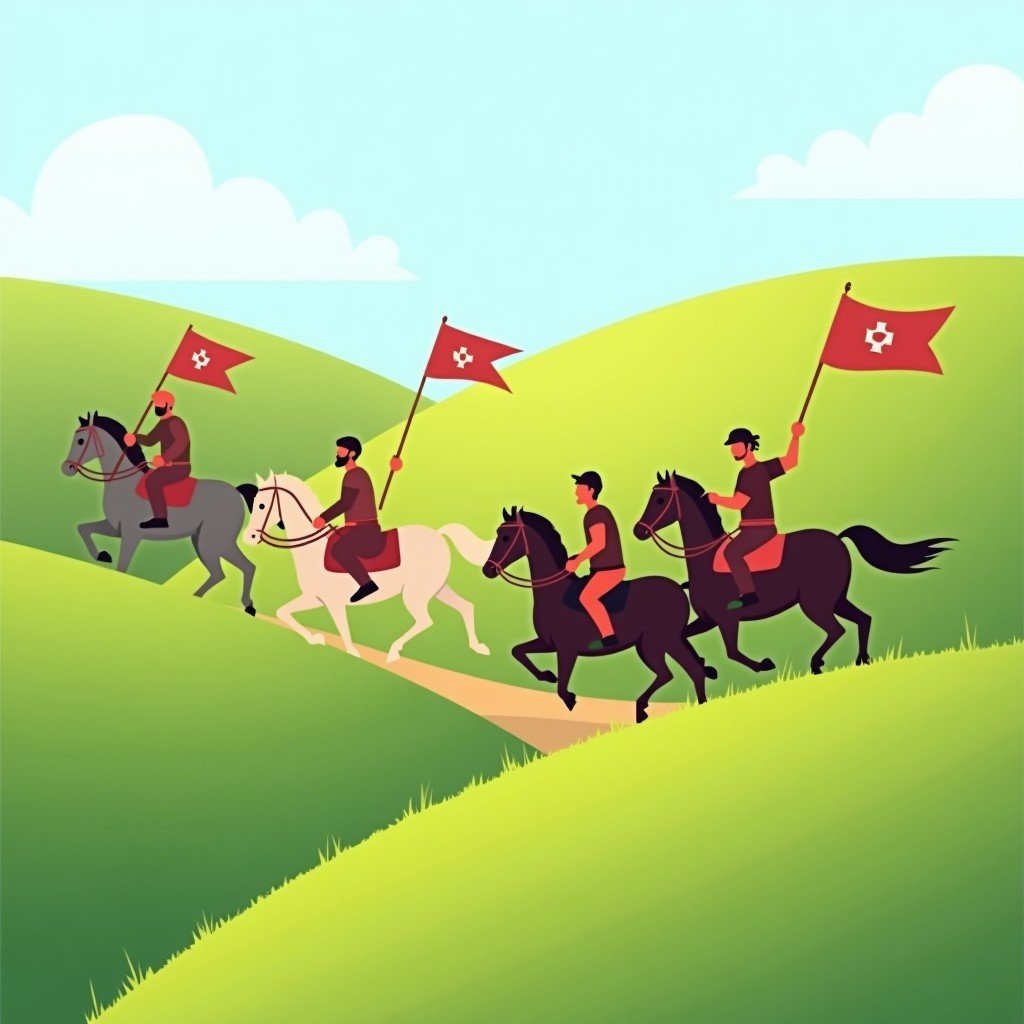
Swift cavalry in hilly country was a great strength of the Marathas.
What the chapter is about
Who were the Marathas?
The Marathas were a people native to the Deccan, in today's Maharashtra region. In the 17th century, under Shivaji, they built a kingdom that grew into a large empire. Geography shaped them from the start: mountains, hill forts and a long coastline gave them defence, speed and, later, sea power.
Shivaji and the foundation of Maratha power
Shivaji was born in 1630 in the Bhonsle clan, to Shahji and Jijabai. In 1674 he was crowned with full Vedic rites at the strong mountain fortress of Raigad, marking the formal beginning of the Maratha Empire — the grand entrance to the palace at Raigad is shown in the chapter's first figure. Shivaji died in 1680, and the years 1682–1707 then saw long Mughal–Maratha wars, which the Marathas survived.
Forts: the core of the state
For the Marathas, forts were not just military posts — the chapter calls them the core of the state. Hill forts such as Raigad, Pratapgad, Sindhudurg and Gingee guarded territory, stored supplies, sheltered people in war, and gave the Marathas bases from which swift cavalry could strike and retreat into the hills. Against larger enemies, forts plus mobility mattered more than matching the enemy army man for man.
After Shivaji: expansion, setback and recovery
After Shivaji, Maratha power kept expanding across large parts of India. They fought the Afghans and suffered a disastrous defeat at Panipat in 1761, yet recovered quickly under Peshwa Madhavrao I. Under Mahadji Shinde (also called Mahadji Scindia), they recaptured Delhi in 1771 and held it until the British captured it three decades later. Three Anglo-Maratha wars were fought between 1775 and 1818, and the chapter notes the striking claim that the British took India from the Marathas more than from the Mughals or any other power — because by then the Marathas, not the Mughals, were the dominant Indian power.
Maratha administration and the sea
Shivaji built an administration that collected revenue, paid soldiers and officials, and even gave pensions — the chapter notes pensions for soldiers' families among its features. At sea, the Marathas built a formidable navy under leaders like Kanhoji Angre, which resisted European naval supremacy for quite some time despite lacking the latest technology of the time. The chapter also notes Maratha military technology: rockets were used from Shivaji's days, and by 1770 metal-tube rockets were in use.
Maratha women, culture and legacy
Maratha women played leading roles: Tarabai was a fearless leader who preserved Maratha power in difficult years, and Ahilyabai Holkar is remembered as an able and respected ruler. Other leaders the chapter names for biography work are Kanhoji Angre, Bajirao I and Mahadji Shinde. The Marathas challenged Mughal dominance, inspired a new cultural confidence among Indians in several regions, and contributed to cultural revival and innovation. On religion, the chapter asks you to compare Shivaji's treatment of religious places and people of different faiths with that of later Marathas, using evidence from the chapter rather than general praise or blame.
What you should learn
Shivaji founded the Maratha kingdom in 1674 from hill forts; forts, cavalry and a navy made the Marathas a great power; after Panipat (1761) they recovered, held Delhi from 1771, and were the power from whom the British ultimately took India.
Key Terms
- Marathas — A people native to the Deccan who, under Shivaji and his successors, built a kingdom and then a large empire.
- Chhatrapati — The title of the Maratha king, used for Shivaji after his coronation at Raigad in 1674.
- Peshwa — The Maratha chief minister; under the Peshwas, Maratha power expanded widely across India.
- Hill fort — A fort built on a mountain, used by the Marathas for defence, storage, shelter and as a base for swift attacks.
- Anglo-Maratha wars — The three wars fought between the Marathas and the British between 1775 and 1818.
- Cultural confidence — The renewed pride and creativity the Marathas inspired among Indians in several regions.
Remember
- Shivaji: born 1630, crowned at Raigad 1674, died 1680.
- Mughal–Maratha wars lasted 1682–1707; the Marathas survived them.
- Panipat 1761 was a disaster, but recovery under Madhavrao I was quick.
- Mahadji Shinde recaptured Delhi in 1771; Anglo-Maratha wars ran 1775–1818.
- Forts were the core of the Maratha state, not an afterthought.
Exam Tip / Common Mistake
Common mistake: writing only about Shivaji and stopping in 1680. Half the chapter is what happened after him — expansion, Panipat, recovery, Delhi, and the wars with the British. An answer on 'the Marathas' must go beyond Shivaji.
Mountains gave forts and hiding places; the coastline gave a navy; open country gave cavalry room to move fast. Whenever a question asks 'why were the Marathas successful?', start from geography, then add leadership and administration.
'The British took India from the Marathas more than from the Mughals' is the chapter's argument, not a slogan. Support it with evidence: Maratha dominance by the late 1700s, Delhi under Mahadji Shinde from 1771, and three Anglo-Maratha wars.
Chart / Table: Maratha timeline — the dates to hold
| Point | Detail |
|---|---|
| 1630 | Shivaji born (Bhonsle clan, to Shahji and Jijabai). |
| 1674 | Shivaji crowned at Raigad with full Vedic rites; formal beginning of the Maratha Empire. |
| 1680 / 1682–1707 | Death of Shivaji; long Mughal–Maratha wars, which the Marathas survived. |
| 1761 | Disastrous Maratha defeat at Panipat against the Afghans; quick recovery under Madhavrao I. |
| 1771 | Mahadji Shinde recaptures Delhi; Marathas hold it for about three decades. |
| 1775–1818 | Three Anglo-Maratha wars against the British. |
Practice set — try it yourself
- Analyse how geography (mountains and coastlines) guided Maratha military strategy.
Hint: Think about forts, cavalry movement and the navy separately. - Why were forts called 'the core of the state' for the Marathas?
Hint: Think about defence, storage, shelter and bases for attack — not just walls. - Choose one Maratha leader (Kanhoji Angre, Bajirao I, Mahadji Shinde, Ahilyabai Holkar or Tarabai) and note one challenge they overcame.
Hint: Pick the challenge first, then the achievement — a biography needs both. - What does 'the British took India from the Marathas more than from the Mughals' mean?
Hint: Think about who was actually dominant in India in the late 1700s. - If you could visit Raigad, Sindhudurg, Gingee or Pratapgad, which would you choose and why?
Hint: Weigh history, architecture and strategic position — and say which matters most to you.
Questions with Answers
- How did Shivaji found the Maratha kingdom?
Born in 1630 in the Bhonsle clan, Shivaji built power from hill forts in the Deccan and was crowned with full Vedic rites at Raigad in 1674, marking the formal beginning of the Maratha Empire. - Why were forts so important to the Marathas?
Forts were the core of their state: they guarded territory, stored supplies, sheltered people during war, and served as bases from which swift cavalry could strike and retreat into the hills. Against larger enemies, this fort-and-mobility system let a smaller power survive. - What happened to Maratha power after Shivaji?
It expanded widely, suffered a disastrous defeat at Panipat in 1761, recovered quickly under Peshwa Madhavrao I, and under Mahadji Shinde recaptured Delhi in 1771. Three Anglo-Maratha wars (1775–1818) then decided the contest with the British. - What was the Maratha contribution at sea?
Under leaders such as Kanhoji Angre, the Marathas built a formidable navy that resisted European naval supremacy for quite some time, even without the latest technology of the time. - What was the Marathas' wider legacy?
They challenged Mughal dominance, held Delhi in the late 1700s, inspired new cultural confidence among Indians in several regions, and contributed to cultural revival and innovation — and, in the chapter's argument, were the power from whom the British ultimately took India.
Extension Questions with Answers
- Timeline question: place these in order — Shivaji's coronation, the Mughal–Maratha wars, Panipat, Mahadji Shinde's recapture of Delhi, the Anglo-Maratha wars.
Order: coronation 1674 → Mughal–Maratha wars 1682–1707 → Panipat 1761 → Delhi recaptured 1771 → Anglo-Maratha wars 1775–1818. - Map question: mark Raigad, Sindhudurg, Gingee and Pratapgad on a blank map and write one strategic fact about each.
Raigad — coronation capital and mountain fortress; Sindhudurg — sea fort on the coast; Gingee — strong southern fort; Pratapgad — hill fort in the mountains. The task tests location plus function, not just names. - Compare how Shivaji and later Marathas treated religious places and people of different faiths. What evidence would you use?
Use chapter evidence for both periods rather than a single sweeping claim: look for treatment of religious places, appointments and protection of diverse communities under Shivaji, then check whether later rulers matched that pattern. - Case-based: you are designing a Maratha coin. Which three symbols would you choose, and what would each stand for?
A fort (defence and the state), a swift horseman (cavalry and mobility), and a ship or anchor (sea power). The chapter's exercise asks you to explain your symbols, so the explanation matters as much as the design. - Why did the Marathas recover so quickly after Panipat (1761)?
Because their strength lay in a system — forts, cavalry, regional bases and administration — rather than in one army or one leader, so a single battlefield defeat, however disastrous, did not destroy the state. - Assertion–Reason: Assertion — Forts were the core of the Maratha state. Reason — Forts only protected the king's palace. Judge both and the link.
The assertion is true, but the reason is false and does not explain it: forts guarded territory, stored supplies, sheltered people and served as military bases, far beyond protecting one palace. - What was the most important Maratha contribution to Indian history, in your judgement, with evidence?
This is an opinion question with evidence: argue from the chapter — for example, challenging Mughal dominance, building a durable state system, sea power, or inspiring cultural confidence — and support your choice with at least two chapter facts. - How did Maratha women shape the empire's story?
Tarabai preserved Maratha power as a fearless leader in crisis years, and Ahilyabai Holkar ruled ably and is remembered with respect — showing that leadership in the Maratha state was not limited to kings and generals.
- Shivaji (1630–1680), crowned at Raigad 1674.
- Forts = core of the state; cavalry + navy = mobility and sea power.
- Survived Mughal–Maratha wars 1682–1707.
- Panipat 1761 → recovery → Delhi 1771 → Anglo-Maratha wars 1775–1818.
- Legacy: challenged Mughal dominance, inspired cultural confidence.
Going deeper — Chapter 3: The Rise of the Marathas
At the centre of this chapter are a few ideas that everything else hangs on: Marathas, Chhatrapati, Peshwa, Hill fort. If you can explain those ideas in your own words without looking at the notes, you already hold the chapter's spine. Everything else on this page — the examples, the tables and the questions — is there to help you practise using those ideas, not to be memorised as separate facts.
Read the chapter in this order. First, read the summary slowly and ask yourself what question the chapter is answering. Then work through each section one at a time and, after each one, close the page and say its main point in two lines. The sections of this chapter are: What the chapter is about; Who were the Marathas?; Shivaji and the foundation of Maratha power; Forts: the core of the state; After Shivaji: expansion, setback and recovery; Maratha administration and the sea. Each section adds one layer: an earlier section gives you the words and tools, and a later section shows you where those tools are used. When you revise, do not re-read passively — explain each section aloud as if you were teaching a classmate who missed the lesson.
In social science answers, build a chain: cause, event, consequence, conclusion. Use subject terms exactly, give dates and places only when you are sure of them, and end with a one-line conclusion that answers the question directly instead of trailing off.
Important Questions with Answers — deepening set
These questions go beyond the sets above. Try each one without looking, then check your answer against the notes.
- What does 'Marathas' mean? Explain it in your own words and say how it is used in this chapter.
A people native to the Deccan who, under Shivaji and his successors, built a kingdom and then a large empire. In this chapter, Marathas is one of the ideas you must be able to use, not just define. When a question mentions Marathas, first write its meaning in one line, then apply it to the situation in the question. That two-step habit — meaning first, application second — is what turns a definition into marks. - What does 'Chhatrapati' mean? Explain it in your own words and say how it is used in this chapter.
The title of the Maratha king, used for Shivaji after his coronation at Raigad in 1674. In this chapter, Chhatrapati is one of the ideas you must be able to use, not just define. When a question mentions Chhatrapati, first write its meaning in one line, then apply it to the situation in the question. That two-step habit — meaning first, application second — is what turns a definition into marks. - What does 'Peshwa' mean? Explain it in your own words and say how it is used in this chapter.
The Maratha chief minister; under the Peshwas, Maratha power expanded widely across India. In this chapter, Peshwa is one of the ideas you must be able to use, not just define. When a question mentions Peshwa, first write its meaning in one line, then apply it to the situation in the question. That two-step habit — meaning first, application second — is what turns a definition into marks. - What does 'Hill fort' mean? Explain it in your own words and say how it is used in this chapter.
A fort built on a mountain, used by the Marathas for defence, storage, shelter and as a base for swift attacks. In this chapter, Hill fort is one of the ideas you must be able to use, not just define. When a question mentions Hill fort, first write its meaning in one line, then apply it to the situation in the question. That two-step habit — meaning first, application second — is what turns a definition into marks. - What does 'Anglo-Maratha wars' mean? Explain it in your own words and say how it is used in this chapter.
The three wars fought between the Marathas and the British between 1775 and 1818. In this chapter, Anglo-Maratha wars is one of the ideas you must be able to use, not just define. When a question mentions Anglo-Maratha wars, first write its meaning in one line, then apply it to the situation in the question. That two-step habit — meaning first, application second — is what turns a definition into marks. - What does 'Cultural confidence' mean? Explain it in your own words and say how it is used in this chapter.
The renewed pride and creativity the Marathas inspired among Indians in several regions. In this chapter, Cultural confidence is one of the ideas you must be able to use, not just define. When a question mentions Cultural confidence, first write its meaning in one line, then apply it to the situation in the question. That two-step habit — meaning first, application second — is what turns a definition into marks.
Revision checklist and exam writing guide
Use this checklist the night before a test. Tick a point only if you can do it without opening the notes.
- I can explain 'What the chapter is about' in two lines without looking.
- I can explain 'Who were the Marathas?' in two lines without looking.
- I can explain 'Shivaji and the foundation of Maratha power' in two lines without looking.
- I can explain 'Forts: the core of the state' in two lines without looking.
- I can explain 'After Shivaji: expansion, setback and recovery' in two lines without looking.
- I can explain 'Maratha administration and the sea' in two lines without looking.
- I can explain 'Maratha women, culture and legacy' in two lines without looking.
- I can write the chapter's key terms from memory, with one example for each.
- I can answer one long question from this chapter in five ordered paragraphs.
In social science answers, build a chain: cause, event, consequence, conclusion. Use subject terms exactly, give dates and places only when you are sure of them, and end with a one-line conclusion that answers the question directly instead of trailing off.
Common mistake to avoid: writing everything you remember about the chapter instead of answering the question asked. Read the question twice, underline its command word — explain, compare, why, what happens — and let that word decide the shape of your answer.
How to use this page: Read the summary, say the Key Terms in your own words, then try the practice set without looking. Use the Questions with Answers to check yourself afterwards. Ask your teacher or parent to check your answers.