

Chapter 2: Reshaping India's Political Map
Invasions, empires and resistance redrew India's map — and its society proved remarkably resilient.
Original notes — ready CBSE (NCERT, English Medium) • Class 8 • Social Science • Book: Exploring Society: India and Beyond • Part I
Chapter 2: Reshaping India's Political Map — EG's own notes, in simple words
Book: Exploring Society: India and Beyond (CBSE, Class 8) | Chapter 2 | Part I | Medium: English
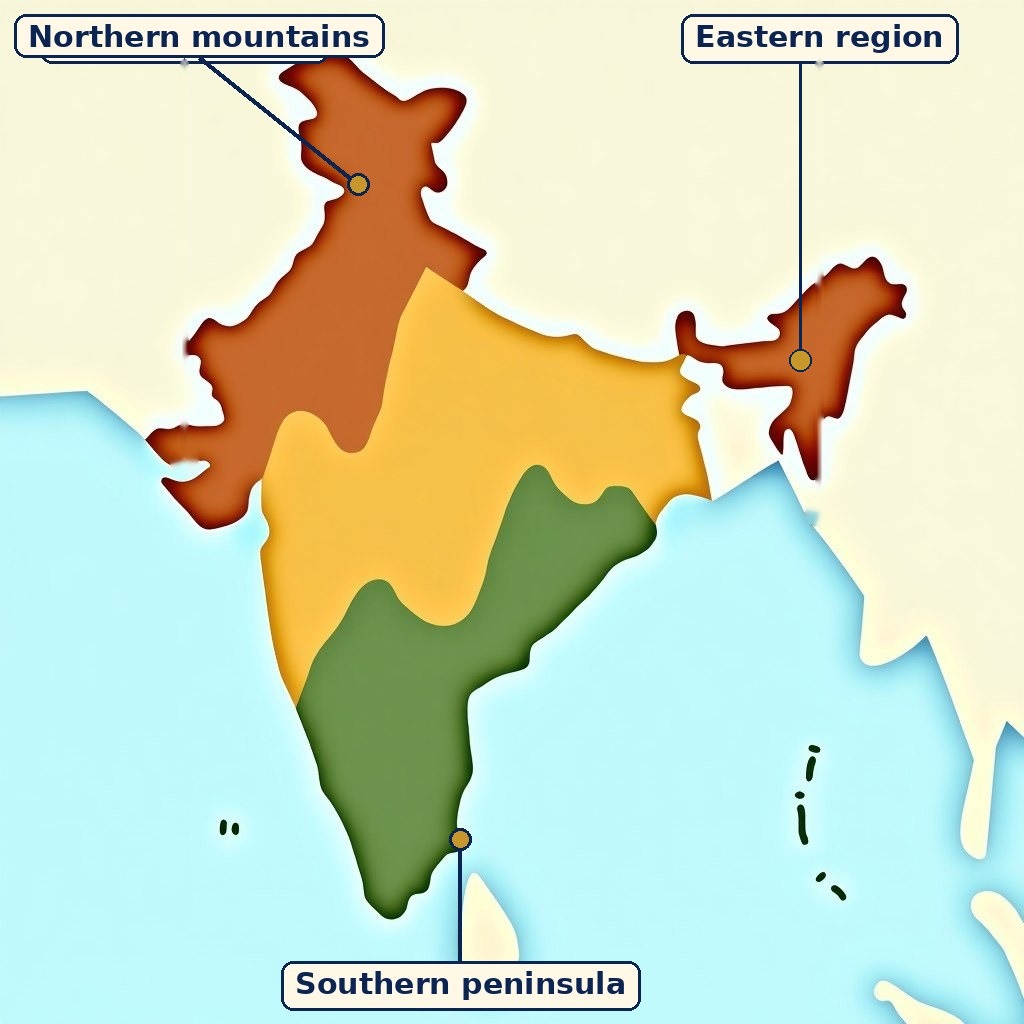
Diagram (labels are printed on the image): A stylised map of India showing its broad regions. It is a general picture, not drawn to scale, and its colours do not mark real state boundaries.
India's states bring together people of many languages and cultures in one country.
What the chapter is about
A period of invasions and new empires
From roughly the medieval centuries onward, Turkic, Afghan and later Mughal forces invaded India, causing destruction, the fall of old dynasties, and the rise and fall of kingdoms and empires. Continuous warfare, alliances and conquests reshaped political boundaries again and again. The chapter's maps compare, for example, the territories held under the Tughlaqs and under the Lodis, showing how quickly the political map could change.
The Delhi Sultanate — rise, resistance, administration
The Delhi Sultanate grew through conquest, but it also faced steady resistance from regional powers that refused to accept its rule. Its administration collected revenue, maintained armies and ran a large empire from Delhi, yet it never controlled the whole subcontinent evenly. The Bahmani Sultanate in the Deccan (shown on the chapter's map around 1477) was one of the powerful regional states that emerged as central power weakened.
The Mughals
The Mughals built a larger, more centralised empire than the Sultanate, expanding under successive rulers and creating an administrative framework that reached deep into the provinces. Agriculture was the mainstay of the economy, and trade — through ports such as Surat, Calicut and Hooghly — connected India with the wider world. Temples, the chapter notes, were also centres of economic activity, not only places of worship.
Kingdoms that resisted: Vijayanagara and the Ahom
Not every region was conquered quickly. The Vijayanagara Empire in the south and the Ahom Kingdom in the north-east resisted for a long time. Geography helped — distance, hills, rivers and strong local organisation — and so did military strength and the support of local society. Their long resistance is one reason the chapter asks you to compare their geographical, military and social advantages with those of kingdoms that fell faster.
Akbar, Krishnadevaraya and changing rulers
Rulers were not fixed characters. Akbar, remembered as a ruthless conqueror in his youth, grew tolerant and broad-minded with experience — the chapter invites you to think about what could have changed him. Krishnadevaraya's Vijayanagara court, like Akbar's, was a centre of politics, trade, culture and learning. Scholars at such courts, and traders in port cities, are good windows on to the period: what they saw, bought and wrote about tells us how the empire actually worked.
Society: hardship, resilience and new culture
For common people, the period was often harsh: agriculture and trade expanded and India grew wealthy and well connected, yet the economic condition of ordinary subjects generally remained hard. At the same time, society showed adaptability and resilience — rebuilding towns, cities and temples, preserving traditions, and blending local and foreign elements into new forms of art, music, painting and architecture. Religious intolerance also marked the period: Buddhists, Jains, Hindus, Sikhs, Zoroastrians and tribals suffered severe persecution at times, though some rulers were more broad-minded than others. Early Sikhism's values — equality, seva (selfless service) and justice — remain relevant today, the chapter notes.
What you should learn
Invasions and empires redrew India's political map repeatedly; the Sultanate and the Mughals built large states, regional kingdoms resisted, and Indian society — though often hard-pressed — rebuilt, adapted and created new culture.
Key Terms
- Delhi Sultanate — The Turkic-Afghan rulers who governed from Delhi before the Mughals, through conquest, revenue collection and a central administration.
- Mughal Empire — The empire founded in the 16th century that grew into India's largest centralised state of the period, with a strong administrative framework.
- Bahmani Sultanate — A powerful Deccan kingdom that emerged as Delhi's central power weakened.
- Vijayanagara Empire — The great southern empire that resisted northern conquest for a long time and became a centre of art and trade.
- Ahom Kingdom — The north-eastern kingdom that held off conquest for centuries, helped by geography and strong local organisation.
- Seva — Selfless service — one of the values promoted by early Sikhism, along with equality and justice.
Remember
- The political map changed through warfare, alliances and conquests — not in one single invasion.
- The Sultanate and the Mughals differed in scale and administration; compare them, do not merge them.
- Vijayanagara and the Ahom resisted longer for geographical, military and social reasons.
- Trade expanded India's wealth and world links, yet ordinary people's lives stayed hard.
- Society rebuilt towns and temples and blended traditions into new art and culture.
Exam Tip / Common Mistake
Common mistake: writing as if one empire ruled all of India at once. In answers, name the region and the period — the Sultanate, the Bahmani Deccan, Vijayanagara, the Ahom kingdom and the Mughals often existed side by side.
When you compare the Tughlaq and Lodi territory maps, look for what shrank, what held, and which regions stayed outside Delhi's control. A map answer should name directions (north, Deccan, east) rather than saying only 'the empire grew'.
A good letter from Akbar's or Krishnadevaraya's court mentions four things: politics (who rules and how), trade (ports and goods), culture (music, painting, building) and society (what ordinary people do). That is exactly what the chapter's exercise asks for.
Chart / Table: Powers of the period — at a glance
| Point | Detail |
|---|---|
| Delhi Sultanate | Ruled from Delhi; faced regional resistance; revenue-based administration. |
| Bahmani Sultanate | Deccan power (map dated 1477); rose as Delhi weakened. |
| Vijayanagara Empire | Southern empire; long resistance; centre of art, trade and temple building. |
| Ahom Kingdom | North-eastern kingdom; resisted conquest for centuries. |
| Mughal Empire | Largest centralised empire of the period; strong administration; trade through Surat, Calicut, Hooghly. |
| Society | Agriculture mainstay; temples as economic centres; hardship for common people, yet resilience and cultural blending. |
Practice set — try it yourself
- Compare the political strategies of the Delhi Sultanate and the Mughals.
Hint: Think about scale, administration and how each dealt with regional powers. - Why did Vijayanagara and the Ahom resist conquest longer than others?
Hint: Think about geography, military strength and social support together. - Imagine you are a trader in Surat, Calicut or Hooghly. Describe a day at the port.
Hint: Think about goods, people you trade with, and ships coming and going. - How could Akbar change from a ruthless young conqueror to a tolerant ruler?
Hint: Think about experience, the size of a diverse empire, and the need to hold it together. - What might have happened if Vijayanagara had won the Battle of Talikota?
Hint: Think about south India's politics and culture — but present it as imagination, not fact.
Questions with Answers
- How did invasions reshape India's political map?
Turkic, Afghan and Mughal invasions destroyed old dynasties and created new kingdoms and empires. Continuous warfare, alliances and conquests moved boundaries repeatedly, so the map of one century looked very different from the next. - How did the Mughal Empire differ from the Delhi Sultanate?
The Mughals built a larger and more centralised empire with a stronger administrative framework reaching into the provinces, while the Sultanate, though powerful from Delhi, controlled territory more unevenly and faced constant regional resistance. - Why did some kingdoms resist conquest for longer?
Kingdoms like Vijayanagara and the Ahom combined favourable geography — distance, hills and rivers — with military organisation and social support, which made conquest slower and costlier for invaders. - What was life like for common people in this period?
Agriculture and trade expanded and India became wealthy and well connected, but ordinary subjects generally remained in harsh economic conditions. They still rebuilt towns, cities and temples after destruction and kept cultural traditions alive. - Which values of early Sikhism does the chapter highlight, and why do they matter today?
Equality, seva (selfless service) and justice. They matter today because they speak to how a diverse society treats its members fairly — the chapter asks you to pick one value and discuss its present-day relevance.
Extension Questions with Answers
- Timeline question: arrange these in order — Bahmani Sultanate on the chapter map (1477), the Mughal Empire's expansion, the Battle of Talikota, and the rise of the Delhi Sultanate.
Order: Delhi Sultanate first, then the Bahmani Sultanate (1477 on the map), then the Battle of Talikota, with Mughal expansion running across the later part of the period. The point is sequence, not exact years for every event. - Case-based: a scholar at Krishnadevaraya's court writes home. What four aspects of life should the letter cover, and why?
Politics, trade, culture and society — because a court was not only a seat of power but a hub of commerce, art and daily life, and the chapter's exercise tests exactly that breadth. - Why were temples economic centres, not only religious ones?
Temples employed artisans, attracted pilgrims and traders, held land and wealth, and supported markets around them — so rebuilding a temple also meant rebuilding a local economy. - How did trade connect India with the wider world in this period?
Ports like Surat, Calicut and Hooghly sent Indian goods abroad and brought foreign merchants, ships and ideas in, which is why agriculture and trade together raised India's wealth even while common people's conditions stayed hard. - Assertion–Reason: Assertion — Indian society showed resilience in this period. Reason — It rebuilt towns, cities and temples and blended traditions into new culture. Judge both and the link.
Both are true, and the reason correctly explains the assertion: rebuilding and blending are the evidence for resilience, not just a claim about it. - What does the chapter mean by religious intolerance in this period, and what is the contrast it draws?
At times Buddhists, Jains, Hindus, Sikhs, Zoroastrians and tribals suffered severe persecution, yet some rulers were more broad-minded than others — so the period cannot be described by one attitude alone. - If you were that port trader, which goods would you most likely handle, and why?
Goods in demand abroad and at home — textiles, spices and similar products carried through Surat, Calicut or Hooghly — because ports lived on the goods that distant buyers wanted. - How does studying this period help us understand India's later history?
It shows how political unity and fragmentation, tolerance and intolerance, and trade and hardship all existed together — the background against which later empires, including the Marathas and the colonial powers, operated.
- Invasions by Turkic, Afghan and Mughal forces redrew boundaries repeatedly.
- Sultanate and Mughals differed in scale and administration.
- Vijayanagara and the Ahom resisted longest.
- Trade grew India's wealth; common life stayed hard.
- Society rebuilt, preserved and blended — new art, music and architecture.
How to use this page: Read the summary, say the Key Terms in your own words, then try the practice set without looking. Use the Questions with Answers to check yourself afterwards. Ask your teacher or parent to check your answers.