

Chapter 1: Natural Resources and Their Use
How do we sort what nature gives us, where is it found, and how do we use it without using it up?
Original notes — ready CBSE (NCERT, English Medium) • Class 8 • Social Science • Book: Exploring Society: India and Beyond • Part I
Chapter 1: Natural Resources and Their Use — EG's own notes, in simple words
Book: Exploring Society: India and Beyond (CBSE, Class 8) | Chapter 1 | Part I | Medium: English
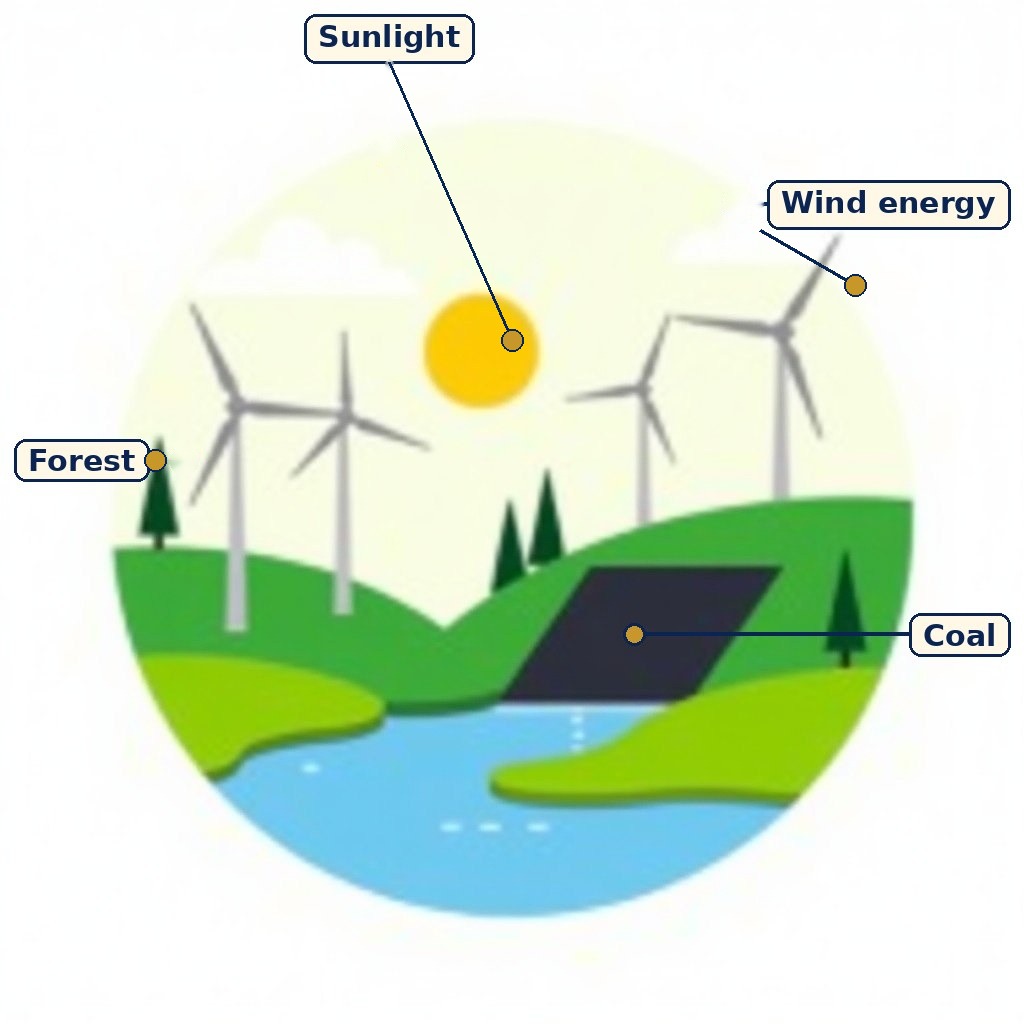
Diagram (labels are printed on the image): Natural resources in one landscape: sunlight, wind, forest, river and coal. A general picture about the kinds of resources we use; it is not a map or a textbook figure.
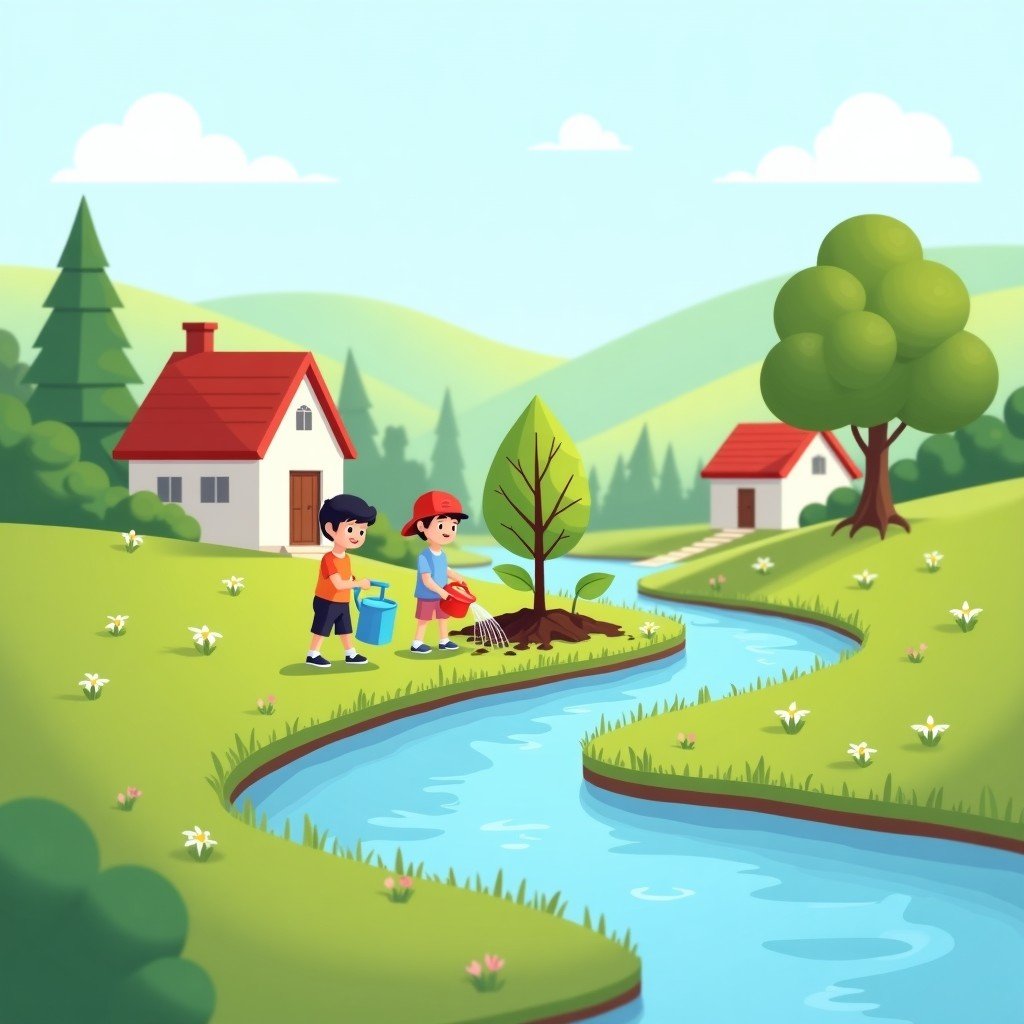
Planting trees and keeping water clean are simple ways of caring for resources.
What the chapter is about
What counts as a natural resource
Nature gives us materials and substances that people find valuable — air, water, soil, forests, minerals, sunlight and flowing water. A thing becomes a resource only when people have the knowledge, tools and need to use it. Cutting a tree and turning its wood into furniture is a simple example: the tree was always there, but it became a useful resource when people learned to use its wood.
Ways of sorting resources
One useful sorting is by what resources are for: some are essential for life itself, like air and water; some give us materials, like wood, cotton and iron ore; and some give us energy, like coal, sunlight and wind. A second sorting, which the chapter stresses most, is by whether a resource comes back on its own. Renewable resources, such as sunlight, wind and flowing water, are replaced naturally again and again. Non-renewable resources, such as coal, oil and minerals, were formed over very long periods and cannot be replaced quickly once used up.
How nature restores itself — and when it cannot
Nature works in cycles, so in a healthy forest almost nothing is wasted: fallen leaves feed the soil, and new trees grow. But a renewable resource can stop being renewable if it is used faster than nature can restore it. Over-fishing, cutting forests faster than they regrow, and pumping out groundwater faster than rain refills it are all cases where people break nature's cycle of restoration and regeneration. The chapter gives the example of a mature tree producing about 275 litres of oxygen a day, to show how much quiet work nature does for us.
Where resources are found — and why it matters
Resources are not spread evenly across the Earth. India has coal around Jharia and Raniganj, iron ore at Bailadila, oil at Mumbai High and Digboi, and bauxite in Koraput, to name a few places shown on the chapter's map. Industries often grow near such deposits and bring jobs, but mining and extraction also bring costs for local people and the environment. Because rivers and mineral belts ignore political boundaries, sharing has to be negotiated — the chapter points to Kaveri river water, shared among Karnataka, Tamil Nadu, Kerala and Puducherry, as a case where careful management was needed.
The resource curse
Having plenty of resources does not automatically make a place rich. This puzzle is called the resource curse: without good technology, skilled people and fair rules, resource wealth can be wasted or captured by a few. India, the chapter notes, has largely avoided this trap by investing in technology and skills instead of depending on raw resources alone.
Using resources wisely: stewardship
Stewardship means acting as a caretaker of nature rather than only as a user. For non-renewables it means using them judiciously so they last longer; for renewables it means watching the rate of use so they are not over-exploited. Two Indian cases make the point. In Punjab, the shift in the 1960s to high-yielding wheat, heavy irrigation and chemical inputs pushed groundwater levels down sharply. In Sikkim, one farming family switched to compost and natural pest control and rebuilt the health of its farm. The chapter also notes the International Solar Alliance, launched by India and France in 2015, through which sunshine-rich countries work together on solar energy, and India's ancient plant science, Vrikshayurveda, which described irrigation and plant care long ago.
What you should learn
Natural resources can be sorted by use and by renewability; they are unevenly spread, so they must be shared and managed; and wise, careful use — stewardship — is what keeps renewable resources renewable.
Key Terms
- Natural resource — A material or substance found in nature that people can use, like water, soil, forests and minerals.
- Renewable resource — A resource replaced naturally again and again, like sunlight, wind and flowing water — provided it is not used faster than nature restores it.
- Non-renewable resource — A resource formed over a very long period that cannot be replaced quickly, like coal, oil and minerals.
- Ecosystem services — The benefits nature gives people for free, such as oxygen from trees, pollination, clean water and fertile soil.
- Resource curse — The puzzle that places rich in natural resources do not always become prosperous, because technology, skills and fair rules matter as much as the resources themselves.
- Stewardship — Using resources as a responsible caretaker would — carefully, fairly and with future generations in mind.
Remember
- A thing is a resource only when people can actually use it — knowledge and tools turn nature's gifts into resources.
- Renewable does not mean unlimited: use a renewable faster than it regrows and it can run out.
- Resources are unevenly distributed, so trade, sharing agreements and transport matter.
- Technology and skills can help a country avoid the resource curse.
- Stewardship means judicious use of non-renewables and watchful use of renewables.
Exam Tip / Common Mistake
Common mistake: calling every natural thing a resource, or calling a forest renewable without a condition. In answers, always add the condition — a forest is renewable only if trees are replanted and cut more slowly than they grow back.
Name five ecosystem functions that serve humans, from the chapter's discussion — for example, trees giving oxygen, bees pollinating crops, forests holding soil, wetlands cleaning water, and plants and animals giving food and medicine. If one of these weakens, human life feels it directly.
Groundwater in Punjab fell as pumping for irrigation rose. The lesson for answers: extraction that ignores the rate of natural refilling turns a renewable (groundwater) into a shrinking stock.
Chart / Table: Types of resources — examples and care
| Point | Detail |
|---|---|
| Essential for life | Air, water, sunlight — without these, life cannot exist. |
| For materials | Wood, cotton, iron ore, bauxite — turned into objects people use. |
| For energy | Sunlight, wind, flowing water (renewable); coal, oil, natural gas (non-renewable). |
| Renewable — but watch the rate | Solar, wind, forests, fish, groundwater — renewable only if use stays within nature's power to restore. |
| Non-renewable — use judiciously | Coal (Jharia, Raniganj), oil (Mumbai High, Digboi), iron ore (Bailadila) — formed over very long periods. |
| Wise use | Save water and electricity; recycle; replant; harvest rainwater; use traditional water-harvesting and pond rejuvenation. |
Practice set — try it yourself
- Name two renewable and two non-renewable resources, and say where in India one of each non-renewable is found.
Hint: Think about what comes back again and again, and what does not; the chapter map names coal and oil places. - What can make a renewable resource non-renewable tomorrow?
Hint: Think about the rate of use compared with the rate at which nature restores it. - Why does the uneven distribution of resources matter for trade and for relations between states?
Hint: Think about the Kaveri example and about industries growing near mines. - What is the resource curse, and how can a country avoid it?
Hint: Think about what India invested in, besides the resources themselves. - Give one example of stewardship from your own home or neighbourhood.
Hint: Think about mindful practices the chapter asks you to notice — saving water, reusing things, planting trees.
Questions with Answers
- What is a natural resource?
A natural resource is a material or substance that occurs in nature and is valuable to humans — for example water, air, soil, forests, sunlight and minerals. It counts as a resource when people have the knowledge and tools to use it. - What is the difference between renewable and non-renewable resources?
Renewable resources are replaced naturally again and again, like sunlight and wind. Non-renewable resources form over very long periods and can run out, like coal and petrol. Even renewables fail if used faster than nature restores them. - Why is conservation of resources necessary?
Our needs keep growing, but many resources are limited. Wasting them leaves less for future generations, and over-use can break nature's cycles of restoration. Conservation — careful, judicious use — stretches resources for longer. - How does the distribution of resources affect people?
Because resources are unevenly spread, some regions have coal or oil while others do not. This shapes where industries grow, creates jobs near deposits, causes environmental costs there, and makes trade and sharing agreements between regions necessary. - What does stewardship mean, with an example?
Stewardship means using resources like a responsible caretaker. For example, using groundwater only as fast as rain refills it, replanting trees that are cut, or switching — as in the Sikkim case — to compost and natural pest control instead of depleting the soil.
Extension Questions with Answers
- Map question: on a blank map of India, mark Jharia, Bailadila, Mumbai High and Koraput and write which resource each place is known for.
Jharia — coal; Bailadila — iron ore; Mumbai High — oil; Koraput — bauxite. Marking practice: locate them roughly (Jharkhand, Chhattisgarh, off the Maharashtra coast, Odisha) rather than guessing exact coordinates. - Case-based: a village pumps groundwater for irrigation every year, and the water table keeps falling. What is happening, and what three steps would you suggest?
The village is using groundwater faster than rain refills it, so a renewable is being treated as if it were unlimited. Steps: recharge through rainwater harvesting and pond rejuvenation, shift to less water-hungry crops or methods, and keep a community watch on the water level. - Assertion–Reason: Assertion — Forests are renewable resources. Reason — Trees grow back on their own. Judge both statements and the link between them.
Both statements are true, but the reason alone does not fully explain the assertion: trees grow back only if cutting stays slower than regrowth and replanting happens. Without that condition the assertion fails. - Why did Punjab's groundwater fall even though water is a renewable resource?
In the 1960s farmers shifted to high-yielding wheat varieties that needed heavy irrigation, and pumping rose beyond the rate of natural refilling, while chemical inputs added pressure on the soil and water. The renewable cycle was broken by the rate of use. - What role does the International Solar Alliance play, and why was it launched?
Launched by India and France in 2015, it brings sunshine-rich countries together to expand solar energy, so that a clean renewable can replace part of the use of non-renewable fuels. - What considerations should guide the production of goods for our current use?
Production should weigh the resource used, the waste created, the effect on local people and nature, and whether the product can be reused or recycled — so that today's goods do not become tomorrow's shortage. - How can traditional practices help modern resource care?
Practices such as community regulation of fishing, water harvesting, pond rejuvenation and the plant-care knowledge of Vrikshayurveda show careful rates of use; modern policy can revive and combine them with new technology. - If a region discovers a large mineral deposit, what should it do first to avoid the resource curse?
Invest in skills, technology and fair rules before extraction grows — schools, training, transparent revenue use and environmental safeguards — so the wealth builds lasting prosperity rather than being wasted.
- Resources become resources when people can use them.
- Sort by use (life, materials, energy) and by renewability.
- Even renewables run out if used faster than nature restores them.
- Uneven distribution → trade, sharing, and costs near extraction sites.
- Stewardship: judicious use of non-renewables, watchful use of renewables.
How to use this page: Read the summary, say the Key Terms in your own words, then try the practice set without looking. Use the Questions with Answers to check yourself afterwards. Ask your teacher or parent to check your answers.