

Chapter 3: Electricity: Circuits and Their Components
Cells, lamps, switches and circuit diagrams — how a torch actually works.
Original notes — ready CBSE (NCERT, English Medium) • Class 7 • Science • Book: Curiosity
Chapter 3: Electricity: Circuits and Their Components — EG's own notes, in simple words
Book: Curiosity (CBSE, Class 7) | Chapter 3 | Medium: English

Diagram (labels are printed on the image): A simple electric circuit with a cell, wires, a bulb and a switch. A general diagram, not a scene from the book.
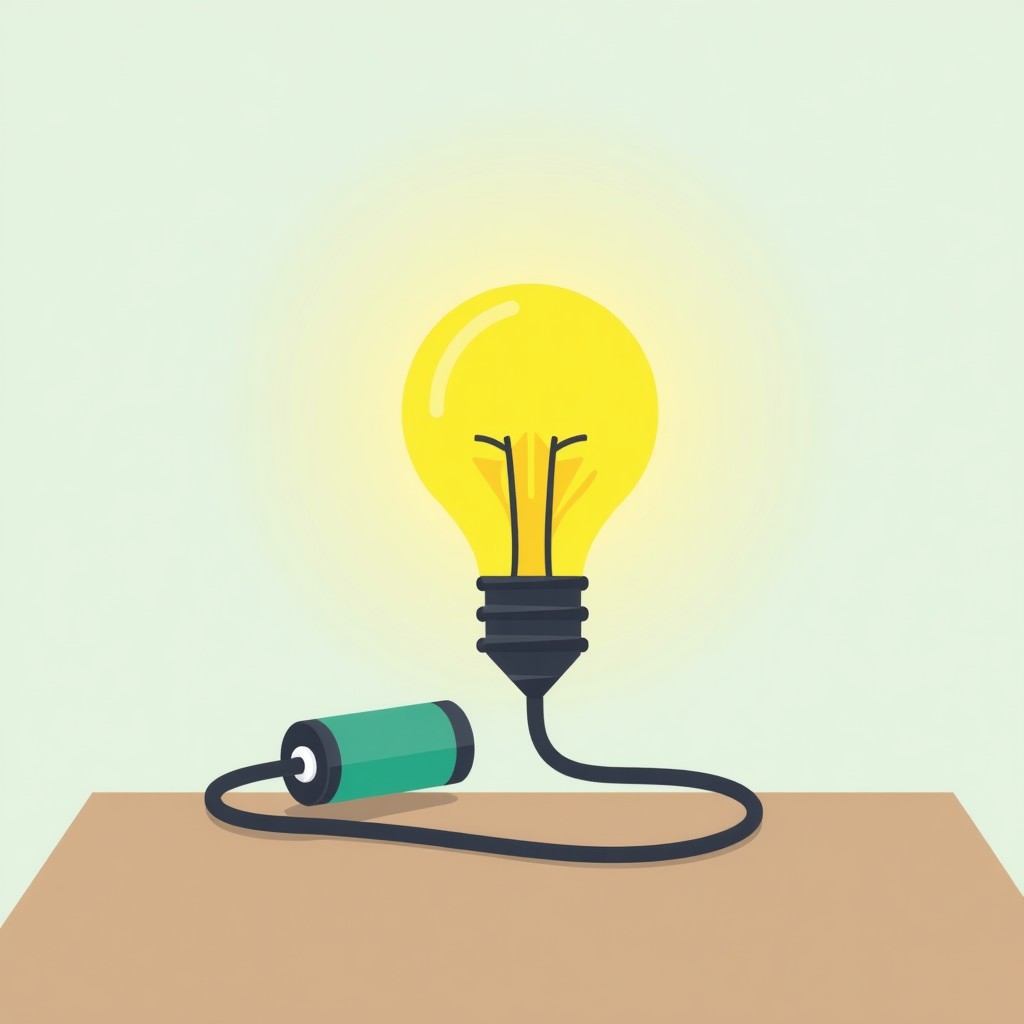
A glowing bulb powered by a cell. A general picture about electric circuits, not a book scene.
What the chapter is about
An electric circuit is a complete path through which electric current can flow. A simple circuit needs a source of electricity such as a cell, connecting wires, a device that uses electricity such as a bulb, and often a switch. Current flows only when the path is complete and unbroken; this is called a closed circuit. If the path is broken, for example by an open switch, the circuit is open and the bulb does not glow.
Each part has a job. The cell pushes the current around the circuit. Wires carry the current. The bulb converts electrical energy into light and heat. The switch controls the flow by opening or closing the path. Electricians draw circuits using symbols for each component, so a circuit diagram is the same for everyone, whatever language they speak.
Materials that allow current to pass easily are called conductors, like copper and aluminium. Materials that do not allow current to pass, like rubber, plastic and wood, are called insulators. Insulators cover wires and handles so that we can use electricity safely. Water and damp hands conduct electricity, so electrical appliances must never be touched with wet hands.
3.1 A torchlight — and where electricity comes from
The chapter begins with a school trip to the Bhakra Nangal Dam, where falling water generates electricity in a hydroelectric power house. Electricity is also generated by windmills, solar panels, natural gas and coal. That generated electricity reaches our homes through wires, while small devices use compact portable sources: electric cells and batteries. A torchlight uses cells, a lamp and a switch — sliding the switch one way completes the path and the lamp glows; sliding it back breaks the path and the lamp goes out.
3.2 A simple electrical circuit
An electric cell has two terminals, positive (+) and negative (−). Inside a torch, two or more cells are usually joined so that the positive terminal of one cell touches the negative terminal of the next — this combination is a battery. The lamp in a torch is an incandescent lamp: current passes through its thin filament, the filament gets hot and glows. An LED lamp is different: it glows only when connected the right way round, and it needs the correct number of cells — an LED that needs two cells in series will not glow properly on a wrong connection.
A circuit is the complete path along which current flows: cell → wire → lamp → switch → wire → back to the cell. If any part of the path is broken — a loose wire, an open switch, a fused filament, or an insulator coating left on a wire — the lamp does not glow. That is why fault-finding in the exercises means checking each part in turn: is the cell working, are the connections tight and clean, is the switch closed, is the filament intact?
3.3 Circuit diagrams
Instead of drawing a torch every time, scientists draw circuit diagrams with symbols: a cell is shown as a short thick line and a long thin line (the long line is the positive terminal), a battery as two or more cells in a row, a lamp as a circle with a cross, a switch as a break in the wire that can be closed, and wires as straight lines. In the symbol for a cell, the longer line is positive and the shorter, thicker line is negative — mixing them up reverses the circuit.
3.4 Electrical conductors and insulators
Metal wires are used because metals are conductors: they let current pass easily. Plastic and rubber covers are insulators: they do not let current pass, so they protect us from shocks and keep the current inside the wire. A circuit made with an insulator in place of a wire will not work, and a wire whose insulating cover has not been removed at the joint will also fail — the metal must actually touch the metal.
What you should learn
Learn the parts of a simple circuit, the difference between open and closed circuits, and why conductors and insulators matter for safety.
- Name the parts of a torch circuit and explain what each part does.
- Draw circuit diagrams using the correct symbols for cell, battery, lamp and switch.
- Find faults in a circuit step by step, and tell conductors from insulators.
Key Terms
- Cell — A source of electric current in a circuit.
- Circuit — A complete path through which electric current flows.
- Closed circuit — A complete, unbroken circuit in which current flows.
- Open circuit — A broken circuit in which current cannot flow.
- Conductor — A material that allows electric current to pass easily, like copper.
- Terminal — One of the two ends of a cell or battery, marked + (positive) or − (negative).
- Battery — Two or more cells joined together, usually positive to negative in a row.
- Filament — The thin wire inside an incandescent lamp that glows when current passes through it.
- LED — A Light Emitting Diode lamp, which glows only when connected the right way round.
Remember
- Current flows only in a complete, closed circuit.
- A cell, wires, a bulb and a switch make a simple circuit.
- Conductors carry current; insulators block it.
- Never touch switches or appliances with wet hands.
Exam Tip / Common Mistake
Common mistake: drawing a circuit with a gap and still expecting the bulb to glow. In answers, always check first whether the path is complete; a single break anywhere makes the whole circuit open.
With an incandescent lamp it does not matter which terminal connects to + or −. With an LED it does — connect it backwards and it will not glow, even though the circuit is complete.
All the chapter's activities use small cells. Household mains supply is far too dangerous for school experiments — never connect a school circuit to a wall socket.
Chart / Table: Circuit components and their jobs
| Point | Detail |
|---|---|
| Cell | Supplies electric current |
| Connecting wire | Carries current around the circuit |
| Bulb | Converts electrical energy into light |
| Switch | Opens or closes the circuit |
| Insulator coating | Stops current reaching the user |
Table: Circuit components and their symbols
| Component | Symbol (described) | Job |
|---|---|---|
| Cell | Long thin line (+) and short thick line (−) | Supplies electrical energy |
| Battery | Two or more cells in a row | Supplies more energy than one cell |
| Incandescent lamp | Circle with a cross inside | Glows when current heats its filament |
| LED lamp | Diode symbol with arrows for light | Glows only in the correct direction |
| Switch (closed) | Wire joined across the break | Completes the circuit |
| Switch (open) | Break in the wire | Breaks the circuit; lamp goes out |
| Wire | Straight line | Carries current between components |
Steps: making a simple torch circuit
- Join two cells positive-to-negative to make a battery.
- Connect one battery terminal to the lamp with a clean, bare wire end.
- Connect the other lamp terminal to a switch, and the switch back to the battery.
- Close the switch and check: if the lamp does not glow, check each connection and the filament in turn.
Practice set — try it yourself
- Why does a bulb not glow when the switch is open?
Hint: Think about whether the path is complete. - Name the four main parts of a simple circuit.
Hint: Think about source, path, device and control. - Why are wires made of copper?
Hint: Think about conductors. - Why are plug covers made of plastic?
Hint: Think about insulators and safety. - What is the difference between an open and a closed circuit?
Hint: Think about a broken path versus a complete path.
Questions with Answers
- What is an electric circuit?
An electric circuit is a complete path for electric current. It usually has a cell, connecting wires, a device like a bulb, and a switch. Current flows only when the path is complete. - Why does the bulb glow when the switch is closed but not when it is open?
Closing the switch completes the path, so current flows through the bulb and it glows. Opening the switch breaks the path, so no current flows and the bulb stays dark. - What is the job of the cell in a circuit?
The cell is the source of electricity. It pushes electric current around the circuit so that devices like a bulb can work. - Give two conductors and two insulators, and state one use of each.
Conductors: copper (wires) and aluminium (cables). Insulators: plastic (wire coating, plug covers) and rubber (gloves, handle grips). Conductors carry current; insulators protect users from it. - Why must we not touch electrical switches with wet hands?
Water conducts electricity, so current can pass through wet skin more easily and give a shock. Dry hands and insulated switches keep the user safe.
More questions with answers — extension
- In a circuit with two lamps, one lamp's filament breaks. Will the other lamp glow? Justify — and what does the answer depend on?
It depends on how the lamps are joined. If they are in one single path (series), the broken filament breaks the whole path and neither lamp glows. If each lamp has its own path, the other lamp keeps glowing. The chapter's exercise asks you to reason from the diagram, not to guess. - A student forgets to remove the insulator covering from the connecting wires. The cell and lamp are both good. Will the lamp glow?
No. The plastic or rubber cover is an insulator, so current cannot reach the lamp even though every part is good. Removing the cover so that metal touches metal is essential. - Draw, in words, a circuit diagram for a simple torch using symbols for its components.
Battery (two cells, positive to negative) — wire — lamp (circle with cross) — switch — wire back to the battery. The switch is drawn as a break that can be closed; when closed, the path is complete and the lamp glows. - Two switches S1 and S2 control two lamps L1 and L2. How would you work out, for each switch combination, which lamps glow?
Trace the complete path for each combination: a lamp glows only if there is an unbroken path from the battery through that lamp and back. Make a table of the four combinations (both ON, S1 only, S2 only, both OFF) and mark each lamp glow or no-glow by tracing. - Vidyut closes the switch, but the lamp does not glow. List as many possible reasons as you can, and say what you would check first.
Possible reasons: a dead cell, a loose or dirty connection, insulator coating not removed, an open switch fault, a broken filament, or a broken wire. Check first the simplest things: is the switch really closed, and are the cells fresh and correctly placed? - The + and − marks on a battery cannot be read. Suggest a method to identify its two terminals.
Connect the battery in a circuit with an LED (which glows only in one direction) or use a known-good cell and lamp arrangement: try both ways round. The way that makes the LED glow tells you which end is positive (the end connected to the LED's positive side). Mark the terminals once found. - You have six cells A–F, some working and some dead. Design an activity to find which ones work.
Items: a working lamp, wires and a switch. Procedure: make a simple circuit with the lamp, then insert one cell at a time in the correct direction and close the switch. A cell that makes the lamp glow is working; one that does not (after checking connections) is dead. Test each cell separately so one dead cell cannot hide another's result. - Tanya's LED needs two cells in series, but her circuit does not glow. What is likely wrong, and how would you correct the wiring?
Likely the cells are not joined positive-to-negative in series, or the LED is connected backwards, or only one cell is in the circuit. Correct it by joining the cells in series (positive of one to negative of the next) and connecting the LED the right way round, then closing the switch. - Why are connecting wires covered with plastic, but the ends must be bare metal at the joints?
The plastic cover is an insulator that protects us and keeps current in the wire. At a joint, current must pass from one metal part to another, so the insulator must be removed there — otherwise no current flows at all. - A solar panel runs a toy fan in the chapter's project. What does this show about sources of electricity?
It shows that electricity can come from many sources, not only cells: sunlight, falling water, wind and fuels can all generate it, and a circuit works the same way whatever the source, as long as the source supplies energy to drive current.
- Cell: + and − terminals. Battery: cells joined positive to negative.
- Lamp glows only on a complete path; any break stops the current.
- Conductors (metals) carry current; insulators (plastic, rubber) block it.
- Circuit symbols let everyone draw and read the same circuit.
How to use this page: Read the summary, say the Key Terms in your own words, then try the practice set without looking. Use the Questions with Answers to check yourself afterwards. Ask your teacher or parent to check your answers.