

Chapter 4: The World of Metals and Non-metals
Why metals shine, bend and carry current — and why iron rusts while gold does not.
Original notes — ready CBSE (NCERT, English Medium) • Class 7 • Science • Book: Curiosity
Chapter 4: The World of Metals and Non-metals — EG's own notes, in simple words
Book: Curiosity (CBSE, Class 7) | Chapter 4 | Medium: English
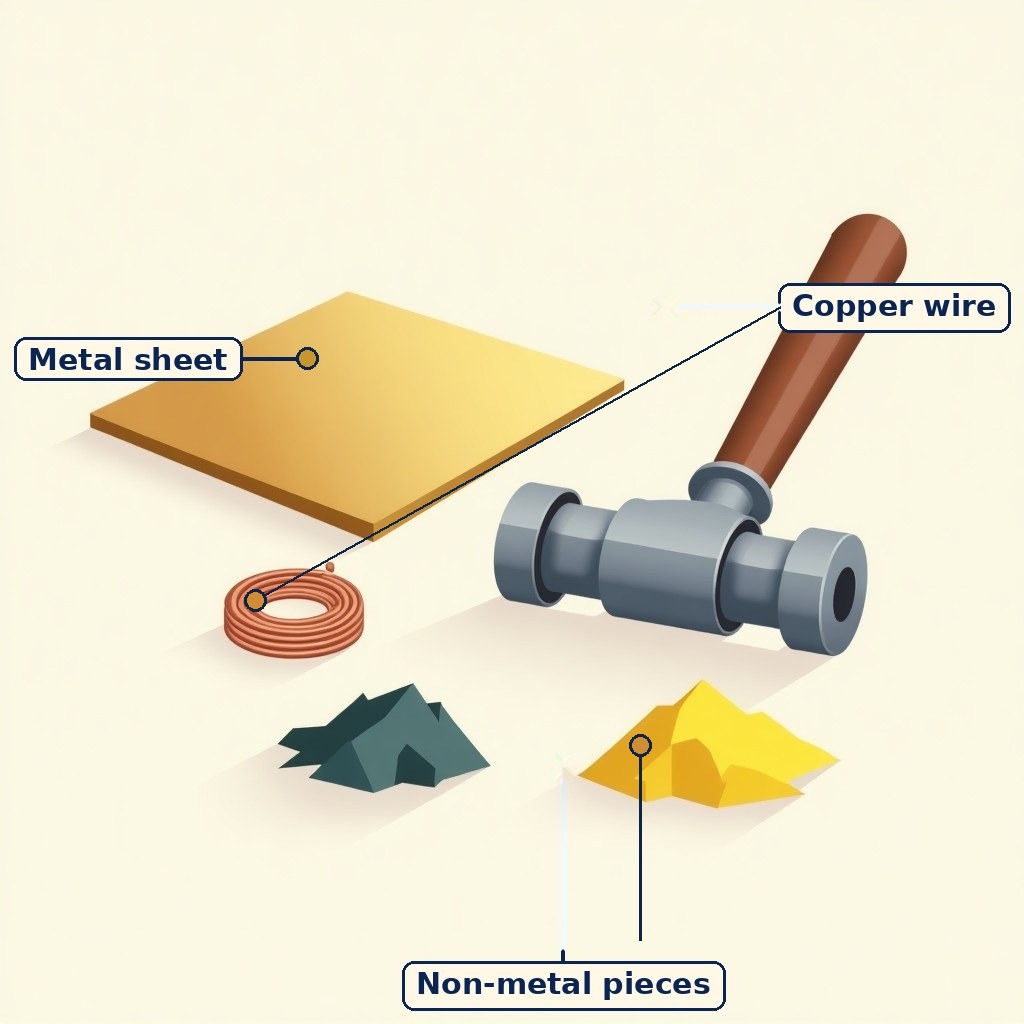
Diagram (labels are printed on the image): Metal sheets and wires beside dull non-metal pieces. A general picture about metals and non-metals; it is not a scene from the book.
Everyday metal objects: a pot, wires and a ring. A general picture, not a book scene.
What the chapter is about
Materials can be sorted into metals and non-metals by their properties. Metals like iron, copper, aluminium and gold are usually shiny, hard and strong. They can be beaten into thin sheets, a property called malleability, and drawn into wires, called ductility. They conduct heat and electricity well and make a ringing sound when struck, which is why they are called sonorous.
Non-metals like oxygen, carbon, sulphur and iodine behave differently. Most are dull, soft or brittle, and poor conductors of heat and electricity. They cannot be beaten into sheets or drawn into wires; they break instead. Some non-metals are gases, like oxygen, and some are solids, like sulphur and coal.
These properties decide the uses. Metals are used for utensils, wires, machines and buildings because they are strong and conduct heat and electricity. Non-metals are used where their properties suit the job: oxygen is needed for breathing, chlorine disinfects water, and graphite, a form of carbon, is used in pencils because it is soft and leaves a mark.
4.1 Properties of metals and non-metals
The chapter follows Yashwant and Anandi to village ironsmiths, who make tawas, buckets, tongs, spades, axes, trowels and rakes from iron. Metals share a family of properties: they are lustrous (shiny), malleable (they can be beaten into thin sheets), ductile (they can be drawn into wires), sonorous (they ring when struck) and good conductors of heat and electricity. That is why cooking vessels are metal, electric wires are copper or aluminium, and bells are metal.
Non-metals are usually the opposite: dull, brittle (they break instead of bending), poor conductors of heat and electricity, and not sonorous. A piece of coal or sulfur does not shine, cannot be beaten into a sheet, and does not ring. But non-metals are far from useless: oxygen is essential for breathing, nitrogen in fertilisers helps plants grow, chlorine purifies water, iodine solution is an antiseptic for wounds, and graphite — a form of carbon — conducts electricity and is used in pencils and electrodes.
Substances that behave differently from both groups are also studied: sulfur and phosphorus, for example, do not react with water the way metals do, and phosphorus catches fire in air, so it is stored under water. Such exceptions are why the chapter tests properties one by one instead of trusting appearance alone.
4.2 Effect of air and water on metals
Iron kept in moist air gets a brown deposit called rust; the process is rusting. Other metals change colour too: copper gets a green coating and silver gets a black coat. The general name for this slow spoiling of a metal surface by air, water or other substances is corrosion. Rusting is a serious and costly problem in India, because iron structures have to be repaired or replaced.
Rusting can be prevented by keeping air and water away from the iron: painting, oiling and greasing all do this, and coating iron with a thin layer of zinc — galvanisation — protects it too. The Iron Pillar of Delhi, made about 1,600 years ago, has famously resisted rust, showing how skilled ancient Indian metalworkers were.
4.3 Metals, non-metals and their oxides
When metals combine with oxygen they form metal oxides, and when non-metals combine with oxygen they form non-metal oxides — and the two kinds behave differently with litmus. Magnesium burns with a bright light to form magnesium oxide, whose solution is basic and turns red litmus blue. Sulfur burns to form sulfur dioxide, whose solution is acidic and turns blue litmus red. This difference is a reliable test: it is not appearance but chemical behaviour that separates the two families.
What you should learn
Learn the main properties of metals and non-metals and connect each property to a real use, rather than memorising lists without reasons.
- List the properties that mark a substance out as a metal or a non-metal.
- Explain rusting and corrosion, and name four ways to prevent rusting.
- Use the oxide-and-litmus test to tell metal oxides from non-metal oxides.
Key Terms
- Metal — A material that is usually shiny, strong, malleable, ductile and a good conductor.
- Non-metal — A material that is usually dull, brittle and a poor conductor.
- Malleability — The property of being beaten into thin sheets without breaking.
- Ductility — The property of being drawn into thin wires.
- Sonorous — Making a ringing sound when struck; a property of metals.
- Malleable — Able to be beaten into thin sheets without breaking — a property of metals.
- Ductile — Able to be drawn into thin wires — a property of metals.
- Corrosion — Gradual deterioration of a metal surface by air, water or other substances.
- Galvanisation — Coating iron with a thin layer of zinc to protect it from rusting.
Remember
- Metals are shiny, malleable, ductile, sonorous and good conductors.
- Non-metals are dull, brittle and poor conductors.
- Malleability is sheets; ductility is wires — do not mix them up.
- Uses follow properties: copper wires because copper conducts electricity.
Exam Tip / Common Mistake
Common mistake: writing that all metals are hard and all non-metals are soft. Sodium is a soft metal that can be cut with a knife, and diamond, a form of carbon, is very hard. Always add 'usually' and give an exception if asked.
Sodium catches fire on contact with water, and phosphorus catches fire in air. Never handle these in a school experiment without a teacher, and never try to test them at home.
Chart / Table: Metals versus non-metals
| Point | Detail |
|---|---|
| Appearance | Metals: shiny (lustrous) | Non-metals: dull |
| Sheets and wires | Metals: malleable and ductile | Non-metals: brittle, break |
| Conduction | Metals: good conductors | Non-metals: poor conductors |
| Sound | Metals: sonorous | Non-metals: do not ring |
| Examples | Metals: iron, copper, aluminium | Non-metals: oxygen, sulphur, carbon |
Table: Metals versus non-metals
| Property | Metals | Non-metals |
|---|---|---|
| Appearance | Lustrous (shiny) | Dull |
| Malleability | Malleable — beaten into sheets | Brittle — break when beaten |
| Ductility | Ductile — drawn into wires | Not ductile |
| Sound | Sonorous — ring when struck | Not sonorous |
| Heat conduction | Good conductors | Poor conductors (except graphite for electricity) |
| Electricity conduction | Good conductors | Poor conductors (graphite is an exception) |
| Oxide with litmus | Basic — turns red litmus blue | Acidic — turns blue litmus red |
Practice set — try it yourself
- Why is copper used for electric wires?
Hint: Think about conduction and ductility together. - What is malleability? Give one use that needs it.
Hint: Think about thin sheets. - Why is a metal plate said to be sonorous?
Hint: Think about the sound on striking. - Why does a sulphur piece break when hammered?
Hint: Think about brittleness. - Name one soft metal and one hard non-metal form.
Hint: Think about exceptions to the usual rules.
Questions with Answers
- List four properties of metals and give one use for each property.
Metals are shiny, so they are used for jewellery. They are malleable, so aluminium is beaten into foil. They are ductile, so copper is drawn into wires. They conduct heat well, so iron and aluminium are used for cooking utensils. - How are non-metals different from metals?
Non-metals are usually dull, soft or brittle, and poor conductors of heat and electricity. They cannot be beaten into sheets or drawn into wires, whereas metals can. - What do malleability and ductility mean? Give one example of each.
Malleability is being beaten into thin sheets, like gold leaf or aluminium foil. Ductility is being drawn into wires, like copper wires. - Why is graphite used in pencils although it is a non-metal?
Graphite is soft and leaves dark marks on paper, which suits writing. Its softness, a non-metal property, is exactly what a pencil needs. - A student says all metals are hard. Is she correct? Explain.
No. Most metals are hard, but sodium is a soft metal that can be cut with a knife. So the correct statement is that metals are usually hard, with exceptions.
More questions with answers — extension
- Which metal is commonly used for food packaging because it is cheap and its thin sheets can be folded into any shape?
Aluminium. It is malleable, so it can be beaten into very thin foil, and it is cheaper than metals like gold or copper for wrapping food. - Which metal catches fire when it comes in contact with water?
Sodium. It reacts violently with water, so it must never be handled with wet hands or dropped into water in a school experiment. - State True or False with reasons: (i) Aluminium and copper are non-metals used for utensils and statues. (ii) Metal oxides turn blue litmus red. (iii) Oxygen is a non-metal essential for respiration. (iv) Copper vessels are used for boiling water because they are good conductors of electricity.
(i) False — aluminium and copper are metals, not non-metals. (ii) False — metal oxides are basic; they turn red litmus blue, while non-metal oxides turn blue litmus red. (iii) True — oxygen is a non-metal and we need it to breathe. (iv) False — copper vessels are used for boiling water because copper is a good conductor of heat, not because of electricity. - Why are only a few metals suitable for making jewellery?
Jewellery metals must be lustrous, malleable and ductile so they can be shaped, and they must resist corrosion so they stay shiny. Only a few metals — gold, silver and platinum are the classic examples — combine all of these, and they are also rare, which is why jewellery is precious. - Match: (i) Used in electrical wiring (ii) Most malleable and ductile (iii) Living organisms cannot survive without it (iv) Plants grow healthy with fertilisers containing it (v) Used in water purification — with COPPER, GOLD, OXYGEN, NITROGEN, CHLORINE.
(i) COPPER — copper wires carry current. (ii) GOLD — gold is the most malleable and ductile metal. (iii) OXYGEN — needed for respiration. (iv) NITROGEN — a fertiliser nutrient for plants. (v) CHLORINE — used to purify water. - What happens when oxygen reacts with magnesium and with sulfur? What is the main difference in the products?
Magnesium burns to form magnesium oxide, a basic oxide that turns red litmus blue. Sulfur burns to form sulfur dioxide, an acidic oxide that turns blue litmus red. The difference is the nature of the oxide: metal oxides are generally basic, non-metal oxides are generally acidic. - From copper, sulfur, coal, plastic, wood and cardboard, which material would you choose for a pan for boiling water, and why?
Copper. It is a good conductor of heat, strong, and can be shaped into a vessel; sulfur and coal are brittle non-metals, and plastic, wood and cardboard are poor conductors that would burn, melt or fall apart on heating. - Three iron nails are dipped in oil, water and vinegar. Which nail will not rust, and why?
The nail in oil will not rust, because oil coats it and keeps both air and water away from the iron surface. The nail in water rusts, and the nail in vinegar rusts fastest, because the acid speeds up the attack on iron. - Iron is protected from rusting by a thin coating of zinc. Since sulfur does not react with water, can sulfur be used for this purpose? Justify.
No. Protection needs a strong, continuous coating that sticks to iron and keeps air and water out. Sulfur is a brittle non-metal that cannot be beaten or drawn into a tough coating like zinc, so it cannot protect iron in the same way, even though it does not react with water itself. - An ironsmith heats iron before making tools. Why is heating necessary?
Heating makes iron softer and easier to shape. Cold iron is hard to beat into a tool; hot iron can be hammered, bent and shaped, and it keeps its new shape when it cools.
- Metals: lustrous, malleable, ductile, sonorous, good conductors.
- Non-metals: usually dull, brittle, poor conductors — but essential (oxygen, nitrogen, chlorine, iodine).
- Rusting = iron + moist air; prevent by painting, oiling, greasing, galvanisation.
- Metal oxides are basic; non-metal oxides are acidic — test with litmus.
How to use this page: Read the summary, say the Key Terms in your own words, then try the practice set without looking. Use the Questions with Answers to check yourself afterwards. Ask your teacher or parent to check your answers.