

Chapter 5: School Museum
Collect, care for, label and exhibit artefacts — and tell the story behind each one.
Original notes — ready CBSE (NCERT, English Medium) • Class 6 • Vocational Education • Book: Kaushal Bodh
School Museum — EG's own notes, in simple words
Book: Kaushal Bodh (CBSE, Class 6) | Chapter 5 | Medium: English
Section: Part 3 – Work in Human Services
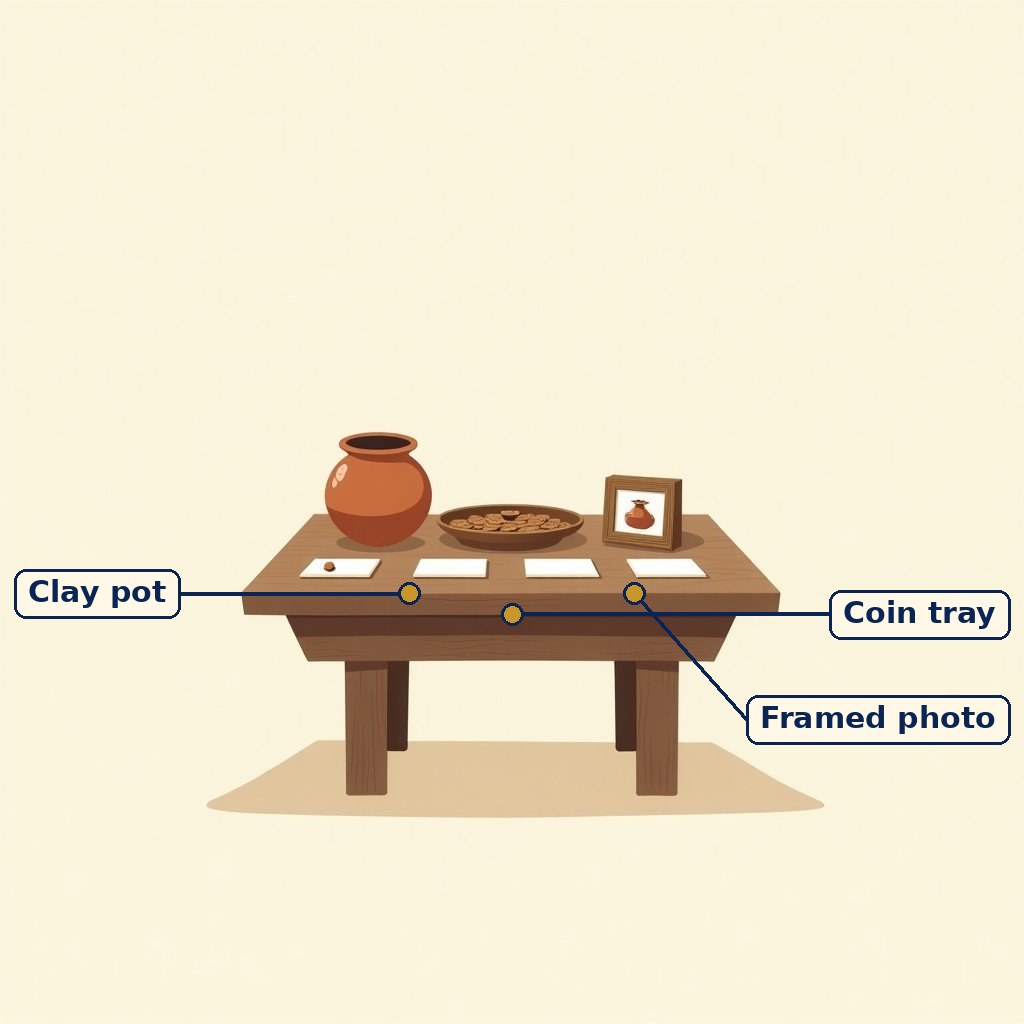
Diagram (labels are printed on the image): A school museum display with a clay pot, a coin tray and a framed photo. A general teaching picture; the labels are blank shapes, not readable text.
Children visiting a school museum display. A general picture about learning from objects; no real museum is pictured.
What the chapter is about
Human Services are about serving people and interacting with them in different ways. This project helps you learn about museums, and you will create your own museum by collecting and describing artefacts. Part 3 offers two projects, of which you take up only one (or design your own with your teacher's help).
You have learnt about many sources for understanding history and culture in Social Science. Among these sources are artefacts — objects made by humans that are old, unique and beautiful and related to our traditions and culture. These artefacts can be ancient, or a part of our lives and societies in the present. A museum is a place in which artefacts are kept. Museums help us understand our history and culture: they show what ancient people wore, what kind of work they did, what kind of artwork they created (for example paintings and sculptures), and what they wrote (manuscripts). Museums help us build the past in our minds, and see things we may never otherwise be able to see.
Museums also help us learn about present culture and the work of different groups of people in the country and the world. They display artefacts related to art, traditions, architecture and science. For example, the National Science Centres/Museums spread across India help us learn about things that no longer exist, such as dinosaurs, and about things we can expect in the future — and even curious objects that defy what we think we know, like a 1200 kg granite ball that spins on water at the National Science Centre in Delhi. The Tribal Museum of Madhya Pradesh in Bhopal displays the traditional art, craft and culture of various tribes. While Science Museums focus mainly on science concepts, museums in general display many things, including traditional textiles and styles of wearing them, and in some museums even animals are preserved and exhibited. An open-air museum — the Kisama Heritage Village in Nagaland — has houses of different tribes, each with its unique design.
What you will be able to do
- Describe how museums preserve history and traditions.
- Identify artefacts that are of interest to you and your peers.
- Create a school museum with your peers.
- Present the history of artefacts using different forms of presentation.
- Learn about museums and artefacts; visit a real museum or take a virtual museum tour; learn your own history; identify artefacts and prepare presentations; organise an exhibition of artefacts; and take feedback from visitors.
What you will need
- Locally collected artefacts that are old, beautiful, or important to your family, and/or photographs of these artefacts.
- Storage containers and display boxes.
- Cleaning brush and cloth.
- Chart paper or cards for making labels.
- Markers, sketch pens, drawing pencils, coloured pens and scissors.
- Equipment and materials for presentation: computer and projector.
Our heritage is the source of our pride and honour, and it is our duty to preserve it. Take care of the artefacts, and handle them with care to avoid any damage. During a museum visit, avoid direct contact with artefacts, as they might be made of sensitive material, and follow all instructions on the sign boards at the museum. Only collect objects with their owner's permission — objects belong to someone.
Before you start: look around, and learn about archaeological sites
Look around your home and neighbourhood, and list at least five artefacts you find interesting because they are old or special to you and your family. Examples: old coins, telephones, vessels, stamps, wood carving, furniture, stone carving, Shilalekh (inscriptions — writing or engraving carved on stone or on the walls of caves or buildings), ancient manuscripts, religious manuscripts, statues, radio, gramophone, camera, spectacles, sticks, ancient books and traditional clothes.
You have learnt about the Sindhu-Sarasvati civilisation in Social Science, and read about Dholavira — locate Dholavira on the map of India. Archaeological sites are places where evidence of ancient human societies is preserved. They are excavated by archaeologists, who carefully dig up these sites and analyse the artefacts and other remains uncovered. These artefacts help us understand the societies that existed many years ago at these sites, and objects discovered during excavation are kept in a museum located near the site.
The activities, step by step
Activity 1 — Visiting a museum. Visiting a museum helps you set up the school museum. If you cannot visit one yourself, ask friends and others if they have visited a museum and what they saw, or visit a museum's website and see its exhibits; some museums have 'virtual exhibitions'. You can take a virtual tour of museums in India on the website of the Ministry of Culture, Government of India (search keywords: 'ministry of culture' + 'virtual museums'). Note the descriptions of exhibits you see.
Activity 2 — Learn the history of your family and area. Learn more about the place you live in and your family's association with it: did your village, town or city ever have a different name; do you know when it was founded or established, and if yes, in which year; where did your family originally come from; and do you have family traditions or customs that have been followed for a long time? Ask elders and family members, and note what you learn.
Activity 3 — Identify artefacts and learn about them. Identify at least 5 artefacts in your home and write about each in a table: what is the artefact; who is the owner; how old is it; and will you bring it to class, or will you bring a photograph?
Activity 4 — Selecting artefacts for the museum. Within your group, select five artefacts you think should be part of the exhibition. You must decide the final set of exhibits with all your peers, choose carefully, and explain why you chose these artefacts and not the others. The book's examples of interesting artefacts include an old travelling iron from the 1950s that worked on electricity, a brass pot for making tea, and telegrams and stamps from the 1960s.
Activity 5 — Keeping the artefacts safe. Different materials need different care: a brass article needs to be washed and polished, a wooden object needs dusting with a soft brush, and clothes should be hung carefully, away from any nail or sharp edge. Photographs should be kept carefully in envelopes, ensuring they do not get bent or out of shape. Select any two artefacts and explain how you will keep each one safe, and why that method suits its material.
Activity 6 — Preparing a presentation on artefacts. There is a story behind each artefact, and you need to present it to each visitor. You can do this in many ways: find a folk story about the artefact, or develop a story; make videos (especially for objects you cannot bring to school, or an interview with someone talking about the history of the object); create a slide presentation; or write a blog or Wikipedia-style article. The book's example is an old handmade fan (Pankha) made of recycled wool and cloth, used before electricity reached all homes — its story is about life before electricity.
Activity 7 — Organising an exhibition of artefacts. Organise an exhibition in your school with your peers, under your teacher's guidance: decide a suitable date and location within the school premises, ensuring the space is large enough for exhibits and visitors; work with peers to take responsibility for five artefacts, discuss and finalise a brief description of each, write the final descriptions neatly on labels, and decide how labels will be placed — on display boards or pasted on charts next to the artefacts; set up tables, stands and display boards, ensuring artefacts are securely displayed and labelled; invite visitors, guide them, present the stories, and collect their feedback on what worked and what could be improved.
A label that guesses an age or an origin teaches visitors something false. The book's table asks 'how old is it?' — if you do not know, say so, and say how you tried to find out (asking the owner, an elder, or an expert). Honest labels build trust, and trust is what makes a museum worth visiting.
Key Terms
- Artefact — An object made by humans that is old, unique and beautiful and related to traditions and culture.
- Museum — A place in which artefacts are kept, so people can understand history and culture.
- Manuscript — Something written by hand in the past, for example an ancient or religious manuscript.
- Shilalekh — An inscription: writing or engraving carved on stone or on the walls of caves or buildings.
- Archaeological site — A place where evidence of ancient human societies is preserved.
- Archaeologist — A person who carefully digs up archaeological sites and analyses the artefacts and remains found there.
- Exhibition — A display of artefacts for visitors, with labels and presentations.
- Label — A card or board next to an exhibit saying what it is, where it came from, how old it is thought to be, and why it matters.
- Virtual exhibition / virtual museum tour — Seeing a museum's exhibits online instead of in person, for example through the Ministry of Culture's virtual museums.
- Heritage — The traditions, objects and history handed down to us, which it is our duty to preserve.
- A museum keeps artefacts so we can understand history, culture and the present — not just the past.
- Start at home: list five interesting artefacts, learn your family and area history, and visit (or virtually tour) a real museum.
- Select five exhibits with your peers, explain your choices, and care for each material correctly — brass polished, wood softly brushed, clothes hung safely, photos kept flat in envelopes.
- Every artefact has a story: present it by folk story, video, interview, slides or writing — and label everything honestly.
Practice set — try it yourself
- What is a school museum?
Hint: Think about a student collection with labels. - Why must labels be honest?
Hint: Think about trust and learning. - Why collect only with permission?
Hint: Think about ownership. - How does a museum serve people?
Hint: Think about history and pride. - Plan a museum corner: five objects and their labels.
Hint: Ask permission for each object.
Questions with Answers
- What is a school museum?
A school museum is a small collection made by students — old coins, tools, clothes, photos and local objects — displayed with labels explaining what each item is and why it matters. - What must a museum label say?
What the object is, where it came from, how old it is thought to be, and why it matters — honestly, without guessing. - Why collect only with permission?
Because objects belong to someone. Taking without permission is wrong, and a museum must respect owners and donors. - How does a museum serve people?
It keeps local history alive, teaches visitors, and gives students pride in their place and heritage. - How should old objects be handled?
Gently, with gloves and adult guidance for old or sharp items, and never cleaned with water unless an adult says it is safe.
Questions with Answers — extension (NCERT museum, artefacts and Think and Answer types)
- What is an artefact, and how is it different from an ordinary object?
An artefact is an object made by humans that is old, unique and beautiful and related to traditions and culture. It may be ancient, or part of present life and society — what makes it museum-worthy is its story and its link to history or culture, not just its age. - How do museums help us understand history and culture?
They show what ancient people wore, what work they did, what artwork they created (paintings and sculptures) and what they wrote (manuscripts); they help us build the past in our minds and see things we may never otherwise see. They also show present culture and the work of different groups across the country and the world. - What is an archaeological site, and who works there?
An archaeological site is a place where evidence of ancient human societies is preserved. Archaeologists carefully dig up such sites and analyse the artefacts and remains uncovered; objects found there are kept in a museum near the site. Dholavira, from the Sindhu-Sarasvati civilisation, is the book's example — locate it on the map of India. - How do you keep a brass article, a wooden object, clothes and photographs safe?
Brass: wash and polish. Wood: dust with a soft brush. Clothes: hang carefully, away from any nail or sharp edge. Photographs: keep carefully in envelopes so they do not get bent or out of shape. - What must you record for each artefact you identify at home?
What the artefact is, who its owner is, how old it is, and whether you will bring it to class or bring a photograph — for at least five artefacts. - How do you present an artefact's story to visitors?
Find a folk story about it or develop a story; make a video (especially for objects you cannot bring to school, or an interview with someone who knows the object's history); create a slide presentation; or write a blog or Wikipedia-style article. - What does organising the exhibition involve?
Choosing a date and a school space large enough for exhibits and visitors; taking responsibility for five artefacts per group; finalising brief descriptions and writing them neatly on labels; deciding whether labels go on display boards or on charts next to artefacts; setting up tables, stands and display boards so artefacts are securely displayed and labelled; and collecting visitor feedback. - How do museums help us in learning about our heritage and history?
By preserving artefacts and their stories in one place, museums let us see, touch (where allowed) and learn from evidence of how people lived, worked, dressed, wrote and made art — in the past and in the present — instead of only reading about it. - Which jobs are related to this project?
Archaeologist, historian, museum curator and tour guide.
How to use this page: Read the summary, say the Key Terms in your own words, then try the practice set without looking. Check your answers against Questions with Answers, and ask your teacher or parent to check your work.