

Chapter 6: Cooking without Fire
Read recipes, measure carefully, cut and mix and assemble — and serve it beautifully.
Original notes — ready CBSE (NCERT, English Medium) • Class 6 • Vocational Education • Book: Kaushal Bodh
Cooking without Fire — EG's own notes, in simple words
Book: Kaushal Bodh (CBSE, Class 6) | Chapter 6 | Medium: English
Section: Part 3 – Work in Human Services
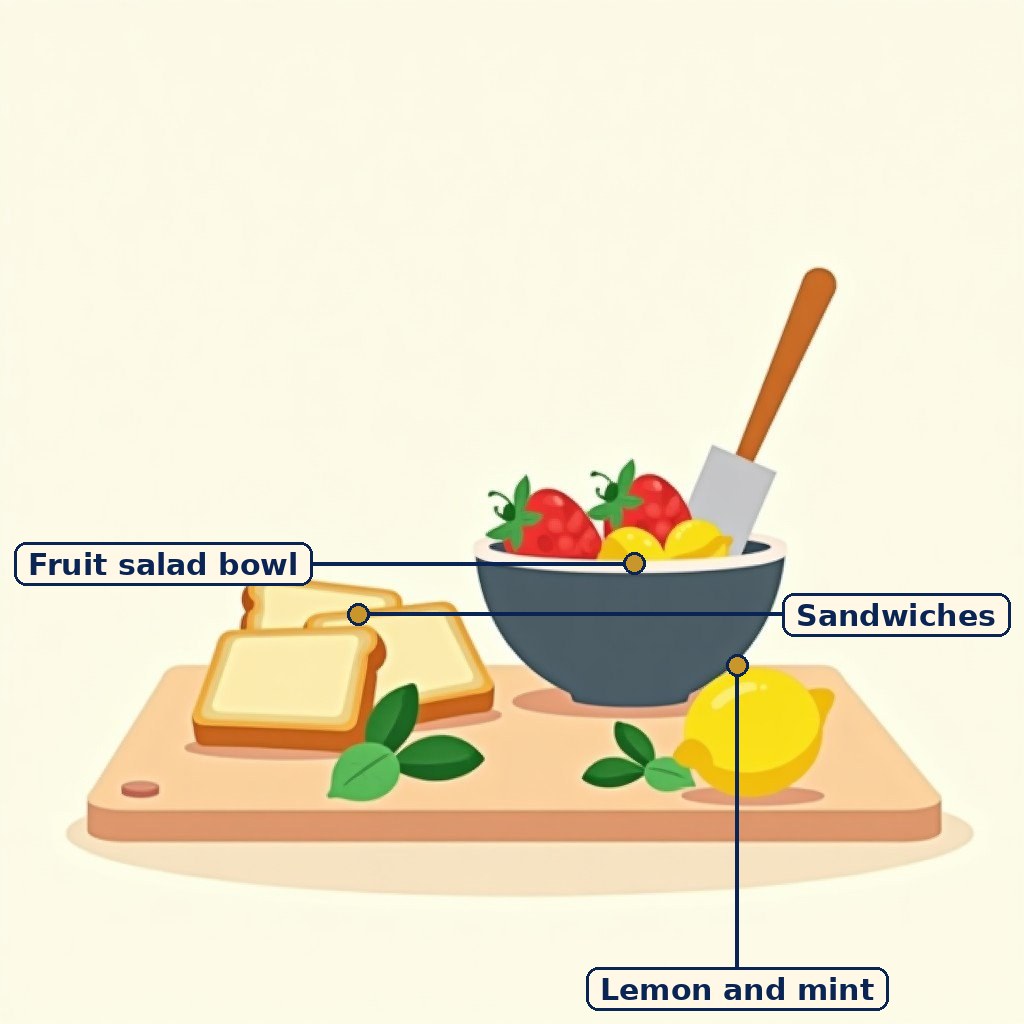
Diagram (labels are printed on the image): No-fire cooking: a fruit salad bowl, sandwiches, lemon and mint on a table. A general teaching picture; the foods shown are examples.
Children making fruit chaat with adult help. A general picture about safe no-fire cooking; no real kitchen is pictured.
What the chapter is about
We all enjoy eating, and some of us enjoy cooking. Cooking involves many methods like boiling, baking, steaming, grilling and frying. Raw food is heated to a high temperature, which changes the food, kills germs, improves texture and flavour, and makes it tastier and easier to eat. We often use a gas or other type of stove — the heat cooks the food — with different utensils depending on what we are preparing. But we can cook without fire as well, and we also eat some foods without heating. Besides raw fruits, we eat certain raw vegetables — only those vegetables that do not need cooking to be edible can be eaten raw. Raw vegetables keep their maximum nutritional value, since they are not exposed to heat, which can break down nutrients.
Preparing food without fire or heat opens up creativity and nutrition: fresh, uncooked ingredients make salads, refreshing smoothies, inventive dips and desserts, and endless other possibilities. This preserves the nutritional value of the ingredients, encourages a closer connection to the food we eat, and promotes mindful eating and a healthy lifestyle. Cooking gives pleasure and a sense of pride, and teaches teamwork and cooperation — people who work in a kitchen, like chef, cook, specialist cook, dish washer and kitchen porter, have to work together. You have learnt about components of food, nutritional value and balanced diet in Science; a diet rich in essential nutrients, especially from raw fruits and vegetables, helps maintain a healthy body and mind.
What you will be able to do
- Make use of basic kitchen tools, equipment and utensils.
- Prepare tasty dishes without using fire.
- Present dishes in a way that makes them look tempting.
- Dispose of food waste and leftovers in an environment-friendly manner.
- Learn about cooking without fire; use tools and equipment, measure ingredients and prepare food; prepare beverages; conduct a survey to decide a menu; dispose of waste materials properly; and organise a food Mela.
What you will need
- Tray, bowl, plates and vessels or pots.
- Measuring cups, knife, kitchen weighing scale, chopping board, peeler, grater, fork, whisk, tablespoon, cups, wooden churner (Maadhani).
- Locally available fruits, vegetables, lentils, pulses, milk, curd, puffed rice, peanuts, butter and bread.
- Soap and water.
- Apron, haircap or any cloth to cover hair.
- Dustbins for keeping wet and dry waste.
The book's tool picture shows, from left to right: (a) chopping board and knife, (b) measuring cups, (c) grater, (d) peeler and (e) whisk.
Always wash your hands before and after handling food. Be extremely careful with sharp tools, and use them exactly as demonstrated — do not rush. Clean up any spilled water or liquid immediately, to prevent anyone slipping and falling. Follow all other safety rules discussed with your teacher at all times. On the Internet: ask your teacher for help, be careful not to upload or download anything, and do not share personal information anywhere. Children should cut only with an adult guiding them.
Before you start: what is a recipe, and three no-fire techniques
A recipe is a set of instructions that tells you how to make a dish: it has the list of ingredients and the steps to follow. In this project you will use a few ways of cooking: mixing — combining ingredients together, as in a salad or a beverage; spreading — applying a soft substance over a surface, such as butter or cheese spread on bread, or chutney in a chapatti roll; and assembling — putting ingredients together to make a dish, like making Bhel Puri or sprouts Chaat.
Activity 1 — Reading recipes. Learn to follow each step: read it all first — read the entire recipe from start to end before you begin; check the ingredients — make sure you have the right quantity of all of them; prepare — gather the equipment and utensils you may need; follow the steps — complete each step in the order listed; and look up unfamiliar words — if you see a word you do not know, use a dictionary or ask the teacher. The space against each recipe's name is for you to write any other name(s) you use for the dish.
The way your dish looks is almost as important as its taste. Use colourful ingredients to make the dish vibrant — for a fruit salad, use fruits of different colours. Arrange food neatly on the plate, and add a little garnish — for example, some sev and peanuts placed decoratively on a plate of Bhel Puri, or mint leaves on buttermilk. Search the Internet for photographs of beautifully arranged food for inspiration, using the keywords 'presentation + beautiful + dishes + food' and 'presentation + beautiful + dishes + food + Indian'.
The book's recipes (summarised in EG's own words)
| Dish | Ingredients (as in the book) | What to do (summary) |
|---|---|---|
| Buttermilk | 2 cups curd, 2 cups water, 1 teaspoon roasted cumin powder, salt to taste, chopped mint leaves (optional) | Combine curd, water, cumin powder and salt in a bowl; whisk until smooth; pour into glasses and garnish with mint leaves if desired. |
| Jaljeera | 2 tablespoons Jaljeera powder, 4 cups cold water, 1 tablespoon lemon juice, 1 tablespoon mint leaves (finely chopped), 1 tablespoon coriander leaves (finely chopped) | In a large jug, mix chopped mint and coriander leaves, Jaljeera powder and lemon juice; add 4 cups of water and mix quickly until completely blended (a blender may be used); pour equally into glasses, add the remaining water, mix well, and serve immediately. |
| Kokam Sherbet | 10–12 dried kokam petals, 4 cups water, sugar or honey to taste, roasted cumin powder (optional) | Soak the kokam petals in water for 2–3 hours; strain the kokam-infused water into a pitcher; add sugar or honey to taste and stir until dissolved; optionally add a pinch of roasted cumin powder; chill in the refrigerator before serving (optional). |
| Salad | 3 cups cut assorted locally available vegetables (cucumbers, tomatoes, capsicum, carrots, lettuce), ¼ cup vegetable oil, 2 tablespoons lemon juice, 1 teaspoon honey, salt and pepper to taste | Wash and chop the vegetables into small cubes; tear lettuce leaves into small pieces; whisk oil, lemon juice, honey, salt and pepper into a dressing, taste and adjust seasoning; toss the vegetables with the dressing, salt and pepper. |
| Koshimbir | 1 cup soaked and drained Moong Dal, 1/2 cup grated carrot, 1/4 cup grated coconut, 1/2 cup cucumber (small cubes), 1–2 green chillies (finely chopped), chopped coriander leaves, salt to taste, lemon juice to taste | Wash and soak the Moong Dal for 30 minutes; wash and prepare the vegetables; mix soaked Moong Dal, grated carrot, grated coconut, chopped green chillies and coriander; season with salt and lemon juice to taste. |
| Fruit Chaat | 3 cups cut assorted locally available fruits (for example apples, grapes, oranges), 2 tablespoons lemon juice, honey or sugar (optional), Chaat Masala to taste | Wash and chop fruits into bite-sized pieces; drizzle lemon juice to prevent discoloration; sweeten with honey or sugar if wanted, season with Chaat Masala, and toss gently. |
| Shrikhand | 3 cups thick curd, 1/2 cup powdered sugar, 1/2 teaspoon cardamom powder, saffron strands (optional), chopped nuts for garnish (optional) | Hang the curd in a muslin cloth for a few hours to remove excess water; mix the hung curd, powdered sugar and cardamom powder until smooth; add saffron strands for flavour; garnish with chopped nuts before serving. |
| Bhel Puri | 2 cups puffed rice (Murmura), 1/2 cup chopped onions, 1/2 cup chopped tomatoes, 1/4 cup chopped coriander, 1/4 cup sev or roasted peanuts, Chaat Masala to taste, salt to taste, 2 tablespoons Mint Chutney (optional) | Wash and chop onions, tomatoes and coriander; mix puffed rice, onions, tomatoes and coriander; season with Chaat Masala and salt; mix well; top with sev or roasted peanuts before serving (add Mint Chutney if available). |
| Sprouts | 1/2 cup legumes (for example green Moong, Kabuli Chana or black Chana), water, muslin cloth | Put the legumes in three separate bowls, cover with water and soak overnight; place the soaked legumes onto a wet muslin cloth and sprinkle water over them; fold the cloth over them, place in a bowl, cover lightly with a lid so air can circulate; check from time to time and sprinkle water if the cloth feels dry; sprouting takes at least 12 hours — once little sprouts appear, transfer to a storage container and the sprouts are ready for salad. |
| Lemonade | 4 cups water, 8 lemons, 1/2 spoon sugar (as per taste) | Cut and squeeze the lemons; in a bowl, mix water, lemon juice and sugar until it dissolves. |
| Mint Chutney | 1/4 cup mint leaves, 1/4 cup coriander leaves, 1 or 2 green chillies, 1 small piece of ginger (about the size of your thumb), 1 small lemon, a pinch of salt, water | Wash mint and coriander leaves and shake off extra water; cut the ginger and green chillies; grind coriander, mint, ginger, green chillies, salt and a little water in a mixer or grinding stone until smooth; add lemon juice and mix well. |
| Sandwich | 8 bread slices, 2 tomatoes, 2 cucumbers, 2 tablespoons butter, salt and pepper to taste | Wash and slice the vegetables; spread a thin layer of butter on all bread slices; put a layer of sliced tomato or cucumber; season with salt and pepper; cover with another bread slice; cut to the desired shape (a thin layer of chutney after the butter is optional if a mixer is available). |
| Cucumber Raita | 1 cup plain yogurt, 1 grated cucumber, 1/2 teaspoon roasted cumin powder, 1 tablespoon chopped coriander leaves, salt and pepper to taste | Whisk the yogurt until smooth; add grated cucumber, roasted cumin powder, salt and chopped coriander leaves; mix well and serve immediately (1–2 tablespoons of Mint Chutney may be added if available). |
| Sprouts Chaat | 1½ cups assorted sprouts (for example green Moong, Kabuli Chana, black Chana), 1½ cups chopped vegetables (for example tomatoes, onions, cucumbers, carrot), 1–2 green chillies (finely chopped), 1 tablespoon lemon juice or vinegar, salt and pepper to taste | Wash and cut the vegetables; mix sprouts and chopped vegetables; season with lemon juice or vinegar, salt and pepper; toss well. |
| Coconut Chocolate Balls | 1 cup shredded coconut (unsweetened), 1/2 cup sweetened condensed milk, 3 tablespoons cocoa powder, 1/2 teaspoon vanilla extract, additional shredded coconut or cocoa powder for rolling (optional), a mixing and serving bowl | Combine shredded coconut, condensed milk, cocoa powder and vanilla extract and stir until a thick, sticky mixture forms; scoop small portions and roll into balls between your palms; roll in extra coconut or cocoa powder if desired; place on a plate or tray lined with paper; leave to set at room temperature for at least 1–2 hours until slightly firm, then enjoy. |
All quantities above are taken from the book's recipes, rewritten in EG's own words; if anything is unclear, ask your teacher before you cook.
Deciding, measuring, handling tools, storing and waste
Activity 2 — Deciding on dishes to be prepared. Conduct a survey of students in the school to find out what they like to eat: what is your favourite dish, and which dishes do you like that can be prepared without fire? Record preferences from 1 (least preferred) to 5 (most preferred) for dishes including Coconut Chocolate Balls, Cucumber Raita, Fruit Chaat, Buttermilk, Koshimbir, Lemonade, Sandwich and Bhel Puri, and use the results to decide your menu.
Activity 3 — Measure your food ingredients. Both standard and non-standard units are used in cooking, and understanding them ensures accuracy and consistency: one pinch of sugar is a non-standard measurement, and 10 grams of flour is a standard measurement. Without a weighing scale or measuring cups, estimate with common kitchen items — cups, teaspoons and tablespoons. For liquids: a teaspoon holds about 5 ml, a tablespoon about 15 ml, one cup about 250 ml, and one litre can be estimated with a 1-litre drinking-water bottle. It is good to have a rough idea of how many grams common ingredients weigh per cup or spoon, so recipes turn out the same each time.
Activity 4 — Handling tools with care and safety. Proper use of kitchen tools improves cooking and ensures safety and hygiene: handle sharp knives with care, use a chopping board while cutting, always cut away from the body and keep fingers clear of the blade; use measuring cups and spoons accurately so recipes succeed; operate appliances such as blenders and mixers according to the manufacturer's instructions to prevent accidents; and clean tools properly after use to prevent cross-contamination and keep the kitchen hygienic.
Activity 5 — Storing food. Different ingredients need different cleaning and storage methods, and proper storage keeps food fresh and prevents spoilage: grains and legumes go in airtight containers to protect them from pests and moisture; spices and herbs go in airtight containers, away from heat and light; use small bowls, plates or containers to keep ingredients separate; and if you have many ingredients, label them to avoid confusion.
Activity 6 — Handling and disposing of kitchen waste. Segregate kitchen waste into different bins: organic waste is collected separately and used for composting or vermicomposting to create nutrient-rich soil for gardening, or disposed of through municipal composting programmes where available; follow local guidelines and regulations for segregation and disposal. Empty containers such as bottles, jars and food trays (check for recycling symbols) go separately for recycling, as do clean cardboard, newspapers, magazines and paper packaging.
Making beverages, dishes and a food Mela
Activity 7 — Beverage making. Beverages include any drink besides water — for example lemonade, buttermilk, Jaljeera and Kokam Sherbet. Prepare one, record what you made, and note what you learnt about measuring, mixing and serving it.
Activity 8 — Dishes that require cutting and mixing. Cut fruits and vegetables that are ready to eat, and mix them with salt, lime juice or another ingredient to make a tasty dish — for example salad and fruit Chaat.
Activity 9 — Dishes that require cutting and assembling. Assembling means taking bits of ready-to-eat food and turning them into something different with minimal effort. Examples: Koshimbir, sprouts Chaat, Bhel Puri, coconut chocolate balls, cucumber Raita and sandwich.
Activity 10 — Organise a food Mela. With your teacher and peers, plan and organise a small-scale food Mela to exhibit the dishes you learnt to prepare. Answer: what do you think is special about your food item; make a poster, invitation card or social-media message to invite visitors; and how will you attract people to try the food items?
The book asks: can you eat raw potatoes? No — only vegetables that do not need cooking to be edible can be eaten raw. Raw fruits and suitable raw vegetables keep maximum nutritional value because heat can break down nutrients — but anything that must be cooked must still be cooked, and anything you cut must be washed first and cut with adult guidance.
Key Terms
- Recipe — A set of instructions for making a dish: its ingredients and the steps to follow.
- Cooking without fire — Preparing food without a stove, flame or heat, using fresh, uncooked ingredients.
- Mixing — Combining ingredients together, as in a salad or a beverage.
- Spreading — Applying a soft substance over a surface, such as butter or cheese spread on bread, or chutney in a chapatti roll.
- Assembling — Putting bits of ready-to-eat food together into a new dish, such as Bhel Puri or sprouts Chaat.
- Standard measurement — An exact unit, such as 10 grams of flour; a teaspoon holds about 5 ml, a tablespoon about 15 ml, and a cup about 250 ml of liquid.
- Non-standard measurement — An approximate amount, such as one pinch of sugar.
- Maadhani — A wooden churner used in the kitchen.
- Cross-contamination — Germs or food passing from one food or tool to another; prevented by cleaning tools properly after use.
- Segregation (of waste) — Separating waste into different bins — organic waste, recyclables, and so on — for proper disposal.
- Vermicomposting / composting — Turning organic waste into nutrient-rich soil, with or without earthworms.
- Food Mela — A small fair exhibiting dishes you have learnt to prepare.
- Read the whole recipe first, check quantities, gather equipment, follow steps in order, and look up unfamiliar words.
- Measure accurately: standard units (grams, ml) beat guesses, but cups, teaspoons and tablespoons work when no scale is available.
- Cut away from your body, fingers clear of the blade, with an adult guiding you; clean spills at once.
- Store grains, legumes, spices and herbs airtight and labelled; segregate waste — organic for composting, containers and clean paper for recycling.
- Present beautifully: colour, neat arrangement and a small garnish — and serve a balanced meal you are proud of.
Practice set — try it yourself
- What is cooking without fire?
Hint: Think about food without a stove. - Name three no-fire dishes.
Hint: Think salads, sandwiches, lemonade. - Why wash hands and vegetables first?
Hint: Think about food safety. - Why need adult help for cutting?
Hint: Think about knife safety. - Make a fruit chaat with adult help and describe the steps.
Hint: Note washing, cutting, mixing, serving.
Questions with Answers
- What is cooking without fire?
Cooking without fire is making food without a stove or flame, such as salads, sandwiches, fruit chaat, lemonade, curd raita and sprout snacks. - Why is hygiene important in no-fire cooking?
Because food is eaten raw or uncooked, so clean hands, washed vegetables, clean boards and covered food keep it safe and tasty. - Why must cutting be done with adult help?
Because knives are sharp and can cut fingers. Children should cut only with an adult guiding them. - What makes food presentation good?
Neat arrangement, colour from fruits and herbs, clean serving plates, and serving with care and a smile. - How should leftovers be handled?
Keep raw and ready food separate, wash hands often, cover leftovers, and refrigerate them quickly instead of leaving them out.
Questions with Answers — extension (NCERT recipes, measuring, storage, waste and Think and Answer types)
- What is a recipe, and how do you follow one?
A recipe is a set of instructions with a list of ingredients and steps. Read it all first, check you have the right quantities, gather equipment and utensils, follow the steps in order, and look up unfamiliar words in a dictionary or by asking your teacher. - What are mixing, spreading and assembling?
Mixing combines ingredients, as in a salad or beverage. Spreading applies a soft substance over a surface, such as butter or cheese spread on bread or chutney in a chapatti roll. Assembling puts bits of ready-to-eat food together into a new dish, such as Bhel Puri or sprouts Chaat. - Give the book's quantities for buttermilk, lemonade and a sandwich.
Buttermilk: 2 cups curd, 2 cups water, 1 teaspoon roasted cumin powder, salt to taste, chopped mint leaves (optional) — whisk until smooth and garnish with mint. Lemonade: 4 cups water, 8 lemons, 1/2 spoon sugar to taste — squeeze the lemons and mix until the sugar dissolves. Sandwich: 8 bread slices, 2 tomatoes, 2 cucumbers, 2 tablespoons butter, salt and pepper — spread butter thinly, layer tomato or cucumber, season, cut and serve. - How are sprouts made?
Soak 1/2 cup legumes (green Moong, Kabuli Chana or black Chana) in water, drain onto a wet muslin cloth, fold the cloth over them, place in a bowl, cover lightly with a lid so air can circulate, check and keep the cloth moist — little sprouts appear and the sprouts are then ready. - What are standard and non-standard measurements? Give liquid equivalents.
Standard: exact units such as 10 grams of flour. Non-standard: approximate amounts such as one pinch of sugar. For liquids, a teaspoon holds about 5 ml, a tablespoon about 15 ml, one cup about 250 ml, and one litre can be estimated with a 1-litre drinking-water bottle. - How do you store grains, legumes, spices and herbs?
Grains and legumes: airtight containers, protected from pests and moisture. Spices and herbs: airtight containers, away from heat and light. Keep ingredients separate in small bowls, plates or containers, and label them to avoid confusion. - How is kitchen waste handled responsibly?
Segregate it into different bins: organic waste separately for composting or vermicomposting into nutrient-rich soil for gardening (or municipal composting where available), following local guidelines; empty bottles, jars and food trays (check recycling symbols) and clean cardboard, newspapers, magazines and paper packaging separately for recycling. - Can you eat raw potatoes? Why or why not?
No. Only vegetables that do not need cooking to be edible can be eaten raw; potatoes need cooking. Suitable raw vegetables keep maximum nutritional value because heat can break down nutrients. - Can you prepare an entire balanced meal without using fire?
Yes, in principle — for example a menu of sprouts Chaat or salad, a sandwich, cucumber Raita, fruit Chaat and lemonade or buttermilk covers vegetables, pulses, curd, bread and fruit — but the book asks you to answer Yes/No for your own menu and explain your choice. - Which jobs are related to this project?
Cook at home, chef in a hotel, and an artist who presents food in different forms.
How to use this page: Read the summary, say the Key Terms in your own words, then try the practice set without looking. Check your answers against Questions with Answers, and ask your teacher or parent to check your work.