

Chapter 4: The d- and f-Block Elements
Transition metals, their trends, KMnO₄ and K₂Cr₂O₇, lanthanoids and actinoids.
Original notes — ready CBSE (NCERT, English Medium) • Class 12 • Chemistry • Book: Chemistry — Part I
Chapter 4: The d- and f-Block Elements — EG's own summary, in simple words
Book: Chemistry — Part I (CBSE, Class 12) | Chapter 4 | Medium: English
The d-block holds the transition metals — hard, dense, coloured, magnetic, and catalytic — and the f-block holds the lanthanoids and actinoids tucked below the table. This chapter explains why their properties follow from half-filled d and f orbitals, tracks the trends across each series, and studies the two oxidising agents the board loves: potassium permanganate and potassium dichromate.
Diagram (labels on the image): d-block, f-block, Transition metals (labels as drawn). Labels added by Educational Galaxy on an originally generated illustration.
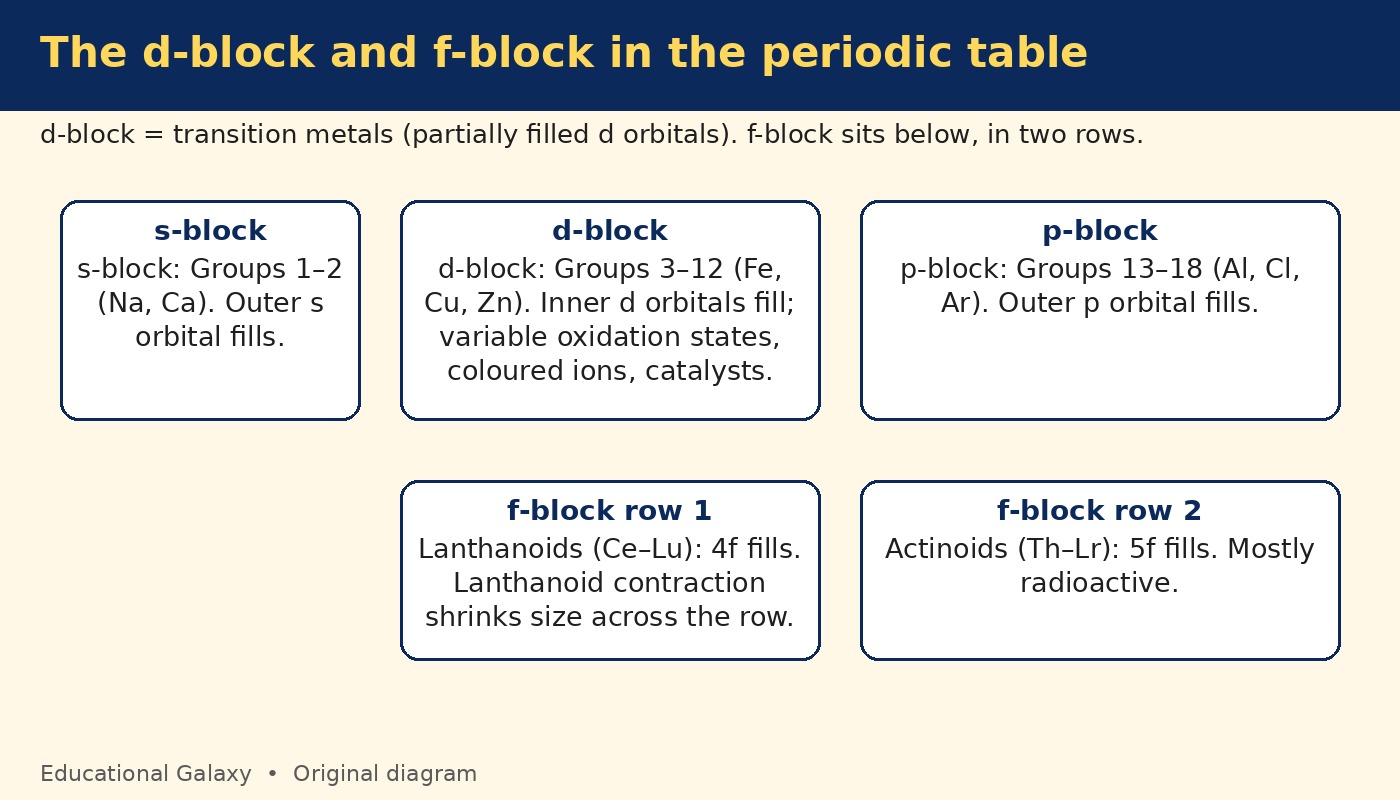
EG schematic (drawn and labelled by Educational Galaxy): Where the blocks sit: the d-block (groups 3–12) between s and p, the f-block below — lanthanoids after lanthanum, actinoids after actinium.
4.1 Position and electronic configuration
The d-block (groups 3 to 12) sits between the s-block and p-block. Its elements fill d orbitals; the f-block (lanthanoids and actinoids) fills f orbitals and is placed below the main table to keep it compact.
A transition metal is defined as an element with an incompletely filled d subshell in its ground state or in one of its oxidation states. By this strict definition, zinc, cadmium and mercury (d¹⁰ in both states) are not transition metals, though they sit in the d-block. Scandium (d¹ in the atom, d⁰ as Sc³⁺) is also excluded in its common state.
Electronic configurations break the simple filling pattern because half-filled and fully filled d subshells are extra stable: chromium is [Ar] 3d⁵4s¹ (not 3d⁴4s²) and copper is [Ar] 3d¹⁰4s¹ (not 3d⁹4s²). Similar exceptions appear in the f-block.
4.2 General properties of transition metals
- Atomic size: radii fall slowly across a series because the added nuclear charge is largely shielded by the added d electrons; the 4d and 5d series are almost the same size because of lanthanoid contraction.
- Ionisation enthalpy: rises slowly across a series, with small irregularities from stable d⁵ and d¹⁰ configurations.
- Oxidation states: many, because both ns and (n−1)d electrons can take part. Manganese shows the widest range (+2 to +7); the most common state for the first series is +2 (loss of the 4s electrons), and higher states appear with oxygen and fluorine, which are small and highly electronegative.
- Trends in stability: for the first series, +2 and +3 dominate; higher states become more stable going down a group (for example, Mo(VI) and W(VI) are more stable than Cr(VI)).
- Magnetic properties: most transition ions are paramagnetic because of unpaired d electrons. Magnetic moment μ = √[n(n+1)] BM, where n is the number of unpaired electrons. A d⁵ ion (Mn²⁺, Fe³⁺) has μ ≈ 5.92 BM, the maximum for the first series.
- Coloured ions: colour comes from d–d transitions — an electron jumps between split d orbitals and absorbs visible light of a complementary colour. Ions with d⁰ (Sc³⁺, Ti⁴⁺) or d¹⁰ (Zn²⁺, Cu⁺) are colourless because no d–d transition is possible.
- Catalytic activity: transition metals catalyse because they change oxidation state easily and adsorb reactants on their surface (Fe in Haber’s process, V₂O₅ in the Contact process, Ni in hydrogenation, Pt in Ostwald’s process).
- Complex formation and interstitial compounds: small size, high charge and empty d orbitals make complex formation easy; small atoms (H, C, N, B) fit into metal lattices to give hard, high-melting interstitial compounds like TiC and Fe₃C.
- Alloy formation: similar atomic sizes let one transition metal dissolve in another, giving alloys such as brass, bronze and stainless steel.
4.3 Some important compounds — KMnO₄ and K₂Cr₂O₇
Potassium permanganate is made from pyrolusite ore (MnO₂): MnO₂ is fused with KOH and oxidised (by air or KNO₃) to green potassium manganate, K₂MnO₄, which is then oxidised (by Cl₂ or by electrolysis) to purple KMnO₄. In acid solution MnO₄⁻ is a very strong oxidising agent: MnO₄⁻ + 8H⁺ + 5e⁻ → Mn²⁺ + 4H₂O, and it oxidises Fe²⁺ to Fe³⁺, oxalate to CO₂, and iodide to iodine. KMnO₄ is its own indicator in titrations — the first permanent pink colour marks the end point. On heating it gives K₂MnO₄ + MnO₂ + O₂.
Potassium dichromate is made from chromite ore (FeCr₂O₄): the ore is fused with Na₂CO₃ in air to give yellow sodium chromate, acidified to orange sodium dichromate, then converted with KCl to K₂Cr₂O₇. The chromate–dichromate equilibrium is pH-dependent: in acid, yellow CrO₄²⁻ becomes orange Cr₂O₇²⁻ (2CrO₄²⁻ + 2H⁺ ⇌ Cr₂O₇²⁻ + H₂O); in alkali the reverse happens. K₂Cr₂O₇ in acid oxidises Fe²⁺, iodide, sulphite and H₂S, itself turning green (Cr³⁺). Both KMnO₄ and K₂Cr₂O₇ are primary-standard-adjacent oxidants in volumetric analysis, but K₂Cr₂O₇ is the true primary standard because it is stable and pure.
Structures: MnO₄⁻ and CrO₄²⁻ are tetrahedral; Cr₂O₇²⁻ has two tetrahedra sharing one oxygen. In both, the metal is in its highest oxidation state (+7 for Mn, +6 for Cr) with d⁰ configuration — so the intense colour is not a d–d transition but charge transfer (oxygen-to-metal).
4.4 The f-block — lanthanoids and actinoids
The lanthanoids (Ce to Lu) fill 4f orbitals. Their common oxidation state is +3; Ce also shows +4 and Eu +2 because of the stability of empty, half-filled and filled f subshells. Lanthanoid contraction is the steady fall in atomic and ionic size across the series: the 4f electrons shield poorly, so the growing nuclear charge pulls the outer electrons in more tightly.
Consequences of lanthanoid contraction: the 5d (third-series) transition metals end up almost the same size as the 4d (second-series) ones — zirconium and hafnium are a famous pair, nearly identical in size and therefore hard to separate. It also makes the separation of lanthanoids themselves difficult, since their chemistry is nearly identical; ion-exchange methods are used.
The actinoids (Th to Lr) fill 5f orbitals and show a wider range of oxidation states (+3 to +7) because 5f, 6d and 7s energies are close. Most actinoids are radioactive, and the later ones are man-made. Their chemistry is harder to study and less regular than the lanthanoids’. Uses: lanthanoids in magnets, phosphors, catalysts (mischmetal in lighter flints) and lasers; actinoids — uranium and plutonium — as nuclear fuels.
Applications of d- and f-block metals overall: iron and steel in construction, titanium in aircraft, copper in wiring, chromium in stainless steel, platinum as a catalyst, and lanthanoid magnets in headphones and wind turbines.
NCERT coverage — every section of this chapter
This page covers, in EG's own words, every section of the NCERT chapter:
- 4.1 Position in the periodic table
- 4.2 Electronic configurations of d-block elements
- 4.3 General properties of the transition elements (d-block)
- 4.4 Some important compounds of transition elements (KMnO₄ and K₂Cr₂O₇)
- 4.5 The lanthanoids
- 4.6 The actinoids
- 4.7 Some applications of d- and f-block elements
No NCERT question type from these sections is left without notes and practice below.
Why transition metals behave the way they do
| Property | Reason |
|---|---|
| Many oxidation states | ns and (n−1)d electrons are close in energy, so both can be used |
| Coloured ions | d–d transitions absorb visible light (needs partly filled d orbitals) |
| Paramagnetism | Unpaired d electrons; μ = √[n(n+1)] BM |
| Good catalysts | Easy change of oxidation state + surface adsorption |
| Complex formation | Small size, high charge, vacant d orbitals |
| Hard, high-melting metals | Strong metallic bonding from d electrons |
Key Terms / Important Terms
- Transition metal: An element with an incompletely filled d subshell in its ground state or an oxidation state.
- Lanthanoid contraction: Steady decrease in size across the lanthanoid series due to poor shielding by 4f electrons.
- Paramagnetism: Attraction to a magnetic field from unpaired electrons; μ = √[n(n+1)] BM.
- d–d transition: Electron jump between split d orbitals that absorbs visible light and gives colour.
- Mischmetal: Lanthanoid alloy (with iron) used in lighter flints.
- Chromate–dichromate equilibrium: 2CrO₄²⁻ + 2H⁺ ⇌ Cr₂O₇²⁻ + H₂O; yellow in alkali, orange in acid.
- Interstitial compound: Small atoms (H, C, N) trapped in a metal lattice, making it hard and high-melting.
- Primary standard: A pure, stable substance weighed directly for standard solutions; K₂Cr₂O₇ qualifies, KMnO₄ does not.
Remember
- Zn, Cd, Hg are d-block but not transition metals (d¹⁰ in all common states).
- Cr is 3d⁵4s¹ and Cu is 3d¹⁰4s¹ — half-filled and filled d subshells win over the filling order.
- Mn shows the most oxidation states (+2 to +7); the common first-series state is +2.
- Lanthanoid contraction makes 4d and 5d metals nearly the same size (Zr ≈ Hf).
Exam Tip / Common Mistake
Colour questions: first count d electrons. d⁰ or d¹⁰ means colourless (no d–d transition). For magnetic moment, count unpaired electrons only — for Fe³⁺ (d⁵) μ = 5.92 BM, for Cu²⁺ (d⁹, one unpaired) μ = 1.73 BM. And remember MnO₄⁻/Cr₂O₇²⁻ are coloured by charge transfer, not d–d transitions, because both metals are d⁰.
Practice set — try it yourself
- Why are Zn, Cd and Hg not considered transition metals, even though they are in the d-block?
- Write the electronic configurations of Cr and Cu and explain why they differ from the expected pattern.
- Calculate the magnetic moment of Fe³⁺ and Cu²⁺ ions. Which is more paramagnetic?
- Why is K₂Cr₂O₇ a primary standard but KMnO₄ is not?
- What is lanthanoid contraction? Give one important consequence.
Questions with Answers — full answers
- Why do transition metals show variable oxidation states, while s-block metals do not? Answer: In transition metals the ns and (n−1)d orbitals are close in energy, so both can lose electrons in different combinations. In s-block metals only the ns electrons are available, so the oxidation state is fixed.
- Sc³⁺ is colourless but Ti³⁺ is coloured. Explain. Answer: Sc³⁺ is d⁰, so no d–d transition is possible and no visible light is absorbed. Ti³⁺ is d¹, so a d–d transition absorbs light and the transmitted light is coloured.
- Why is Mn²⁺ more stable than Mn³⁺ in aqueous solution, while Fe³⁺ is more stable than Fe²⁺? Answer: Mn²⁺ is d⁵ (half-filled, extra stable) while Mn³⁺ is d⁴; Fe³⁺ is d⁵ while Fe²⁺ is d⁶. The half-filled d⁵ configuration is unusually stable, so the d⁵ ion wins in each pair.
- Describe the preparation of KMnO₄ from pyrolusite ore in two steps. Answer: Fuse MnO₂ with KOH and oxidise in air to green K₂MnO₄; then oxidise K₂MnO₄ (with Cl₂ or electrolysis) to purple KMnO₄. In acid, MnO₄⁻ is reduced to Mn²⁺ and acts as a strong oxidising agent.
- What happens to the colour of a chromate solution when acid is added? Write the equilibrium. Answer: Yellow CrO₄²⁻ turns orange as it becomes Cr₂O₇²⁻: 2CrO₄²⁻ + 2H⁺ ⇌ Cr₂O₇²⁻ + H₂O. Adding alkali reverses it.
- Why are the 4d and 5d transition metals almost the same size? Answer: Lanthanoid contraction: the poor shielding of 4f electrons between them lets the nuclear charge pull the outer shells in, cancelling the expected size increase from 4d to 5d.
- Give two uses of transition metals as catalysts, with the process named. Answer: Iron in the Haber process (ammonia synthesis); V₂O₅ in the Contact process (sulphuric acid); finely divided nickel in oil hydrogenation.
- Why are transition metal fluorides and oxides in high oxidation states stable, but the corresponding iodides are not? Answer: Fluorine and oxygen are small and highly electronegative, so they can stabilise high positive charge on the metal. Iodide is large and easily oxidised, so it reduces the metal instead of stabilising a high state.
Extension Questions with Answers
- Calculate μ for Ni²⁺ (d⁸) and Co²⁺ (d⁷). Which has the larger moment? Answer: Ni²⁺ has 2 unpaired electrons: μ = √[2×3] = 2.45 BM. Co²⁺ has 3: μ = √[3×4] = 3.87 BM. Co²⁺ is more paramagnetic.
- Why does Cu⁺ (d¹⁰) disproportionate in water while Cu²⁺ is stable? Answer: Cu⁺ in water gives Cu²⁺ + Cu. The high hydration enthalpy of Cu²⁺ (small, doubly charged) more than compensates, making the d⁹ state energetically favoured in water despite the stable d¹⁰ configuration of Cu⁺.
- Explain why KMnO₄ solution must be acidified before use as an oxidant in titrations, and why HCl is not used for acidification. Answer: In acid, MnO₄⁻ reduces cleanly to colourless Mn²⁺ (5-electron change), giving a sharp end point. HCl is avoided because MnO₄⁻ oxidises Cl⁻ to Cl₂, which consumes extra permanganate and spoils the titre; dilute H₂SO₄ is used instead.
- Why is the separation of lanthanoids difficult, and how is it done? Answer: Their sizes and chemistry are almost identical because of lanthanoid contraction, so ordinary precipitation fails. Ion-exchange chromatography separates them by tiny differences in ionic size and complex stability.
- Actinoids show more oxidation states than lanthanoids. Why? Answer: In actinoids the 5f, 6d and 7s orbitals are very close in energy, so more electrons can take part in bonding. In lanthanoids the 4f electrons are buried and the +3 state dominates.
Board-pattern Questions with Answers
- Write the electronic configuration of Fe³⁺ and state its magnetic moment. Answer: Fe is [Ar] 3d⁶4s²; Fe³⁺ is [Ar] 3d⁵. Five unpaired electrons: μ = √[5×6] = 5.92 BM.
- Why is Cu²⁺ coloured and Zn²⁺ colourless? Answer: Cu²⁺ is d⁹ with one unpaired electron, so d–d transitions absorb visible light. Zn²⁺ is d¹⁰ with no vacancy for a d–d transition, so it is colourless.
- Name the ore used for K₂Cr₂O₇ and write the first step of its preparation. Answer: Chromite ore, FeCr₂O₄. It is fused with sodium carbonate in air to give yellow sodium chromate, Na₂CrO₄.
- What is the oxidation state of Mn in KMnO₄ and Cr in K₂Cr₂O₇? Why are both intensely coloured despite being d⁰? Answer: Mn is +7, Cr is +6, both d⁰. Their colour comes from ligand-to-metal charge transfer (oxygen electrons jumping to the metal), not from d–d transitions.
- Define lanthanoid contraction and state its effect on the size of Hf relative to Zr. Answer: The steady decrease in atomic/ionic size across the lanthanoids from poor 4f shielding. It makes Hf (5d) almost the same size as Zr (4d), instead of larger.
Recap
- d-block = groups 3–12; transition metals have incomplete d subshells; Zn/Cd/Hg are exceptions.
- Variable oxidation states, colour (d–d), paramagnetism (μ = √[n(n+1)]), catalysis and complexes all follow from d electrons.
- KMnO₄ (from MnO₂) and K₂Cr₂O₇ (from chromite) are strong acid oxidants; chromate ⇌ dichromate depends on pH.
- Lanthanoid contraction (poor 4f shielding) makes 4d ≈ 5d sizes; actinoids are mostly radioactive with many oxidation states.