

Chapter 3: Chemical Kinetics
Rate, order, molecularity, integrated rate laws, Arrhenius equation and collision theory.
Original notes — ready CBSE (NCERT, English Medium) • Class 12 • Chemistry • Book: Chemistry — Part I
Chapter 3: Chemical Kinetics — EG's own summary, in simple words
Book: Chemistry — Part I (CBSE, Class 12) | Chapter 3 | Medium: English
Chemical kinetics asks how fast a reaction goes and what controls its speed. This chapter defines rate, separates order from molecularity, derives the zero-order and first-order rate laws with half-lives, explains why temperature has such a big effect through the Arrhenius equation, and finishes with collision theory — why most collisions still fail to react.
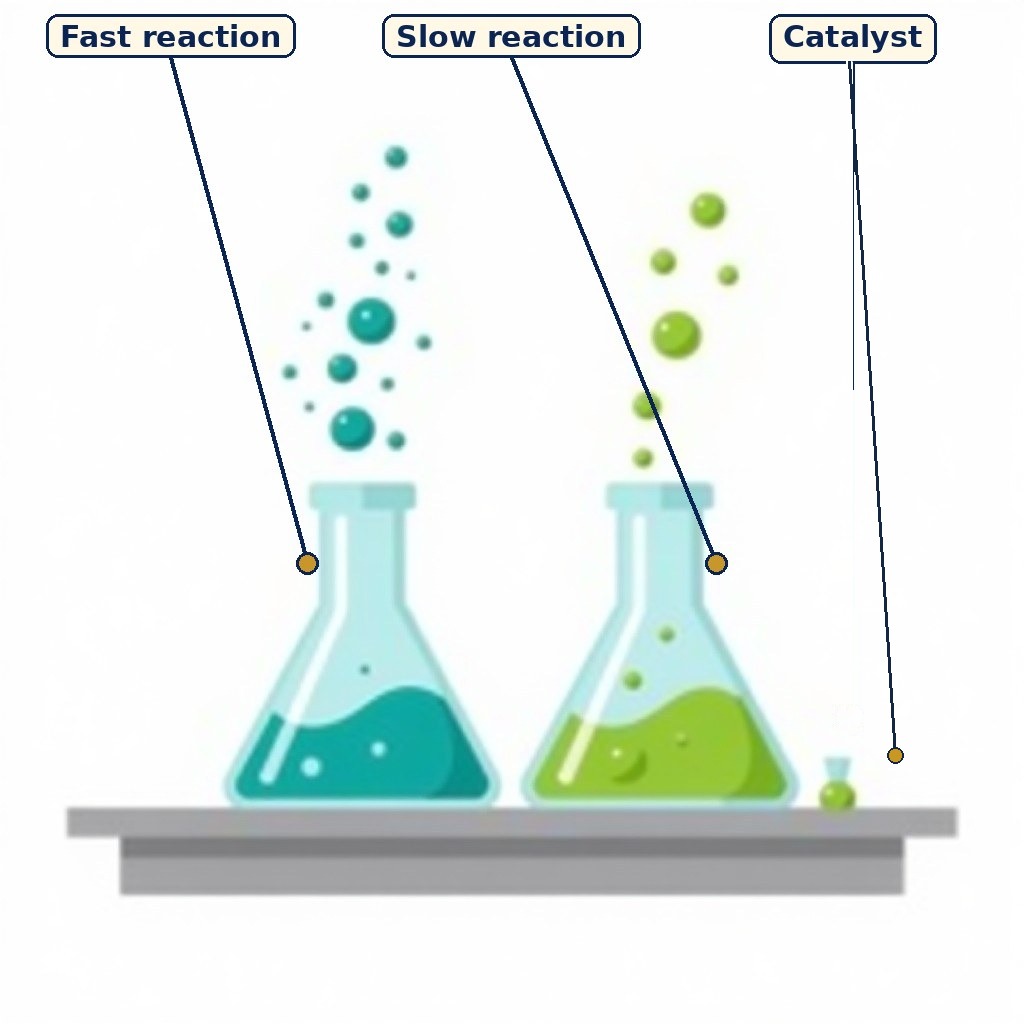
Diagram (labels on the image): Reactants, Activated complex, Products (labels as drawn). Labels added by Educational Galaxy on an originally generated illustration.
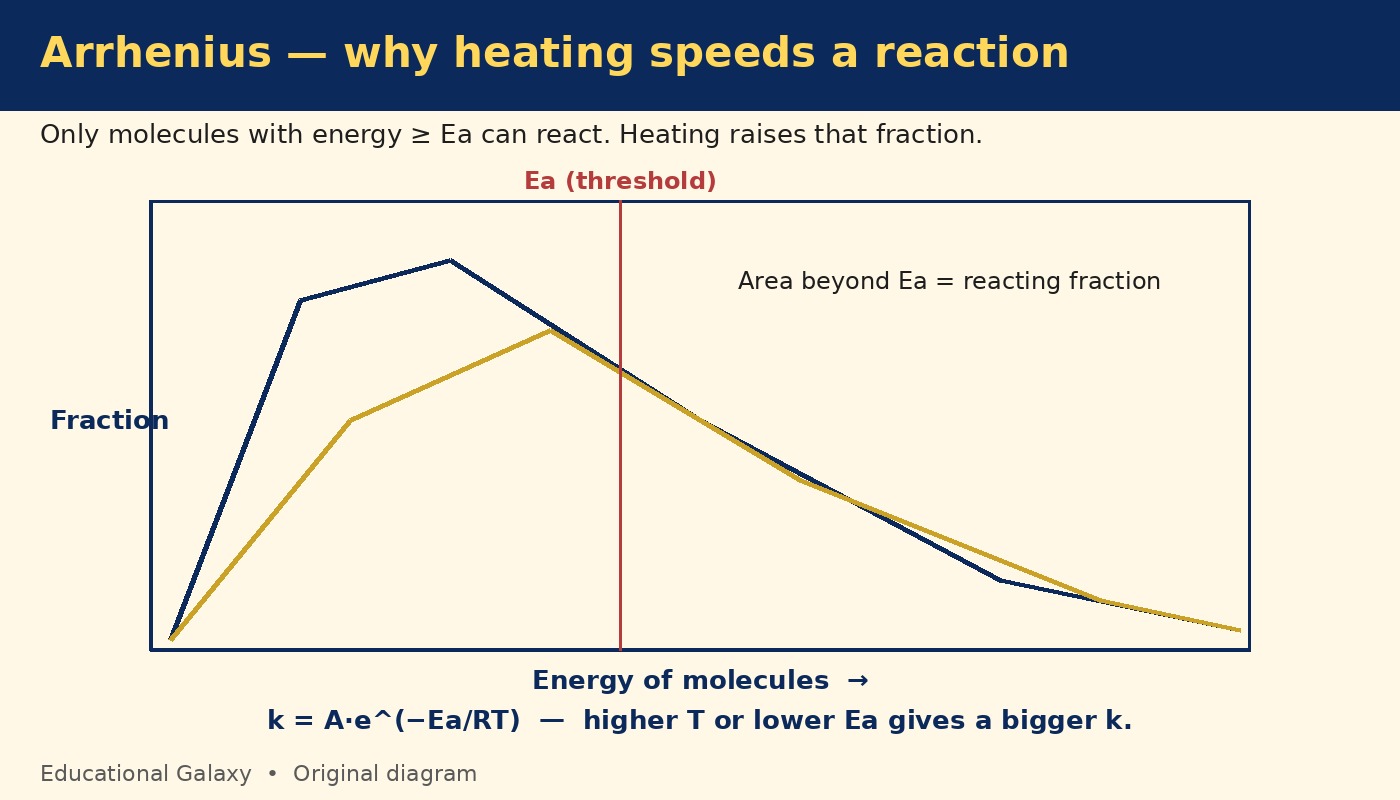
EG schematic (drawn and labelled by Educational Galaxy): Energy profile and Arrhenius idea: only molecules with energy above the activation energy Ea, colliding with the right orientation, cross the barrier to products; a catalyst lowers Ea.
3.1 Rate of a chemical reaction
Average rate is change in concentration over a time interval: for R → P, average rate = −Δ[R]/Δt = +Δ[P]/Δt. The minus sign keeps the rate positive even though reactant concentration falls. Instantaneous rate is the same idea over a vanishingly small interval — the slope of the concentration–time curve at that instant.
Rates are measured in mol L⁻¹ s⁻¹. A rate always refers to a chosen species; for a reaction aA + bB → cC, the single reaction rate is (1/a)(−d[A]/dt) = (1/b)(−d[B]/dt) = (1/c)(d[C]/dt), so that the rate does not depend on which species you watched.
- Rate falls as reactants are used up, because fewer reactant particles meet per second.
- Initial rate (at t ≈ 0) is used to find orders, because concentrations are still known exactly.
3.2 Factors influencing rate of reaction
- Concentration: more particles per volume means more collisions per second, so rate rises.
- Temperature: rate usually doubles or triples for a 10 K rise, because many more molecules cross the activation-energy barrier.
- Catalyst: provides a new path with lower activation energy, so it speeds the reaction without being consumed.
- Surface area: a powdered solid reacts faster than a lump, because more surface is exposed.
- Nature of reactants: ionic reactions are usually fast (ions already exist); covalent bonds must break first, so those reactions are slower. Light can also start reactions (photochemical reactions).
3.3 Rate law, order and molecularity
The rate law is found by experiment, never by looking at the balanced equation: rate = k[A]ˣ[B]ʸ, where k is the rate constant and x, y are orders with respect to A and B. The overall order is x + y. Orders can be zero, fractional, or negative in complex reactions.
Molecularity is different: it is the number of reactant particles that collide in one elementary step. It is always a whole number (1, 2, or rarely 3), never zero or fractional, and it only applies to elementary reactions. A complex reaction goes in steps; its rate is decided by the slowest step, the rate-determining step.
- Order is experimental; molecularity is theoretical. For an elementary reaction they agree; for a complex reaction they usually do not.
- Example: for 2NO + O₂ → 2NO₂ the experimental rate law is rate = k[NO]²[O₂], so order = 3, and the mechanism happens to involve a termolecular step — but order 3 here is still an experimental fact.
- Pseudo first order: a reaction that is really second order looks first order when one reactant is in huge excess (its concentration barely changes). Acid hydrolysis of ethyl acetate in excess water is the classic example: rate = k[ester], because [H₂O] is effectively constant.
Units of k depend on order: for order n, units are (mol L⁻¹)¹⁻ⁿ s⁻¹. First order: s⁻¹. Second order: L mol⁻¹ s⁻¹. Zero order: mol L⁻¹ s⁻¹. Checking units is a quick way to check an order in a numerical.
3.4 Integrated rate equations — zero order and first order
Zero order: rate does not depend on concentration at all: [R] = [R]₀ − kt. A plot of [R] against t is a straight line with slope −k. Half-life t½ = [R]₀/2k — it depends on the starting concentration. Example: decomposition of ammonia on a hot platinum surface; photochemical reactions.
First order: rate = k[R], so ln[R] = ln[R]₀ − kt, or log([R]₀/[R]) = kt/2.303. A plot of log[R] against t is a straight line. Half-life t½ = 0.693/k — independent of starting concentration, the signature test for first order. After n half-lives, (1/2)ⁿ of the reactant remains.
- To find k from data: use k = (2.303/t) log([R]₀/[R]) for first order.
- To test order graphically: [R] vs t straight → zero order; log[R] vs t straight → first order.
- For first order, time for 99% completion is about 6.64 half-lives, and time for 75% completion is 2 half-lives (50% then 25% remaining).
3.5 Temperature dependence — the Arrhenius equation
The Arrhenius equation is k = A·e^(−Ea/RT), where A is the frequency factor (collisions with correct orientation), Ea is the activation energy, R the gas constant and T in kelvin. Taking logs: log k = log A − Ea/(2.303RT). A plot of log k against 1/T is a straight line with slope −Ea/2.303R — the standard way to find Ea from two rate constants: log(k₂/k₁) = (Ea/2.303R)(1/T₁ − 1/T₂).
Why is temperature so powerful? At room temperature only a small fraction of molecules have energy ≥ Ea. Raising T shifts the Maxwell–Boltzmann distribution so that the fraction above Ea grows roughly exponentially — that is why a 10 K rise often doubles the rate, while concentrations change it only modestly.
A catalyst works by providing an alternative path with lower Ea, so more molecules qualify at the same temperature. It does not change ΔH or the equilibrium constant; it speeds both forward and reverse reactions equally, so equilibrium is reached faster but unchanged.
3.6 Collision theory
Collision theory says a reaction needs a collision with (1) enough energy (≥ Ea) and (2) the right orientation. The rate is k = P·Z·e^(−Ea/RT), where Z is the collision frequency and P is the steric (probability/orientation) factor.
Most collisions fail: either the molecules are too slow, or they hit in the wrong geometry. This explains why reactions are far slower than the raw collision count suggests, and why complex molecules (which need precise alignment) have small P values. Raising temperature helps twice: more collisions, and a bigger fraction above Ea.
The theory works well for simple gas reactions but is approximate for complex ones — it still gives the right picture for board questions: energy + orientation + catalyst lowering the barrier.
NCERT coverage — every section of this chapter
This page covers, in EG's own words, every section of the NCERT chapter:
- 3.1 Rate of a chemical reaction (average and instantaneous rate)
- 3.2 Factors influencing rate of reaction
- 3.3 Rate law and rate constant
- 3.4 Order and molecularity of a reaction
- 3.5 Integrated rate equations (zero order and first order)
- 3.6 Half-life of a reaction
- 3.7 Pseudo first order reactions
- 3.8 Temperature dependence of rate — Arrhenius equation
- 3.9 Collision theory of chemical reactions
No NCERT question type from these sections is left without notes and practice below.
Zero order vs first order
| Feature | Zero order | First order |
|---|---|---|
| Rate law | Rate = k | Rate = k[R] |
| Integrated form | [R] = [R]₀ − kt | ln[R] = ln[R]₀ − kt |
| Straight-line plot | [R] vs t | log[R] vs t |
| Half-life | t½ = [R]₀/2k (depends on [R]₀) | t½ = 0.693/k (independent of [R]₀) |
| Units of k | mol L⁻¹ s⁻¹ | s⁻¹ |
Key Terms / Important Terms
- Rate of reaction: Change in concentration per unit time; mol L⁻¹ s⁻¹.
- Rate law: Experimentally found relation: rate = k[A]ˣ[B]ʸ.
- Order of reaction: Sum of powers in the rate law; experimental, can be fractional or zero.
- Molecularity: Number of particles colliding in an elementary step; whole number only.
- Rate-determining step: The slowest step of a mechanism; it fixes the rate law.
- Half-life (t½): Time for concentration to fall to half its value; 0.693/k for first order.
- Activation energy (Ea): Minimum extra energy reactants need to reach the activated complex.
- Catalyst: A substance that lowers Ea and speeds a reaction without being consumed.
Remember
- Order comes from experiment, never from the balanced equation.
- First-order half-life does not depend on starting concentration; zero-order half-life does.
- Arrhenius plot: log k vs 1/T is straight with slope −Ea/2.303R.
- A catalyst lowers Ea and speeds both directions equally; it never changes the equilibrium position.
Exam Tip / Common Mistake
In rate-law questions, read the data table, not the equation: compare two experiments where only one concentration changes. If doubling A doubles the rate, order in A is 1; if it quadruples the rate, order is 2; if nothing changes, order is 0. And in log calculations, remember the 2.303 factor: ln x = 2.303 log x.
Practice set — try it yourself
- Define average rate and instantaneous rate. Why does the reactant term carry a minus sign?
- Distinguish order from molecularity with one example each.
- A first-order reaction has k = 0.0693 min⁻¹. What is its half-life?
- Why does a 10 K rise in temperature often double a reaction rate, while doubling concentration may not?
- What is a pseudo first order reaction? Give an example.
Questions with Answers — full answers
- For the reaction R → P, the concentration of R falls from 0.40 M to 0.10 M in 30 minutes. Calculate the average rate. Answer: Average rate = −Δ[R]/Δt = (0.40 − 0.10)/30 = 0.01 mol L⁻¹ min⁻¹.
- A reaction is first order in A and second order in B. Write the rate law. What happens to the rate if [B] is doubled? Answer: Rate = k[A][B]². Doubling [B] makes the rate 2² = 4 times.
- A first-order reaction is 75% complete in 40 minutes. Calculate its half-life. Answer: 75% complete means 25% remains, which is two half-lives (50% → 25%). So 2 × t½ = 40 min, t½ = 20 min.
- Why can molecularity never be zero or fractional, while order can? Answer: Molecularity counts whole particles colliding in one elementary step, so it must be a positive integer. Order is an experimental power in the rate law and can be zero, fractional or even negative.
- The rate constant of a reaction doubles when temperature rises from 300 K to 310 K. What does this tell you about Ea? Answer: A large temperature effect means a substantial activation energy: from log(k₂/k₁) = (Ea/2.303R)(1/T₁ − 1/T₂), with k₂/k₁ = 2, Ea ≈ 53.6 kJ mol⁻¹.
- Draw and explain the Maxwell–Boltzmann idea behind the Arrhenius equation. Answer: Most molecules sit below Ea; only the tail beyond Ea can react. Raising T flattens and shifts the distribution, so the area beyond Ea grows sharply — hence the exponential rise in k.
- Why does a catalyst not change the equilibrium constant of a reaction? Answer: It lowers Ea for forward and reverse reactions by the same amount, so both rates increase equally and the equilibrium position is unchanged; equilibrium is only reached faster.
- A zero-order reaction has k = 0.02 mol L⁻¹ s⁻¹ and [R]₀ = 0.50 M. How long for [R] to reach 0.10 M? Answer: [R] = [R]₀ − kt gives 0.10 = 0.50 − 0.02t, so t = 20 s.
Extension Questions with Answers
- For a first-order reaction, show that the time for 99% completion is about twice the time for 90% completion. Answer: t = (2.303/k) log([R]₀/[R]). For 90%: log 10 = 1; for 99%: log 100 = 2. So t₉₉ = 2 × t₉₀.
- The decomposition of N₂O₅ is first order with k = 5.0 × 10⁻⁴ s⁻¹. How long for the concentration to fall to one-eighth? Answer: One-eighth means three half-lives: t½ = 0.693/(5.0 × 10⁻⁴) = 1386 s; t = 3 × 1386 = 4158 s.
- Explain the steric factor P with a simple example. Answer: In NO + O₃ → NO₂ + O₂, the molecules must collide with the right atoms facing each other; a collision with the wrong orientation bounces off even with enough energy. P is the fraction of collisions with correct orientation.
- A reaction has Ea = 0. What happens to its rate when temperature rises? Answer: From k = A·e⁰ = A, the rate constant does not change with temperature (all collisions already have enough energy); the rate is temperature-independent.
- Two first-order reactions have half-lives 10 min and 30 min. Which is faster, and by what factor? Answer: k = 0.693/t½, so k₁/k₂ = 30/10 = 3. The first is three times faster.
Board-pattern Questions with Answers
- Define rate constant. What are its units for a second-order reaction? Answer: The rate constant k is the rate when every reactant concentration is 1 mol L⁻¹. For second order its units are L mol⁻¹ s⁻¹.
- For a reaction, doubling [A] with [B] constant doubles the rate, and doubling [B] with [A] constant quadruples the rate. Find the orders and the overall order. Answer: Order in A = 1, order in B = 2, overall order = 3.
- A first-order reaction takes 40 minutes for 50% completion. Calculate k and the time for 75% completion. Answer: t½ = 40 min, so k = 0.693/40 = 0.0173 min⁻¹. 75% completion needs two half-lives = 80 min.
- Why do powdered reactants react faster than lumps of the same mass? Answer: Powdering increases surface area, exposing more particles to collision at any moment, so the rate rises.
- State the Arrhenius equation and name each term. Answer: k = A·e^(−Ea/RT): k = rate constant, A = frequency factor, Ea = activation energy, R = gas constant, T = kelvin temperature.
Recap
- Rate = change in concentration per unit time; rate law is experimental.
- Order (experimental, any value) ≠ molecularity (whole particles in one step).
- Zero order: [R] = [R]₀ − kt, t½ = [R]₀/2k. First order: ln[R] = ln[R]₀ − kt, t½ = 0.693/k.
- Arrhenius: k = A·e^(−Ea/RT); catalyst lowers Ea; collision needs energy + correct orientation.