

Chapter 5: Coordination Compounds
Werner’s theory, ligands, IUPAC names, isomerism, VBT and crystal field theory.
Original notes — ready CBSE (NCERT, English Medium) • Class 12 • Chemistry • Book: Chemistry — Part I
Chapter 5: Coordination Compounds — EG's own summary, in simple words
Book: Chemistry — Part I (CBSE, Class 12) | Chapter 5 | Medium: English
A coordination compound hides a metal ion inside a cage of ligands — molecules or ions donating electron pairs to it. This chapter starts with Werner’s theory that explained their strange formulas, teaches the language of ligands and coordination numbers, gives the IUPAC naming rules, explores the many kinds of isomerism, and explains colour and magnetism with valence bond theory and crystal field theory.

Diagram (labels on the image): Central metal, Ligands, Coordination sphere (labels as drawn). Labels added by Educational Galaxy on an originally generated illustration.
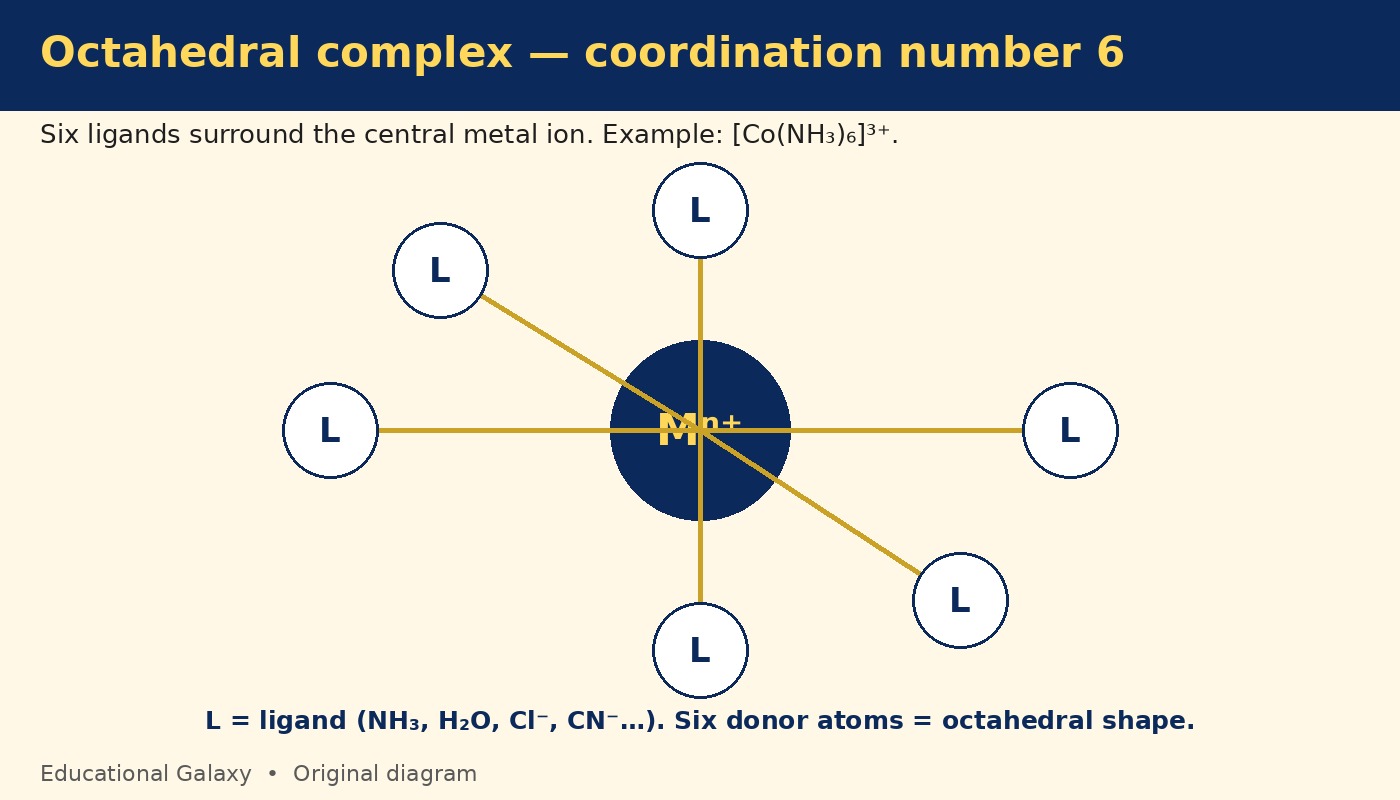
EG schematic (drawn and labelled by Educational Galaxy): An octahedral complex: the central metal ion surrounded by six ligands along the x, y and z axes — the geometry behind crystal field splitting into t2g and eg sets.
5.1 Werner’s theory — primary and secondary valency
Alfred Werner (1893) explained why CoCl₃·6NH₃ and CoCl₃·5NH₃ behave differently. His postulates: (1) metals show two kinds of valency — primary valency (the oxidation state), satisfied by anions and ionisable; (2) secondary valency (the coordination number), satisfied by ligands and non-ionisable, with a fixed geometry around the metal.
The test is precipitation with AgNO₃: CoCl₃·6NH₃, written [Co(NH₃)₆]Cl₃, gives 3 moles of AgCl (all three chlorides are outside, ionisable). CoCl₃·5NH₃, written [Co(NH₃)₅Cl]Cl₂, gives 2 moles (one chloride is inside the sphere, bonded to cobalt). The part in square brackets is the coordination entity; everything outside is the ionisation sphere.
Werner also predicted geometry: coordination number 6 is octahedral, 4 is usually square planar or tetrahedral. His work earned the 1913 Nobel Prize and founded coordination chemistry.
5.2 Terms, ligands and coordination number
- Central atom/ion: the metal that accepts electron pairs (usually a transition metal).
- Ligand: an ion or molecule donating at least one pair of electrons to the metal. Monodentate (one donor atom: NH₃, H₂O, Cl⁻, CN⁻), bidentate (two donor atoms: ethylenediamine ‘en’, oxalate ‘ox’), polydentate (several: EDTA is hexadentate and wraps a metal completely).
- Chelate: a ring formed when a bidentate or polydentate ligand binds through two or more atoms; chelates are extra stable (chelate effect). Ambidentate ligands can bind through either of two atoms (NO₂⁻ through N as nitro, through O as nitrito; SCN⁻ through S or N).
- Coordination number: the number of sigma bonds between ligands and the metal (number of donor atoms attached). Common values: 4 and 6; also 2 (Ag⁺ in [Ag(NH₃)₂]⁺), 5 and 7 in some complexes.
- Coordination sphere vs ionisation sphere: ligands inside brackets are bonded and do not ionise; ions outside brackets ionise freely.
- Homoleptic complexes have one kind of ligand ([Ni(CO)₄]); heteroleptic have more than one ([Co(NH₃)₄Cl₂]⁺).
5.3 IUPAC nomenclature
Rules, in order: (1) name the cation first, then the anion; (2) inside the sphere, name ligands alphabetically (ignoring multiplicative prefixes di/tri), then the metal; (3) anionic ligands end in ‘o’ (chloro, cyano, hydroxo, oxalato); neutral ligands keep their names except aqua (H₂O), ammine (NH₃), carbonyl (CO), nitrosyl (NO); (4) add di/tri/tetra for repeated ligands, or bis/tris for complex ligand names; (5) end with the metal name plus its oxidation state in Roman numerals in brackets; if the complex is an anion, the metal name ends in ‘ate’ (ferrate, cuprate, cobaltate).
- [Co(NH₃)₆]Cl₃: hexaamminecobalt(III) chloride.
- [Pt(NH₃)₂Cl₂]: diammine dichloridoplatinum(II) — the cis isomer is the anticancer drug cisplatin.
- K₃[Fe(CN)₆]: potassium hexacyanidoferrate(III).
- [Ni(CO)₄]: tetracarbonylnickel(0).
- [Co(en)₂Cl₂]Cl: dichloridobis(ethane-1,2-diamine)cobalt(III) chloride.
Board tip: write the oxidation state by charge balance — total charge of the sphere minus ligand charges. For [Fe(CN)₆]³⁻, six cyanides give −6, so Fe must be +3.
5.4 Isomerism in coordination compounds
Structural isomerism: (a) ionisation isomerism — the counter ion and a ligand swap places: [Co(NH₃)₅Br]SO₄ (gives BaSO₄ precipitate) vs [Co(NH₃)₅SO₄]Br (gives AgBr precipitate). (b) Linkage isomerism — an ambidentate ligand binds through a different atom: [Co(NH₃)₅(NO₂)]²⁺ (nitro, N-bound, yellow-brown) vs [Co(NH₃)₅(ONO)]²⁺ (nitrito, O-bound, red). (c) Coordination isomerism — ligands swap between cationic and anionic spheres in a salt with two complexes: [Co(NH₃)₆][Cr(CN)₆] vs [Cr(NH₃)₆][Co(CN)₆]. (d) Solvate/hydrate isomerism — water inside vs outside the sphere: [Cr(H₂O)₆]Cl₃ (violet) vs [Cr(H₂O)₅Cl]Cl₂·H₂O (green).
Stereoisomerism: (a) geometrical isomerism — cis/trans in square planar [Pt(NH₃)₂Cl₂] (cisplatin vs transplatin) and fac/mer in octahedral [Co(NH₃)₃Cl₃] (facial: three identical ligands on one face; meridional: around the meridian). (b) Optical isomerism — non-superimposable mirror images, chiral complexes such as [Co(en)₃]³⁺ rotate plane-polarised light; the two enantiomers are labelled d (dextro) and l (laevo). Square planar complexes with all four different ligands are rare in the syllabus; octahedral chirality comes from chelate rings.
To count isomers in a question, first identify the geometry (square planar vs octahedral), then place ligands: cis/trans for MA₂B₂, fac/mer for MA₃B₃, and check for chirality in chelate complexes.
5.5 Bonding — valence bond theory
Valence bond theory says the metal uses hybrid orbitals to accept ligand pairs: coordination number 6 with d²sp³ hybridisation gives an inner-orbital (low-spin) octahedral complex; sp³d² gives an outer-orbital (high-spin) complex. Coordination number 4 gives dsp² (square planar) or sp³ (tetrahedral).
- [Fe(CN)₆]⁴⁻: Fe²⁺ is d⁶; strong CN⁻ pairs the electrons, leaving two d orbitals for d²sp³ hybridisation — inner orbital, diamagnetic.
- [FeF₆]³⁻: F⁻ is weak, electrons stay unpaired, metal uses outer 4d orbitals (sp³d²) — outer orbital, paramagnetic (5 unpaired).
- [Ni(CO)₄]: Ni⁰ is d¹⁰ in the atom but d⁸ with sp³ hybridisation after pairing — tetrahedral, diamagnetic.
- VBT explains geometry and magnetism but cannot explain colour, spectra, or why some ligands are strong and others weak. That needs crystal field theory.
5.6 Crystal field theory — splitting, colour and magnetism
Crystal field theory treats ligands as point charges that repel the metal’s d electrons. In an octahedral field, the five d orbitals split: the three t2g orbitals (dxy, dxz, dyz), pointing between ligands, drop in energy; the two eg orbitals (dz², dx²−y²), pointing straight at ligands, rise. The gap is Δo (crystal field splitting energy).
Strong-field ligands (CN⁻, CO, en) make Δo large, so electrons pair in t2g (low spin). Weak-field ligands (I⁻, Br⁻, F⁻, H₂O, OH⁻) make Δo small, so electrons occupy eg before pairing (high spin). The spectrochemical series orders ligands: I⁻ < Br⁻ < SCN⁻ < Cl⁻ < F⁻ < OH⁻ < H₂O < NH₃ < en < CN⁻ ≈ CO (weak → strong).
Colour: when white light falls on a complex, an electron jumps from t2g to eg, absorbing light of energy Δo. The transmitted (complementary) colour is what we see. [Ti(H₂O)₆]³⁺ is d¹ and purple because it absorbs green-yellow light. Crystal field stabilisation energy (CFSE) is the energy gained by the actual electron arrangement versus the unsplit average: for t2g³eg⁰, CFSE = −0.4Δo × 3 = −1.2Δo (ignoring pairing energy).
Limitations: CFT treats ligands as point charges and ignores covalency; it cannot fully explain why CO is such a strong ligand (π-backbonding) or the spectra of all complexes. Still, for board questions it predicts spin state, magnetism and colour correctly in most cases.
Importance in life: haemoglobin (Fe²⁺ in a porphyrin ring) carries oxygen; chlorophyll (Mg²⁺) drives photosynthesis; vitamin B₁₂ (Co) is a coordination compound; EDTA chelates Ca²⁺ and Pb²⁺ in medical treatment of lead poisoning; cisplatin treats cancer.
NCERT coverage — every section of this chapter
This page covers, in EG's own words, every section of the NCERT chapter:
- 5.1 Werner’s theory of coordination compounds
- 5.2 Definitions of important terms (ligands, coordination number, chelate)
- 5.3 Nomenclature of coordination compounds
- 5.4 Isomerism in coordination compounds
- 5.5 Bonding in coordination compounds (VBT)
- 5.6 Bonding in metal carbonyls (outline)
- 5.7 Crystal field theory
- 5.8 Importance and applications of coordination compounds
No NCERT question type from these sections is left without notes and practice below.
Strong-field vs weak-field octahedral complexes
| Feature | Strong-field ligands | Weak-field ligands |
|---|---|---|
| Δo | Large | Small |
| Electron filling | Pair in t2g first (low spin) | Fill eg before pairing (high spin) |
| Examples | CN⁻, CO, en | F⁻, Cl⁻, H₂O, OH⁻ |
| [Fe] example | [Fe(CN)₆]⁴⁻ diamagnetic | [FeF₆]³⁻ paramagnetic (5 unpaired) |
Key Terms / Important Terms
- Coordination entity: The metal plus its bonded ligands, written in square brackets.
- Ligand: An ion/molecule donating electron pairs to the central metal.
- Coordination number: Number of sigma bonds (donor atoms) attached to the metal.
- Chelate: A ring complex formed by a polydentate ligand; extra stable.
- Ambidentate ligand: A ligand that can bind through either of two donor atoms (NO₂⁻, SCN⁻).
- Crystal field splitting (Δo): Energy gap between t2g and eg sets in an octahedral field.
- Spectrochemical series: Ligands ordered by field strength: I⁻ < … < H₂O < NH₃ < en < CN⁻ ≈ CO.
- CFSE: Energy gained by the actual d-electron arrangement over the unsplit average.
Remember
- Primary valency = oxidation state (ionisable); secondary valency = coordination number (non-ionisable).
- Anionic complex → metal name ends in ‘ate’; oxidation state in Roman numerals.
- Strong field → low spin, pairing in t2g; weak field → high spin.
- Colour in complexes is usually a t2g → eg jump absorbing energy Δo.
Exam Tip / Common Mistake
Naming questions: (1) balance charge first to get the oxidation state; (2) ligands alphabetical, ignoring di/tri — ‘dichlorido’ counts under C, not D; (3) ammine (with double m) is NH₃, amine (single m) is an organic group — mixing them loses the mark. For isomerism, always state the geometry first, then cis/trans or fac/mer.
Practice set — try it yourself
- State Werner’s postulates. How does AgNO₃ distinguish [Co(NH₃)₆]Cl₃ from [Co(NH₃)₅Cl]Cl₂?
- Define ligand, coordination number and chelate, with one example each.
- Name [Co(NH₃)₄Cl₂]Cl and K₃[Fe(CN)₆] by IUPAC rules.
- What is the difference between linkage isomerism and ionisation isomerism? Give one pair each.
- Why is [Ti(H₂O)₆]³⁺ coloured while [Sc(H₂O)₆]³⁺ is colourless?
Questions with Answers — full answers
- A complex CoCl₃·4NH₃ gives 1 mole of AgCl per mole with AgNO₃. Write its formula and name it. Answer: Only one chloride is outside the sphere: [Co(NH₃)₄Cl₂]Cl. Name: tetraamminedichloridocobalt(III) chloride.
- Define ambidentate ligand and give two examples with both binding modes. Answer: A ligand that can donate through either of two atoms. NO₂⁻: nitro (N-bound) and nitrito (O-bound). SCN⁻: thiocyanato (S-bound) and isothiocyanato (N-bound).
- Draw and explain fac and mer isomers of [Co(NH₃)₃Cl₃]. Answer: Facial (fac): the three NH₃ ligands occupy one triangular face of the octahedron. Meridional (mer): the three NH₃ ligands lie around the meridian (in one plane through the metal).
- Why is [Co(en)₃]³⁺ optically active while [Co(NH₃)₆]³⁺ is not? Answer: [Co(en)₃]³⁺ has three chelate rings arranged like a propeller; its mirror image cannot be superimposed, so it is chiral and rotates polarised light. [Co(NH₃)₆]³⁺ is perfectly symmetric and achiral.
- Using VBT, explain why [Ni(CN)₄]²⁻ is square planar and diamagnetic. Answer: Ni²⁺ is d⁸. Strong CN⁻ pairs electrons, leaving one d orbital for dsp² hybridisation: square planar, all electrons paired, diamagnetic.
- [Fe(H₂O)₆]³⁺ is strongly paramagnetic (5.92 BM) but [Fe(CN)₆]³⁻ is weakly paramagnetic (1.73 BM). Explain with CFT. Answer: H₂O is weak-field: Δo is small, so Fe³⁺ (d⁵) stays high-spin with 5 unpaired electrons (μ = 5.92 BM). CN⁻ is strong-field: electrons pair in t2g, leaving 1 unpaired (μ = 1.73 BM).
- Place these ligands in the spectrochemical series and state which gives low-spin complexes: I⁻, NH₃, CN⁻, H₂O. Answer: Order (weak → strong): I⁻ < H₂O < NH₃ < CN⁻. CN⁻ (and NH₃ in many cases) gives low-spin complexes; I⁻ and H₂O give high-spin.
- Why is EDTA used to treat lead poisoning? Answer: EDTA is hexadentate and wraps Pb²⁺ in a very stable chelate, which is water-soluble and excreted, removing lead from the body.
Extension Questions with Answers
- Calculate CFSE for [CoF₆]³⁻ (high spin, d⁶) and [Co(CN)₆]³⁻ (low spin, d⁶), ignoring pairing energy. Answer: High spin d⁶: t2g⁴eg² → CFSE = 4(−0.4Δo) + 2(0.6Δo) = −0.4Δo. Low spin d⁶: t2g⁶eg⁰ → CFSE = 6(−0.4Δo) = −2.4Δo. The low-spin complex is far more stabilised.
- How many geometrical isomers does square planar [Pt(NH₃)₂Cl₂] have? Which is the drug? Answer: Two: cis (NH₃ groups adjacent) and trans (opposite). The cis isomer is cisplatin, used against cancer; the trans isomer is inactive.
- A complex has formula [Cr(H₂O)₆]Cl₃ and another [Cr(H₂O)₅Cl]Cl₂·H₂O. What kind of isomerism is this, and how would you distinguish them? Answer: Hydrate (solvate) isomerism — water inside vs outside the sphere. The first gives 3 moles of AgCl with AgNO₃; the second gives 2 moles. Their colours also differ (violet vs green).
- Explain why CO is a strong-field ligand despite being neutral. Answer: CO is a π-acceptor: it accepts electron density back from the metal into its empty π* orbitals (backbonding), which increases Δo greatly. Simple point-charge CFT cannot explain this; molecular orbital ideas are needed.
- Predict the geometry and magnetism of [Zn(NH₃)₄]²⁺. Answer: Zn²⁺ is d¹⁰ with no CFSE preference and no empty d orbital for dsp², so it uses sp³ hybridisation: tetrahedral, diamagnetic (all electrons paired).
Board-pattern Questions with Answers
- Name the compound [Pt(NH₃)₂Cl(NO₂)] and state its oxidation state of Pt. Answer: Diamminechloridonitrito-N-platinum(II) — here NO₂ is N-bound (nitro would be the older name for the same N-bound form; O-bound is nitrito-O). Pt is +2 by charge balance: 0 = Pt + 0 + (−1) + (−1).
- Write the IUPAC name of K₄[Fe(CN)₆]. Answer: Potassium hexacyanidoferrate(II): six CN⁻ give −6, four K⁺ give +4, so the complex ion is −4 and Fe is +2.
- Why do tetrahedral complexes rarely show geometrical isomerism? Answer: In a tetrahedron all four positions are adjacent to each other, so cis/trans positions do not exist; swapping any two ligands gives the same arrangement.
- What is the coordination number of Fe in [Fe(C₂O₄)₃]³⁻? Is oxalate monodentate or bidentate? Answer: Oxalate is bidentate (two donor oxygens), and three oxalates give coordination number 6.
- Give one biological importance of a coordination compound, naming the metal. Answer: Haemoglobin contains Fe²⁺ in a porphyrin ring and carries oxygen in blood; chlorophyll contains Mg²⁺ and absorbs light for photosynthesis.
Recap
- Werner: primary valency (oxidation state, ionisable) vs secondary valency (coordination number, geometry).
- Ligands: mono/bi/polydentate, chelate, ambidentate; IUPAC names list ligands alphabetically, metal + oxidation state, ‘ate’ for anionic complexes.
- Isomerism: ionisation, linkage, coordination, solvate (structural); geometrical (cis/trans, fac/mer) and optical (stereo).
- VBT (hybridisation, inner/outer orbital) + CFT (t2g/eg splitting, Δo, spectrochemical series) explain geometry, spin, magnetism and colour.