

Chapter 2: Electrochemistry
Galvanic cells, the Nernst equation, conductance, electrolysis, batteries and corrosion.
Original notes — ready CBSE (NCERT, English Medium) • Class 12 • Chemistry • Book: Chemistry — Part I
Chapter 2: Electrochemistry — EG's own summary, in simple words
Book: Chemistry — Part I (CBSE, Class 12) | Chapter 2 | Medium: English
Electrochemistry connects chemical change with electricity: a spontaneous redox reaction can produce current, and current can force a non-spontaneous reaction. This chapter builds the galvanic cell, measures its potential with the Nernst equation, studies how solutions conduct, applies Faraday’s laws to electrolysis, and ends with the batteries and corrosion you meet every day.

Diagram (labels on the image): Anode, Cathode, Salt bridge, Voltmeter (labels as drawn). Labels added by Educational Galaxy on an originally generated illustration.
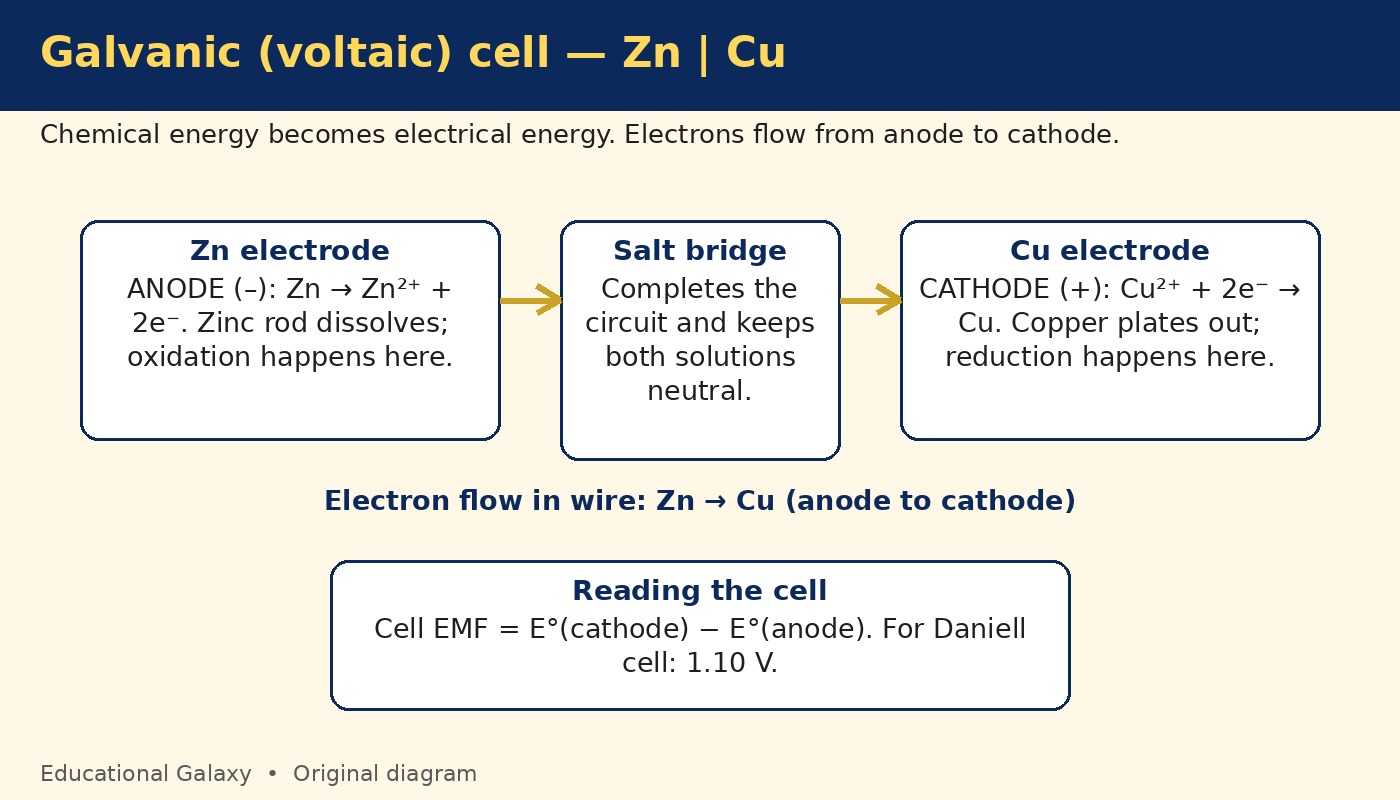
EG schematic (drawn and labelled by Educational Galaxy): A galvanic cell: oxidation at the anode (electrons leave), reduction at the cathode (electrons arrive), salt bridge completing the circuit and keeping both solutions neutral.
2.1 Electrochemical cells and galvanic cells
In an electrochemical cell, chemical energy becomes electrical energy (galvanic or voltaic cell) or electrical energy drives a chemical change (electrolytic cell). The Daniell cell is the standard example: zinc rod in ZnSO₄ solution connected to a copper rod in CuSO₄ solution.
Zinc is oxidised at the anode: Zn → Zn²⁺ + 2e⁻. Electrons travel through the outer wire to the copper cathode, where Cu²⁺ + 2e⁻ → Cu. The salt bridge (a gel containing KCl or KNO₃) completes the circuit: its ions move into each half-cell to balance the charge, without mixing the solutions.
- Anode = oxidation, cathode = reduction — in a galvanic cell the anode is negative and the cathode positive.
- Cell notation: Zn(s) | Zn²⁺(aq) || Cu²⁺(aq) | Cu(s). Single lines are phase boundaries; the double line is the salt bridge.
- Electrons flow anode → cathode in the wire; in solution, cations move toward the cathode and anions toward the anode.
2.2 Electrode potential, standard potential and EMF
Electrode potential is the tendency of an electrode to lose or gain electrons. It is measured against the standard hydrogen electrode (SHE), whose potential is fixed at 0 V: a platinum electrode in 1 M H⁺ with hydrogen gas at 1 bar.
Standard electrode potential E° is measured at 298 K with all species at unit concentration (1 M) or 1 bar pressure. The electrochemical series arranges electrodes by E°: a higher E° means a stronger oxidising agent (easier reduction). Fluorine is the strongest oxidising agent; lithium is the strongest reducing agent.
- Cell EMF: E°cell = E°cathode − E°anode (both as reduction potentials). A positive EMF means the cell reaction is spontaneous.
- E°cell also gives the standard Gibbs energy: ΔG° = −nFE°cell, and the equilibrium constant: log K = nE°/0.059 at 298 K.
- If E°cell comes out negative, the reaction as written is not spontaneous — the reverse cell would run.
2.3 The Nernst equation
Electrode potentials change with concentration. For the reduction Mⁿ⁺ + ne⁻ → M, the Nernst equation is E = E° − (RT/nF) ln [M]/[Mⁿ⁺], which for the pure solid simplifies to E = E° − (0.059/n) log (1/[Mⁿ⁺]) at 298 K.
For a full cell reaction, Ecell = E°cell − (0.059/n) log Q, where Q is the reaction quotient (products over reactants). As the cell runs, products build up, Q rises, and Ecell falls — the cell dies when Ecell reaches zero, which is equilibrium.
- For the Daniell cell: Ecell = E°cell − (0.059/2) log ([Zn²⁺]/[Cu²⁺]).
- Diluting the cathode solution lowers Ecell; diluting the anode solution raises it.
- Concentration cells work on this alone: two identical electrodes in different concentrations give a small EMF that drives ions until concentrations equalise.
2.4 Conductance of electrolytic solutions
Metallic conduction uses electrons and falls with temperature; electrolytic conduction uses ions and rises with temperature, because ions move faster in warmer, less viscous solution. Conductivity κ (kappa) is the conductance of a 1 cm cube of solution; molar conductivity Λm = κ × 1000 / M, where M is molarity.
Conductivity is measured with a conductivity cell whose cell constant G* = l/A (distance between electrodes over area). Resistance R gives κ = G*/R. The cell constant is found by measuring a standard KCl solution of known conductivity.
- Strong electrolytes (KCl, HCl) are almost fully dissociated even at moderate concentration, so Λm falls only slightly on dilution (less inter-ionic attraction).
- Weak electrolytes (acetic acid) dissociate more on dilution, so Λm rises steeply as concentration falls.
- Kohlrausch’s law: at infinite dilution, Λ°m of an electrolyte is the sum of the limiting ionic conductivities: Λ°m = λ°₊ + λ°₋. It lets you find Λ° for a weak electrolyte (e.g. CH₃COOH) from strong electrolytes: Λ°(CH₃COOH) = Λ°(CH₃COONa) + Λ°(HCl) − Λ°(NaCl).
- Kohlrausch’s law also gives the degree of dissociation α = Λm/Λ°m and hence the dissociation constant of a weak acid or base.
2.5 Electrolytic cells and electrolysis — Faraday’s laws
In electrolysis, current forces a non-spontaneous reaction: the anode is now positive and the cathode negative (opposite labels to a galvanic cell, but oxidation still happens at the anode and reduction at the cathode).
- Electrolysis of molten NaCl: Na⁺ + e⁻ → Na at the cathode; 2Cl⁻ → Cl₂ + 2e⁻ at the anode.
- Electrolysis of aqueous NaCl: water is reduced more easily than Na⁺ at the cathode (H₂ gas), and Cl⁻ is oxidised at the anode in concentrated solution (Cl₂ gas); in dilute solution water is oxidised to O₂.
- Products of electrolysis depend on the species present, their electrode potentials, and overvoltage — for example, Na⁺ is not discharged from water because water reduction needs less voltage.
Faraday’s first law: mass deposited or liberated is proportional to charge passed: m = Z·I·t, where Z is the electrochemical equivalent. Faraday’s second law: the same charge liberates masses in proportion to equivalent masses. One faraday (96,500 C) deposits one gram-equivalent: 1 mol of electrons = 96,500 C.
2.6 Batteries, fuel cells and corrosion
- Dry cell (Leclanché): zinc anode, MnO₂ + carbon cathode, NH₄Cl/ZnCl₂ paste. Voltage about 1.5 V; it is primary (not rechargeable) and the paste can leak once the zinc case is eaten away.
- Mercury cell: used in watches and hearing aids because its voltage stays constant; Zn–HgO with KOH electrolyte.
- Lead storage battery: secondary (rechargeable). Anode Pb, cathode PbO₂, electrolyte H₂SO₄. On discharge both electrodes become PbSO₄ and acid is consumed; on charging, the reactions reverse. It powers cars and inverters.
- Nickel–cadmium cell: rechargeable, long life, but cadmium is toxic, so it is being replaced.
- Hydrogen–oxygen fuel cell: H₂ oxidised at the anode, O₂ reduced at the cathode, product is water, efficiency 60–70%. Used in spacecraft (Apollo) and now in buses; pollution-free except for the cost of hydrogen.
Corrosion is electrochemical: iron rusts when a tiny galvanic cell forms on its surface — one spot acts as anode (Fe → Fe²⁺ + 2e⁻), oxygen is reduced at another spot, and Fe²⁺ oxidises further to Fe₂O₃·xH₂O, rust. Prevention: painting or oiling (barrier), galvanising (zinc coating — zinc is sacrificed first because it is more reactive), cathodic protection (connecting a more reactive metal like magnesium), and alloying (stainless steel).
NCERT coverage — every section of this chapter
This page covers, in EG's own words, every section of the NCERT chapter:
- 2.1 Electrochemical cells
- 2.2 Galvanic cells (electrode potential, standard hydrogen electrode, electrochemical series, EMF)
- 2.3 Nernst equation
- 2.4 Conductance of electrolytic solutions (Kohlrausch’s law)
- 2.5 Electrolytic cells and electrolysis (Faraday’s laws)
- 2.6 Batteries
- 2.7 Fuel cells
- 2.8 Corrosion
No NCERT question type from these sections is left without notes and practice below.
Galvanic cell vs electrolytic cell
| Feature | Galvanic cell | Electrolytic cell |
|---|---|---|
| Energy change | Chemical → electrical | Electrical → chemical |
| Spontaneity | Spontaneous (Ecell > 0) | Non-spontaneous (needs power supply) |
| Anode | Negative; oxidation | Positive; oxidation |
| Cathode | Positive; reduction | Negative; reduction |
| Example | Daniell cell, dry cell | Electroplating, NaCl electrolysis |
Key Terms / Important Terms
- Galvanic cell: A cell that converts a spontaneous redox reaction into electric current.
- Standard hydrogen electrode (SHE): Reference electrode with potential fixed at 0 V (Pt, 1 M H⁺, 1 bar H₂).
- EMF of a cell: Potential difference when no current flows; E°cell = E°cathode − E°anode.
- Nernst equation: E = E° − (0.059/n) log Q at 298 K; potential varies with concentration.
- Molar conductivity (Λm): Conductivity per mole of electrolyte; Λm = κ × 1000 / M.
- Kohlrausch’s law: Λ°m = sum of limiting ionic conductivities at infinite dilution.
- Faraday: 96,500 C — the charge of one mole of electrons.
- Corrosion: Electrochemical eating away of a metal, e.g. rusting of iron.
Remember
- Oxidation always at the anode, reduction always at the cathode — in both cell types; only the +/− signs swap.
- E°cell = E°cathode − E°anode using reduction potentials; a positive value means spontaneous.
- Nernst: Ecell falls as products build up; the cell is dead at Ecell = 0.
- Electrolysis products depend on competing species and overvoltage, not just on the salt alone.
Exam Tip / Common Mistake
The commonest errors: (1) writing E°cell as E°anode − E°cathode; (2) forgetting to divide 0.059 by n; (3) using concentrations the wrong way round in log Q (products over reactants); (4) in conductance, mixing κ (conductivity) with Λm (molar conductivity) — Λm = κ × 1000 / molarity.
Practice set — try it yourself
- Draw a labelled Daniell cell and write the reactions at each electrode. Why is a salt bridge needed?
- E°(Cu²⁺/Cu) = +0.34 V and E°(Zn²⁺/Zn) = −0.76 V. Calculate E°cell for the Daniell cell and say whether it is spontaneous.
- State the Nernst equation for a cell reaction. How does Ecell change if the Cu²⁺ concentration is halved in a Daniell cell?
- Define molar conductivity. How does it vary with dilution for strong and weak electrolytes?
- State Faraday’s first law. How much charge is needed to deposit 1 mole of silver from AgNO₃?
Questions with Answers — full answers
- What is the standard hydrogen electrode? Why is its potential taken as zero? Answer: A platinum electrode dipped in 1 M H⁺ solution with hydrogen gas bubbled at 1 bar and 298 K. Its potential is arbitrarily fixed at 0 V so that all other electrode potentials can be measured relative to it.
- For the cell Zn | Zn²⁺(0.1 M) || Cu²⁺(1.0 M) | Cu, E°cell = 1.10 V. Calculate Ecell at 298 K. Answer: Ecell = 1.10 − (0.059/2) log ([Zn²⁺]/[Cu²⁺]) = 1.10 − 0.0295 × log(0.1) = 1.10 + 0.0295 = 1.1295 V.
- Why does molar conductivity of acetic acid rise sharply on dilution, while that of KCl rises only slightly? Answer: Acetic acid is weak: dilution increases its degree of dissociation, creating many more ions. KCl is already almost fully dissociated, so dilution only reduces inter-ionic attraction slightly.
- Use Kohlrausch’s law to find Λ°m for acetic acid from: Λ°(CH₃COONa) = 91, Λ°(HCl) = 426, Λ°(NaCl) = 126 (all S cm² mol⁻¹). Answer: Λ°(CH₃COOH) = 91 + 426 − 126 = 391 S cm² mol⁻¹.
- Why is Na⁺ not discharged during electrolysis of aqueous NaCl, even though it is present? Answer: Water is reduced to hydrogen more easily (needs less voltage) than Na⁺ is reduced to sodium, so H₂ is liberated at the cathode instead.
- How many faradays are needed to reduce 1 mole of Al³⁺ to aluminium? Answer: Al³⁺ + 3e⁻ → Al, so 3 moles of electrons = 3 faradays.
- Why is a lead storage battery rechargeable while a dry cell is not? Answer: In the lead battery, discharge converts both electrodes to PbSO₄ and consumes acid; charging reverses exactly those reactions. In a dry cell the reactions (including eating away of the zinc case and changes in the paste) are not practically reversible.
- Name two methods of preventing rusting and explain one. Answer: Painting/oiling (barrier), galvanising (zinc coating), cathodic protection, alloying. Galvanising works because zinc is more reactive than iron, so zinc is oxidised first and sacrificed, protecting the iron underneath.
Extension Questions with Answers
- ΔG° = −nFE°cell. A cell has E°cell = 1.10 V and n = 2. Calculate ΔG° and comment on spontaneity. Answer: ΔG° = −2 × 96500 × 1.10 = −212,300 J mol⁻¹ = −212.3 kJ mol⁻¹. Negative, so the reaction is spontaneous.
- A concentration cell has two silver electrodes in 0.1 M and 1.0 M AgNO₃. Which is the anode, and what is Ecell? Answer: The dilute side is oxidised (anode) and the concentrated side is reduced (cathode); Ecell = 0.059 log(1.0/0.1) = 0.059 V.
- Calculate the mass of copper deposited when 2 A flows for 30 minutes through CuSO₄ solution (Cu molar mass 63.5). Answer: Charge = 2 × 1800 = 3600 C = 3600/96500 = 0.0373 F. Cu²⁺ needs 2e⁻, so moles Cu = 0.0187; mass = 0.0187 × 63.5 = 1.18 g.
- Why does a fuel cell give only water as product, and why is it not yet universal? Answer: H₂ + ½O₂ → H₂O with no carbon products, so it is pollution-free and efficient. It is limited by the cost and storage of hydrogen and by the cost of electrodes and catalysts.
- Explain why iron rusts faster in salty coastal air than in dry inland air. Answer: Salt water is a better electrolyte, so the tiny galvanic cells on the iron surface work faster; moisture and ions complete the circuit, speeding up Fe → Fe²⁺ oxidation and rust formation.
Board-pattern Questions with Answers
- Write the Nernst equation for the electrode Fe³⁺ + e⁻ → Fe²⁺ and explain each symbol. Answer: E = E° − 0.059 log ([Fe²⁺]/[Fe³⁺]) at 298 K (n = 1). E is the electrode potential, E° the standard potential, and the log term is the ratio of reduced to oxidised form.
- The resistance of a 0.01 M KCl solution in a cell with cell constant 1.0 cm⁻¹ is 100 Ω. Calculate conductivity and molar conductivity. Answer: κ = G*/R = 1.0/100 = 0.01 S cm⁻¹. Λm = κ × 1000/M = 0.01 × 1000/0.01 = 1000 S cm² mol⁻¹.
- Why do metals conduct better when cold, while electrolytes conduct better when warm? Answer: Metals conduct by electrons, which are scattered more by atomic vibrations at higher temperature. Electrolytes conduct by ions, which move faster in warmer, less viscous water.
- Give the reactions at anode and cathode during electrolysis of molten lead bromide with inert electrodes. Answer: Cathode: Pb²⁺ + 2e⁻ → Pb. Anode: 2Br⁻ → Br₂ + 2e⁻.
- What is corrosion? Give the overall rusting reaction in words. Answer: Electrochemical destruction of a metal by its environment. Iron is oxidised to Fe²⁺ at anodic spots, oxygen is reduced at cathodic spots, and the products combine and hydrate to Fe₂O₃·xH₂O (rust).
Recap
- Galvanic cell: anode oxidation, cathode reduction, salt bridge balances charge.
- E°cell = E°cathode − E°anode; ΔG° = −nFE°cell; Nernst: Ecell = E°cell − (0.059/n) log Q.
- Conductance: Λm = κ × 1000/M; Kohlrausch’s law gives Λ° for weak electrolytes.
- Faraday: 1 F = 96,500 C deposits one gram-equivalent; batteries and corrosion are everyday electrochemistry.