

Chapter 1: Solutions
Concentration, Henry’s law, Raoult’s law and the four colligative properties — with numericals.
Original notes — ready CBSE (NCERT, English Medium) • Class 12 • Chemistry • Book: Chemistry — Part I
Chapter 1: Solutions — EG's own summary, in simple words
Book: Chemistry — Part I (CBSE, Class 12) | Chapter 1 | Medium: English
A solution is a homogeneous mixture whose composition is the same throughout. This chapter teaches how to express how much solute is present, how solubility depends on temperature and pressure, why a dissolved solute lowers vapour pressure and changes boiling and freezing points, and how osmotic pressure works — including the case where the measured molar mass comes out wrong.
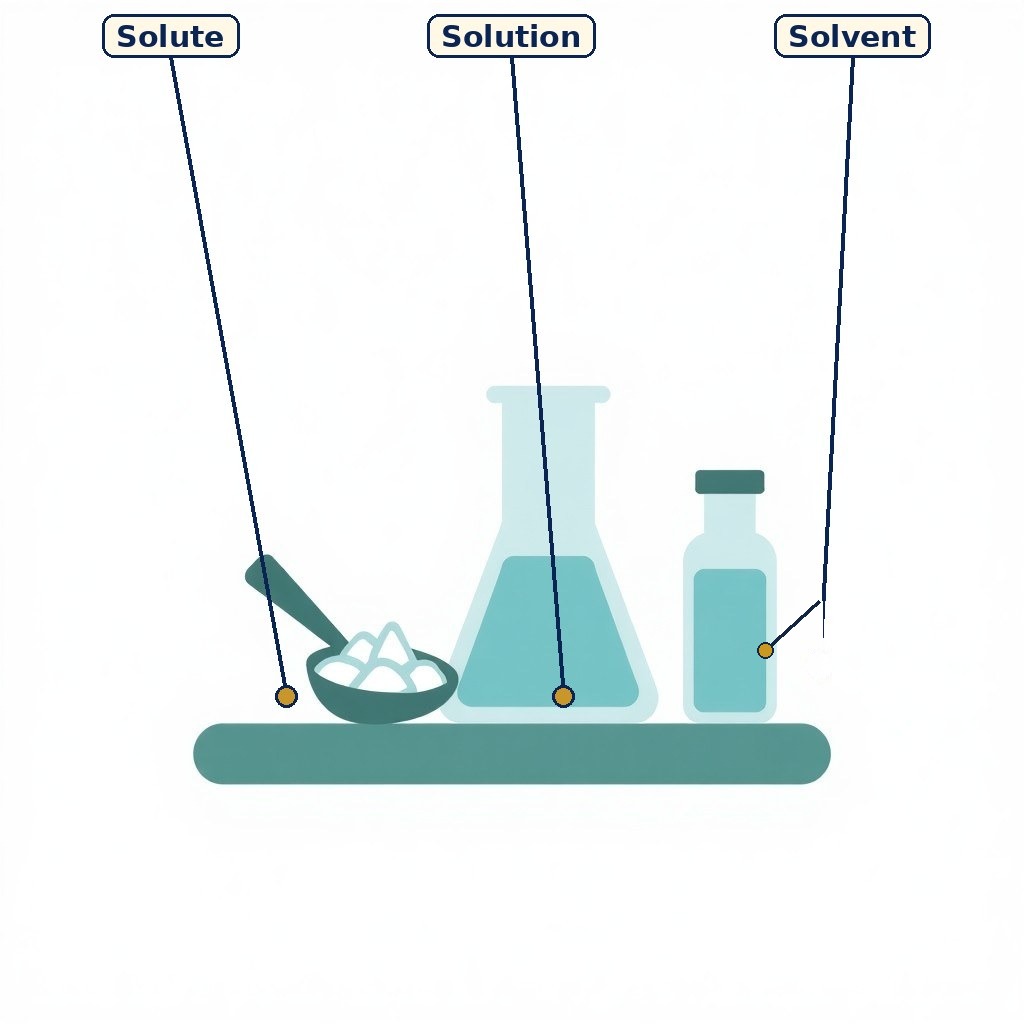
Diagram (labels on the image): Solute, Solution, Solvent. Labels added by Educational Galaxy on an originally generated illustration.

EG schematic (drawn and labelled by Educational Galaxy): The four colligative properties at a glance: relative lowering of vapour pressure, elevation of boiling point, depression of freezing point and osmotic pressure — all depend on the number of solute particles, not their nature.
1.1 Types of solutions
A solution has two parts: the solute, present in smaller amount, which dissolves; and the solvent, present in larger amount, which does the dissolving. Salt water is a solution of salt in water; air is a solution of oxygen and other gases in nitrogen.
- Solid in liquid: salt or sugar dissolved in water — the commonest case in this chapter.
- Liquid in liquid: alcohol in water. Gas in liquid: carbon dioxide in soda water.
- Solid in solid: brass (zinc in copper). Gas in gas: air. A solution can therefore be in any physical state, but this chapter concentrates on liquid solutions, especially a solid or a gas dissolved in a liquid.
Two solutions are compared by concentration: dilute means relatively little solute, concentrated means relatively much. The chapter makes these words exact with numbers.
1.2 Expressing concentration — the terms you must not mix up
Mass percentage is mass of solute per 100 g of solution. Parts per million (ppm) is parts of solute per million parts of solution, used when the amount is tiny, for example pollutants in water. Mole fraction is moles of one component divided by total moles; the mole fractions of all components add to 1.
Molarity (M) is moles of solute per litre of solution. Molality (m) is moles of solute per kilogram of solvent. The difference matters: molarity changes with temperature because volume changes, but molality does not, because mass does not change with temperature.
- Molarity = moles of solute / volume of solution in litres.
- Molality = moles of solute / mass of solvent in kilograms.
- Mass % = (mass of solute / mass of solution) × 100. Mole fraction of A = nA / (nA + nB).
- For dilute aqueous solutions, molarity and molality are nearly equal, but in a numerical you must use the one asked for.
Worked idea: 1 mole of glucose (180 g) dissolved in 1 kg of water gives a 1 molal solution, whatever the temperature. The same amount made up to 1 litre of solution is 1 molar only at the temperature where the volume is exactly 1 litre.
1.3 Solubility — solids in liquids, gases in liquids, Henry’s law
Solubility of a solid in a liquid usually rises with temperature, but the rule is not universal: sodium chloride changes little, while potassium nitrate rises steeply. A saturated solution holds the maximum solute at that temperature; adding more leaves undissolved solid.
Solubility of a gas in a liquid falls as temperature rises — that is why warm water holds less dissolved oxygen, and why a warm bottle of soda goes flat faster. It rises with pressure: this is Henry’s law. At constant temperature, the mass (or mole fraction) of a gas dissolved in a liquid is proportional to the partial pressure of the gas above the liquid: p = KH × x, where KH is the Henry’s law constant.
- A larger KH means lower solubility: the gas escapes more easily.
- Scuba divers breathe compressed air at high pressure, so extra nitrogen dissolves in their blood. If they rise too fast, nitrogen bubbles form in blood — painful and dangerous. Divers therefore use helium mixtures and rise slowly, and decompression is gradual.
- Soda water is bottled under high pressure of carbon dioxide; opening the bottle drops the pressure and the gas escapes as fizz.
- At high altitude, less oxygen dissolves in blood, so climbers feel weak and people with weak hearts are warned against altitude — the partial pressure of oxygen is lower.
1.4 Vapour pressure of liquid solutions — Raoult’s law, ideal and non-ideal
A liquid’s vapour pressure is the pressure of its vapour in equilibrium with the liquid. Adding a non-volatile solute lowers the vapour pressure of the solvent, because fewer solvent molecules sit at the surface and escape.
Raoult’s law (volatile solute case): for a solution of volatile liquids, the partial vapour pressure of each component equals its mole fraction times the vapour pressure of the pure component: pA = xA × p°A, and total pressure p = pA + pB. For a non-volatile solute, the vapour pressure of the solution is simply p = x_solvent × p°_solvent.
- Ideal solution: obeys Raoult’s law at all concentrations; mixing involves no change in enthalpy or volume (ΔmixH = 0, ΔmixV = 0). Example: benzene + toluene, n-hexane + n-heptane.
- Non-ideal solution with positive deviation: vapour pressure higher than Raoult’s law predicts (weak A–B attractions, e.g. ethanol + acetone). It forms a minimum-boiling azeotrope.
- Non-ideal solution with negative deviation: vapour pressure lower than predicted (strong A–B attractions, e.g. nitric acid + water, chloroform + acetone). It forms a maximum-boiling azeotrope.
- An azeotrope is a mixture that boils at a constant temperature with the same composition in liquid and vapour, so it cannot be separated by fractional distillation. The 68% nitric acid + 32% water mixture (boiling point 393.5 K) is the classic example.
1.6 Colligative properties — four properties, one cause
Colligative properties depend only on the number of solute particles, not on what they are. All four follow from the lowering of vapour pressure by a non-volatile solute.
- Relative lowering of vapour pressure: (p° − p) / p° = x_solute. For dilute solutions this equals n_solute / n_solvent.
- Elevation of boiling point: ΔTb = Kb × m, where Kb is the ebullioscopic constant and m is molality. The solution boils above the pure solvent because its vapour pressure is lower, so a higher temperature is needed to reach atmospheric pressure.
- Depression of freezing point: ΔTf = Kf × m. The solution freezes below the pure solvent. This is why salt is spread on icy roads and why antifreeze (ethylene glycol) is added to car radiators.
- Osmosis and osmotic pressure: osmosis is the flow of solvent through a semipermeable membrane from dilute solution to concentrated solution. Osmotic pressure (π) is the extra pressure needed to stop that flow: π = CRT, where C is molarity, R the gas constant and T the temperature in kelvin. Reverse osmosis — applying pressure greater than π — forces solvent the other way and is used to desalinate sea water.
Osmotic pressure is the most sensitive colligative property for large molecules such as proteins, because even a tiny molar concentration gives a measurable pressure at room temperature, whereas boiling-point changes would be too small to measure.
1.7 Abnormal molar mass — the van’t Hoff factor
When a solute dissociates (like NaCl into Na⁺ and Cl⁻) or associates (like ethanoic acid dimerising in benzene, or benzoic acid forming dimers), the number of particles in solution differs from the number of formula units dissolved. The measured molar mass then comes out abnormal — too low for dissociation, too high for association.
The van’t Hoff factor i = (number of particles actually present) / (number of formula units dissolved), or equivalently i = (normal molar mass) / (abnormal molar mass) = (observed colligative property) / (calculated colligative property). All colligative formulas are then corrected: ΔTb = i·Kb·m, ΔTf = i·Kf·m, π = i·CRT, and relative lowering = i·x_solute.
- NaCl fully dissociated: i approaches 2. MgCl₂: i approaches 3. K₂SO₄: i approaches 4.
- Ethanoic acid dimerised in benzene: i approaches 0.5, so the observed molar mass is about double (120 instead of 60).
- In practice i is less than the ideal value because dissociation is rarely complete and ions interact; the closer to complete dissociation, the closer i is to the ideal number.
- Board trap: if a question gives a salt solution, always check whether i is needed before applying a colligative formula — forgetting i is the commonest numerical error in this chapter.
NCERT coverage — every section of this chapter
This page covers, in EG's own words, every section of the NCERT chapter:
- 1.1 Types of solutions
- 1.2 Expressing concentration of solutions
- 1.3 Solubility (solid in liquid; gas in liquid and Henry’s law)
- 1.4 Vapour pressure of liquid solutions and Raoult’s law
- 1.5 Ideal and non-ideal solutions and azeotropes
- 1.6 Colligative properties and determination of molar mass
- 1.7 Abnormal molar mass and the van’t Hoff factor
No NCERT question type from these sections is left without notes and practice below.
Comparing the concentration terms
| Term | Definition | Changes with temperature? |
|---|---|---|
| Mass percentage | Mass of solute per 100 g of solution | No |
| Parts per million (ppm) | Parts of solute per 10⁶ parts of solution | No |
| Mole fraction | Moles of component / total moles | No |
| Molarity (M) | Moles of solute per litre of solution | Yes — volume changes |
| Molality (m) | Moles of solute per kg of solvent | No — mass based |
Key Terms / Important Terms
- Solute / solvent: The smaller-amount component that dissolves / the larger-amount component that dissolves it.
- Molarity: Moles of solute per litre of solution (mol L⁻¹).
- Molality: Moles of solute per kilogram of solvent (mol kg⁻¹).
- Henry’s law: At constant temperature, gas solubility in a liquid is proportional to its partial pressure: p = KH·x.
- Raoult’s law: Partial vapour pressure = mole fraction × pure vapour pressure.
- Azeotrope: A mixture boiling at constant temperature with unchanged composition; cannot be separated by distillation.
- Osmotic pressure: The pressure needed to stop osmosis; π = CRT.
- van’t Hoff factor (i): Actual particles / formula units dissolved; corrects colligative formulas for dissociation or association.
Remember
- Molarity depends on volume, so it changes with temperature; molality does not.
- Henry’s law: higher pressure dissolves more gas; higher temperature dissolves less gas.
- All four colligative properties depend on particle number only — that is why they measure molar mass.
- Dissociation gives i > 1 and low observed molar mass; association gives i < 1 and high observed molar mass.
Exam Tip / Common Mistake
In numericals, first decide: is the solute an electrolyte or does it associate? If yes, find i before touching ΔTb, ΔTf or π. Second, check units: Kb and Kf go with molality (kg of solvent), while π goes with molarity (litres of solution). Mixing those two is the classic mark-loser.
Practice set — try it yourself
- Define molarity and molality. Why is molality preferred when studying the effect of temperature on concentration?
- State Henry’s law. Why do scuba divers use a helium mixture instead of ordinary compressed air?
- A solution of glucose in water is labelled 0.5 m. What does the label mean, and how much glucose is present per kilogram of water?
- Why does a solution of a non-volatile solute boil at a higher temperature than the pure solvent?
- Ethanoic acid dissolved in benzene shows a molar mass of about 120 g mol⁻¹ instead of 60. Explain, with the van’t Hoff factor.
Questions with Answers — full answers
- What is a homogeneous mixture? Give two examples of solutions in different physical states. Answer: A homogeneous mixture has the same composition throughout and its parts cannot be seen separately. Examples: salt water (solid in liquid) and air (gas in gas); brass is a solid-in-solid solution.
- Calculate the mole fraction of water in a solution made by dissolving 18 g of glucose (molar mass 180) in 90 g of water (molar mass 18). Answer: Moles of glucose = 18/180 = 0.1; moles of water = 90/18 = 5. Total = 5.1. Mole fraction of water = 5/5.1 = 0.98.
- State Raoult’s law for a solution containing a non-volatile solute. A solution has a solvent mole fraction of 0.9 and the pure solvent vapour pressure is 25.0 mm Hg. Find the solution vapour pressure. Answer: p = x_solvent × p° = 0.9 × 25.0 = 22.5 mm Hg. The vapour pressure is lowered because the solute occupies surface sites and reduces escaping solvent molecules.
- Why do soda bottles fizz on opening? Use Henry’s law. Answer: The drink is bottled under high carbon dioxide pressure, so much gas is dissolved (Henry’s law: solubility ∝ pressure). Opening drops the pressure, solubility falls, and excess gas escapes as bubbles.
- Define osmotic pressure. Why is it preferred for measuring the molar mass of proteins? Answer: Osmotic pressure is the extra pressure that must be applied to a solution to stop osmosis. Even tiny molar concentrations of large molecules give a measurable pressure at room temperature, while boiling-point or freezing-point changes would be too small to measure accurately.
- A 0.1 M glucose solution and a 0.1 M urea solution have the same osmotic pressure. Why? Answer: Both are non-electrolytes giving one particle per formula unit, so at equal molarity they have equal particle numbers, and osmotic pressure depends only on particle number.
- What is an azeotrope? Why can a nitric acid–water azeotrope not be concentrated beyond 68% by distillation? Answer: An azeotrope boils at a constant temperature with liquid and vapour of the same composition. The 68% HNO₃ mixture is a maximum-boiling azeotrope: on boiling, both components leave together in the same ratio, so distillation cannot change the composition.
- A solution freezes at −0.372 °C. Kf for water is 1.86 K kg mol⁻¹. Find its molality. Answer: ΔTf = Kf × m, so m = 0.372 / 1.86 = 0.20 mol kg⁻¹.
Extension Questions with Answers
- Derive the relation between relative lowering of vapour pressure and mole fraction of solute for a dilute solution. Answer: For a non-volatile solute, p = x_solvent·p°. So (p° − p)/p° = 1 − x_solvent = x_solute. For a dilute solution, x_solute ≈ n_solute/n_solvent.
- Why does salt spread on icy roads melt ice, and why is ethylene glycol used in radiators? Answer: Both use depression of freezing point: a solute lowers the freezing point of water, so ice melts below 0 °C and radiator water does not freeze in winter. Ethylene glycol also raises the boiling point.
- Two beakers, one with 0.1 M NaCl and one with 0.1 M glucose, are compared. Which has higher osmotic pressure and why? Answer: NaCl dissociates into two ions (i ≈ 2), so it has roughly twice the particle concentration and roughly twice the osmotic pressure of glucose at the same molarity.
- Explain reverse osmosis and one practical use. Answer: Applying pressure greater than the osmotic pressure to the concentrated side forces solvent back through the membrane to the dilute side. It is used to desalinate sea water and to purify drinking water.
- A compound AB dissociates 50% in water. What is its van’t Hoff factor? Answer: Start with 1 mole: 0.5 mole remains undissociated, 0.5 mole gives 0.5 A + 0.5 B = 1 mole of particles. Total particles = 1.5, so i = 1.5.
Board-pattern Questions with Answers
- Calculate the molarity of a solution containing 4.0 g of NaOH (molar mass 40) in 500 mL of solution. Answer: Moles = 4.0/40 = 0.10; volume = 0.500 L; molarity = 0.10/0.500 = 0.20 M.
- Why is the vapour pressure of a solution lower than that of the pure solvent? (2 marks) Answer: Dissolved non-volatile solute particles occupy part of the surface, so fewer solvent molecules can escape into the vapour; equilibrium vapour pressure therefore falls.
- State two differences between ideal and non-ideal solutions. Answer: Ideal solutions obey Raoult’s law at all concentrations with ΔmixH = 0 and ΔmixV = 0. Non-ideal solutions deviate (positive or negative), show non-zero enthalpy/volume of mixing, and may form azeotropes.
- A 1% (w/w) solution of a solute in water shows a freezing-point depression of 0.20 K. Kf = 1.86 K kg mol⁻¹. Calculate the molar mass of the solute. Answer: 1% w/w means 1 g solute in 99 g water ≈ 0.099 kg solvent; molality = (1/M)/0.099. ΔTf = Kf·m gives 0.20 = 1.86 × (1/M)/0.099, so M ≈ 94 g mol⁻¹.
- What happens when a red blood cell is placed in (a) pure water, (b) concentrated salt solution? Name the process. Answer: Osmosis. In pure water the cell swells and may burst (endosmosis); in concentrated salt solution water leaves the cell and it shrinks (exosmosis).
Recap
- Concentration terms: mass %, ppm, mole fraction, molarity (per litre of solution), molality (per kg of solvent).
- Henry’s law links gas solubility to pressure; Raoult’s law links vapour pressure to mole fraction.
- Four colligative properties — RLVP, ΔTb, ΔTf, π — depend only on particle number.
- van’t Hoff factor i corrects every colligative formula when the solute dissociates or associates.