

Unit 2: Middle English
English after the Norman Conquest • 1066–1500 • Chaucer's age • Original EG notes in simple English
Unit 2: Middle English — EG's own notes, in simple English
Book: Rainbow – Story of English (BSEB, Class 12, Part 2) | Unit 2
This page carries Educational Galaxy's own original notes — a theme-level summary in simple English, not a copy of the textbook. No official textbook PDF is given here.
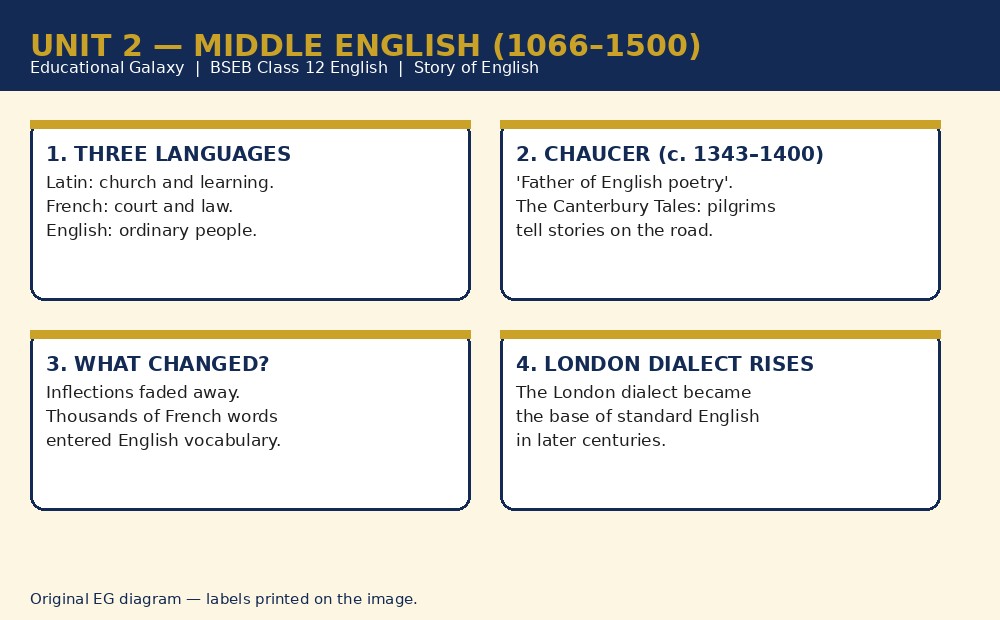
Diagram (labels are printed on the image): Middle English at a glance: three languages, Chaucer, the loss of inflections, and the London dialect.
Three languages in one country
After the Norman Conquest of 1066, England lived in three languages at once. Latin was the language of the church and of scholarship. French was the language of the court, of law and of polite society. English was the language of ordinary people — farmers, traders and servants. For nearly three hundred years, English was hardly written for serious purposes at all.
Slowly the balance changed. French speakers in England began to use more English, and by the fourteenth century English was returning to parliament, to law courts and to literature. This revived, changed English is called Middle English. It is much closer to modern English than Old English is, and a patient modern reader can begin to make sense of it.
What changed in the language
The biggest grammatical change was the loss of inflections. Word-endings wore away, so word order had to do the work that endings used to do — the subject now normally came before the verb, and the object after it. At the same time, thousands of French words poured in, especially words about government, law, food, fashion and the arts: government, justice, beef, beauty and army are all French gifts to English.
English also broke into dialects. People in the north, the Midlands and the south spelled and pronounced words differently, and there was no single standard. Gradually the dialect of London — the centre of government, trade and printing — began to win out over the others, and it became the base of the standard English of later centuries.
Chaucer and his contemporaries
The greatest Middle English writer is Geoffrey Chaucer (about 1343–1400), often called the father of English poetry. His Canterbury Tales gathers a company of pilgrims travelling to Canterbury, and each pilgrim tells a story on the road. A knight, a miller, a wife, a pardoner and many others speak in their own voices, so the book is both a set of lively tales and a portrait of a whole society.
Chaucer had important contemporaries. William Langland's Piers Plowman is a long dream-vision about truth, work and corruption in church and society. John Gower wrote moral and love poetry, and Sir Thomas Malory's Morte d'Arthur gathered the legends of King Arthur into the form that later writers would keep retelling. John Wycliffe's translation of the Bible into English also made scripture available to ordinary readers for the first time.
Why the period matters
Middle English is the bridge of the language. It lost the heavy grammar of Old English, gained the huge French vocabulary that still makes English so rich in synonyms — ask and demand, freedom and liberty — and produced the first writer, Chaucer, who could be read as a national poet. When printing arrived at the end of this period, it was Middle English's London dialect that printers spread across the country, and that is one reason modern standard English looks the way it does.
What you should learn
Understand Middle English (1066–1500) as the bridge period: French influence, loss of inflections, dialects, and Chaucer's Canterbury Tales.
Key Terms
- Middle English — English as spoken and written between about 1066 and 1500, after the Norman Conquest.
- Norman Conquest — The Norman victory in 1066 that made French the language of England's rulers.
- Dialect — A regional variety of a language, with its own pronunciation, words and spellings.
- The Canterbury Tales — Chaucer's collection of stories told by pilgrims travelling to Canterbury.
- Father of English poetry — The title often given to Geoffrey Chaucer for making English a literary language again.
- Morte d'Arthur — Malory's gathering of the King Arthur legends into one great prose work.
Remember
- After 1066 England used three languages: Latin (church), French (court), English (people).
- Middle English lost most inflections and gained thousands of French words.
- Chaucer's Canterbury Tales (pilgrims telling stories) is the period's greatest work.
- The London dialect rose to become the base of standard English.
Exam Tip / Common Mistake
Common mistake: saying Chaucer 'wrote in modern English'. He wrote in Middle English — readable with effort, but with different spellings, endings and pronunciations.
Chart / Table
| Point | Detail |
|---|---|
| Period | 1066–1500 |
| Languages in use | Latin, French, English |
| Grammar change | Loss of inflections; fixed word order grows |
| Vocabulary gain | French words: government, justice, beauty, army |
| Greatest writer | Geoffrey Chaucer — The Canterbury Tales |
| Other writers | Langland, Gower, Malory, Wycliffe |
Practice set — try it yourself
- Why did England use three languages after 1066?
- What happened to inflections in Middle English, and what replaced their job?
- Give four English words that came from French in this period.
- Who are the pilgrims in The Canterbury Tales, and why do they tell stories?
- Why did the London dialect become so important?
Core Questions with Answers
- What is Middle English?
English between about 1066 and 1500, spoken after the Norman Conquest, when French influence and the loss of inflections changed Old English into a form closer to modern English. - Why is Chaucer called the father of English poetry?
Because he made English a great literary language again after centuries in which French and Latin dominated writing, and his Canterbury Tales set a model for English storytelling. - What is The Canterbury Tales about?
A company of pilgrims travelling to Canterbury tell stories to pass the journey; each tale fits the character of its teller, giving a portrait of medieval society. - How did French change English vocabulary?
It added thousands of words for government, law, food, fashion and the arts — which is why English often has pairs of words, one Germanic and one French, like ask and demand. - What role did dialects play in Middle English?
There was no single standard: regions spelled and spoke differently. The London dialect gradually won out, helped by government, trade and later printing.
Extension Questions with Answers
- Why did English survive at all when French ruled the court for centuries?
Because ordinary people kept speaking it every day. The rulers were few; the farmers, traders and servants were many, and their language outlived the court fashion for French. - How does the loss of inflections explain modern English word order?
Once endings stopped showing who did what, position had to do it. 'The dog bit the man' and 'The man bit the dog' mean different things only because order is now fixed. - Why is The Canterbury Tales still read as social history, not just as stories?
Because Chaucer lets each pilgrim speak in character — knight, miller, prioress, pardoner — so the tales together show medieval ranks, jobs, beliefs and hypocrisies from the inside. - Compare Malory and Chaucer as storytellers.
Chaucer invents lively, realistic characters in verse; Malory gathers old Arthurian legends into prose romance. One looks at his own society, the other preserves a heroic past. - Apply this unit: find synonym pairs in your own speech.
Pairs like begin/commence, help/aid, freedom/liberty usually split Germanic and French roots. Noticing them is noticing Middle English history in your own mouth.
Board Exam Questions (board-pattern practice)
These are Educational Galaxy's own board-pattern practice questions, written in the style of board questions. They are not claimed to be real past-year questions.
- Describe the language situation in England after 1066. Answer: Three languages were used: Latin for church and learning, French for court and law, and English for ordinary people; English slowly returned to public use by the fourteenth century.
- Explain the two great changes in Middle English grammar and vocabulary. Answer: Inflections were largely lost, so fixed word order took over; and thousands of French words entered English, enriching it with synonyms.
- Why is Chaucer important in English literature? Answer: He restored English as a literary language, and The Canterbury Tales — pilgrims telling tales on the road to Canterbury — portrays a whole society in vivid, individual voices.
- Who were Langland, Gower and Malory? Answer: Langland wrote the dream-vision Piers Plowman; Gower wrote moral and love poetry; Malory gathered the Arthur legends in Morte d'Arthur.
- How did the London dialect shape modern English? Answer: As the dialect of government and trade, and later of printing, it spread across England and became the base of standard English.
How to use this page: First read the summary, say the key terms in your own words, then try the practice set without looking. Finally check yourself with the questions and answers. Get your answers checked by your teacher or parents.
In depth — understanding ‘Middle English’ fully
The best way to prepare any lesson for an examination is to first state its central idea in one sentence, in your own words, and then join its supporting ideas to that sentence in order. Study ‘Middle English’ in the same order. First ask what the central question of the lesson is, and towards which answer the text leads you. Once the central question is clear, the smaller incidents and details stop looking like things to memorise and start looking like evidence or examples for that answer.
In this lesson, key terms such as ‘Middle English’ and ‘Norman Conquest’ do much of the work. It is not enough to learn their definitions; you must also see where in the lesson each term appears, what result follows from it, and why the lesson's argument would be incomplete without it. A student who learns words with their context can answer a question even when its wording changes, because what he or she holds is understanding, not only a definition.
While reading, pause after every paragraph and ask yourself — what has this paragraph added to the central idea? Is it a new argument, an example, a comparison, or the removal of a misunderstanding? Answering that question, paragraph by paragraph, builds the outline of the lesson in your mind. At the end, try writing that outline in five to seven sentences without looking at the book. Wherever you get stuck, that is exactly where your understanding is still incomplete — read that part again.
Key terms explained in detail
Learn each word below at three levels — definition, context and importance. These three levels make an examination answer complete.
- Middle English — ‘Middle English’ means — English as spoken and written between about 1066 and 1500, after the Norman Conquest.. In ‘Middle English’ this word matters because the central argument of the lesson is built around this idea. In an examination, do not stop at the definition: add the context — where and why this word appears in the lesson — and finish with one result or importance. Definition, context and importance: these three links together make a complete answer.
- Norman Conquest — To understand ‘Norman Conquest’, first take its plain meaning — The Norman victory in 1066 that made French the language of England's rulers. — and then its special meaning in the context of ‘Middle English’. Here the word carries the reader towards the central idea. An answer that gives only the definition remains incomplete; after the definition, add one sentence showing what difference this idea makes to the situation in the lesson.
- Dialect — ‘Dialect’ — A regional variety of a language, with its own pronunciation, words and spellings.. Give this word special attention, because in ‘Middle English’ it returns in one form or another in many questions — sometimes as a direct definition, sometimes as an example, and sometimes as a comparison. When you answer, connect the word with the main message of the lesson and make clear whether the lesson supports this idea or argues against it, and why.
- The Canterbury Tales — The general meaning of ‘The Canterbury Tales’ is — Chaucer's collection of stories told by pilgrims travelling to Canterbury.. But in ‘Middle English’ its meaning goes beyond the dictionary: here it is one link in the whole argument of the lesson. A simple way to remember it is to bind three things together in one group of sentences — the word, its context, and its result. When all three are remembered together, the examination answer writes itself in order.
- Father of English poetry — ‘Father of English poetry’ means — The title often given to Geoffrey Chaucer for making English a literary language again.. In ‘Middle English’ this word matters because the central argument of the lesson is built around this idea. In an examination, do not stop at the definition: add the context — where and why this word appears in the lesson — and finish with one result or importance. Definition, context and importance: these three links together make a complete answer.
- Morte d'Arthur — To understand ‘Morte d'Arthur’, first take its plain meaning — Malory's gathering of the King Arthur legends into one great prose work. — and then its special meaning in the context of ‘Middle English’. Here the word carries the reader towards the central idea. An answer that gives only the definition remains incomplete; after the definition, add one sentence showing what difference this idea makes to the situation in the lesson.
Language and style — how to read this lesson
Prose, poetry and stories each demand a different way of reading. In prose, catch the order of the argument: what the writer first establishes, what example or comparison then supports it, and what conclusion follows. In poetry, catch the feeling and the image: through which picture does the poet express the feeling, and what effect does that picture leave on the reader's mind? In a story, catch the order of character, event and result: which character does what in which situation, and what lesson follows from it.
While reading, also notice the words that give a special colour to the feeling — comparisons, contrasts, questions and repetitions. When a writer wants to stress something, he repeats it, compares it with something familiar, or presents it as a question. Recognising these devices makes the feeling of the lesson clearer and makes language questions in the examination easier to face.
A useful exercise is to take one paragraph or stanza and write it in two or three sentences in your own language, without copying the original words. Then compare it with the original and check whether the central feeling has been left out. This exercise deepens understanding and is direct preparation for questions that ask you to ‘answer in your own words’.
How to write in the examination
Questions on ‘Middle English’ usually come in three kinds — direct questions about a fact or definition, questions about the central idea or reason, and questions asking for a summary or opinion in your own words. The structure of the answer is the same for all three: introduction, main part and conclusion. In the introduction, give one sentence introducing the topic. In the main part, write two to four points in order — each point a separate argument, example or result. In the conclusion, write one sentence giving the message or importance of the lesson.
Fix the length of your answer by the marks. For a one- or two-mark question, a definition and one example are enough. For a three- or four-mark question, add the context and one or two results to the definition. For a five-mark long question, you need everything — introduction, three or four points, a comparison or example, and a conclusion. Divide the answer into paragraphs; writing everything in one long paragraph makes even a correct answer hard to read.
Use the key terms of the lesson correctly in your answer, but do not copy lines from the original text. The examiner wants to see that you have understood — and understanding shows only in your own words. After writing, read the answer once: does the first sentence directly answer the question? Are the points in order? Does the last sentence give a conclusion? If the answer to all three is yes, the answer is complete.
- After 1066 England used three languages: Latin (church), French (court), English (people).
- Middle English lost most inflections and gained thousands of French words.
- Chaucer's Canterbury Tales (pilgrims telling stories) is the period's greatest work.
- The London dialect rose to become the base of standard English.