

Unit 3: Modern English
From printing to the internet • 1500–today • Shakespeare to global English • Original EG notes in simple English
Unit 3: Modern English — EG's own notes, in simple English
Book: Rainbow – Story of English (BSEB, Class 12, Part 2) | Unit 3
This page carries Educational Galaxy's own original notes — a theme-level summary in simple English, not a copy of the textbook. No official textbook PDF is given here.
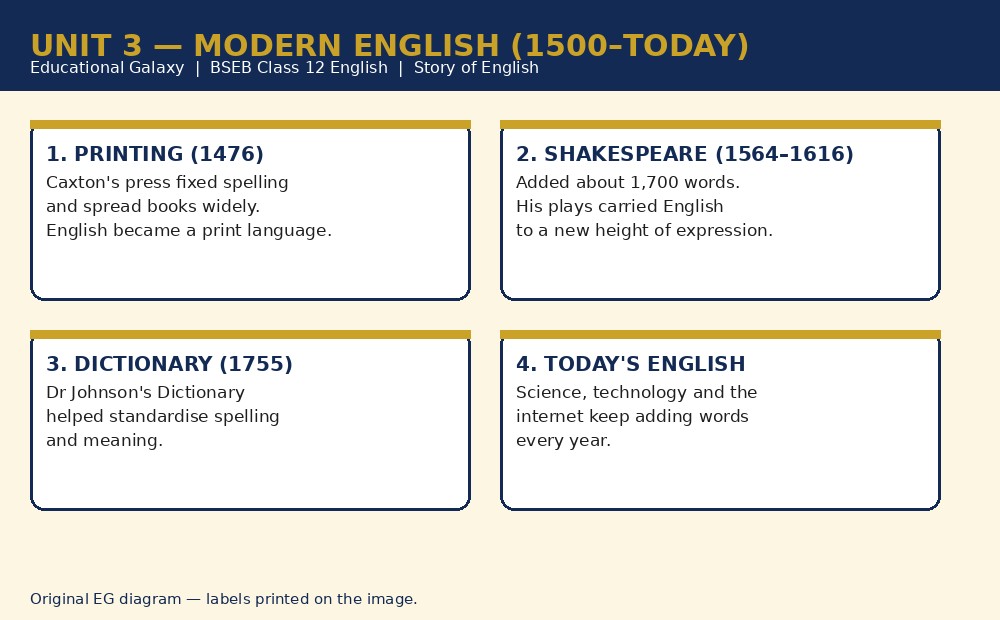
Diagram (labels are printed on the image): Modern English at a glance: printing, Shakespeare, the dictionary, and English today.
The printing revolution
Modern English begins around 1500, and its first great engine was the printing press. William Caxton set up the first press in England in 1476, and suddenly books could be made in hundreds of copies instead of being copied by hand one at a time. Printers had to choose spellings, and their choices — usually the London ones — helped fix English spelling and spread one standard form across the country.
The Renaissance poured new ideas and new words into English at the same time. Scholars revived Greek and Latin learning, explorers brought back names of new lands and goods, and writers argued about religion, science and government. English, which had once borrowed mainly from French, now borrowed from Latin and Greek too, gaining words like atmosphere, skeleton and democracy.
Early Modern English: Shakespeare's age
The period from about 1500 to 1700 is called Early Modern English. Its greatest writer is William Shakespeare (1564–1616), whose plays and poems stretched English as no one had before. He is credited with adding or popularising around 1,700 words — eyeball, bedroom, lonely, gossip and countless others — and with turning ordinary phrases into expressions we still use.
Two other landmarks belong to this age. The King James Bible of 1611 gave English a noble, widely heard prose style, since it was read aloud in churches week after week. And the Great Vowel Shift — a long change in how long vowels were pronounced — was completing, which is why English spelling and pronunciation often seem to disagree today: words like name and bite kept old spellings while their sounds moved on.
Late Modern English: standardisation
From about 1700 onwards, English was standardised. Dr Samuel Johnson's Dictionary of the English Language (1755) listed and defined words with examples, giving writers and readers a shared authority for spelling and meaning. Grammars and schoolbooks followed, and a 'correct' standard English became something schools could teach and examiners could test.
The Industrial Revolution and the British Empire then carried English around the world, while science, trade and technology kept inventing words: engine, railway, telephone, computer. American English grew into its own confident variety, with its own spellings and words, and later the twentieth century added film, radio and television English.
English today
Today's English is still changing fast. The internet, social media and global popular culture add words every year — blog, selfie, emoji — and English borrows freely from other languages, including Indian words like guru, yoga and chutney. The story of Modern English is therefore not finished: printing fixed it, Shakespeare enriched it, dictionaries standardised it, and the world keeps remaking it. For exams, hold the four landmarks in order: Caxton 1476, Shakespeare, King James Bible 1611, Johnson's Dictionary 1755.
What you should learn
Understand Modern English (1500–today): printing, Shakespeare, the King James Bible, standardisation, and continuing change.
Key Terms
- Modern English — English from about 1500 to today, divided into Early Modern (1500–1700) and Late Modern (1700–today).
- Printing press — Caxton's 1476 press, which made books cheap and helped fix spelling and standard English.
- Great Vowel Shift — A long change in vowel pronunciation that left English spelling and sound often disagreeing.
- King James Bible (1611) — The English Bible translation whose prose style shaped English for centuries.
- Johnson's Dictionary (1755) — Dr Samuel Johnson's dictionary, a landmark in standardising English spelling and meaning.
- Standardisation — The process by which one accepted standard form of spelling, grammar and usage develops.
Remember
- Caxton's press (1476) spread books and helped fix London-based spelling.
- Shakespeare (1564–1616) enriched English with about 1,700 words.
- The King James Bible (1611) gave English a widely heard prose model.
- Johnson's Dictionary (1755) standardised spelling and meaning.
Exam Tip / Common Mistake
Common mistake: mixing up the dates — Caxton printed in 1476 (before 1500), Shakespeare wrote around 1600, the King James Bible is 1611, Johnson's Dictionary is 1755.
Chart / Table
| Point | Detail |
|---|---|
| 1476 | Caxton's printing press in England |
| c. 1500–1700 | Early Modern English; Renaissance borrowing |
| 1564–1616 | Shakespeare: plays, poems, ~1,700 words |
| 1611 | King James Bible |
| 1755 | Johnson's Dictionary; standardisation |
| 1700–today | Late Modern English: empire, science, internet |
Practice set — try it yourself
- How did printing change English spelling?
- Name three words Shakespeare is credited with adding or popularising.
- What was the Great Vowel Shift, and why does it matter for spelling?
- Why was Johnson's Dictionary important?
- Give three modern words that entered English through technology.
Core Questions with Answers
- How did Caxton's press change English?
It made books cheap and plentiful, and printers' spelling choices — usually London forms — spread one standard across England. - Why is Shakespeare central to Modern English?
His plays and poems stretched vocabulary by about 1,700 words and fixed many phrases in everyday speech, showing what English could express. - What did the King James Bible do for English?
Read aloud in churches for centuries, it gave English a noble, familiar prose style and fixed many phrases in common use. - What is standardisation, and when did it happen?
The growth of one accepted standard of spelling and usage, led in the eighteenth century by Johnson's Dictionary (1755), grammars and schoolbooks. - Is Modern English still changing? Give examples.
Yes: the internet and global culture add words yearly — blog, selfie, emoji — and English keeps borrowing, for example guru and yoga from India.
Extension Questions with Answers
- Why did printing fix spelling more than hand-copying ever could?
A hand copyist could spell as he pleased, but a printer reused the same type for hundreds of copies, so one spelling reached hundreds of readers at once and became the expected form. - Did Shakespeare invent all 1,700 words alone? Explain with care.
No: he is credited with adding or popularising them. Some he coined, some he was the first to write down, and some were already in speech. The point is his role in carrying them into lasting literature. - Why do English spelling and pronunciation disagree so often?
Because the Great Vowel Shift changed vowel sounds after many spellings were fixed by print. Spelling froze an older sound; speech moved on. - Compare Early and Late Modern English in one paragraph.
Early Modern English (1500–1700) is the age of printing, Renaissance borrowing and Shakespeare, with shifting spelling. Late Modern English (1700–today) is the age of dictionaries, grammars and global spread, with a taught standard. - Apply this unit: trace one word you use daily.
Take 'computer' or 'telephone': both combine Greek roots, were coined for inventions, and spread worldwide. That is Late Modern English word-making at work.
Board Exam Questions (board-pattern practice)
These are Educational Galaxy's own board-pattern practice questions, written in the style of board questions. They are not claimed to be real past-year questions.
- How did the printing press help standard English? Answer: Caxton's press (1476) produced many identical copies, so printers' London-based spellings spread widely and became the accepted standard.
- Discuss Shakespeare's contribution to English. Answer: He enriched vocabulary by about 1,700 words, created lasting phrases, and showed English could handle tragedy, comedy and history at the highest level.
- What was the importance of the King James Bible (1611)? Answer: Read aloud in churches for centuries, it gave English a noble prose model and fixed many phrases in everyday speech.
- What role did Johnson's Dictionary (1755) play? Answer: It defined words with examples and gave writers and readers a shared authority, driving the standardisation of spelling and meaning.
- Why is Modern English still changing? Answer: Science, technology, the internet and global contact keep adding words and borrowings every year, so the language keeps growing.
How to use this page: First read the summary, say the key terms in your own words, then try the practice set without looking. Finally check yourself with the questions and answers. Get your answers checked by your teacher or parents.
In depth — understanding ‘Modern English’ fully
The best way to prepare any lesson for an examination is to first state its central idea in one sentence, in your own words, and then join its supporting ideas to that sentence in order. Study ‘Modern English’ in the same order. First ask what the central question of the lesson is, and towards which answer the text leads you. Once the central question is clear, the smaller incidents and details stop looking like things to memorise and start looking like evidence or examples for that answer.
In this lesson, key terms such as ‘Modern English’ and ‘Printing press’ do much of the work. It is not enough to learn their definitions; you must also see where in the lesson each term appears, what result follows from it, and why the lesson's argument would be incomplete without it. A student who learns words with their context can answer a question even when its wording changes, because what he or she holds is understanding, not only a definition.
While reading, pause after every paragraph and ask yourself — what has this paragraph added to the central idea? Is it a new argument, an example, a comparison, or the removal of a misunderstanding? Answering that question, paragraph by paragraph, builds the outline of the lesson in your mind. At the end, try writing that outline in five to seven sentences without looking at the book. Wherever you get stuck, that is exactly where your understanding is still incomplete — read that part again.
Key terms explained in detail
Learn each word below at three levels — definition, context and importance. These three levels make an examination answer complete.
- Modern English — ‘Modern English’ means — English from about 1500 to today, divided into Early Modern (1500–1700) and Late Modern (1700–today).. In ‘Modern English’ this word matters because the central argument of the lesson is built around this idea. In an examination, do not stop at the definition: add the context — where and why this word appears in the lesson — and finish with one result or importance. Definition, context and importance: these three links together make a complete answer.
- Printing press — To understand ‘Printing press’, first take its plain meaning — Caxton's 1476 press, which made books cheap and helped fix spelling and standard English. — and then its special meaning in the context of ‘Modern English’. Here the word carries the reader towards the central idea. An answer that gives only the definition remains incomplete; after the definition, add one sentence showing what difference this idea makes to the situation in the lesson.
- Great Vowel Shift — ‘Great Vowel Shift’ — A long change in vowel pronunciation that left English spelling and sound often disagreeing.. Give this word special attention, because in ‘Modern English’ it returns in one form or another in many questions — sometimes as a direct definition, sometimes as an example, and sometimes as a comparison. When you answer, connect the word with the main message of the lesson and make clear whether the lesson supports this idea or argues against it, and why.
- King James Bible (1611) — The general meaning of ‘King James Bible (1611)’ is — The English Bible translation whose prose style shaped English for centuries.. But in ‘Modern English’ its meaning goes beyond the dictionary: here it is one link in the whole argument of the lesson. A simple way to remember it is to bind three things together in one group of sentences — the word, its context, and its result. When all three are remembered together, the examination answer writes itself in order.
- Johnson's Dictionary (1755) — ‘Johnson's Dictionary (1755)’ means — Dr Samuel Johnson's dictionary, a landmark in standardising English spelling and meaning.. In ‘Modern English’ this word matters because the central argument of the lesson is built around this idea. In an examination, do not stop at the definition: add the context — where and why this word appears in the lesson — and finish with one result or importance. Definition, context and importance: these three links together make a complete answer.
- Standardisation — To understand ‘Standardisation’, first take its plain meaning — The process by which one accepted standard form of spelling, grammar and usage develops. — and then its special meaning in the context of ‘Modern English’. Here the word carries the reader towards the central idea. An answer that gives only the definition remains incomplete; after the definition, add one sentence showing what difference this idea makes to the situation in the lesson.
Language and style — how to read this lesson
Prose, poetry and stories each demand a different way of reading. In prose, catch the order of the argument: what the writer first establishes, what example or comparison then supports it, and what conclusion follows. In poetry, catch the feeling and the image: through which picture does the poet express the feeling, and what effect does that picture leave on the reader's mind? In a story, catch the order of character, event and result: which character does what in which situation, and what lesson follows from it.
While reading, also notice the words that give a special colour to the feeling — comparisons, contrasts, questions and repetitions. When a writer wants to stress something, he repeats it, compares it with something familiar, or presents it as a question. Recognising these devices makes the feeling of the lesson clearer and makes language questions in the examination easier to face.
A useful exercise is to take one paragraph or stanza and write it in two or three sentences in your own language, without copying the original words. Then compare it with the original and check whether the central feeling has been left out. This exercise deepens understanding and is direct preparation for questions that ask you to ‘answer in your own words’.
How to write in the examination
Questions on ‘Modern English’ usually come in three kinds — direct questions about a fact or definition, questions about the central idea or reason, and questions asking for a summary or opinion in your own words. The structure of the answer is the same for all three: introduction, main part and conclusion. In the introduction, give one sentence introducing the topic. In the main part, write two to four points in order — each point a separate argument, example or result. In the conclusion, write one sentence giving the message or importance of the lesson.
Fix the length of your answer by the marks. For a one- or two-mark question, a definition and one example are enough. For a three- or four-mark question, add the context and one or two results to the definition. For a five-mark long question, you need everything — introduction, three or four points, a comparison or example, and a conclusion. Divide the answer into paragraphs; writing everything in one long paragraph makes even a correct answer hard to read.
Use the key terms of the lesson correctly in your answer, but do not copy lines from the original text. The examiner wants to see that you have understood — and understanding shows only in your own words. After writing, read the answer once: does the first sentence directly answer the question? Are the points in order? Does the last sentence give a conclusion? If the answer to all three is yes, the answer is complete.
- Caxton's press (1476) spread books and helped fix London-based spelling.
- Shakespeare (1564–1616) enriched English with about 1,700 words.
- The King James Bible (1611) gave English a widely heard prose model.
- Johnson's Dictionary (1755) standardised spelling and meaning.