

Unit 1: Old English
The earliest English • c. 450–1100 • Anglo-Saxon England • Original EG notes in simple English
Unit 1: Old English — EG's own notes, in simple English
Book: Rainbow – Story of English (BSEB, Class 12, Part 2) | Unit 1
This page carries Educational Galaxy's own original notes — a theme-level summary in simple English, not a copy of the textbook. No official textbook PDF is given here.
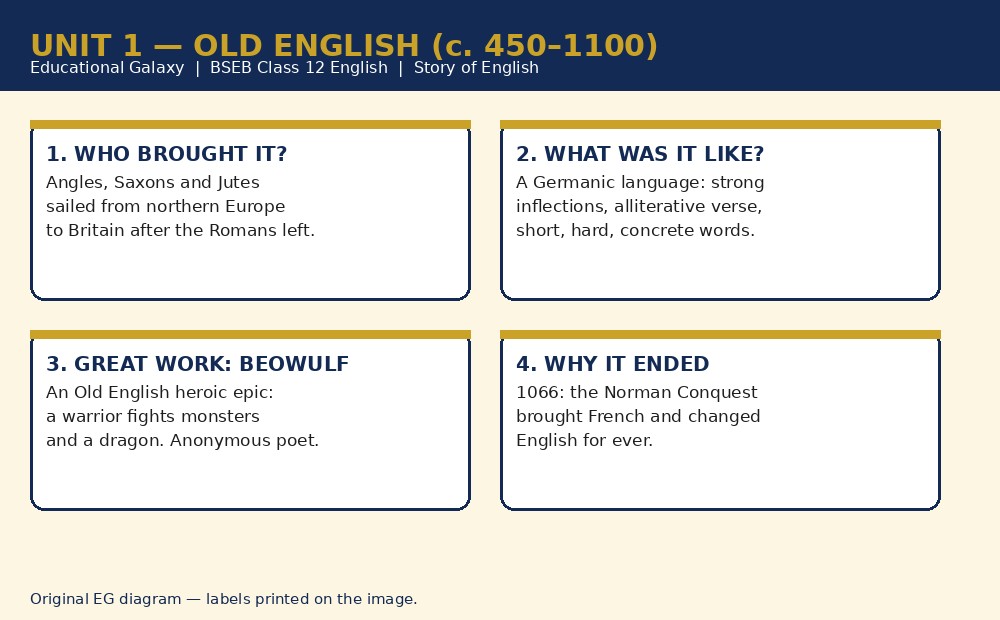
Diagram (labels are printed on the image): Old English at a glance: who brought it, what it was like, Beowulf, and why the period ended.
How English began
English did not start in England. Around the middle of the fifth century, after the Romans left Britain, Germanic tribes from northern Europe — the Angles, the Saxons and the Jutes — crossed the sea and settled in Britain. The language they spoke is what we now call Old English, or Anglo-Saxon.
Old English sounded very different from the English we speak today. A modern reader cannot read it without learning it almost like a new language. Yet many of its simplest words survive in our daily speech: house, water, earth, strong, night, day, mother, father, eat and drink all come from this period.
What Old English looked like
Old English was a heavily inflected language. That means the endings of words changed to show their job in a sentence — who did the action, who received it, and whether there was one thing or many. Word order was therefore freer than in modern English, because the endings, not the position, carried much of the meaning.
Its poetry did not rhyme the way later English poetry does. Instead it used alliteration: several stressed words in a line began with the same sound. Poets also loved kennings — compact picture-phrases such as 'whale-road' for the sea and 'bone-house' for the body. These devices made poems easy to remember in a time when most literature was spoken aloud, not read from books.
Literature and learning
The greatest surviving Old English poem is Beowulf, a heroic epic about a warrior who fights the monster Grendel, Grendel's mother, and finally a dragon. It mixes the old warrior values of courage and loyalty with Christian ideas that were spreading through England at the time.
Christianity, brought by missionaries from Rome and Ireland, changed Old English deeply. Monasteries became centres of learning, monks wrote down poems and histories, and hundreds of Latin words entered the language — words connected with the church, learning and everyday new things, such as school, candle and priest. The poets Caedmon and Cynewulf are among the few named Old English poets we know.
Why the period ended
In 1066 the Normans conquered England, and French became the language of the court and government. Old English did not die overnight, but it stopped being the language of power and writing. Over the next centuries it absorbed French words and lost many of its inflections, and slowly became Middle English. For exams, remember this chain: Germanic tribes bring the language, Christianity brings Latin words and writing, and the Norman Conquest ends the Old English period.
What you should learn
Understand that Old English is a Germanic language (c. 450–1100), rich in inflections and alliterative poetry, whose greatest work is Beowulf.
Key Terms
- Old English — The earliest form of English, spoken c. 450–1100, also called Anglo-Saxon.
- Inflection — A change in a word's ending to show its grammatical job, such as subject or object.
- Alliteration — The repetition of the same starting sound in stressed words in a line of poetry.
- Kenning — A compact picture-phrase used instead of a plain noun, e.g. 'whale-road' for the sea.
- Beowulf — The great Old English heroic epic about a warrior who fights monsters and a dragon.
- Anglo-Saxon — Relating to the Angles and Saxons who settled Britain and their language and culture.
Remember
- Old English (c. 450–1100) came from Germanic tribes: Angles, Saxons and Jutes.
- It was heavily inflected, and its poetry used alliteration and kennings, not rhyme.
- Beowulf is its greatest surviving poem; Caedmon and Cynewulf are named poets.
- Christianity brought Latin words and monastic writing; 1066 ended the period.
Exam Tip / Common Mistake
Common mistake: calling Old English 'the same as modern English with old spellings'. It is a different stage of the language — grammar, vocabulary and pronunciation all differ.
Chart / Table
| Point | Detail |
|---|---|
| Period | c. 450–1100 |
| Brought by | Angles, Saxons, Jutes (Germanic tribes) |
| Key features | Inflections, alliteration, kennings |
| Great work | Beowulf (heroic epic) |
| Latin influence | Through Christianity and monasteries |
| End | Norman Conquest, 1066 |
Practice set — try it yourself
- Name the three Germanic tribes that brought Old English to Britain.
- What is an inflection, and why did it matter in Old English?
- Give two kennings and explain what each one means.
- Why is Beowulf important in the history of English literature?
- How did Christianity change Old English?
Core Questions with Answers
- When was Old English spoken, and who spoke it?
From about 450 to 1100, by the Anglo-Saxons — the Angles, Saxons and Jutes who settled Britain after the Romans left. - What is alliterative verse?
Verse in which stressed words in a line begin with the same sound, instead of rhyming at the ends of lines. - What is Beowulf about?
It is a heroic epic about the warrior Beowulf, who fights Grendel, Grendel's mother and a dragon, showing courage and loyalty. - How did Latin enter Old English?
Through Christianity: missionaries and monks brought church and learning words such as school, candle and priest. - Why did the Old English period end?
The Norman Conquest of 1066 made French the language of power, so English lost its written status and began to change into Middle English.
Extension Questions with Answers
- Why do so many short, everyday English words come from Old English?
Because the Anglo-Saxons named the basic things of life — house, water, night, mother, eat — and those words stayed in daily speech while later French and Latin words mostly named law, government and learning. - How did alliteration help poems survive before printing?
Repeated starting sounds gave each line a rhythm and a pattern that listeners could hold in memory, so poems could be passed on by voice for generations before anyone wrote them down. - Is Beowulf a Christian poem or a pagan poem? Explain with care.
It is both: its hero lives by old warrior values, but the poem was written down in a Christian age, so Christian ideas about God, fate and good versus evil run through it as well. - Why does word order matter more in modern English than in Old English?
Modern English has lost most inflections, so position must show who did what. In Old English the word-endings showed that job, so order could vary. - Apply this unit: pick five words you used today and guess which are Old English.
Short, concrete, everyday words — hand, foot, bread, milk, sun — are usually Old English. Long, formal words about government or science usually came later, from French or Latin.
Board Exam Questions (board-pattern practice)
These are Educational Galaxy's own board-pattern practice questions, written in the style of board questions. They are not claimed to be real past-year questions.
- Describe the origin of Old English. Answer: Old English came with the Germanic tribes — Angles, Saxons and Jutes — who settled Britain after the Romans left, around the middle of the fifth century.
- Explain the main features of Old English poetry. Answer: It used alliteration instead of end-rhyme, and kennings such as 'whale-road' for the sea; poems were often spoken aloud before they were written down.
- What is Beowulf, and why is it important? Answer: It is the greatest Old English heroic epic, about Beowulf's fights with Grendel, Grendel's mother and a dragon; it shows Anglo-Saxon warrior values mixed with Christian ideas.
- How did Christianity influence Old English? Answer: Monasteries became centres of learning, monks wrote literature down, and Latin words for church, learning and new objects entered English.
- Why did Old English change into Middle English? Answer: After the Norman Conquest of 1066, French became the language of the court, English lost its high status, and over centuries it gained French words and lost inflections.
How to use this page: First read the summary, say the key terms in your own words, then try the practice set without looking. Finally check yourself with the questions and answers. Get your answers checked by your teacher or parents.
In depth — understanding ‘Old English’ fully
The best way to prepare any lesson for an examination is to first state its central idea in one sentence, in your own words, and then join its supporting ideas to that sentence in order. Study ‘Old English’ in the same order. First ask what the central question of the lesson is, and towards which answer the text leads you. Once the central question is clear, the smaller incidents and details stop looking like things to memorise and start looking like evidence or examples for that answer.
In this lesson, key terms such as ‘Old English’ and ‘Inflection’ do much of the work. It is not enough to learn their definitions; you must also see where in the lesson each term appears, what result follows from it, and why the lesson's argument would be incomplete without it. A student who learns words with their context can answer a question even when its wording changes, because what he or she holds is understanding, not only a definition.
While reading, pause after every paragraph and ask yourself — what has this paragraph added to the central idea? Is it a new argument, an example, a comparison, or the removal of a misunderstanding? Answering that question, paragraph by paragraph, builds the outline of the lesson in your mind. At the end, try writing that outline in five to seven sentences without looking at the book. Wherever you get stuck, that is exactly where your understanding is still incomplete — read that part again.
Key terms explained in detail
Learn each word below at three levels — definition, context and importance. These three levels make an examination answer complete.
- Old English — ‘Old English’ means — The earliest form of English, spoken c. 450–1100, also called Anglo-Saxon.. In ‘Old English’ this word matters because the central argument of the lesson is built around this idea. In an examination, do not stop at the definition: add the context — where and why this word appears in the lesson — and finish with one result or importance. Definition, context and importance: these three links together make a complete answer.
- Inflection — To understand ‘Inflection’, first take its plain meaning — A change in a word's ending to show its grammatical job, such as subject or object. — and then its special meaning in the context of ‘Old English’. Here the word carries the reader towards the central idea. An answer that gives only the definition remains incomplete; after the definition, add one sentence showing what difference this idea makes to the situation in the lesson.
- Alliteration — ‘Alliteration’ — The repetition of the same starting sound in stressed words in a line of poetry.. Give this word special attention, because in ‘Old English’ it returns in one form or another in many questions — sometimes as a direct definition, sometimes as an example, and sometimes as a comparison. When you answer, connect the word with the main message of the lesson and make clear whether the lesson supports this idea or argues against it, and why.
- Kenning — The general meaning of ‘Kenning’ is — A compact picture-phrase used instead of a plain noun, e.g. 'whale-road' for the sea.. But in ‘Old English’ its meaning goes beyond the dictionary: here it is one link in the whole argument of the lesson. A simple way to remember it is to bind three things together in one group of sentences — the word, its context, and its result. When all three are remembered together, the examination answer writes itself in order.
- Beowulf — ‘Beowulf’ means — The great Old English heroic epic about a warrior who fights monsters and a dragon.. In ‘Old English’ this word matters because the central argument of the lesson is built around this idea. In an examination, do not stop at the definition: add the context — where and why this word appears in the lesson — and finish with one result or importance. Definition, context and importance: these three links together make a complete answer.
- Anglo-Saxon — To understand ‘Anglo-Saxon’, first take its plain meaning — Relating to the Angles and Saxons who settled Britain and their language and culture. — and then its special meaning in the context of ‘Old English’. Here the word carries the reader towards the central idea. An answer that gives only the definition remains incomplete; after the definition, add one sentence showing what difference this idea makes to the situation in the lesson.
Language and style — how to read this lesson
Prose, poetry and stories each demand a different way of reading. In prose, catch the order of the argument: what the writer first establishes, what example or comparison then supports it, and what conclusion follows. In poetry, catch the feeling and the image: through which picture does the poet express the feeling, and what effect does that picture leave on the reader's mind? In a story, catch the order of character, event and result: which character does what in which situation, and what lesson follows from it.
While reading, also notice the words that give a special colour to the feeling — comparisons, contrasts, questions and repetitions. When a writer wants to stress something, he repeats it, compares it with something familiar, or presents it as a question. Recognising these devices makes the feeling of the lesson clearer and makes language questions in the examination easier to face.
A useful exercise is to take one paragraph or stanza and write it in two or three sentences in your own language, without copying the original words. Then compare it with the original and check whether the central feeling has been left out. This exercise deepens understanding and is direct preparation for questions that ask you to ‘answer in your own words’.
How to write in the examination
Questions on ‘Old English’ usually come in three kinds — direct questions about a fact or definition, questions about the central idea or reason, and questions asking for a summary or opinion in your own words. The structure of the answer is the same for all three: introduction, main part and conclusion. In the introduction, give one sentence introducing the topic. In the main part, write two to four points in order — each point a separate argument, example or result. In the conclusion, write one sentence giving the message or importance of the lesson.
Fix the length of your answer by the marks. For a one- or two-mark question, a definition and one example are enough. For a three- or four-mark question, add the context and one or two results to the definition. For a five-mark long question, you need everything — introduction, three or four points, a comparison or example, and a conclusion. Divide the answer into paragraphs; writing everything in one long paragraph makes even a correct answer hard to read.
Use the key terms of the lesson correctly in your answer, but do not copy lines from the original text. The examiner wants to see that you have understood — and understanding shows only in your own words. After writing, read the answer once: does the first sentence directly answer the question? Are the points in order? Does the last sentence give a conclusion? If the answer to all three is yes, the answer is complete.
- Old English (c. 450–1100) came from Germanic tribes: Angles, Saxons and Jutes.
- It was heavily inflected, and its poetry used alliteration and kennings, not rhyme.
- Beowulf is its greatest surviving poem; Caedmon and Cynewulf are named poets.
- Christianity brought Latin words and monastic writing; 1066 ended the period.