

Chapter 7: Growth, Development, and Maturation
Growth is size, development is change, maturation is progress — three words students always mix up.
Original notes — ready CBSE (NCERT, English Medium) • Class 9 • Physical Education • Book: Khel Praveen
Chapter 7: Growth, Development, and Maturation — EG's own notes, in simple words
Book: Khel Praveen (CBSE, Class 9) | Chapter 7 | Section: Unit 2: Science and Sports | Medium: English

Diagram (labels are printed on the image): Children growing taller at different rates — growth and maturation differ for everyone. A general picture about growth; it is not a scene from the book.

Classmates of different heights — everyone grows at their own pace.
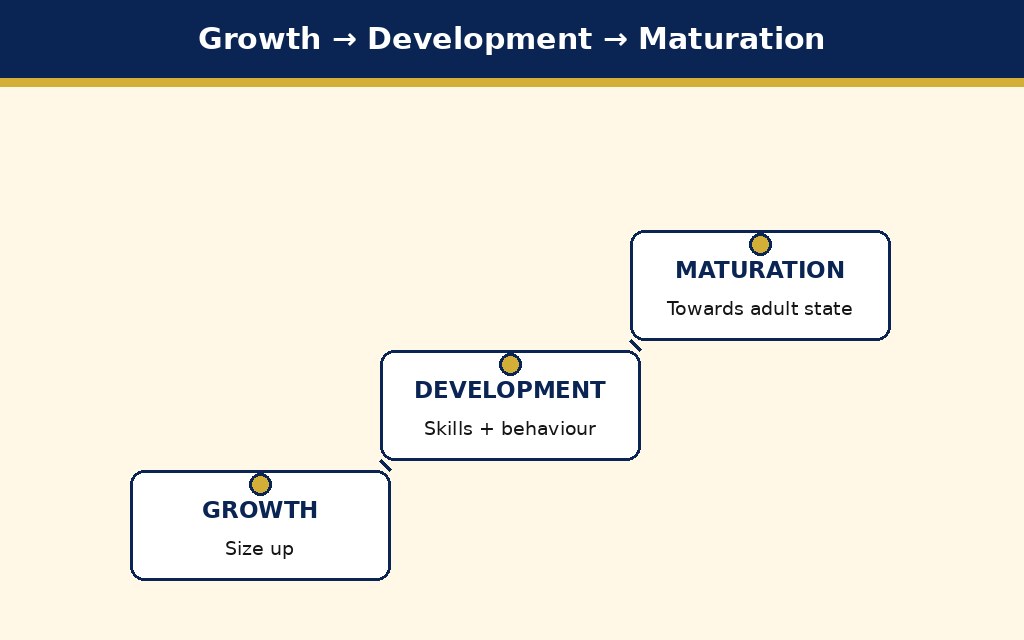
New labelled schematic (labels and gold dots are printed on the image): Growth, development, maturation steps
What the chapter is about
Growth means getting bigger — taller, heavier, stronger. Development means getting better at skills and thinking — running faster, balancing better, understanding rules. Maturation is the body's natural ripening toward adulthood, which happens at different ages for different people.
During adolescence, growth speeds up and bodies change quickly. This is normal, but the timing differs: some students shoot up in Class 8, others in Class 11. Comparing yourself anxiously with classmates is unfair, because maturation clocks are personal.
For sport, this matters. Early maturers may look stronger for a while, but late maturers often catch up. Coaches should judge effort, skill and improvement, not only size. Good food, sleep and exercise support healthy growth for everyone.
Three definitions, kept apart
Growth is quantitative: an increase in size, height, weight or body composition that can be measured. Development is broader and qualitative as well as biological: it covers motor skills, behaviour and the organisation of abilities, not just size. Maturation is progress towards the adult state — the timing and order in which adult characteristics appear, which is why two children of the same age can be at very different stages.
The chapter's comparison table makes the split exam-proof. Growth: change in size, measured in centimetres and kilograms. Development: change in function and behaviour, seen in skills and understanding. Maturation: the process of reaching maturity, driven by heredity and shaped by environment. If a question asks about height, answer growth; about learning a new skill, development; about reaching puberty early or late, maturation.
Why classmates of the same age differ so much
Heredity sets the broad plan — parents' height and build strongly influence a child's growth pattern — while environment decides how fully that plan is reached: nutrition, sleep, illness, activity and stress all shift the pace. That is why the chapter's exercise asks how heredity and environment are together responsible for growth, and why two students of the same age differ in height.
For young athletes the lesson is practical. Training must match maturation, not just age: a late-maturing player is not a weak player, and an early-maturing player is not automatically the better athlete long-term. Coaches and teachers who group only by age, and never by stage, misjudge both. The bone life-cycle activity in the chapter makes the same point by observation — look at your peer group and list the differences you can actually see.
What you should learn
Growth is size increase, development is skill improvement, maturation is ripening toward adulthood, and timing differs for everyone.
Key Terms
- Growth — Increase in size, height and weight.
- Development — Improvement in skills, thinking and behaviour.
- Maturation — Natural ripening of the body toward adulthood.
- Adolescence — The stage between childhood and adulthood.
- Puberty — The period of rapid physical change in adolescence.
Remember
- Growth, development and maturation are different.
- Everyone matures at a different age.
- Early size advantage often disappears later.
- Food, sleep and exercise support healthy growth.
Exam Tip / Common Mistake
Common mistake: judging a young player only by size. A smaller, skilful, hard-working player often overtakes a bigger early maturer.
Chart / Table: Growth, development, maturation compared
| Point | Detail |
|---|---|
| Growth | Size: height, weight, muscle |
| Development | Skills: running, thinking, social |
| Maturation | Timing: body's move to adulthood |
| Adolescence | Rapid change, different timing |
| Sport lesson | Judge effort and skill, not only size |
Growth measures size, development covers skills and behaviour, maturation tracks progress to adulthood — and because heredity and environment set different paces, age alone never tells you a student's stage.
Practice set — try it yourself
- Explain growth, development and maturation in one line each.
Hint: Hint: Size, skill, timing. - Why do two Class 9 friends differ greatly in height?
Hint: Hint: Think maturation clocks. - How should a coach treat early and late maturers fairly?
Hint: Hint: Think effort and improvement. - List three habits that support healthy growth.
Hint: Hint: Food, sleep, movement. - Why is comparing yourself with others unhelpful in adolescence?
Hint: Hint: Think different timing, same destination.
Questions with Answers
- What is the difference between growth and development?
Growth is increase in size — height, weight, muscles. Development is improvement in abilities — skills, thinking and behaviour. - What is maturation?
The body's natural process of ripening toward adulthood, including puberty changes, which happens at different ages for different people. - Why do adolescents grow at different rates?
Because maturation timing is personal, influenced by heredity, food, health and sleep. Some mature early, some late, and both are normal. - Why does maturation matter in sport?
Because early maturers may temporarily look stronger. Fair selection looks at skill, effort and improvement, not size alone. - What supports healthy growth in adolescence?
Balanced food, enough sleep, regular exercise, and avoiding harmful substances. These give the growing body what it needs.
Questions with Answers — Extension
- Two students are both 14. One is much taller and stronger. Explain using all three terms.
Growth differs (measured size), development differs (skills and behaviour built so far), and maturation differs (one is further towards the adult state) — same age does not mean same stage. - Give one example each of biological development, motor-skill development and behavioural development.
Biological: stronger heart and lungs with training. Motor: learning a clean badminton serve. Behavioural: staying calm and fair after losing a match. - Why is it wrong to call a late-maturing player 'weak'?
Because maturation is timing, not talent: the player is earlier in the same process, and may catch up or overtake once their growth spurt arrives. - How do heredity and environment work together in growth? Give one example of each.
Heredity sets potential, e.g. parents' height; environment decides how much is reached, e.g. good nutrition and sleep supporting full growth, illness or poor diet holding it back. - A coach picks teams by age only. What is the flaw, and what fairer method does the chapter suggest?
Age-only grouping ignores maturation stage; fairer grouping considers stage, size and skill, so late developers are not misjudged and early developers are still challenged.
How to use this page: Read the summary, say the Key Terms in your own words, then try the practice set without looking. Use the Questions with Answers to check yourself afterwards. Ask your teacher or parent to check your answers.