

Chapter 2: History and Culture of Physical Education in India
From Vedic verses to national policy — how India has always trained body with mind.
Original notes — ready CBSE (NCERT, English Medium) • Class 9 • Physical Education • Book: Khel Praveen
Chapter 2: History and Culture of Physical Education in India — EG's own notes, in simple words
Book: Khel Praveen (CBSE, Class 9) | Chapter 2 | Section: Unit 1: Evolution of Physical Education and Well-being | Medium: English
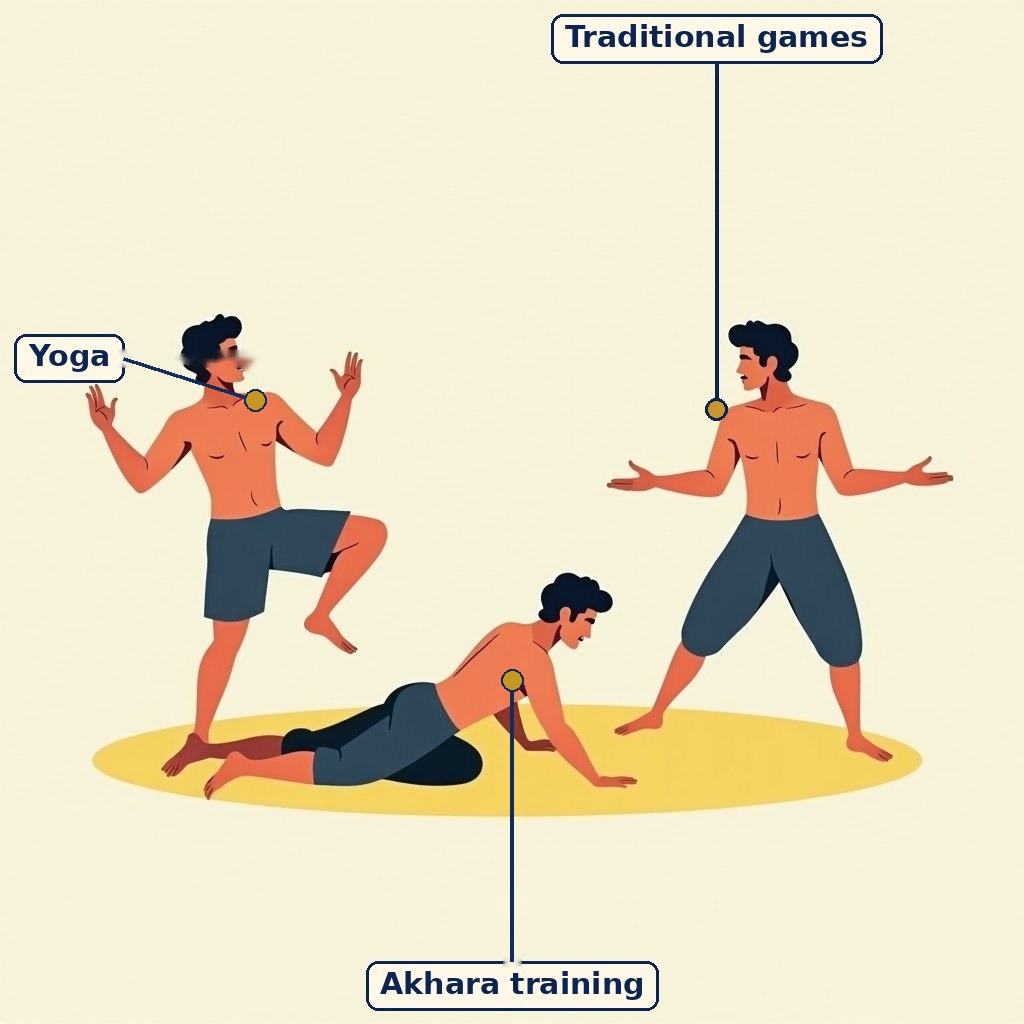
Diagram (labels are printed on the image): Yoga, traditional games and akhara training from India's long physical culture. A general picture about Indian PE history; it is not a scene from the book.

Students playing a traditional game passed down through generations.
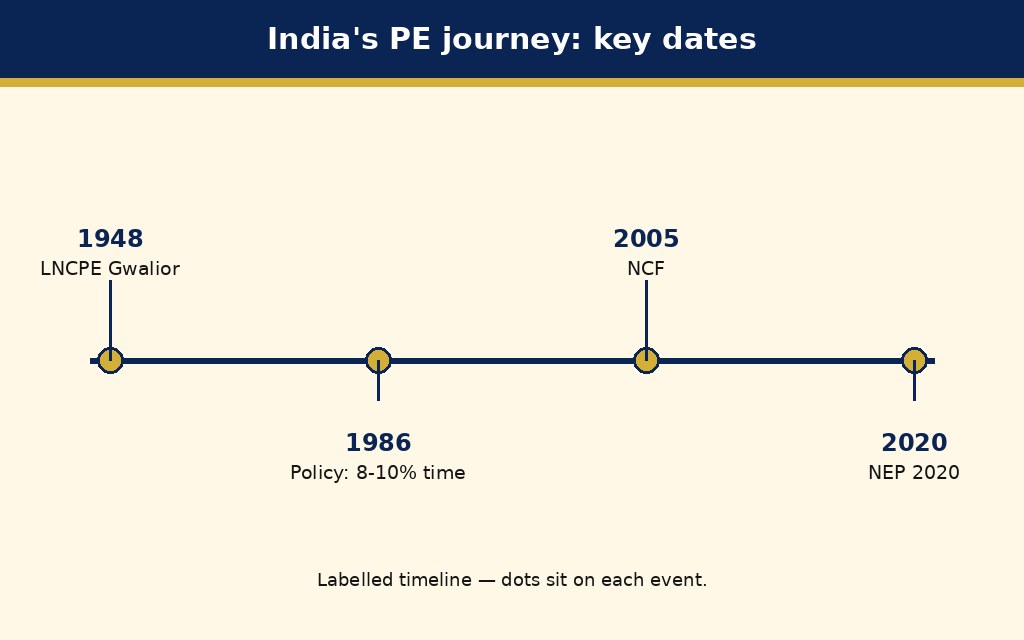
New labelled schematic (labels and gold dots are printed on the image): Timeline of PE in India
What the chapter is about
India's physical culture is thousands of years old. Yoga, wrestling in akharas, martial arts, archery and countless village games were part of daily life and training. Physical skill was tied to discipline, health and character, not only to competition.
Traditional games like kabaddi, kho-kho, gilli-danda and many local games were played in villages long before modern stadiums. They needed little equipment but built speed, strength, teamwork and quick thinking.
In modern times, India built schools, federations and programmes like Khelo India to support sport for all. The new approach keeps the old wisdom — yoga, traditional games, discipline — and adds science, safety and inclusion.
Physical culture in ancient India
India's physical tradition is very old. The Vedas and the epics describe bodily training as part of a good life, and the Charaka-samhita links exercise with lightness of body, better appetite and freedom from heaviness and sleepiness. The text quotes Kalidasa's line from the Kumarasambhavam — the body is the first instrument of dharma — to show that caring for the body was treated as a duty, not a luxury.
Classical works also name specific practices. The Manasollasa mentions Mallakhamb, the pole practice that still survives today. Traditional games differed by region because terrain shaped them: hill areas, river plains and coastal regions each produced their own forms of play, and many games still carry different names in different states. That is why the chapter asks you to map a state and name its games.
From independence to the present day
After independence, India built institutions for physical education step by step. The Tara Chand Committee's work led to the National Cadet Corps (NCC), founded to build discipline and fitness among youth. The Lakshmibai College of Physical Education, Gwalior, was founded in 1948 as a pioneer institute, and the Central Advisory Board on Physical Education was created to guide the subject nationally.
Policy kept moving the same way: the National Policy on Education (1986) directed schools to spend about 8–10 per cent of teaching time on physical and health education, the National Curriculum Framework (2005) treated sports and yoga as part of learning, and NEP 2020 and NCF-SE 2023 now present PE as vital for holistic child development. The timeline matters for exams: 1948, 1986, 2005 and 2020 are the four dates to fix first.
What you should learn
India has an ancient physical culture of yoga, akharas and village games, and modern PE builds on that heritage.
Key Terms
- Akhara — A traditional training ground, especially for wrestling.
- Kabaddi — An ancient Indian team game of tag and breath control.
- Kho-kho — A fast Indian chasing game played by teams.
- Khelo India — A national programme to find and support young sporting talent.
- Heritage — Traditions passed down from earlier generations.
Remember
- Yoga and wrestling are ancient Indian practices.
- Village games built fitness with little equipment.
- Kabaddi and kho-kho are Indian games now played worldwide.
- Modern PE keeps tradition and adds science and safety.
Exam Tip / Common Mistake
Common mistake: thinking Indian games are 'old-fashioned' and less valuable. Kabaddi is now a professional world sport — tradition and modern sport go together.
Chart / Table: India's physical heritage
| Point | Detail |
|---|---|
| Yoga | Breath, posture and mind training |
| Akhara wrestling | Strength and discipline |
| Kabaddi, kho-kho | Team speed and strategy |
| Martial arts | Kalaripayattu, Thang-Ta, Gatka |
| Modern programmes | Khelo India, Fit India, school sports |
Going deeper — Chapter 2: History and Culture of Physical Education in India
At the centre of this chapter are a few ideas that everything else hangs on: Akhara, Kabaddi, Kho-kho, Khelo India. If you can explain those ideas in your own words without looking at the notes, you already hold the chapter's spine. Everything else on this page — the examples, the tables and the questions — is there to help you practise using those ideas, not to be memorised as separate facts.
Read the chapter in this order. First, read the summary slowly and ask yourself what question the chapter is answering. Then work through each section one at a time and, after each one, close the page and say its main point in two lines. The sections of this chapter are: What the chapter is about; Physical culture in ancient India; From independence to the present day. Each section adds one layer: an earlier section gives you the words and tools, and a later section shows you where those tools are used. When you revise, do not re-read passively — explain each section aloud as if you were teaching a classmate who missed the lesson.
In physical education answers, name the concept or procedure first, then give its steps or components in order, then its benefit or application. For fitness and training questions, give the correct term, the method, and one precaution or example.
Important Questions with Answers — deepening set
These questions go beyond the sets above. Try each one without looking, then check your answer against the notes.
- What does 'Akhara' mean? Explain it in your own words and say how it is used in this chapter.
A traditional training ground, especially for wrestling. In this chapter, Akhara is one of the ideas you must be able to use, not just define. When a question mentions Akhara, first write its meaning in one line, then apply it to the situation in the question. That two-step habit — meaning first, application second — is what turns a definition into marks. - What does 'Kabaddi' mean? Explain it in your own words and say how it is used in this chapter.
An ancient Indian team game of tag and breath control. In this chapter, Kabaddi is one of the ideas you must be able to use, not just define. When a question mentions Kabaddi, first write its meaning in one line, then apply it to the situation in the question. That two-step habit — meaning first, application second — is what turns a definition into marks. - What does 'Kho-kho' mean? Explain it in your own words and say how it is used in this chapter.
A fast Indian chasing game played by teams. In this chapter, Kho-kho is one of the ideas you must be able to use, not just define. When a question mentions Kho-kho, first write its meaning in one line, then apply it to the situation in the question. That two-step habit — meaning first, application second — is what turns a definition into marks. - What does 'Khelo India' mean? Explain it in your own words and say how it is used in this chapter.
A national programme to find and support young sporting talent. In this chapter, Khelo India is one of the ideas you must be able to use, not just define. When a question mentions Khelo India, first write its meaning in one line, then apply it to the situation in the question. That two-step habit — meaning first, application second — is what turns a definition into marks. - What does 'Heritage' mean? Explain it in your own words and say how it is used in this chapter.
Traditions passed down from earlier generations. In this chapter, Heritage is one of the ideas you must be able to use, not just define. When a question mentions Heritage, first write its meaning in one line, then apply it to the situation in the question. That two-step habit — meaning first, application second — is what turns a definition into marks. - What does 'Yoga' mean? Explain it in your own words and say how it is used in this chapter.
Breath, posture and mind training In this chapter, Yoga is one of the ideas you must be able to use, not just define. When a question mentions Yoga, first write its meaning in one line, then apply it to the situation in the question. That two-step habit — meaning first, application second — is what turns a definition into marks.
Revision checklist and exam writing guide
Use this checklist the night before a test. Tick a point only if you can do it without opening the notes.
- I can explain 'What the chapter is about' in two lines without looking.
- I can explain 'Physical culture in ancient India' in two lines without looking.
- I can explain 'From independence to the present day' in two lines without looking.
- I can write the chapter's key terms from memory, with one example for each.
- I can answer one long question from this chapter in five ordered paragraphs.
In physical education answers, name the concept or procedure first, then give its steps or components in order, then its benefit or application. For fitness and training questions, give the correct term, the method, and one precaution or example.
Common mistake to avoid: writing everything you remember about the chapter instead of answering the question asked. Read the question twice, underline its command word — explain, compare, why, what happens — and let that word decide the shape of your answer.
Important Questions with Answers — deepening set
These questions go beyond the sets above. Try each one without looking, then check your answer against the notes.
- What does 'Akhara wrestling' mean? Explain it in your own words and say how it is used in this chapter.
Strength and discipline In this chapter, Akhara wrestling is one of the ideas you must be able to use, not just define. When a question mentions Akhara wrestling, first write its meaning in one line, then apply it to the situation in the question. That two-step habit — meaning first, application second — is what turns a definition into marks. - What does 'Kabaddi, kho-kho' mean? Explain it in your own words and say how it is used in this chapter.
Team speed and strategy In this chapter, Kabaddi, kho-kho is one of the ideas you must be able to use, not just define. When a question mentions Kabaddi, kho-kho, first write its meaning in one line, then apply it to the situation in the question. That two-step habit — meaning first, application second — is what turns a definition into marks. - What does 'Martial arts' mean? Explain it in your own words and say how it is used in this chapter.
Kalaripayattu, Thang-Ta, Gatka In this chapter, Martial arts is one of the ideas you must be able to use, not just define. When a question mentions Martial arts, first write its meaning in one line, then apply it to the situation in the question. That two-step habit — meaning first, application second — is what turns a definition into marks. - What does 'Modern programmes' mean? Explain it in your own words and say how it is used in this chapter.
Khelo India, Fit India, school sports In this chapter, Modern programmes is one of the ideas you must be able to use, not just define. When a question mentions Modern programmes, first write its meaning in one line, then apply it to the situation in the question. That two-step habit — meaning first, application second — is what turns a definition into marks.
Important Questions with Answers — deepening set
These questions go beyond the sets above. Try each one without looking, then check your answer against the notes.
- What is the main point of the section 'What the chapter is about', and why does it come at that place in the chapter?
Work through the section slowly and write its main point in two lines of your own: what new idea it introduces, and how it follows from the section before it. In revision, if you cannot state that point without looking, re-read the section once, say it aloud, and only then move on. A section you can summarise is a section you have understood; a section you can only recognise is not yet ready for the exam. - What is the main point of the section 'Physical culture in ancient India', and why does it come at that place in the chapter?
Work through the section slowly and write its main point in two lines of your own: what new idea it introduces, and how it follows from the section before it. In revision, if you cannot state that point without looking, re-read the section once, say it aloud, and only then move on. A section you can summarise is a section you have understood; a section you can only recognise is not yet ready for the exam. - What is the main point of the section 'From independence to the present day', and why does it come at that place in the chapter?
Work through the section slowly and write its main point in two lines of your own: what new idea it introduces, and how it follows from the section before it. In revision, if you cannot state that point without looking, re-read the section once, say it aloud, and only then move on. A section you can summarise is a section you have understood; a section you can only recognise is not yet ready for the exam. - What is the one message or conclusion of Chapter 2: History and Culture of Physical Education in India that you should never forget?
Every chapter in this book has one idea that ties its sections together. For this chapter, find that idea in the summary above and write it as a single sentence in your notebook. In the exam, when a long question feels confusing, that one sentence is your compass: start from it, add two supporting points from the sections, and close by repeating it in different words.
India's physical tradition runs from Vedic ideals and classical practices like Mallakhamb to modern institutions and policies — and every stage treats the trained body as the base of a full life.
Practice set — try it yourself
- Name three traditional Indian games and one skill each builds.
Hint: Hint: Think kabaddi, kho-kho and a local game. - Why were akharas important in old India?
Hint: Hint: Think training, discipline and community. - How does Khelo India help young players?
Hint: Hint: Think finding talent and giving support. - Play a traditional game and note its rules and fitness benefits.
Hint: Hint: Ask an elder for a local game. - How is yoga different from a race?
Hint: Hint: Think competition versus mind-body training.
Questions with Answers
- What is India's physical heritage?
A long tradition of yoga, wrestling in akharas, martial arts, archery and village games, all tied to health, discipline and character. - Give two examples of ancient Indian games.
Kabaddi, a team game of tag and breath control, and kho-kho, a fast team chasing game. Both are still played competitively today. - What is an akhara?
A traditional training ground, especially for wrestling, where learners trained in strength, technique and discipline under a teacher. - What is Khelo India?
A national programme that searches for young sporting talent and supports it with training, facilities and competitions. - Why should modern students learn traditional games?
Because they build fitness cheaply, carry cultural heritage, and teach teamwork and strategy — and many, like kabaddi, are now world sports.
Questions with Answers — Extension
- Why does the chapter open with Kalidasa's line about the body?
To show that in Indian tradition the body was the first instrument of dharma — physical training was a duty, not entertainment, which is why it appears in epics and medical texts alike. - How does geography explain why traditional games differ across India?
Terrain shapes play: hill, plain, river and coastal regions favour different movements and materials, so the same kind of game takes different forms and names in different states. - Arrange these in order: NCC founded, LNCPE Gwalior founded, NCF 2005, NEP 2020. What changed at each step?
Tara Chand Committee → NCC (youth discipline and fitness); LNCPE Gwalior 1948 (professional training); NCF 2005 (sport and yoga as learning); NEP 2020 (PE as essential, holistic education). - A school gives PE only 2 per cent of teaching time. Which policy does this fall short of, and by roughly how much?
The 1986 National Policy on Education's 8–10 per cent direction — the school is roughly 6–8 percentage points short. - Pick one shloka or epic reference from the chapter and explain what it teaches about exercise.
The Charaka-samhita teaching: proper exercise brings lightness of body, better appetite and freedom from heaviness and sleepiness — exercise as medicine for daily life, not only for sport.
How to use this page: Read the summary, say the Key Terms in your own words, then try the practice set without looking. Use the Questions with Answers to check yourself afterwards. Ask your teacher or parent to check your answers.