

Chapter 19: Combat Sports
Judo, wrestling, taekwondo and boxing — four combat sports, four histories, one code of respect.
Original notes — ready CBSE (NCERT, English Medium) • Class 9 • Physical Education • Book: Khel Praveen
Chapter 19: Combat Sports — EG's own notes, in simple words
Book: Khel Praveen (CBSE, Class 9) | Chapter 19 | Section: Unit 5: Sports | Medium: English
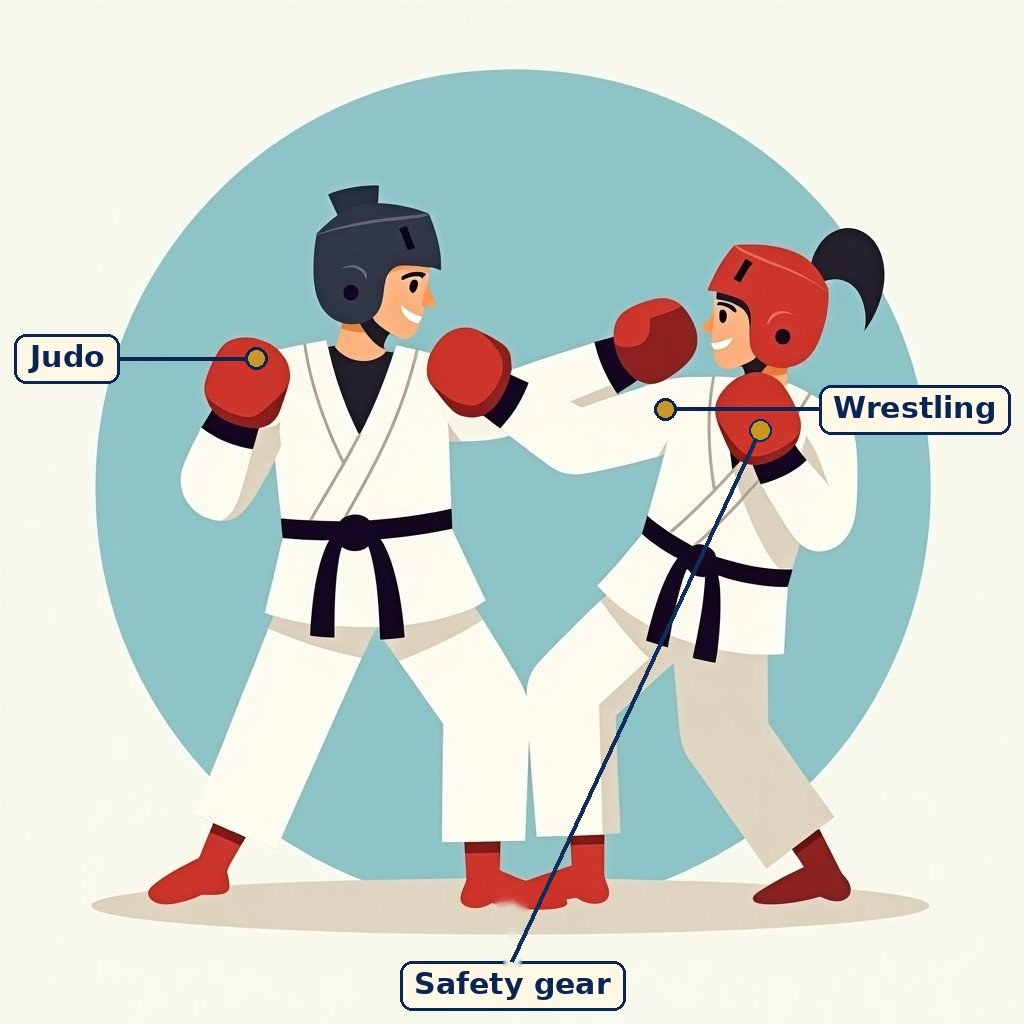
Diagram (labels are printed on the image): Judo, wrestling and boxing training with mats and safety gear. A general picture about combat sports; it is not a scene from the book.
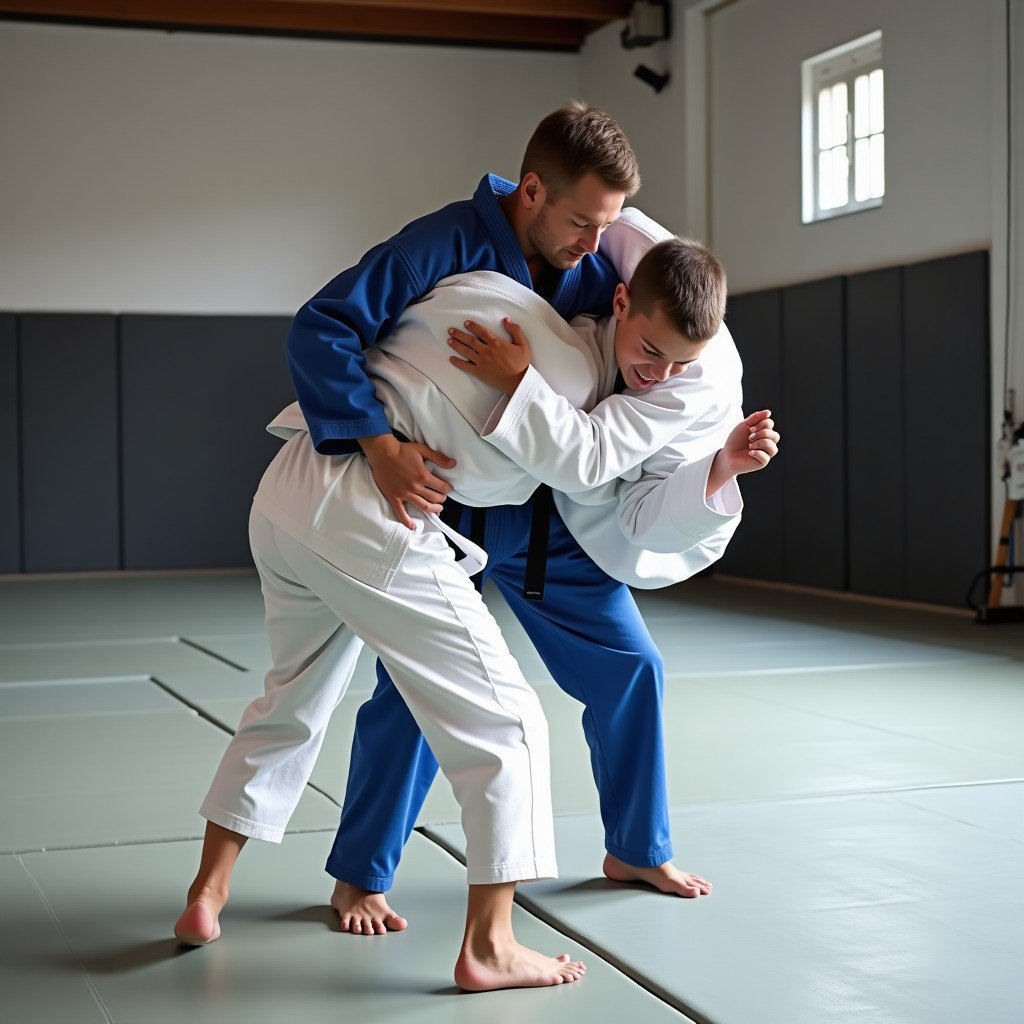
Students practising judo safely on mats under a coach.
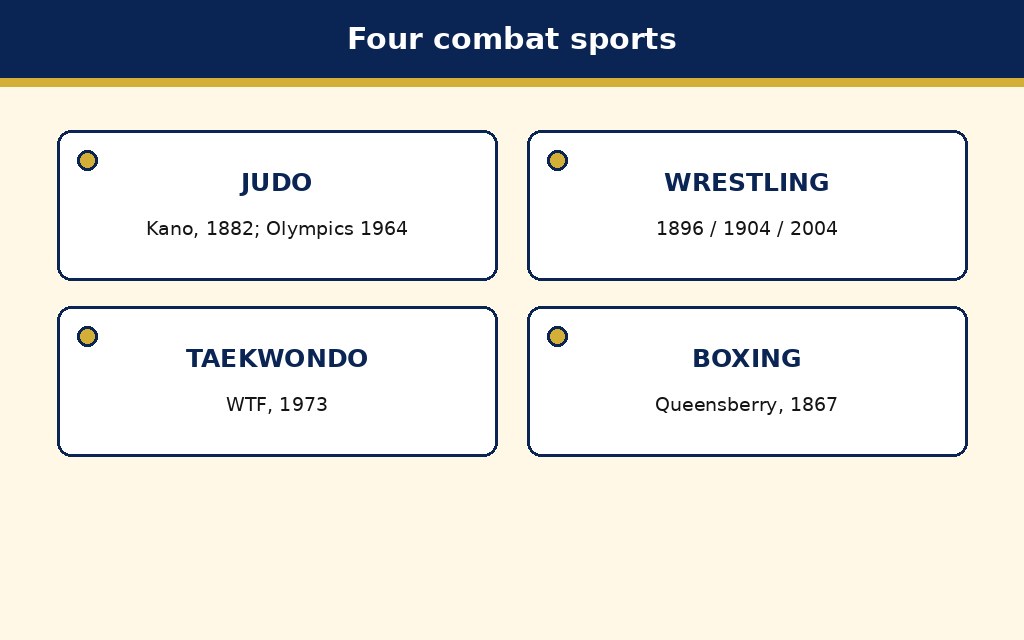
New labelled schematic (labels and gold dots are printed on the image): Four combat sports
What the chapter is about
Combat sports are contests of controlled fighting skill: judo, wrestling, boxing, taekwondo and karate. Each has strict rules, weight categories, referees and protective gear, so skill decides the result, not brute force alone.
Training builds strength, speed, balance and courage, but safety comes first. Players learn to fall safely, to tap out or stop when caught, and to respect opponents. A good combat athlete is disciplined outside the ring too.
Combat sports also teach self-defence and confidence, especially for girls. But they must be learned from trained coaches, never copied from films or tried without mats and supervision.
Judo and wrestling: the grappling arts
Judo has its origin in the ancient Japanese art of jiu-jitsu (the gentle art), a system of hand-to-hand combat. It is a sport of Asian origin that was included in the Tokyo Olympic Games in 1964. The first school of judo was started by Professor Jigoro Kano in 1882 at Eishoji, a Buddhist temple in Tokyo, Japan. Judo's principle is the gentle way: use an opponent's force and balance against them, through throws, holds and control, rather than strikes.
Wrestling is older in Olympic history. The Greco-Roman style was introduced in the first modern Olympics at Athens in 1896, while freestyle wrestling was introduced in 1904 at St. Louis. After a century, women's freestyle wrestling was introduced in the Athens Olympics in 2004. The chapter's tables of men's and women's freestyle categories exist so you can see that wrestling is organised by weight — the fairness idea from Chapter 15, applied here.
Taekwondo and boxing: the striking arts
Taekwondo evolved during the 1940s and 1950s in Korea from ancient Korean martial arts practised during the Three-Kingdom era, and was formalised through the establishment of the World Taekwondo Federation (WTF) in 1973, later renamed World Taekwondo (WT). It is famous for fast, high kicks and for a scoring system that rewards clean, controlled technique over wild force.
Modern boxing developed in England with the establishment of the Marquess of Queensberry Rules in 1867, which introduced gloves and rounds. Before those rules, bare-knuckle contests were far more dangerous; gloves, rounds, weight divisions and refereeing turned fighting into a regulated sport. Across all four sports the chapter's lesson is the same: combat sport is controlled, respectful contest — bow, rules, referee, weight class — never street violence.
What you should learn
Combat sports are rule-bound contests of skill with safety gear and referees, teaching discipline, confidence and safe practice.
Key Terms
- Judo — A Japanese art of throws and holds, using balance.
- Wrestling — A grappling sport of holds, throws and pins.
- Weight category — Groups by body weight for fair matches.
- Tap out — Signalling surrender to stop a hold safely.
- Referee — The official who stops unsafe action.
Remember
- Combat sports are controlled by rules and referees.
- Weight categories keep matches fair.
- Learn to fall safely and to stop when caught.
- Train only with coaches, mats and gear.
Exam Tip / Common Mistake
Common mistake: copying film fights with friends. Real combat sport needs coaching, mats, rules and supervision — film stunts are not training.
Chart / Table: Combat sports and their core skill
| Point | Detail |
|---|---|
| Judo | Throws and holds using balance |
| Wrestling | Grappling, pins and control |
| Boxing | Punches with gloves, footwork |
| Taekwondo | Kicks and speed |
| Karate | Strikes, blocks and forms |
Going deeper — Chapter 19: Combat Sports
At the centre of this chapter are a few ideas that everything else hangs on: Judo, Wrestling, Weight category, Tap out. If you can explain those ideas in your own words without looking at the notes, you already hold the chapter's spine. Everything else on this page — the examples, the tables and the questions — is there to help you practise using those ideas, not to be memorised as separate facts.
Read the chapter in this order. First, read the summary slowly and ask yourself what question the chapter is answering. Then work through each section one at a time and, after each one, close the page and say its main point in two lines. The sections of this chapter are: What the chapter is about; Judo and wrestling: the grappling arts; Taekwondo and boxing: the striking arts. Each section adds one layer: an earlier section gives you the words and tools, and a later section shows you where those tools are used. When you revise, do not re-read passively — explain each section aloud as if you were teaching a classmate who missed the lesson.
In physical education answers, name the concept or procedure first, then give its steps or components in order, then its benefit or application. For fitness and training questions, give the correct term, the method, and one precaution or example.
Important Questions with Answers — deepening set
These questions go beyond the sets above. Try each one without looking, then check your answer against the notes.
- What does 'Judo' mean? Explain it in your own words and say how it is used in this chapter.
A Japanese art of throws and holds, using balance. In this chapter, Judo is one of the ideas you must be able to use, not just define. When a question mentions Judo, first write its meaning in one line, then apply it to the situation in the question. That two-step habit — meaning first, application second — is what turns a definition into marks. - What does 'Wrestling' mean? Explain it in your own words and say how it is used in this chapter.
A grappling sport of holds, throws and pins. In this chapter, Wrestling is one of the ideas you must be able to use, not just define. When a question mentions Wrestling, first write its meaning in one line, then apply it to the situation in the question. That two-step habit — meaning first, application second — is what turns a definition into marks. - What does 'Weight category' mean? Explain it in your own words and say how it is used in this chapter.
Groups by body weight for fair matches. In this chapter, Weight category is one of the ideas you must be able to use, not just define. When a question mentions Weight category, first write its meaning in one line, then apply it to the situation in the question. That two-step habit — meaning first, application second — is what turns a definition into marks. - What does 'Tap out' mean? Explain it in your own words and say how it is used in this chapter.
Signalling surrender to stop a hold safely. In this chapter, Tap out is one of the ideas you must be able to use, not just define. When a question mentions Tap out, first write its meaning in one line, then apply it to the situation in the question. That two-step habit — meaning first, application second — is what turns a definition into marks. - What does 'Referee' mean? Explain it in your own words and say how it is used in this chapter.
The official who stops unsafe action. In this chapter, Referee is one of the ideas you must be able to use, not just define. When a question mentions Referee, first write its meaning in one line, then apply it to the situation in the question. That two-step habit — meaning first, application second — is what turns a definition into marks. - What does 'Boxing' mean? Explain it in your own words and say how it is used in this chapter.
Punches with gloves, footwork In this chapter, Boxing is one of the ideas you must be able to use, not just define. When a question mentions Boxing, first write its meaning in one line, then apply it to the situation in the question. That two-step habit — meaning first, application second — is what turns a definition into marks.
Revision checklist and exam writing guide
Use this checklist the night before a test. Tick a point only if you can do it without opening the notes.
- I can explain 'What the chapter is about' in two lines without looking.
- I can explain 'Judo and wrestling: the grappling arts' in two lines without looking.
- I can explain 'Taekwondo and boxing: the striking arts' in two lines without looking.
- I can write the chapter's key terms from memory, with one example for each.
- I can answer one long question from this chapter in five ordered paragraphs.
In physical education answers, name the concept or procedure first, then give its steps or components in order, then its benefit or application. For fitness and training questions, give the correct term, the method, and one precaution or example.
Common mistake to avoid: writing everything you remember about the chapter instead of answering the question asked. Read the question twice, underline its command word — explain, compare, why, what happens — and let that word decide the shape of your answer.
Important Questions with Answers — deepening set
These questions go beyond the sets above. Try each one without looking, then check your answer against the notes.
- What does 'Taekwondo' mean? Explain it in your own words and say how it is used in this chapter.
Kicks and speed In this chapter, Taekwondo is one of the ideas you must be able to use, not just define. When a question mentions Taekwondo, first write its meaning in one line, then apply it to the situation in the question. That two-step habit — meaning first, application second — is what turns a definition into marks. - What does 'Karate' mean? Explain it in your own words and say how it is used in this chapter.
Strikes, blocks and forms In this chapter, Karate is one of the ideas you must be able to use, not just define. When a question mentions Karate, first write its meaning in one line, then apply it to the situation in the question. That two-step habit — meaning first, application second — is what turns a definition into marks. - What is the main point of the section 'What the chapter is about', and why does it come at that place in the chapter?
Work through the section slowly and write its main point in two lines of your own: what new idea it introduces, and how it follows from the section before it. In revision, if you cannot state that point without looking, re-read the section once, say it aloud, and only then move on. A section you can summarise is a section you have understood; a section you can only recognise is not yet ready for the exam. - What is the main point of the section 'Judo and wrestling: the grappling arts', and why does it come at that place in the chapter?
Work through the section slowly and write its main point in two lines of your own: what new idea it introduces, and how it follows from the section before it. In revision, if you cannot state that point without looking, re-read the section once, say it aloud, and only then move on. A section you can summarise is a section you have understood; a section you can only recognise is not yet ready for the exam.
Important Questions with Answers — deepening set
These questions go beyond the sets above. Try each one without looking, then check your answer against the notes.
- What is the main point of the section 'Taekwondo and boxing: the striking arts', and why does it come at that place in the chapter?
Work through the section slowly and write its main point in two lines of your own: what new idea it introduces, and how it follows from the section before it. In revision, if you cannot state that point without looking, re-read the section once, say it aloud, and only then move on. A section you can summarise is a section you have understood; a section you can only recognise is not yet ready for the exam. - What is the one message or conclusion of Chapter 19: Combat Sports that you should never forget?
Every chapter in this book has one idea that ties its sections together. For this chapter, find that idea in the summary above and write it as a single sentence in your notebook. In the exam, when a long question feels confusing, that one sentence is your compass: start from it, add two supporting points from the sections, and close by repeating it in different words. - How would you answer a five-mark question from this chapter?
Start with a one-line introduction that names the topic. Then write three clear points, each in two or three lines, in a sensible order. Add one example, one term used correctly, or one short reason wherever the question allows it. End with a one-line conclusion. Five short, ordered paragraphs with correct terms score far better than one long, unordered paragraph. - What is the hardest part of this chapter, and how do you master it?
The hardest part is usually the part you keep skipping. Find it — the section you re-read most, or the term you always forget — and give it ten focused minutes: read it, cover it, write its three key points from memory, and check. Repeat that cycle the next day. Two short recalls beat one long re-reading, and they show you honestly what is still weak.
Judo (Kano, 1882; Olympics 1964), wrestling (1896, 1904, 2004), taekwondo (WTF, 1973) and boxing (Queensberry Rules, 1867) all turn fighting into disciplined, weight-matched, refereed sport.
Practice set — try it yourself
- Why do combat sports use weight categories?
Hint: Hint: Think fairness and safety. - What does 'tap out' mean, and why does it matter?
Hint: Hint: Safety signal. - Practise a safe forward roll on a mat.
Hint: Hint: Tuck chin, round back. - How does judo use balance instead of strength?
Hint: Hint: Think using opponent's movement. - Why must combat sport be learned from a coach?
Hint: Hint: Think injury and correct technique.
Questions with Answers
- What are combat sports?
Rule-bound sports of controlled fighting skill, such as judo, wrestling, boxing, taekwondo and karate, with referees and safety gear. - Why are weight categories used?
So matches are fair and safer — a much heavier player would otherwise have an unsafe advantage. - What is tapping out?
Signalling surrender, usually by tapping the mat or opponent, to stop a hold before injury. It is respected, not shameful. - How do combat sports build confidence?
By teaching safe falling, self-defence and discipline, so students feel capable and calm under pressure. - Why should film fights never be copied?
Because film stunts are choreographed and performed by trained experts with safety teams. Copying them without coaching causes serious injury.
Questions with Answers — Extension
- Who founded the first judo school, where, and when?
Professor Jigoro Kano, at Eishoji, a Buddhist temple in Tokyo, Japan, in 1882. - Arrange the wrestling milestones: Greco-Roman debut, freestyle debut, women's freestyle debut.
Greco-Roman, Athens 1896; freestyle, St. Louis 1904; women's freestyle, Athens 2004. - How did the Queensberry Rules of 1867 change boxing?
They introduced gloves and rounds (with weight divisions and refereeing following), turning dangerous bare-knuckle contests into a regulated sport. - What does WTF stand for, when was it founded, and what is it called now?
World Taekwondo Federation, founded 1973, later renamed World Taekwondo (WT). - Why do all four sports use weight categories and referees?
Weight categories keep contests fair and safer between differently sized athletes; referees enforce rules and stop bouts, so combat stays controlled sport, not violence.
How to use this page: Read the summary, say the Key Terms in your own words, then try the practice set without looking. Use the Questions with Answers to check yourself afterwards. Ask your teacher or parent to check your answers.