

Chapter 16: Women in Sports
Women in sport: benefits, barriers, health facts and the fight for equality.
Original notes — ready CBSE (NCERT, English Medium) • Class 9 • Physical Education • Book: Khel Praveen
Chapter 16: Women in Sports — EG's own notes, in simple words
Book: Khel Praveen (CBSE, Class 9) | Chapter 16 | Section: Unit 4: Sports for All | Medium: English

Diagram (labels are printed on the image): Women athletes competing with pride — equal chance, role models, team pride. A general picture about women in sports; it is not a scene from the book.

Girls playing football with confidence on the school ground.
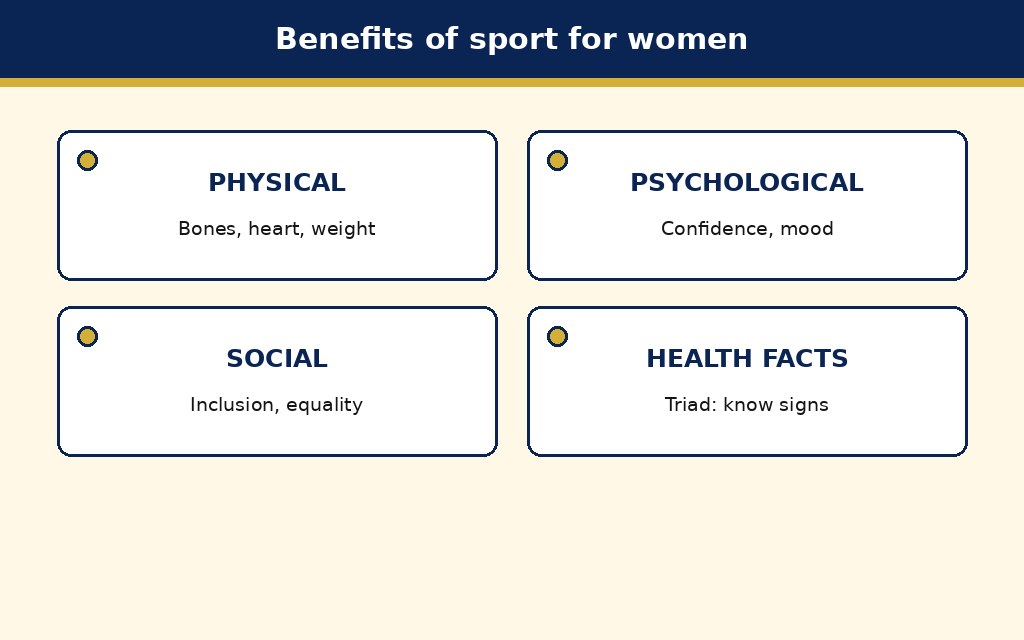
New labelled schematic (labels and gold dots are printed on the image): Benefits for women in sport
What the chapter is about
Women have always played, but for long they were given fewer chances, less money and less respect in sport. That is changing. Indian stars like P. V. Sindhu, Mary Kom, Sakshi Malik and the women's cricket and hockey teams have shown the world what women athletes can do.
Barriers still exist: fewer facilities, doubts about girls playing, safety worries, and media that covers men's sport more. Breaking them needs equal ground time, equal encouragement at home and school, and stories that celebrate girls' sport.
When girls play, everyone gains. Girls grow strong and confident, teams get more talent, and younger girls get role models. Sport is not a boys' subject — it belongs to everyone.
A long history, a recent stage
The chapter roots women's sport in Indian history: warriors like Rani Laxmi Bai, Jhalkari Bai and Devi Ahilya Bai demonstrated courage and physical prowess long before modern sport existed. The point is that women in physical action are not new — what is new is organised, equal opportunity to compete. India has achieved a significant milestone in this area, with women athletes now winning at the highest levels, and both the Indian Olympic Association and the Indian Paralympic Committee now frame women's participation as part of the mainstream.
Government and school programmes support this change, including talent searches that look for girls as well as boys. The chapter's message for students is direct: a girl's place in sport is not a favour granted by others but a right she already holds — the same right Chapter 12 states for everyone.
Benefits and health knowledge every student should have
Physical benefits for women in sport include stronger bones and muscles, improved muscle tone, better heart and lung health, weight control, improved sleep and bone density, and reduced risk of lifestyle diseases, lower blood pressure and lower cholesterol. Psychological benefits include confidence, stress relief and better mood; social benefits include inclusion — sport brings women from different backgrounds together, promoting equality, understanding and mutual respect.
The chapter also teaches health facts honestly. Menstruation is the monthly shedding of the uterine lining through the vagina. Primary amenorrhea is when menstruation does not start by puberty. The Female Athlete Triad — first described by the American College of Sports Medicine (ACSM) in 1992 — links low energy availability, menstrual disturbance and low bone density, and it is a warning sign that training and food must be balanced. These facts are examinable and, more importantly, they protect athletes who might otherwise train through harm.
What you should learn
Women athletes have faced unequal chances, Indian stars prove their excellence, and equal facilities and encouragement remove remaining barriers.
Key Terms
- Gender equality — Equal chances and respect for all genders.
- Role model — A person whose success inspires others.
- Barrier — An obstacle that blocks fair participation.
- Media coverage — How much attention news and TV give a sport.
- Empowerment — Gaining confidence and power through opportunity.
Remember
- Women athletes have long faced unequal chances.
- Indian women stars inspire millions.
- Barriers include facilities, doubts and coverage.
- Equal encouragement helps everyone.
Exam Tip / Common Mistake
Common mistake: saying girls are 'naturally' worse at sport. Differences in results usually come from unequal practice, coaching and chances — not nature.
Chart / Table: Barriers and solutions for women in sport
| Point | Detail |
|---|---|
| Fewer facilities | Share grounds and times fairly |
| Doubts at home | Celebrate girls' achievements |
| Safety worries | Safe transport, safe grounds |
| Less media coverage | Cover girls' matches equally |
| Few role models | Share stories of women stars |
Women's sport in India runs from warrior queens to Olympic podiums; its benefits are physical, psychological and social — and its health facts, from menstruation to the Female Athlete Triad, must be known, not whispered about.
Practice set — try it yourself
- Name three Indian women sports stars and their sports.
Hint: Hint: Badminton, boxing, wrestling, cricket. - Why does media coverage matter for girls' sport?
Hint: Hint: Think role models and sponsorship. - How would you make ground time fair in your school?
Hint: Hint: Equal slots, mixed schedules. - What would you say to someone who says sport is for boys?
Hint: Hint: Use examples and fairness. - Plan a girls' sports day event for your school.
Hint: Hint: Include three sports and equal prizes.
Questions with Answers
- Why have women faced barriers in sport?
Because of old beliefs, fewer facilities, less encouragement, safety worries and far less media coverage than men's sport. - Name Indian women athletes who broke barriers.
P. V. Sindhu (badminton), Mary Kom (boxing), Sakshi Malik (wrestling), and stars of women's cricket and hockey. - How does unequal practice affect results?
Players with less ground time, coaching and competition improve slower. Gaps often reflect chances, not natural ability. - What can schools do for girls' sport?
Give equal ground time, coaching, matches and prizes, and celebrate girls' achievements as loudly as boys'." - Why do role models matter?
Because when younger girls see women succeeding in sport, they believe they can too, and families support them more.
Questions with Answers — Extension
- Why does the chapter begin with Rani Laxmi Bai, Jhalkari Bai and Ahilya Bai?
To show women's physical courage is old in India; the modern struggle is for equal organised opportunity, not for proving women can be strong. - List three physical, two psychological and one social benefit of sport for women.
Physical: stronger bones, better heart and lung health, weight control. Psychological: confidence, stress relief. Social: inclusion across backgrounds. - What is the Female Athlete Triad, and why is it a warning sign?
Low energy availability plus menstrual disturbance plus low bone density (ACSM, 1992): it warns that training load exceeds food intake and harms bones and health. - What is primary amenorrhea, and what should a young athlete do about it?
Menstruation not starting by puberty; the athlete should tell a parent and see a doctor rather than ignore it or train harder. - A school holds trials only for boys' teams. Which chapter ideas does this break, and what is the fix?
It breaks inclusion (Chapter 12) and equality: the fix is equal trials, teams and facilities for girls, with talent searches covering both.
How to use this page: Read the summary, say the Key Terms in your own words, then try the practice set without looking. Use the Questions with Answers to check yourself afterwards. Ask your teacher or parent to check your answers.