

Chapter 14: Disability Etiquettes: Respecting Everyone with Dignity
Etiquette is dignity in action: general rules, group-specific manners, and the STEP model.
Original notes — ready CBSE (NCERT, English Medium) • Class 9 • Physical Education • Book: Khel Praveen
Chapter 14: Disability Etiquettes: Respecting Everyone with Dignity — EG's own notes, in simple words
Book: Khel Praveen (CBSE, Class 9) | Chapter 14 | Section: Unit 4: Sports for All | Medium: English

Diagram (labels are printed on the image): Talking at eye level, asking first, and putting the person first. A general picture about disability etiquette; it is not a scene from the book.

Classmates chatting at eye level with respect.
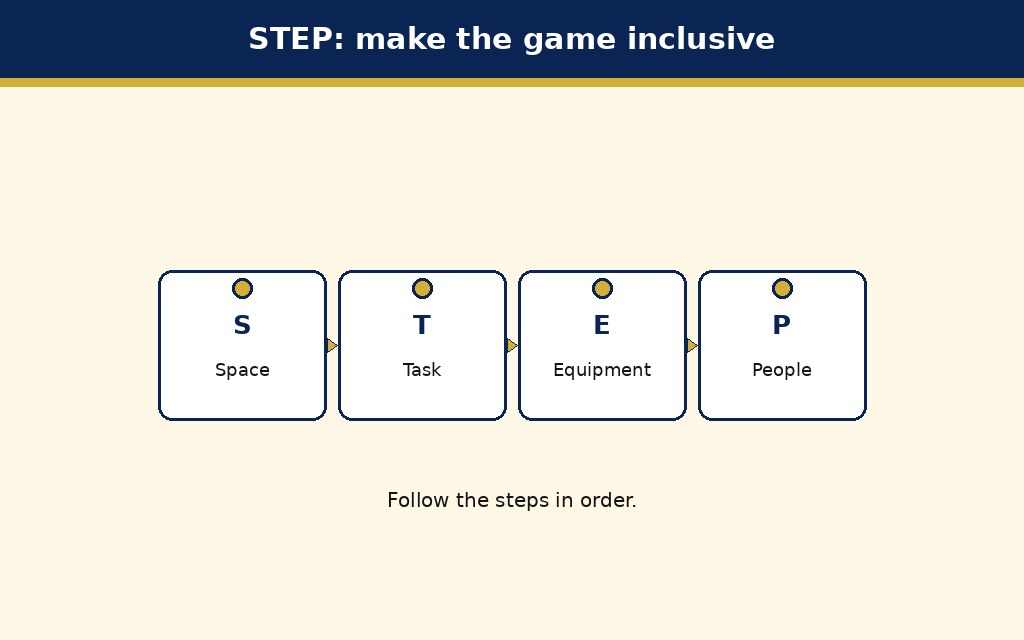
New labelled schematic (labels and gold dots are printed on the image): STEP model
What the chapter is about
Etiquette is good manners, and disability etiquette is good manners toward people with disabilities. Its heart is simple: treat the person as a person first, and their disability second. Use person-first language — 'a student with a disability', not a label that defines them.
Practical manners matter. Speak directly to the person, not to their helper. If you chat with a wheelchair user, sit or crouch to eye level when you can. Ask before helping, and do not touch mobility aids without permission — a wheelchair is part of the person's space.
In sport, etiquette means fair play plus dignity: no teasing, no unwanted pity, and no changing rules without asking the players. Dignity is not extra kindness — it is basic respect everyone deserves.
General principles first
Disability etiquettes are about the correct ways of behaving with people who have disabilities — and the first rule is to treat the person first. Be respectful: speak to the person, not about them or only to a companion. Be inclusive: do not assume what someone can or cannot do. Ask before helping: never grab a wheelchair, an arm or an aid without permission — help offered without consent is control, not kindness. Do not stare, point or make jokes: drawing attention to a disability embarrasses and excludes.
These four principles answer the chapter's first exercise directly, and they apply everywhere: classroom, playground, bus and market. Overprotecting someone also breaks etiquette, because it takes away independence — the chapter asks how overprotection makes someone uncomfortable, and the answer is that it signals incapability where the person only needed access.
Group-specific manners and the STEP model
Different situations need different manners. For wheelchair users: ask before pushing, sit at eye level for long talks, and keep paths clear. For people with visual impairments: identify yourself, describe the surroundings, and offer your arm rather than pulling. For hearing loss: face the person, speak clearly, and do not cover your mouth. For speech difficulties: listen patiently and never finish their sentences. For cognitive or developmental disabilities: use simple, clear language and give time. For invisible disabilities: believe what the person says about their needs.
The STEP model turns manners into inclusive teaching. It changes four things: Space (arrange the ground and seating), Task (adjust rules and roles), Equipment (adapt balls, bats and aids) and People (pair and group thoughtfully). The chapter's exercise asks how STEP promotes inclusion — the answer is that it fixes the activity, not the person: change the space, task, equipment or people, and the same game welcomes everyone.
What you should learn
Disability etiquette means person-first language, speaking directly, asking before helping, and respecting aids and dignity.
Key Terms
- Etiquette — Good manners in dealing with others.
- Person-first language — Saying 'person with a disability', putting the person before the disability.
- Dignity — The respect every person deserves.
- Mobility aid — Equipment like a wheelchair or crutch that helps movement.
- Consent — Permission asked before helping or touching.
Remember
- Person first, disability second.
- Speak to the person, not their helper.
- Ask before helping; do not grab aids.
- Dignity is basic respect, not extra kindness.
Exam Tip / Common Mistake
Common mistake: pushing someone's wheelchair without asking. It is their personal space — always ask first, even when you mean well.
Chart / Table: Disability etiquette do's and don'ts
| Point | Detail |
|---|---|
| Do | Speak directly to the person |
| Do | Ask before helping |
| Do | Sit to eye level when chatting |
| Don't | Touch aids without permission |
| Don't | Use pitying or labelling words |
Going deeper — Chapter 14: Disability Etiquettes: Respecting Everyone with Dignity
At the centre of this chapter are a few ideas that everything else hangs on: Etiquette, Person-first language, Dignity, Mobility aid. If you can explain those ideas in your own words without looking at the notes, you already hold the chapter's spine. Everything else on this page — the examples, the tables and the questions — is there to help you practise using those ideas, not to be memorised as separate facts.
Read the chapter in this order. First, read the summary slowly and ask yourself what question the chapter is answering. Then work through each section one at a time and, after each one, close the page and say its main point in two lines. The sections of this chapter are: What the chapter is about; General principles first; Group-specific manners and the STEP model. Each section adds one layer: an earlier section gives you the words and tools, and a later section shows you where those tools are used. When you revise, do not re-read passively — explain each section aloud as if you were teaching a classmate who missed the lesson.
In physical education answers, name the concept or procedure first, then give its steps or components in order, then its benefit or application. For fitness and training questions, give the correct term, the method, and one precaution or example.
Important Questions with Answers — deepening set
These questions go beyond the sets above. Try each one without looking, then check your answer against the notes.
- What does 'Etiquette' mean? Explain it in your own words and say how it is used in this chapter.
Good manners in dealing with others. In this chapter, Etiquette is one of the ideas you must be able to use, not just define. When a question mentions Etiquette, first write its meaning in one line, then apply it to the situation in the question. That two-step habit — meaning first, application second — is what turns a definition into marks. - What does 'Person-first language' mean? Explain it in your own words and say how it is used in this chapter.
Saying 'person with a disability', putting the person before the disability. In this chapter, Person-first language is one of the ideas you must be able to use, not just define. When a question mentions Person-first language, first write its meaning in one line, then apply it to the situation in the question. That two-step habit — meaning first, application second — is what turns a definition into marks. - What does 'Dignity' mean? Explain it in your own words and say how it is used in this chapter.
The respect every person deserves. In this chapter, Dignity is one of the ideas you must be able to use, not just define. When a question mentions Dignity, first write its meaning in one line, then apply it to the situation in the question. That two-step habit — meaning first, application second — is what turns a definition into marks. - What does 'Mobility aid' mean? Explain it in your own words and say how it is used in this chapter.
Equipment like a wheelchair or crutch that helps movement. In this chapter, Mobility aid is one of the ideas you must be able to use, not just define. When a question mentions Mobility aid, first write its meaning in one line, then apply it to the situation in the question. That two-step habit — meaning first, application second — is what turns a definition into marks. - What does 'Consent' mean? Explain it in your own words and say how it is used in this chapter.
Permission asked before helping or touching. In this chapter, Consent is one of the ideas you must be able to use, not just define. When a question mentions Consent, first write its meaning in one line, then apply it to the situation in the question. That two-step habit — meaning first, application second — is what turns a definition into marks. - What does 'Do' mean? Explain it in your own words and say how it is used in this chapter.
Speak directly to the person In this chapter, Do is one of the ideas you must be able to use, not just define. When a question mentions Do, first write its meaning in one line, then apply it to the situation in the question. That two-step habit — meaning first, application second — is what turns a definition into marks.
Revision checklist and exam writing guide
Use this checklist the night before a test. Tick a point only if you can do it without opening the notes.
- I can explain 'What the chapter is about' in two lines without looking.
- I can explain 'General principles first' in two lines without looking.
- I can explain 'Group-specific manners and the STEP model' in two lines without looking.
- I can write the chapter's key terms from memory, with one example for each.
- I can answer one long question from this chapter in five ordered paragraphs.
In physical education answers, name the concept or procedure first, then give its steps or components in order, then its benefit or application. For fitness and training questions, give the correct term, the method, and one precaution or example.
Common mistake to avoid: writing everything you remember about the chapter instead of answering the question asked. Read the question twice, underline its command word — explain, compare, why, what happens — and let that word decide the shape of your answer.
Important Questions with Answers — deepening set
These questions go beyond the sets above. Try each one without looking, then check your answer against the notes.
- What does 'Don't' mean? Explain it in your own words and say how it is used in this chapter.
Touch aids without permission In this chapter, Don't is one of the ideas you must be able to use, not just define. When a question mentions Don't, first write its meaning in one line, then apply it to the situation in the question. That two-step habit — meaning first, application second — is what turns a definition into marks. - What is the main point of the section 'What the chapter is about', and why does it come at that place in the chapter?
Work through the section slowly and write its main point in two lines of your own: what new idea it introduces, and how it follows from the section before it. In revision, if you cannot state that point without looking, re-read the section once, say it aloud, and only then move on. A section you can summarise is a section you have understood; a section you can only recognise is not yet ready for the exam. - What is the main point of the section 'General principles first', and why does it come at that place in the chapter?
Work through the section slowly and write its main point in two lines of your own: what new idea it introduces, and how it follows from the section before it. In revision, if you cannot state that point without looking, re-read the section once, say it aloud, and only then move on. A section you can summarise is a section you have understood; a section you can only recognise is not yet ready for the exam. - What is the main point of the section 'Group-specific manners and the STEP model', and why does it come at that place in the chapter?
Work through the section slowly and write its main point in two lines of your own: what new idea it introduces, and how it follows from the section before it. In revision, if you cannot state that point without looking, re-read the section once, say it aloud, and only then move on. A section you can summarise is a section you have understood; a section you can only recognise is not yet ready for the exam.
Important Questions with Answers — deepening set
These questions go beyond the sets above. Try each one without looking, then check your answer against the notes.
- What is the one message or conclusion of Chapter 14: Disability Etiquettes: Respecting Everyone with Dignity that you should never forget?
Every chapter in this book has one idea that ties its sections together. For this chapter, find that idea in the summary above and write it as a single sentence in your notebook. In the exam, when a long question feels confusing, that one sentence is your compass: start from it, add two supporting points from the sections, and close by repeating it in different words. - How would you answer a five-mark question from this chapter?
Start with a one-line introduction that names the topic. Then write three clear points, each in two or three lines, in a sensible order. Add one example, one term used correctly, or one short reason wherever the question allows it. End with a one-line conclusion. Five short, ordered paragraphs with correct terms score far better than one long, unordered paragraph. - What is the hardest part of this chapter, and how do you master it?
The hardest part is usually the part you keep skipping. Find it — the section you re-read most, or the term you always forget — and give it ten focused minutes: read it, cover it, write its three key points from memory, and check. Repeat that cycle the next day. Two short recalls beat one long re-reading, and they show you honestly what is still weak. - How does this chapter connect with real life or with other chapters of this book?
Do not treat this chapter as isolated. Ask where you have seen its ideas outside the book — at home, in the news, or in an earlier chapter — and note one such connection. Examiners reward answers that show understanding, and understanding shows most clearly when you can connect a textbook idea to something real without forcing it.
Good etiquette is simple: respect the person, ask before helping, never stare or assume — and when a game excludes someone, change the Space, Task, Equipment or People, never blame the player.
Practice set — try it yourself
- Rewrite these with person-first language: 'disabled boy', 'wheelchair-bound'.
Hint: Hint: Person first, aid as tool. - Role-play asking to help, and accepting a 'no, thanks'.
Hint: Hint: Offer once, respect the answer. - Why sit to eye level when chatting with a wheelchair user?
Hint: Hint: Think equal conversation. - What would you do if someone teased a disabled classmate?
Hint: Hint: Speak up, support, tell a teacher. - List three etiquette rules for your games class.
Hint: Hint: Use the chart.
Questions with Answers
- What is person-first language?
Language that puts the person before the disability, like 'a student with a disability', instead of a label that defines them by it. - Why ask before helping a person with a disability?
Because help is welcome only when wanted. Asking respects independence and consent; unasked help can feel controlling. - Why should you not touch a wheelchair without permission?
Because it is part of the person's personal space and mobility. Grabbing it is like grabbing someone's body. - How should you speak to a person with a helper?
Directly to the person, not to the helper. The person speaks for themselves. - What is dignity in disability etiquette?
Treating every person with basic respect — no teasing, no pity, no labels — as a right, not as a favour.
Questions with Answers — Extension
- List four general principles of disability etiquette and give one example of breaking each.
Respect (talking only to a companion), inclusion (assuming inability), asking before helping (grabbing a wheelchair), not staring or joking (pointing and laughing). - A classmate insists on carrying a disabled student's bag every day though the student refuses. What is wrong, and what should happen?
It is overprotection: it removes independence and signals incapability. The classmate should respect the refusal and offer help only when asked. - How should you guide a person with a visual impairment across a playground?
Identify yourself, describe the route and obstacles, offer your arm, and let them hold it — never pull or push them. - Apply STEP to make a relay race inclusive for a student using a wheelchair.
Space: flat, wide lanes. Task: shorter leg or a rolling leg with equal scoring. Equipment: a ball that can be carried on the lap. People: mixed teams where the wheelchair user anchors the relay. - How can pairing students (the People part of STEP) build teamwork and empathy?
Thoughtful pairing makes students depend on each other's strengths, so they learn a partner's needs and abilities directly instead of through labels.
How to use this page: Read the summary, say the Key Terms in your own words, then try the practice set without looking. Use the Questions with Answers to check yourself afterwards. Ask your teacher or parent to check your answers.