

Propositions and their Converses
A true statement can have a false converse — and one single counterexample is enough to knock a claim down for good.
Original notes — ready CBSE (NCERT, English Medium) • Class 9 • Mathematics • Book: Ganita Manjari — Part 2
Chapter 9: Propositions and their Converses — EG's own notes, in simple words
Book: Ganita Manjari — Part 2 (CBSE, Class 9) | Chapter 9 | Medium: English
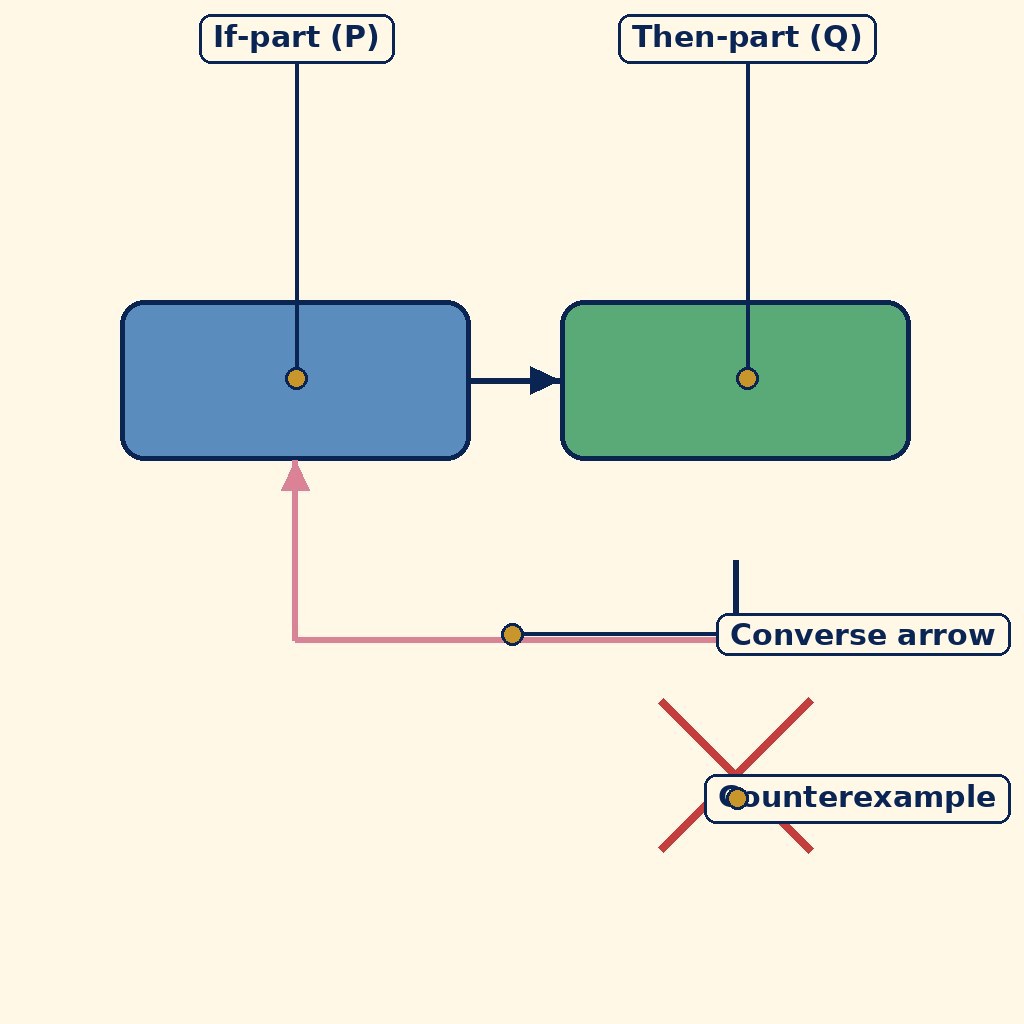
Diagram (labels are printed on the image): Two statement boxes joined by arrows: an if-then statement and its converse, with a counterexample mark showing the converse can fail.

Weighing statements as true or false — the heart of mathematical reasoning.
What the chapter is about
In everyday talk we say things loosely, but mathematics needs statements that are clearly true or clearly false. A proposition is a statement that is either true or false — never both, and never 'maybe'. '2 + 3 = 5' is a true proposition; '2 + 3 = 6' is a false one; but 'What a lovely day!' is not a proposition at all, because it is not the kind of sentence that can be true or false.
Many mathematical statements have the form 'if P, then Q'. For example: if a number is even, then it is divisible by 2. Its converse swaps the two parts: if a number is divisible by 2, then it is even. The surprising lesson of this chapter is that a true statement can have a false converse — and a single counterexample, one case where it fails, is enough to knock a claim down.
Learning to form propositions, test converses and hunt for counterexamples is the foundation of proof. It turns 'I think this is true' into 'I can show this is true — or show exactly where it fails'.
The chapter's central example comes from triangles: if two sides of a triangle are equal, then the angles opposite them are equal — a true proposition. Its converse swaps the parts: if two angles of a triangle are equal, then the sides opposite them are equal. Here the converse also happens to be true, and it can be proved by drawing the altitude from the third vertex. The lesson is not that converses are false, but that each converse must be tested on its own — never assumed.
The chapter also shows the power of a single counterexample through a famous false claim: Fermat once claimed that all numbers of a certain form are prime, and the claim stood until Euler found one number of that form that is not prime — one counterexample, and a claim believed for a century fell. That is why mathematicians hunt for counterexamples before they trust a pattern: examples can suggest, but only proof establishes, and one failure disproves.
What you should learn
- Recognise propositions, form the converse of an if-then statement, and test claims with counterexamples.
- Write if-then statements as 'X implies Y' and form their converses by swapping.
- Tell a statement from a question, a command or an opinion — only statements can be true or false.
- Use one counterexample to disprove, and proof — not many examples — to establish.
Key Terms
- Proposition — A statement that is either true or false, but not both.
- If-then statement — A statement of the form 'if P, then Q', where P is the condition and Q is the conclusion.
- Converse — The statement formed by swapping the parts of an if-then statement: 'if Q, then P'.
- Counterexample — A single example that shows a general statement is false.
- Proof — A logical argument that shows a statement must be true, not just true in the examples tried.
- Implication — Another way to say an if-then statement: 'X implies Y' means exactly 'if X, then Y'.
- Non-proposition — A sentence that cannot be true or false, such as a question ('Is it raining?'), a command ('Close the door!') or an exclamation — it is not a proposition at all.
Remember
- A proposition must be definitely true or definitely false.
- The converse of a true statement is not automatically true.
- One counterexample is enough to disprove a general claim.
- Many examples can support a claim but never prove it.
- A converse swaps if and then — test it fresh; it inherits nothing from the original.
- Questions and commands are not propositions: they have no truth value to test.
Exam Tip / Common Mistake
Common mistake: assuming that because 'if P then Q' is true, 'if Q then P' must be true too. Always test the converse separately — often with a counterexample.
Chart / Table: Statement, converse and verdict
| Point | Detail | Verdict |
|---|---|---|
| If a number is even, then it is divisible by 2. | Converse: if divisible by 2, then even. | Both true. |
| If a shape is a square, then it has four sides. | Converse: if four sides, then a square. | Statement true, converse false (a rectangle is a counterexample). |
| If x = 5, then x² = 25. | Converse: if x² = 25, then x = 5. | Statement true, converse false (x = −5 is a counterexample). |
| If a number ends in 0, then it is divisible by 10. | Converse: if divisible by 10, then it ends in 0. | Both true. |
Worked method: testing a converse with a counterexample
- Statement: if a number ends in 5, then it is divisible by 5. This is true.
- Converse: if a number is divisible by 5, then it ends in 5. Swap the parts and test it fresh.
- Counterexample: 10 is divisible by 5 but ends in 0, not 5. One counterexample disproves the converse.
Practice set — try it yourself
- Is 'Close the door!' a proposition? Explain.
Hint: Hint: Can it be true or false? - Write the converse of: If a triangle is equilateral, then all its angles are 60°.
Hint: Hint: Swap the if-part and the then-part. - Is the converse in question 2 true? Explain.
Hint: Hint: Think about whether equal angles force equal sides. - Give a counterexample to: If a number is divisible by 4, then it is divisible by 8.
Hint: Hint: Find a multiple of 4 that is not a multiple of 8. - A claim has held for 100 examples. Is it proved? Explain.
Hint: Hint: Think about what proof requires.
Questions with Answers
- What is a proposition? Give one true and one false example.
A proposition is a statement that is either true or false. True example: '7 is a prime number.' False example: '7 is an even number.' - What is the converse of 'If it rains, then the ground gets wet'?
The converse is: 'If the ground gets wet, then it rains.' It is false — the ground could get wet from a sprinkler. - How can one example disprove a statement?
A general statement claims something about every case. A single counterexample is a case where it fails, and one failure is enough to show the general claim is false. - Give a statement whose converse is also true.
'If a number is a multiple of 10, then it ends in 0.' Its converse, 'If a number ends in 0, then it is a multiple of 10,' is also true. - Why are counterexamples useful in mathematics?
They stop false ideas early. Finding a counterexample tells you exactly where a claim breaks, which often points to the correct, narrower claim.
Extension questions
- Is 'x + 3 = 7' a proposition? Explain.
No. Its truth depends on x: true when x = 4, false otherwise. A proposition must be definitely true or definitely false on its own. - Write the converse of: If a number is divisible by 6, then it is divisible by 3. Is the converse true?
Converse: if a number is divisible by 3, then it is divisible by 6. False — 9 is divisible by 3 but not by 6. - Give a counterexample to: All prime numbers are odd.
2 is prime and even, so the claim is false. - A statement and its converse are both true. Give an example.
'If a number is a multiple of 10, then it ends in 0' and its converse 'If a number ends in 0, then it is a multiple of 10' are both true. - Is the converse of 'If a figure is a square, then it has equal diagonals' true? Explain.
No. A rectangle has equal diagonals but need not be a square — it is a counterexample. - Why did one counterexample defeat Fermat's claim about primes?
Because the claim was about every number of that form. One number of that form that is not prime shows the 'every' claim is false, however long it was believed.
If P then Q says nothing about if Q then P — swap it, test it, and let one counterexample speak louder than a hundred examples.
How to use this page: Read the summary, say the Key Terms in your own words, then try the practice set without looking. Use the Questions with Answers to check yourself afterwards. Ask your teacher or parent to check your answers.