

Chapter 9: Music Travels Around the World
When people travel, their music travels too — flutes, lutes, drums and the songs of migration.
Original notes — ready CBSE (NCERT, English Medium) • Class 9 • Arts • Book: Madhurima
Chapter 9: Music Travels Around the World — EG's own notes, in simple words
Book: Madhurima (CBSE, Class 9) | Chapter 9 | Section: Music | Medium: English
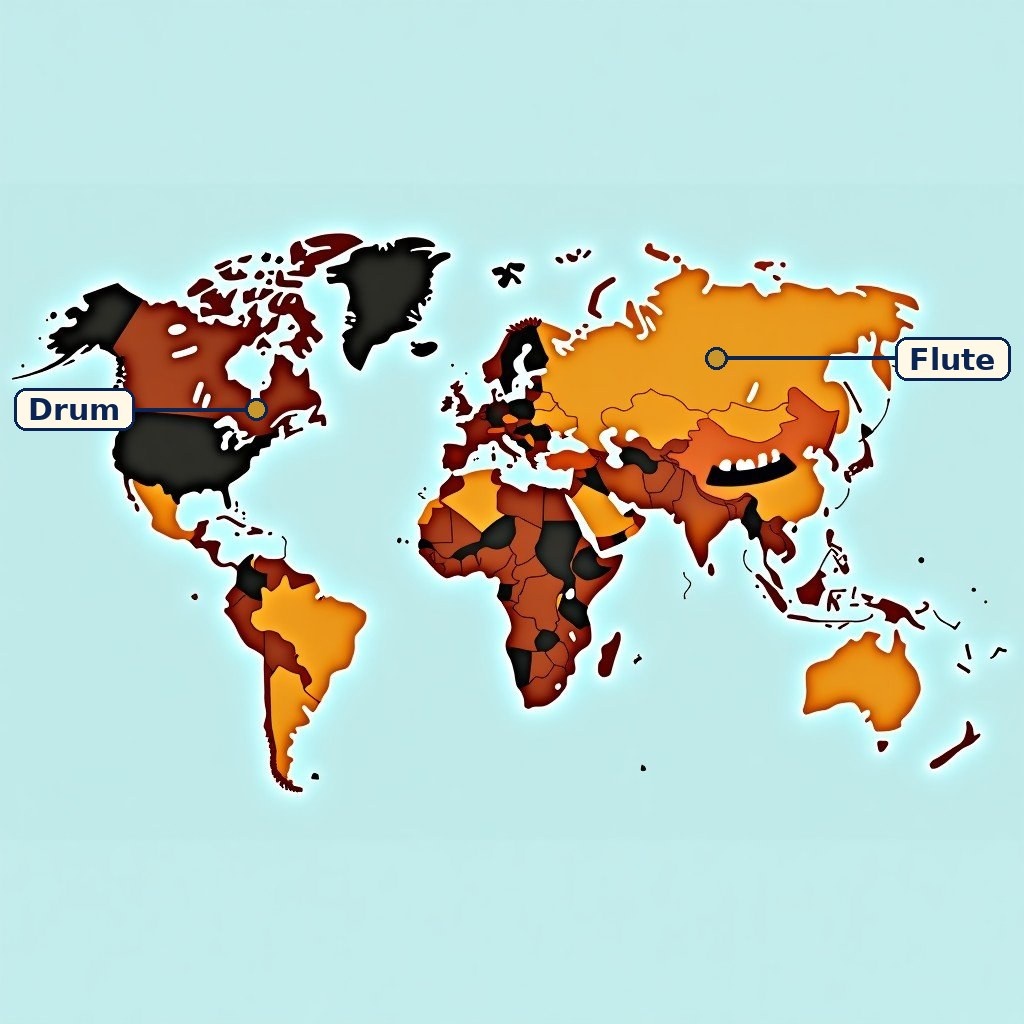
Diagram (labels are printed on the image): Instruments from different parts of the world sharing rhythm and melody. A general picture about world music; it is not a scene from the book.

Students enjoying music from different countries together.
What the chapter is about
Have you travelled to a town, city or country different from where you live? Just as people travel, music travels with them. When people migrate, they carry songs, instruments and rhythms in memory, and make music again in a new place — sometimes keeping it unchanged, sometimes mixing it with what they find there.
That is how instruments and genres spread across the world. The same family of instruments can appear on different continents in different shapes and materials, and the same song can return home changed by its journey. Music, in this chapter, is a map of human movement.
Instrument families across the world
Instruments belong to families by how they make sound and by shape. The flute family, for example, includes wind instruments played by blowing across or into a tube; the lute family includes stringed instruments with a neck and a rounded body, plucked rather than bowed. Two instruments from the same family may look different, but their sound-making idea is the same.
Materials matter too. An instrument's body may be wood, metal, gourd, skin or bamboo, depending on what a region has and what sound its people want. Comparing two instruments from one family — their materials, shapes and playing styles — shows how one idea adapts to many places.
Migration, memory and mixing
Music serves migrating people in several ways: it keeps memory alive, comforts in a strange place, marks festivals far from home, and tells children who they are. Chutney music is one example studied in this chapter: a dance music born where Indian migrants met Caribbean rhythms, mixing Bhojpuri folk roots with new beats and instruments.
Mixing can be a gain, not a loss. When genres meet, new sounds are born and old songs reach new listeners. But mixing also raises a question worth debating: does the original survive, or does it change beyond recognition? The chapter asks you to judge, with examples, rather than to accept one answer.
What you should learn
Music travels with migrating people: instrument families (like flute and lute) adapt to new places, and genres like chutney music are born from mixing.
Key Terms
- Migration — People moving from one place to live in another.
- Diaspora — A community living away from its original homeland, keeping its culture alive.
- Flute family — Wind instruments played by blowing across or into a tube.
- Lute family — Plucked stringed instruments with a neck and rounded body.
- Chutney music — Dance music mixing Bhojpuri folk roots with Caribbean rhythms.
- Fusion — Music made by mixing two or more genres or traditions.
- Genre — A category of music with characteristic features (vidha).
Remember
- People carry songs and instruments when they migrate.
- Instrument families share a sound-making idea across shapes and materials.
- Materials (wood, metal, gourd, skin, bamboo) shape an instrument's sound.
- Music keeps memory alive far from home.
- Mixing genres creates new music — and a debate about what survives.
Common mistake: thinking an instrument belongs to only one country. Families like flute and lute appear worldwide, adapted to local materials and styles.
Chart / Table: Music across the world
| Point | Detail |
|---|---|
| Flute family | Wind instruments, blown across or into a tube |
| Lute family | Plucked strings, neck and rounded body |
| Drums (avanaddha) | Stretched membrane, struck by hand or stick |
| Chutney music | Bhojpuri folk roots + Caribbean rhythms |
| Migration's gift | Old songs kept alive, new genres born |
| Migration's question | What changes, and what survives the journey? |
Practice set — try it yourself
- Name two instruments of the flute family and where they are found.
Hint: Think about blowing technique, not just shape. - Describe chutney music in about 50 words.
Hint: Mention its roots and its new home. - Give two instruments and the materials they are made from.
Hint: Link material to sound and region. - Imagine you migrate to another state, leaving family behind. What music would you carry?
Hint: Think memory, comfort and identity. - Listen to two world instruments and name their families.
Hint: Ask: blown, plucked, struck membrane, or solid?
Questions with Answers
- Name two instruments that belong to the flute family.
Any two blown wind instruments of that family, such as the bansuri and its cousins elsewhere in the world, identified by their blowing technique and tube shape. - Describe some features of chutney music.
Chutney music is a dance music born among Indian migrants in the Caribbean, mixing Bhojpuri folk songs and rhythms with Caribbean beats and instruments, made for celebration and dancing. - What purpose does music serve when people migrate?
It keeps memory alive, comforts people in a new place, marks festivals far from home, and teaches children their community's identity. - Give two examples of instruments and the materials used to make them.
Answers vary: wood and bamboo for flutes, gourd and wood for lutes, skin and wood for drums — material shapes the sound and reflects what a region has. - Is the mixing of genres through migration beneficial? Give reasons.
Yes, when it creates new music and new listeners; but it also changes originals, so the gain must be weighed against what is lost or transformed.
Extension questions — go deeper
- Besides tata, sushira, avanaddha and ghana, how else can instruments be classified?
By family and shape (flute family, lute family), by playing method (blown, plucked, bowed, struck), or by material — each system answers a different question. - Describe characteristic features of lute-family instruments.
Plucked strings over a neck and rounded body; sound shaped by string length and body resonance; found worldwide in local materials and tunings. - Debate: does migration preserve music or change it beyond recognition?
Both happen: songs survive in memory and ritual, yet instruments, language and rhythms adapt. Use one example (like chutney) to argue either side with evidence. - Trace one instrument's journey across two countries.
Name the instrument, its original form and material, and how shape, tuning or repertoire changed in its new home. - What would you record first if your family migrated: songs, instruments, or stories? Why?
Answers vary, but must link the choice to memory, identity or practicality — what survives travel best?
- Music travels with people; migration is a map of genres.
- Flute family = blown tubes; lute family = plucked strings with neck and body.
- Materials shape sound: wood, metal, gourd, skin, bamboo.
- Chutney music: Bhojpuri roots + Caribbean rhythms.
- Mixing creates new music — and a debate about survival.
How to use this page: Read the summary, say the Key Terms in your own words, then try the practice set without looking. Use the Questions with Answers to check yourself afterwards. Ask your teacher or parent to check your answers.