

Chapter 8: Rāga and Tāla
Seven notes, rising and falling scales, and the beat cycles that hold a song together.
Original notes — ready CBSE (NCERT, English Medium) • Class 9 • Arts • Book: Madhurima
Chapter 8: Rāga and Tāla — EG's own notes, in simple words
Book: Madhurima (CBSE, Class 9) | Chapter 8 | Section: Music | Medium: English
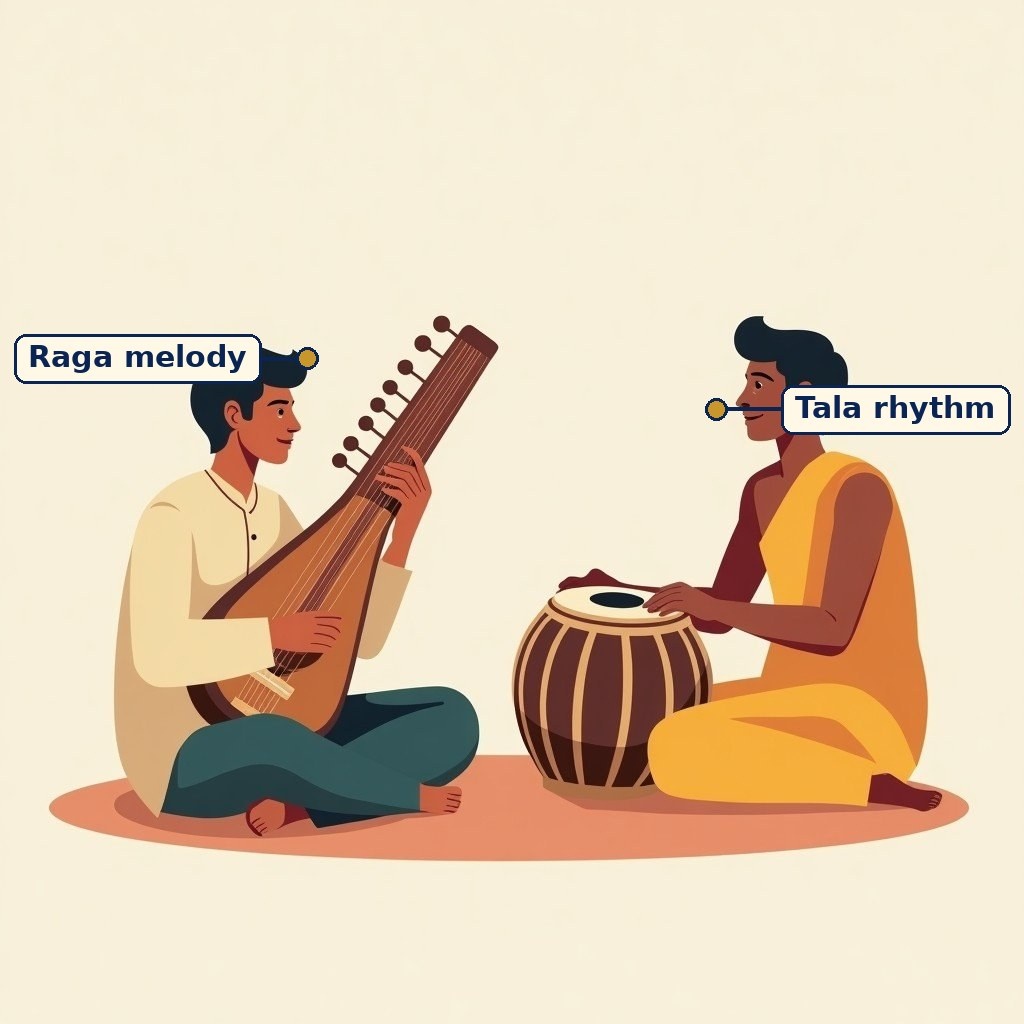
Diagram (labels are printed on the image): Musicians playing a melody over a steady rhythmic cycle, returning to the first beat. A general picture about raga and tala; it is not a scene from the book.

Students clapping a rhythm cycle while listening to a melody.
What the chapter is about
Before this chapter, recall the building blocks of melody. Nada is musical sound. Shruti is a sound heard clearly and recognised as distinct from another. Svara is a note in music: there are seven notes in Indian music, SRGMPDN. A saptak, or sthayi, is an octave or register, and musicians usually perform in mandra (lower), madhya (middle) and tara (higher) saptaks.
A raga is built from these notes, and a tala is built from beats. This chapter revisits both, so that you can recognise a raga by its scale and count a tala with your fingers, instead of only feeling them.
Raga: arohana, avarohana, jati and svara types
A raga's scale is described by its arohana (ascending order of notes) and avarohana (descending order). The number of svaras in the scale gives the raga's jati: for example, a raga with 6 svaras in the arohana and 6 in the avarohana is a shadava-jati raga (shadava means six).
Svaras are also of two kinds. Achala-svaras, or prakriti-svaras, are fixed: Sa and Pa never change. Chala-svaras, or vikriti-svaras — Re, Ga, Ma, Dha, Ni — can take altered forms. One system of classifying ragas groups them by their parent scale: for example, ragas derived from Shankarabharanam share its scale as their base, while Raga Hamsadhvani is known for dropping Ma and Dha from that scale.
Tala: counting with fingers, and tala lipi
Talas are revisited in both Hindustani and Carnatic music in this chapter. Counting a tala with your fingers — beats, claps and waves in a fixed cycle — turns an abstract cycle into something your hands remember.
Tala lipi is the written notation of a tala. Writing the tala lipi of Teen Tala, for example, means writing its beats in order with their divisions and clap-and-wave pattern, so another musician can read the cycle and play it exactly. A jatisvaram is a pure dance item set to svaras, while a svarajati adds words (sahitya) to a similar svara pattern — the difference is the presence of lyrics.
What you should learn
Raga is melody built from svaras (fixed achala and changing chala), described by arohana, avarohana and jati; tala is a beat cycle counted and written as tala lipi.
Key Terms
- Nada — Musical sound.
- Shruti — A sound heard clearly and recognised as distinct from another.
- Svara — A note in music; seven notes: SRGMPDN.
- Saptak / Sthayi — An octave or register: mandra (lower), madhya (middle), tara (higher).
- Arohana — The ascending order of notes in a raga's scale.
- Avarohana — The descending order of notes in a raga's scale.
- Jati — A raga's class by its svara count, e.g. shadava = six.
- Achala-svara — Fixed note: Sa and Pa.
- Chala-svara — Note that can change form: Re, Ga, Ma, Dha, Ni.
- Tala lipi — Written notation of a tala's beats and divisions.
Remember
- Seven svaras: SRGMPDN; saptaks: mandra, madhya, tara.
- Arohana ascends, avarohana descends; count gives jati (6 = shadava).
- Achala (Sa, Pa) never change; chala (Re, Ga, Ma, Dha, Ni) can.
- Hamsadhvani drops Ma and Dha; many ragas derive from Shankarabharanam.
- Tala is counted with fingers and written as tala lipi.
Common mistake: calling every scale a raga. A raga also has characteristic phrases, rests and feelings — the scale alone does not make it.
Chart / Table: Raga and tala side by side
| Point | Detail |
|---|---|
| Raga | Melody: a scale of svaras with rules and feeling |
| Tala | Rhythm: a cycle of beats counted and written |
| Arohana | Ascending scale |
| Avarohana | Descending scale |
| Achala-svara | Sa, Pa — fixed |
| Chala-svara | Re, Ga, Ma, Dha, Ni — can change |
| Jati (6 + 6) | Shadava-shadava |
| Tala lipi | Written beat notation, e.g. Teen Tala |
Practice set — try it yourself
- Sing the seven svaras in mandra, madhya and tara saptaks.
Hint: Feel the register change, not just the notes. - If a raga has 6 svaras in arohana and 6 in avarohana, what is its jati?
Hint: Count: six means shadava. - Count a tala with your fingers for one full cycle.
Hint: Keep the clap-and-wave pattern steady. - Name the achala and chala svaras from memory.
Hint: Fixed: Sa, Pa. Changing: the other five. - Write the tala lipi of Teen Tala.
Hint: Beats in order, with divisions and claps marked.
Questions with Answers
- Explain in one line: nada, shruti, svara, saptak.
Nada is musical sound; shruti is a clearly distinct heard sound; svara is a musical note (seven: SRGMPDN); saptak is an octave or register (mandra, madhya, tara). - Which are achala-svaras and which are chala-svaras?
Achala (prakriti) svaras are Sa and Pa — fixed. Chala (vikriti) svaras are Re, Ga, Ma, Dha, Ni — they can take altered forms. - If a raga has 6 svaras in arohana and 6 in avarohana, what is its jati?
Shadava-shadava jati: shadava means six, applied to both the ascending and descending scales. - Give a brief introduction of Raga Hamsadhvani.
Hamsadhvani is a raga derived from the Shankarabharanam scale family, known for leaving out Ma and Dha, which gives it a bright, clear character. - What is the difference between Jatisvaram and Svarajati?
Jatisvaram is a dance item set to pure svaras without words; Svarajati sets a similar svara pattern with words (sahitya) added.
Extension questions — go deeper
- Name two ragas and their scales derived from Shankarabharanam.
Answers name ragas of that parent scale and give their note patterns; Hamsadhvani (without Ma and Dha) is the chapter's worked example. - Describe one system of classification of ragas with examples.
Classification by parent scale (janaka): ragas sharing Shankarabharanam's notes belong to its family, differing in which notes they keep, drop or stress. - Identify the raga-jati from a given arohana/avarohana count.
Count the svaras in each direction: 7 = sampurna, 6 = shadava, 5 = audava — then name the combined jati. - Complete a table of Teen Tala's beats, divisions and claps.
Write the beats in order, mark each division, and show where the claps and the wave (khali) fall. - Find out about the contributions of stalwarts of Indian music.
Choose named musicians from the chapter; note one lasting contribution each — a raga, a style, a teaching lineage — not just dates.
- Svaras: SRGMPDN; saptaks mandra, madhya, tara.
- Arohana up, avarohana down; svara count = jati (6 = shadava).
- Achala Sa, Pa fixed; chala Re, Ga, Ma, Dha, Ni change.
- Hamsadhvani: Shankarabharanam family, without Ma and Dha.
- Tala counted by fingers, written as tala lipi.
How to use this page: Read the summary, say the Key Terms in your own words, then try the practice set without looking. Use the Questions with Answers to check yourself afterwards. Ask your teacher or parent to check your answers.