

Chapter 12: Cultural Connections Through Dance
Bhangra in Birmingham, the Ramayana in Cambodia — how dance crosses borders and still belongs.
Original notes — ready CBSE (NCERT, English Medium) • Class 9 • Arts • Book: Madhurima
Chapter 12: Cultural Connections Through Dance — EG's own notes, in simple words
Book: Madhurima (CBSE, Class 9) | Chapter 12 | Section: Dance | Medium: English
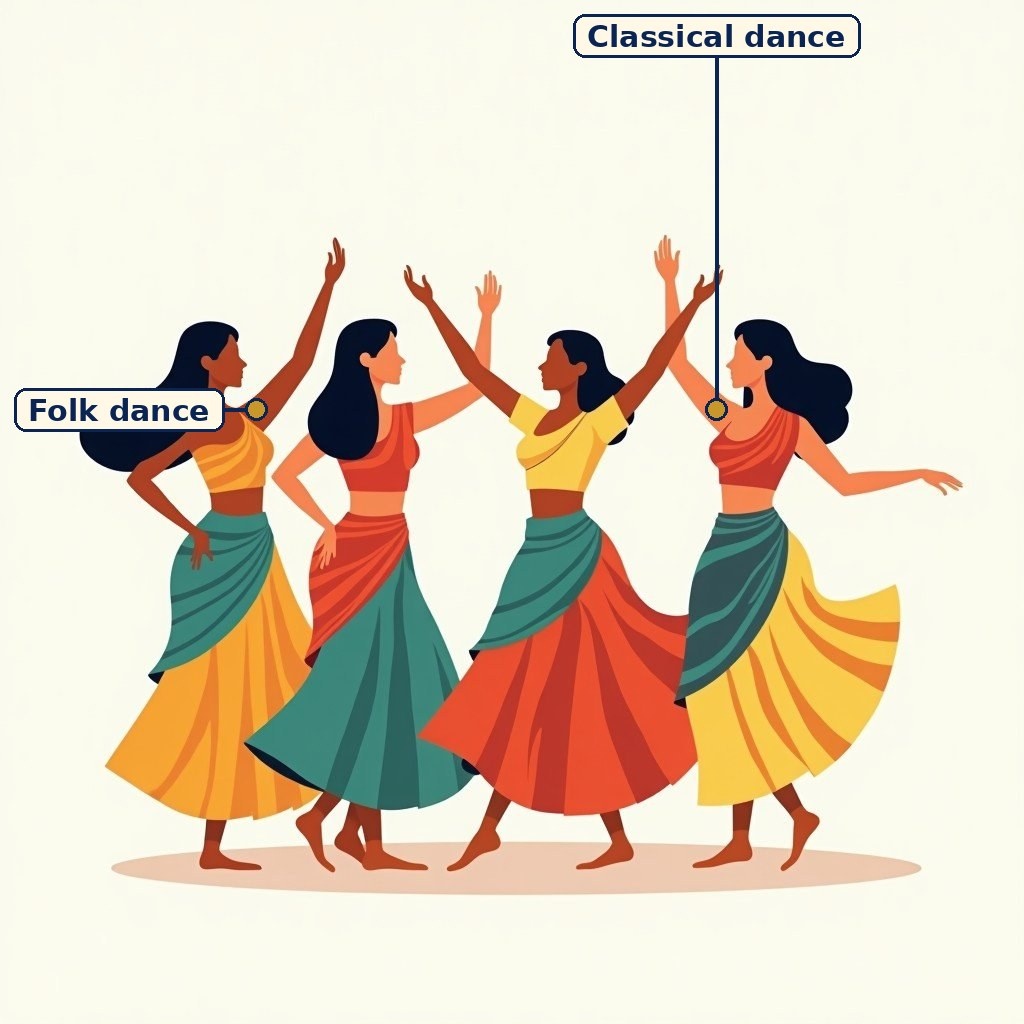
Diagram (labels are printed on the image): Dancers in different regional costumes sharing rhythm on one stage. A general picture about dance and culture; it is not a scene from the book.
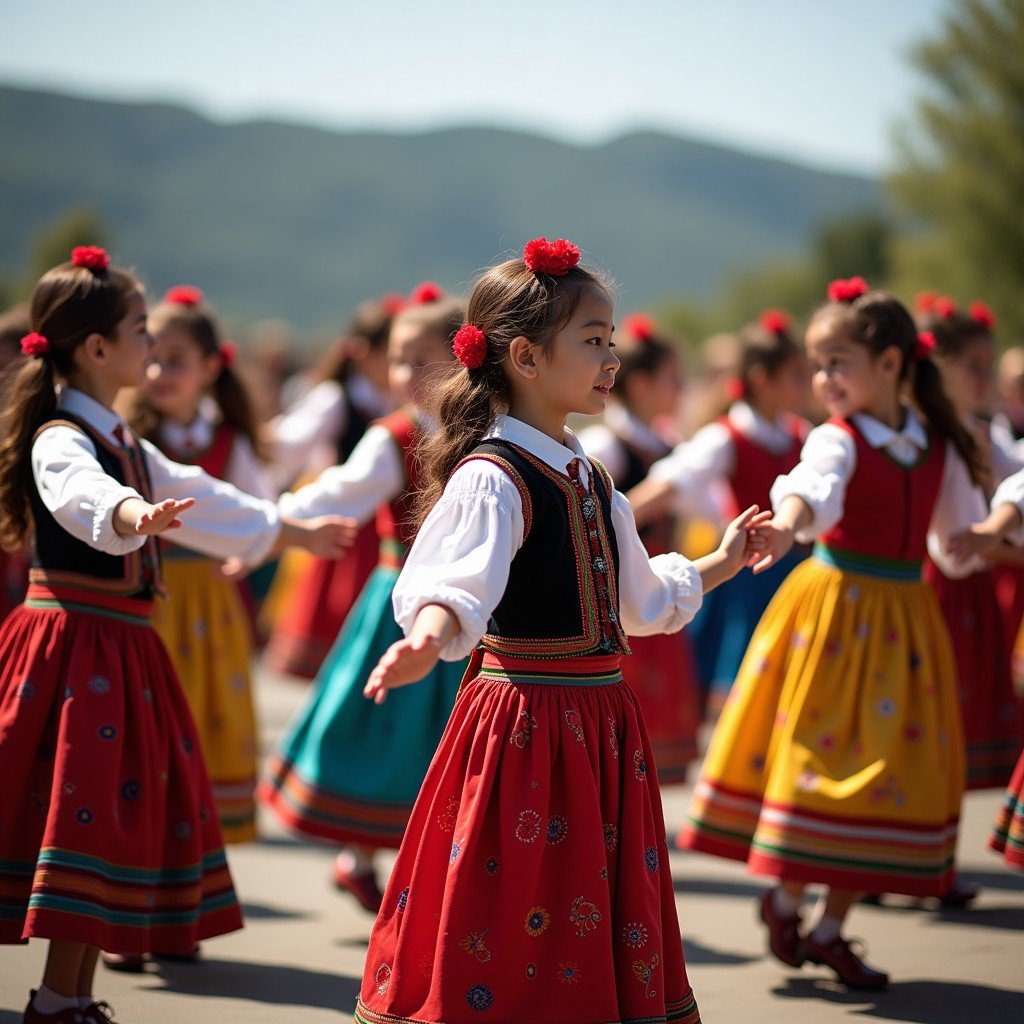
Students performing folk dances from different regions together.
What the chapter is about
Culture connects people beyond boundaries. Our customs, social traditions, regions and stories travel with us, and dance is one of the clearest ways that connection is seen: a dance learned in one place is performed, loved and remade in another.
This chapter follows dance across regions and countries. It asks where dances are performed and by whom, how the same epic story is danced differently in different lands, and what respect — including consent when interviewing artists — the work of cultural connection requires.
Dance with a global presence: Bhangra
Bhangra is the chapter's example of a dance with a global presence. Its global footprint is shown in four pictures: flashmobs in Birmingham, half-time performances at NBA games in the USA, stage competitions in Singapore, and Lohri celebrations in Punjab.
The same dance therefore means different things in different places: a street celebration, a stadium show, a competition piece, and a harvest festival at home. Its steps travel, but its occasion changes — and that is what ‘global presence’ really means.
One epic, many dances: the Ramayana across Asia
The Ramayana is danced across South and Southeast Asia, in versions that share a story but not a style. Cambodia's Reamker is presented by the Royal Khmer Ballet through classical dance; Thailand, Java (Indonesia) and Bali have their own versions too, each with signature movements, costumes and music.
Matching a version to its land is the chapter's test of careful reading: the same hero, Hanuman, can look and move differently in each tradition. The story connects the cultures; the dance styles keep them distinct.
Respect in cultural work: consent
Cultural connection also has an ethic. When students make a podcast or interview artists as part of production work, taking the interviewee's consent matters: permission to record, to quote and to share must be asked, not assumed.
Consent protects the artist and the art. It says that a tradition belongs to its people first, and that outsiders — even admiring ones — record and share it only with agreement.
What you should learn
Dance connects cultures: Bhangra's global presence, the Ramayana danced differently across Asia, and respect — including consent — in cultural work.
Key Terms
- Global presence — A dance performed and loved far beyond its home region.
- Flashmob — A sudden, organised group dance in a public place.
- Reamker — Cambodia's Ramayana, presented by the Royal Khmer Ballet.
- Signature movement — A characteristic movement that marks a dance tradition.
- Consent — An interviewee's permission to record, quote and share.
- Cultural connection — Links between peoples formed through shared customs and arts.
- Tradition — Practices passed down within a community.
Remember
- Culture connects people beyond boundaries.
- Bhangra: Birmingham flashmobs, NBA half-time (USA), Singapore competitions, Lohri in Punjab.
- Cambodia's Reamker is the Ramayana in Royal Khmer Ballet classical dance.
- Thailand, Java and Bali have their own Ramayana versions too.
- Interview consent must be taken, never assumed.
Common mistake: saying a dance ‘belongs’ only to its birthplace. Dances travel and are remade — but they still belong to the people and traditions that carry them.
Chart / Table: Some Indian dances and where they live
| Point | Detail |
|---|---|
| Bhangra | Punjab at home; Birmingham, USA, Singapore abroad |
| Reamker (Cambodia) | Royal Khmer Ballet's classical Ramayana |
| Ramayana versions | Thailand, Java (Indonesia), Bali — each its own style |
| Dance in rites | Some dances belong to funeral rites and sacred occasions |
| Dance at harvest | Some dances celebrate a good harvest |
| Martial dance | Some martial arts are presented as dance |
| Community dance | Some dances exist for community joy and togetherness |
Practice set — try it yourself
- Name a dance form with a global presence. Where is it performed, and by whom?
Hint: Use Bhangra's four pictures as your model. - Match the Ramayana versions to their lands: Cambodia, Thailand, Java, Bali.
Hint: Remember: Cambodia = Reamker; check the others carefully. - Why is interviewee consent important in a podcast or interview?
Hint: Think record, quote, share — and who owns the tradition. - Plan a Ramayana dance in your group's own style.
Hint: Choose one episode; keep signature movements consistent. - List dances for: funeral rites, harvest, martial art, community joy.
Hint: Use the chapter's matching exercise as your guide.
Questions with Answers
- Name a dance form that has a global presence. Describe where it is performed and by whom.
Bhangra: flashmobs in Birmingham, half-time performances at NBA games in the USA, stage competitions in Singapore, and Lohri celebrations in Punjab — performed by Punjabi communities and international dancers alike. - What is Reamker?
Cambodia's version of the Ramayana, presented through classical dance by the Royal Khmer Ballet. - Why do the same epic's dances look different across Asia?
Because each land keeps its own signature movements, costumes and music. The story is shared; the dance style is local. - What is the importance of taking consent from the interviewee in a podcast or interview?
Consent is permission to record, quote and share. It respects the artist and the community that owns the tradition, and it must be asked, never assumed. - How does dance connect cultures?
By travelling with people and being performed, loved and remade in new places, while still carrying its home story and identity.
Extension questions — go deeper
- Match: dance in funeral rites / harvest celebration / martial art as dance / community joy — with Bihu, Nata-Sankirtana, Garba, Mayurbhanj Chhau.
This is the chapter's matching exercise: answer by the occasion each form serves, and be ready to justify each pair from what you studied. - Compare Bhangra at Lohri in Punjab with Bhangra at an NBA half-time show.
Same steps, different occasion, audience and meaning: home festival versus stadium entertainment. What is kept, and what changes? - Write consent questions you would ask before interviewing a folk artist.
May I record? May I quote you by name? May I share this online, and where? Can you withdraw permission later? - Present a Ramayana episode in dance, in a style your group chooses.
Pick one episode, agree on signature movements, and present it so the story reads without narration. - Does global fame help or harm a traditional dance? Argue with Bhangra as evidence.
Fame spreads learning and pride, but can also flatten a dance into a showpiece. Weigh both sides with examples.
- Culture connects people beyond boundaries.
- Bhangra global: Birmingham, NBA (USA), Singapore, Lohri (Punjab).
- Reamker = Cambodia's Ramayana (Royal Khmer Ballet).
- Same epic, different styles: Thailand, Java, Bali too.
- Consent in interviews: ask, never assume.
How to use this page: Read the summary, say the Key Terms in your own words, then try the practice set without looking. Use the Questions with Answers to check yourself afterwards. Ask your teacher or parent to check your answers.