

Chapter 1: Introduction to the History of Arts
From Bhimbetka's cave walls to living folk traditions — how art travelled through thousands of years.
Original notes — ready CBSE (NCERT, English Medium) • Class 9 • Arts • Book: Madhurima
Chapter 1: Introduction to the History of Arts — EG's own notes, in simple words
Book: Madhurima (CBSE, Class 9) | Chapter 1 | Section: History of Arts | Medium: English
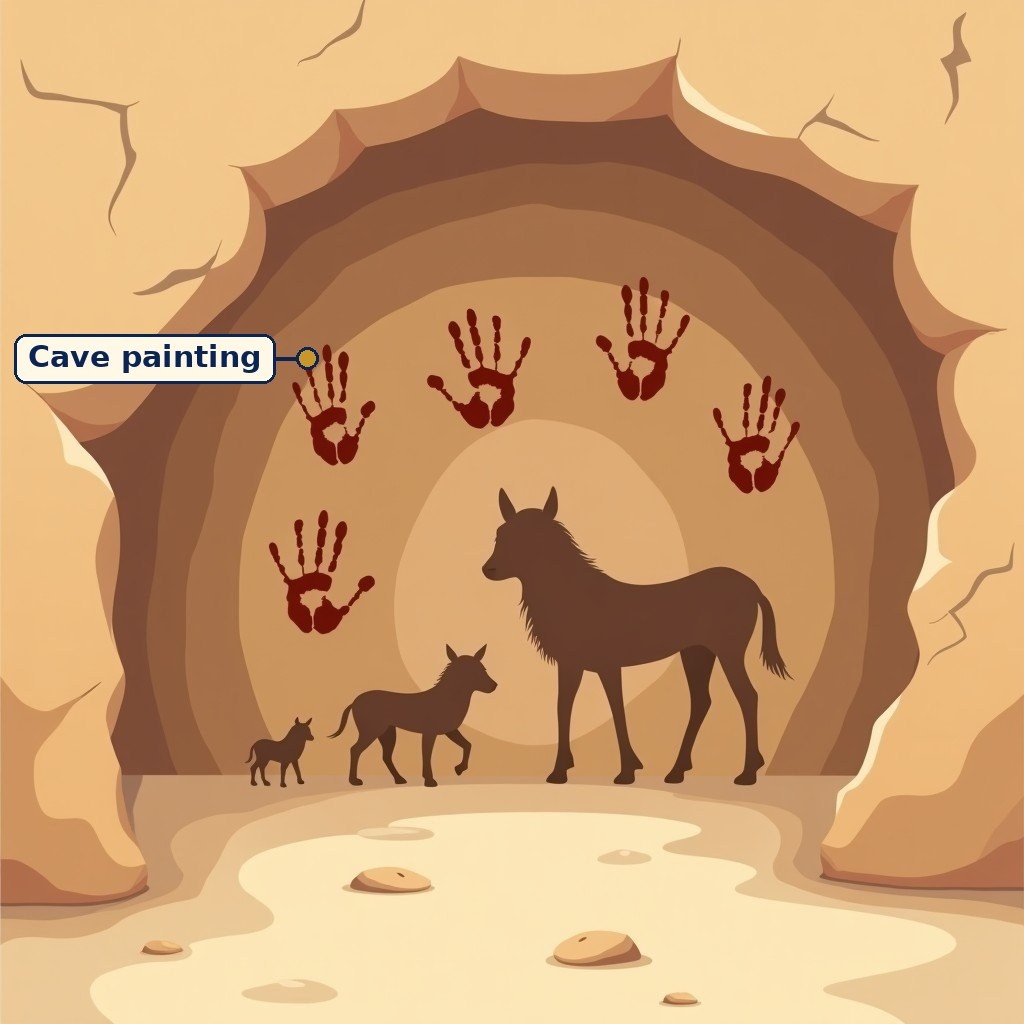
Diagram (labels are printed on the image): A rock wall with early paintings, a carved temple panel, and a long timeline of art history. A general picture about the history of arts; it is not a copy of any book illustration.

Students studying pictures of old Indian art and talking about what they see.
What the chapter is about
Art is as old as human beings themselves. Long before books were written, people painted on cave walls, carved stone, sang songs and danced together. These early artworks tell us how people lived, what they believed and what they found beautiful.
Indian art has a very long story, from the paintings of the Bhimbetka rock shelters and the carvings of Sanchi and Sarnath to temple sculpture, Ajanta's murals, folk painting and classical dance and music. At the same time, art was growing in other parts of the world too, and artists often learned from one another.
Tangible and intangible heritage
UNESCO describes cultural heritage as two kinds. Tangible heritage is what we can touch and see: monuments, sculptures, paintings, manuscripts and objects in museums. Intangible heritage lives in people: songs, dances, rituals, festivals, crafts and oral traditions passed from one generation to the next.
India's heritage holds both kinds side by side. A stone temple is tangible; the songs sung at its festival are intangible. Both need care, because when a tradition stops being practised, a part of heritage is lost even if the building still stands.
How traditions were passed on: shruti and smriti
Much of India's art was first passed on by listening. Shruti means ‘that which is heard’ — learning by careful listening, as in the chanting of the Sāmaveda, which grew from one note to three notes and then to the seven notes of music. Smriti means ‘that which is remembered’ — texts like the Rāmāyaṇa, Mahābhārata and Purāṇas, carried by narration based on memory.
Ancient treatises still guide artists today. The Nāṭyashāstra is one of the earliest known treatises on Indian arts, and its rasa theory — eight bhāvas as the basis for eight rasas — still shapes how performers express feeling. That is why old texts are studied, not just admired.
Reading art: symbols and living traditions
Artworks speak in symbols. In iconography, a figure is recognised by its symbols: Shiva by the trishula and damaru, Sarasvatī by the veena and a swan. The lion capital at Sarnath, our national emblem, shows another skill of ancient artists — mirror polish, stone ground so smooth it reflects light.
Many traditions in this chapter are still alive. Rāmalīlā, Bhavāi, Terukūtu, Paṭachitra and Aṅkīyā Nāṭ are living traditions: they connect us with the past and keep changing as each generation performs them. Studying art history means noticing both what survived in stone and what survives in people.
What you should learn
Art has a long history in India and the world; knowing that history — tangible and intangible, ancient and living — helps us understand and enjoy every art form better.
Key Terms
- Heritage — The art, buildings, songs and customs passed down from earlier generations.
- Tangible heritage — Heritage we can touch: monuments, sculptures, paintings and manuscripts.
- Intangible heritage — Heritage that lives in practice: songs, dances, rituals, festivals and oral traditions.
- Shruti — ‘That which is heard’ — knowledge passed on by careful listening.
- Smriti — ‘That which is remembered’ — texts carried by narration based on memory.
- Iconography — Identifying figures or themes by their symbols, like Shiva's trishula.
- Mural — A painting made directly on a wall surface, as in the Ajanta caves.
- Living tradition — An old art practice that communities still perform today.
Remember
- Art began long before writing, with painting, music and dance.
- Heritage is both tangible (monuments, objects) and intangible (songs, rituals, traditions).
- Shruti is learning by hearing; smriti is learning by remembered narration.
- The Nāṭyashāstra's rasa theory still guides performers today.
- Living traditions connect us with the past and keep changing with each generation.
Common mistake: saying old art is only about kings and temples. Folk art, toys, songs and everyday crafts are also part of art history — and much of it is intangible heritage.
Chart / Table: Art history at a glance
| Point | Detail |
|---|---|
| Bhimbetka rock shelters | Very old paintings of animals, hunters and daily life, in red, white, yellow and green. |
| Sanchi and Sarnath | Stone railings, gateways and the lion capital — carving and mirror polish. |
| Ajanta caves | Murals painted directly on walls, telling stories in pictures. |
| Temple sculpture | Carved gods, dancers and scenes; figures recognised by symbols (iconography). |
| Living traditions | Rāmalīlā, Paṭachitra, folk songs and dances still practised today. |
Practice set — try it yourself
- Sort these into tangible and intangible heritage: a temple, a folk song, a manuscript, a harvest dance.
Hint: Think: can you touch it, or does it live in performance? - Why are the Nāṭyashāstra and other old treatises still relevant today?
Hint: Think about rasa theory and rules artists still follow. - Write three rules you would follow at a historical monument or art gallery.
Hint: Think about touching, photographing and noise. - Choose an art form you know. How do today's artists still learn from its past?
Hint: Think about techniques, stories and symbols. - Make a mini timeline: Bhimbetka, Sanchi/Sarnath, Ajanta, and one living tradition.
Hint: Put the oldest first and label each one.
Questions with Answers
- What is the history of arts?
It is the story of how people have made art over thousands of years — painting, sculpture, music, dance and theatre — and what that art meant to them. - What is the difference between tangible and intangible heritage?
Tangible heritage can be touched: monuments, sculptures and manuscripts. Intangible heritage lives in practice: songs, dances, rituals and oral traditions. - What do shruti and smriti mean?
Shruti is ‘that which is heard’, passed on by listening, like Vedic chanting. Smriti is ‘that which is remembered’, texts like the Rāmāyaṇa carried by narration from memory. - Give one example of very old Indian art.
The cave paintings at Bhimbetka, where early people painted animals and scenes of daily life on rock walls. - What can we learn from temple carvings?
Temple carvings show gods and stories, but also clothes, music, dance and daily life of the people who made them — and their symbols identify the figures.
Extension questions — go deeper
- Why have the Ajanta murals survived for so long, and what threatens wall paintings?
They survived inside sheltered rock-cut caves, away from sun, rain and daily wear. Moisture, light, touching and pollution damage wall paintings, which is why visitors must follow gallery rules. - How does iconography help a viewer ‘read’ a sculpture?
Symbols act like labels: a trishula and damaru point to Shiva, a veena and swan to Sarasvatī. Knowing the symbols turns looking into reading. - Pick a living tradition from your region. What has changed in it over the last 20–25 years?
Answers vary: instruments, costumes, venues or audiences may have changed while the core story or occasion stayed. Note both what changed and what stayed. - Why should captions of artworks be read carefully?
Captions give subject, materials, size and time period — the facts that turn a pretty picture into evidence about a period. - Is folk art part of art history? Justify.
Yes. Folk paintings, songs, toys and crafts made by ordinary people are a living part of art history, and many are intangible heritage.
- Art is older than writing: cave painting, carving, song and dance.
- Heritage = tangible (objects, monuments) + intangible (songs, rituals, traditions).
- Shruti = heard; smriti = remembered; both carried Indian arts forward.
- Nāṭyashāstra's rasa theory still guides performers.
- Symbols (iconography) and living traditions complete the picture.
How to use this page: Read the summary, say the Key Terms in your own words, then try the practice set without looking. Use the Questions with Answers to check yourself afterwards. Ask your teacher or parent to check your answers.