

Chapter 5: Fundamental Skills of Sports – Volleyball
Pass, set, spike, block, dig — six players, three touches, one team.
Original notes — ready CBSE (NCERT, English Medium) • Class 8 • Physical Education • Book: Khel Yatra
Fundamental Skills of Sports – Volleyball — EG's own notes, in simple words
Book: Khel Yatra (CBSE, Class 8) | Chapter 5 | Medium: English

Diagram (labels are printed on the image): Volleyball players at the net during a rally. A general picture about volleyball, not a book scene.
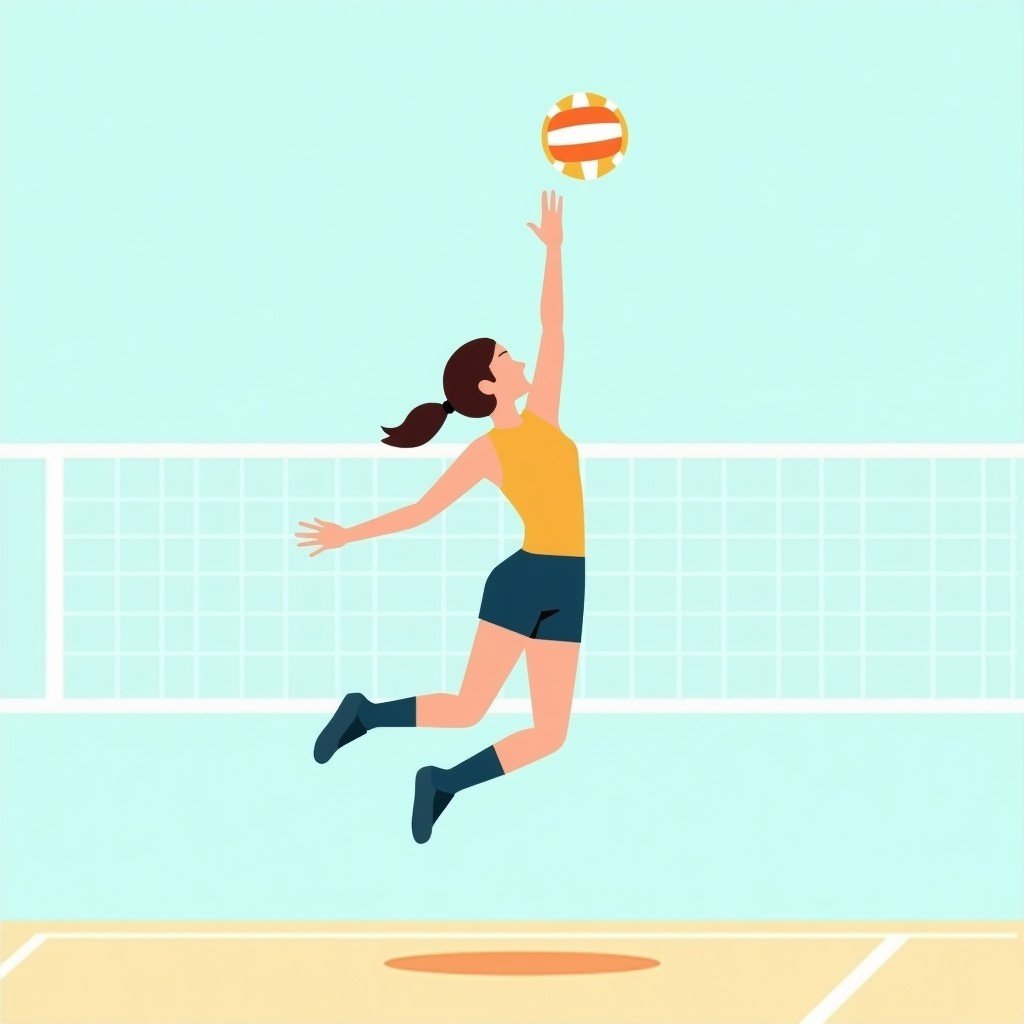
A player serving a volleyball over the net. A general picture about serving.
What the chapter is about
Volleyball is a fast-paced, exciting team sport played by two teams on a rectangular court divided by a net. The objective is to score points by sending the ball over the net so it lands on the opponent's court. Each team has six players on the court at a time, with specialised roles such as spikers, setters, blockers and liberos. Each team has up to three touches to return the ball over the net, and the block touch is not counted. In this unit pupils experience and learn the basic skills: serving, passing, setting, spiking, blocking and digging.
The unit teaches twelve sessions (VB-1 to VB-12): eight skills and four activities, each with warm-up, skill or activity, cool-down and circle time.
The skills at a glance
| Skill | What it does |
|---|---|
| Underhand Pass (VB-1) | Receive and control the ball — the bump / dig pass |
| Overhead Pass (VB-2) | Control with the fingertips above the head |
| Underhand Serve (VB-3) | Serve with an underhand swinging motion |
| Overhead Serve (VB-4) | Serve by tossing up and striking overhead |
| Setting (VB-5) | Boost the ball high or low near the net for the spiker |
| Spike (VB-6) | Attack: smash the ball down across the net |
| Block (VB-7) | Defend at the net: stop or deflect a spike |
| Dig (VB-8) | Defend a spike or drop: keep the ball off the ground |
Passing: the first touch
The Underhand Pass, also known as the bump pass, dig pass or simple pass, receives and controls the ball, typically after a serve or an attacking hit from the opposition. Its grip: bring the hands together by overlapping one hand over the other, creating a semi-closed fist with one hand and covering it with the other, thumbs parallel, pointing forward and slightly down. Lock the elbows (they must not bend), extend the arms in front and bend the wrists downwards. Its stance: feet shoulder-width apart and diagonal to each other, knees slightly bent, spine straight, leaning slightly forward, arms relaxed below the chest yet ready, low stance for control and balance. Its execution: get the body into the centre of the falling ball's path; let the forearms contact the ball with straight, locked elbows and upward-swinging arms; extend the bent knees to push the ball higher — never swing the arms excessively, which spoils control.
The Overhead Pass is played with the hands above the head. The ball contacts the fingertips, not the palms; hands are above the hairline, or on the midline of the body; feet are shoulder-width apart with one foot forward; knees slightly bent, torso upright; elbows slightly bent and positioned outwards for a stable shape; the player stays balanced, facing the direction of the pass. Contact is above the hairline, the lower legs straighten to push the ball, the arms extend fully in the pass's direction, and the motion ends with the hands pointing towards the target, ready for the next move.
Serving: starting the rally
The Underhand Serve strikes the ball with an upwards and forward motion from below. Stance: non-dominant foot slightly ahead, toes forward, ball held in the non-dominant hand, slightly cupped so it does not sway or fall, knees and upper body bent while keeping balance. The holding arm moves from the lower side of the body in front of the hitting arm until the ball is at upper-thigh height beside the body; shoulders move towards the ball and hips shift back, upper back straight. Execution: swing the arm like a pendulum and strike the ball's bottom forcefully with a closed fist, shifting weight onto the front (non-dominant) foot. Follow-through: the arm continues in an upwards arc to its maximum height, and the whole body moves forward and upwards to push the ball over the net. Its lead-up activity is paired serving and catching, starting six metres apart and increasing the distance with skill.
The Overhead (Overhand) Serve tosses the ball into the air and strikes it with an overhead arm swing. Stand behind the baseline, feet shoulder-width apart, one foot in front of the other opposite the hitting hand. Toss with the non-dominant hand, near vertical and high enough for a full arm swing, with the ball falling on the desired path. Step forward with the foot opposite the serving hand, swing the serving arm back beside the head, lead with the elbow, and strike with the heel or base of the palm. Follow-through transfers weight from back to front, the hand dropping naturally down by the thigh. Its lead-up game scores ten serves per player into a pentagon marked on the opponent's court, zero for balls landing outside.
To serve powerfully, use the whole body and both kinds of energy. Potential energy is stored when the player bends the knees, loads the arm and prepares; kinetic energy is released when the legs extend, the arm swings and contact is made, converting stored energy into motion for a strong serve. Spiking is also known as smashing, and it can be done from anywhere on the court — but smashing near the net helps scoring most.
Setting, spiking, blocking, digging
Setting, also known as boosting, sets the ball for spiking so that its movement surprises the opposition and helps score. Watching the ball's path, the setter bends the elbows slightly and positions them outwards near the forehead, creating a stable cup-shaped platform. By an overhand pass, the setter then returns the ball high or low near the net, forwards or backwards, as the spiker needs; the follow-through extends the upper limbs in the ball's direction, following its path.
The Spike is volleyball's attack. Preparation: dominant arm raised, elbow bent, slightly behind the head for a powerful angle; eyes on the ball continuously, especially as it enters the spiking zone. Execution: extend the non-dominant hand upwards, tilt the torso into the ball's path, bring the dominant arm down forcefully and contact the ball at its highest point with the palm, at its centre or top centre, snapping the wrist to create spin and a sharp downward trajectory; rotate the torso slightly for core power — power comes from upper extremities, torso, pelvic region and lower extremities together. Right-handed players step left, then right, then left; left-handed players reverse the sequence. Follow-through continues the arm downwards and forwards, wrist snapping to direct the ball to the opposite court. Its lead-up pairs a feeder and a spiker for five attempts each; honesty about successful spikes is itself a circle-time lesson (claiming more than you scored holds back learning).
The Block is played close to the net to intercept a spike: defenders try to stop or deflect the ball back to the opponent's side, solo or with another blocker. The Dig is the defensive skill that prevents the ball from touching the ground after an opponent's spike or drop near the net: feet shoulder-width apart, knees bent, body low, weight on the balls of the feet, arms extended and hands together forming a strong platform; move quickly under the ball, keep the arms straight, absorb impact with the forearms, angle them to direct the ball towards the setter, and whenever possible use both hands together for a single contact point that controls direction.
Activities, safety and match play
Four activities apply the skills. Ball Rotation (VB-9) includes a pulling contest in pairs and circle time on safety measures: how you feel helping an injured player, ensuring your own and others' safety, and identifying and reporting distress signals — facial expressions, discomfort in movement, bruises and rashes, blood, intense pain and others. Ace Accuracy Contest (VB-10) lines teams up at the serving line; each player serves once, scoring extra for landing in a designated target area (zones numbered 1–6), and the highest team total wins, training eye-hand coordination. Ball Throw Activity (VB-11) simplifies the game: the receiving team catches the ball and, within 3 seconds and without moving from position, throws it back over the net; when a team wins the serve, it rotates one position clockwise before serving again. 11-Point Match (VB-12) puts everything together in a full match to 11 points.
Key Terms
- Bump / dig pass — The underhand pass, played with locked elbows and the forearms.
- Setting (boosting) — Placing the ball high or low near the net so the spiker can attack.
- Spike (smash) — A powerful downward attack, ideally near the net, with wrist snap.
- Block — Intercepting a spike at the net; the block touch is not counted in the three touches.
- Dig — Saving a spiked or dropped ball from the ground with the forearms.
- Libero, setter, spiker, blocker — Specialised roles in a six-player team.
- Upper / lower extremities — Arms from shoulder to hands; legs from hip to toes.
- Potential / kinetic energy — Stored energy in preparation; released energy in the swing and contact.
- Spatial / temporal attributes — Movement described by distance (spatial) or by time (temporal).
Remember
- Six players a side; up to three touches; the block touch does not count.
- Underhand pass: semi-closed fist, thumbs parallel forward and slightly down, elbows locked, forearms contact, knees extend.
- Overhead pass: fingertips, contact above the hairline, arms extend towards the target.
- Underhand serve: pendulum swing, closed fist to the ball's bottom, arm finishing high.
- Overhead serve: near-vertical toss, elbow leads, heel or base of palm, weight back to front.
- Spike footwork (right-handed): left, right, left; contact at the highest point, wrist snap down.
- Dig: low, both hands together, angle the forearms to the setter.
- Report distress signals at once: pain, bruises, blood, troubled movement or facial expressions.
A model rally is pass → set → spike, and the block does not count. If a question asks for "the second touch", it almost always wants setting; "the first touch after a serve" wants the underhand pass or dig.
Volleyball is a team machine: the pass controls the ball, the set places it, the spike finishes it, and the block and dig keep rallies alive. Serve with the whole body, move to the ball's centre, keep elbows locked on the pass, hands high on the set — and play honestly and safely, reporting any injury or distress at once.
Practice set — try it yourself
- How many players are on court per team, how many touches are allowed, and does the block count?
Hint: Six players, three touches, and one touch is free. - Describe the hand position for the underhand pass.
Hint: Semi-closed fist, covered by the other hand, thumbs parallel. - What is the difference between an underhand serve and an overhead serve?
Hint: One swings from below with a closed fist; the other tosses up and strikes overhead. - What does a setter do, and why is setting also called boosting?
Hint: It lifts the ball high or low near the net for the spiker. - Describe the spike's footwork for a right-handed player.
Hint: Left, right, left.
Questions with Answers
- What is the objective of volleyball, and what are the basic team rules?
To score by sending the ball over the net so it lands on the opponent's court. Two teams play on a rectangular court divided by a net, six players per team on court, with up to three touches to return the ball — the block touch is not counted. Roles include spikers, setters, blockers and liberos. - Describe the underhand pass in full: grip, stance and execution.
Grip: overlap one hand over the other, semi-closed fist covered by the other hand, thumbs parallel pointing forward and slightly down, elbows locked, wrists bent down. Stance: feet shoulder-width apart and diagonal, knees slightly bent, spine straight, slight forward lean, low for control. Execution: centre the body on the ball's path, contact with the forearms and locked elbows, extend the knees to lift the ball, without excessive arm swing. - How is the overhead serve performed?
Stand behind the baseline, feet shoulder-width apart, one foot forward opposite the hitting hand. Toss near-vertically with the non-dominant hand, high enough for a full swing. Step forward with the foot opposite the serving hand, swing the arm back beside the head, lead with the elbow, strike with the heel or base of the palm, and follow through with weight moving back to front and the hand dropping by the thigh. - What makes a good spike, step by step?
Raise the dominant arm, elbow bent, slightly behind the head; watch the ball into the spiking zone; extend the non-dominant hand up and tilt the torso into the ball's path; contact at the highest point with the palm at the ball's centre or top centre; snap the wrist for spin and a sharp downward path; rotate the torso for core power; step left-right-left (right-handed); follow through downwards and forwards. - How does a dig differ from a block?
A block is played at the net to stop or deflect a spike directly, solo or double, and its touch is not counted. A dig is played anywhere to save a spiked or dropped ball from the ground: low stance, both hands together as a platform, forearms absorbing impact and angling the ball towards the setter so play continues.
Questions with Answers — Extension
- (Match) Match: Bump pass — forearms, locked elbows; Setting — cup-shaped platform near the forehead; Spike — wrist snap, downward path; Block — at the net, touch not counted; Dig — save the ball from the ground.
- (Numbers) What do these numbers mean: 6, 3, 3 seconds, 6 metres, 10, 11? — Six players per team on court; three touches allowed; 3 seconds to throw back in Ball Throw Activity; 6 metres starting distance for paired underhand serving practice; 10 serves each in the overhead-serve pentagon game; 11 points in the final match.
- (Reason) Why must the elbows stay locked in the underhand pass? — Because bent elbows absorb the ball unevenly and destroy control; locked elbows with forearm contact and knee extension give a stable, predictable platform.
- (Distinguish) Overhead pass versus setting — are they the same? — They share the overhand technique, but setting is the tactical second touch: it deliberately places the ball high or low, forwards or backwards, near the net for a spiker, while a general overhead pass simply controls and directs the ball.
- (Sequence) Put a rally in order: spike, dig, block, set, underhand pass. — Underhand pass (receive serve), set, spike; the opposition's block or dig then continues the rally — block at the net, dig to save the ball.
- (True / False) A team that blocks a spike has used one of its three touches. — False. The block touch is not counted.
- (Apply) The ball is dropping fast near the net after the opponent's spike and your team must keep it alive. Which skill, and what platform? — The dig: low stance, both hands together, forearms angled to the setter.
- (Explain) Why does the book use potential and kinetic energy to explain the serve? — Because a serve is a whole-body action: bending the knees and loading the arm stores potential energy, and extending the legs and swinging the arm releases it as kinetic energy at contact — power comes from the body, not the arm alone.
How to use this page: Read the summary, say the Key Terms in your own words, then try the practice set without looking. Use the Questions with Answers to check yourself afterwards. Ask your teacher or parent to check your answers.