

Number Play
Divisibility shortcuts that test a number in seconds — and letter puzzles where each letter hides exactly one digit.
Original notes — ready CBSE (NCERT, English Medium) • Class 8 • Mathematics • Book: Ganita Prakash — Part I
Chapter 5: Number Play — EG's own notes, in simple words
Book: Ganita Prakash — Part I (CBSE, Class 8) | Chapter 5 | Medium: English
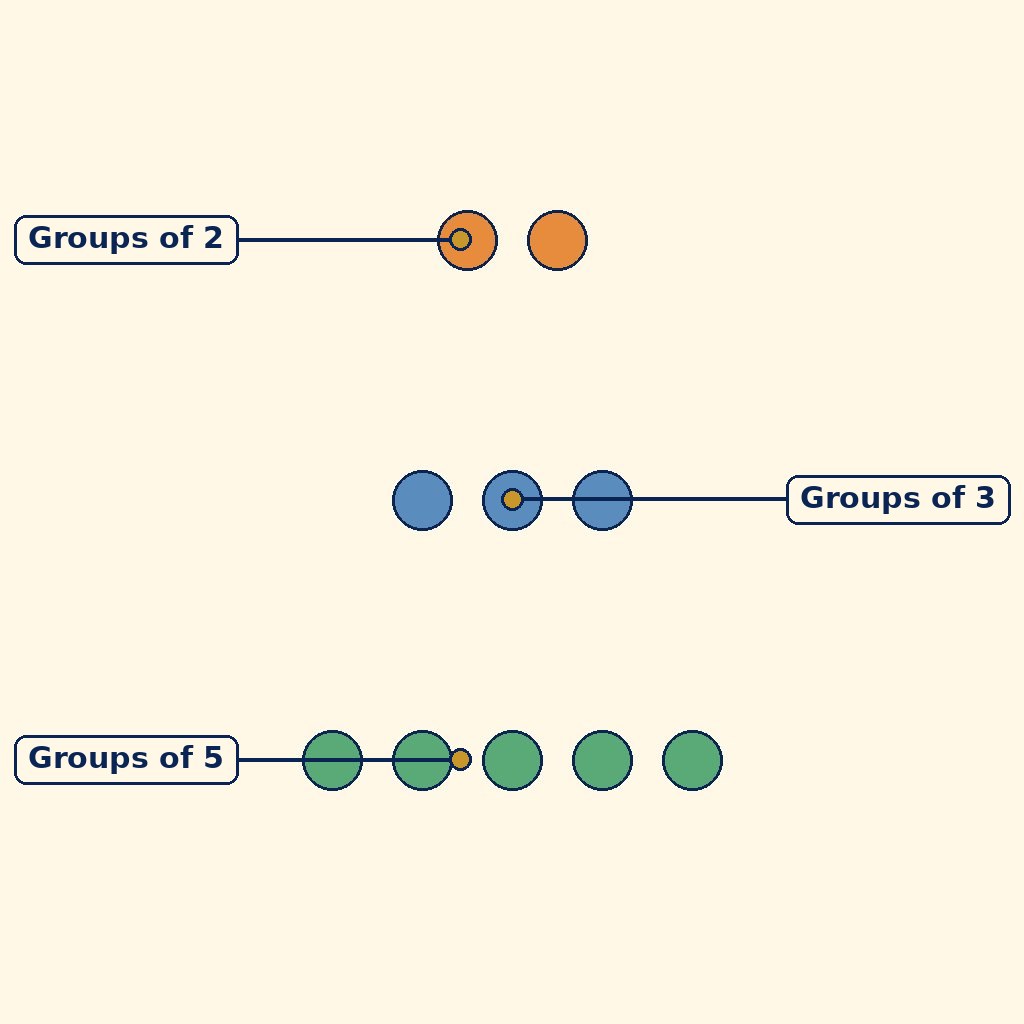
Diagram (labels are printed on the image): Rows of small counters arranged in groups of two, three and five. A general picture of divisibility patterns, not a book scene.
Children playing a number game with counters and a spinning wheel. A general picture of playing with numbers, not a book scene.
What the chapter is about
Divisibility tests answer "is this a multiple of...?" without long division. A number is divisible by 2 if it is even, by 5 if it ends in 0 or 5, and by 10 if it ends in 0. For 3 and 9, add the digits: 432 has digit sum 9, so it is divisible by both 3 and 9. For 4, look at the last two digits: 432 ends in 32, and 32 ÷ 4 = 8, so 432 is divisible by 4. For 8, look at the last three digits. For 6, combine the tests for 2 and 3. For 11, take the alternating sum of digits (add the digits in odd places, subtract those in even places): for 1001, (1 + 0) − (0 + 1) = 0, which is a multiple of 11, so 1001 is divisible by 11.
The second game is cryptarithms — "digits in disguise". Each letter stands for exactly one digit, the same letter always means the same digit, different letters mean different digits, and a leading letter cannot be zero. Solve by place value and carrying: in AB + BA = 121, the ones column gives B + A = 11 with 1 carried, and the tens column gives A + B + 1 = 12, which fits the same condition — so any pair with A + B = 11 works, such as 56 + 65 = 121. The chapter also uses multiplication cryptarithms, where the same discipline applies column by column.
These tests are not tricks for their own sake: they are the first step of factorising, checking answers, and recognising multiples quickly in later chapters.
What you should learn
- Apply divisibility tests for 2, 3, 4, 5, 6, 8, 9, 10 and 11.
- Explain why the digit-sum tests work for 3 and 9 (in words, not by proof alone).
- Combine tests, for example 6 = 2 and 3 together.
- Solve addition and multiplication cryptarithms using place value and carries.
- State the cryptarithm rules: one letter, one digit; leading letters are never zero.
Key Terms
- Multiple — A number obtained by multiplying another by a whole number; 432 is a multiple of 4.
- Divisibility test — A shortcut that decides divisibility without full division.
- Digit sum — The sum of a number's digits; used in the tests for 3 and 9.
- Alternating sum — Digits added and subtracted alternately; used in the test for 11.
- Cryptarithm — A puzzle where letters stand for digits and the arithmetic must work out.
Remember
- 2: even; 5: ends 0/5; 10: ends 0.
- 3 and 9: digit sum is a multiple of 3 (or 9).
- 4: last two digits divisible by 4; 8: last three digits divisible by 8.
- 6: passes both 2 and 3. 11: alternating sum is 0 or a multiple of 11.
- Cryptarithm: same letter, same digit; leading letter never zero.
Exam Tip / Common Mistake
Common mistake: testing 4 with the last digit only. 432 is divisible by 4 because its last two digits, 32, are divisible by 4 — the last digit 2 alone proves nothing.
Why does the digit-sum test work? Because 10, 100, 1000 and so on are each one more than a multiple of 9, so a number and its digit sum always differ by a multiple of 9 — if one is divisible by 9, so is the other.
A number divisible by 9 is always divisible by 3, but not the other way round: 432 passes both, while 12 passes 3 only.
Chart / Table: Divisibility tests at a glance
| Divisor | Test | Example |
|---|---|---|
| 2 | Last digit even | 432 ✓ |
| 3 | Digit sum multiple of 3 | 432: 4+3+2 = 9 ✓ |
| 4 | Last two digits multiple of 4 | 432: 32 ✓ |
| 5 | Ends in 0 or 5 | 435 ✓ |
| 6 | Passes 2 and 3 | 432 ✓ |
| 8 | Last three digits multiple of 8 | 1232: 232 ✓ |
| 9 | Digit sum multiple of 9 | 432: 9 ✓ |
| 11 | Alternating sum 0 or multiple of 11 | 1001: 0 ✓ |
Worked method: test a number for divisibility by 11
- Write the digits and mark alternate positions starting from the right.
- Add the digits in the odd positions and the digits in the even positions separately.
- Subtract the smaller sum from the larger one.
- If the difference is 0 or a multiple of 11, the number is divisible by 11.
Practice set — try it yourself
- Is 432 divisible by 3? By 4? Give reasons.
Hint: Digit sum for 3; last two digits for 4. - Is 1232 divisible by 8?
Hint: Look at the last three digits. - Is 1001 divisible by 11? Show the alternating sum.
Hint: (1 + 0) − (0 + 1) = ? - Find a pair of digits A, B with A + B = 11 such that AB + BA = 121.
Hint: Any pair adding to 11 works — pick one and check. - Which of 2, 3, 5, 9 and 10 divide 1530?
Hint: Run each test in turn; 1530 ends in 0.
Questions with Answers
- Is 918 divisible by 9? By 6?
Digit sum 9 + 1 + 8 = 18, a multiple of 9, so yes for 9. It is even and divisible by 3, so yes for 6 as well. - Is 1001 divisible by 11?
Alternating sum: (1 + 0) − (0 + 1) = 0, a multiple of 11, so yes. Indeed 1001 = 11 × 91. - What are the rules of a cryptarithm?
Each letter stands for one digit, the same letter always stands for the same digit, different letters stand for different digits, and a leading letter cannot be zero. - Solve AB + BA = 121 with A + B = 11, giving one example.
Take A = 5, B = 6: 56 + 65 = 121. The ones column 6 + 5 = 11 gives 1 with 1 carried, and the tens column 5 + 6 + 1 = 12, giving the answer 121. - Is 2728 divisible by 8?
Last three digits 728 ÷ 8 = 91, so yes.
Extension questions
- Is 121 divisible by 11?
Alternating sum: (1 + 1) − 2 = 0, so yes; 121 = 11 × 11. - Find the smallest 3-digit number divisible by 2, 3 and 5.
It must end in 0 (for 2 and 5) and have a digit sum that is a multiple of 3: 120 works (1 + 2 + 0 = 3), and 100 and 110 fail the 3-test. - A number ends in 4 and has digit sum 15. Which tests does it pass?
It passes 2 (even) and 3 (digit sum 15), hence also 6. It fails 5 and 10 (does not end in 0 or 5). - If A + A + A = 27 in a cryptarithm, what is A?
A = 9, since 9 + 9 + 9 = 27, and no other single digit works. - Is 98765 divisible by 11?
Alternating sum from the right: (5 + 7 + 9) − (6 + 8) = 21 − 14 = 7, not a multiple of 11, so no. - Give a 4-digit number divisible by 4 but not by 8, and prove both claims.
1036: last two digits 36 ÷ 4 = 9, so divisible by 4; last three digits 036 = 36, and 36 ÷ 8 is not whole, so not divisible by 8.
Last digits test 2, 4, 5, 8 and 10; digit sums test 3 and 9; the alternating sum tests 11; 6 combines 2 and 3. Cryptarithms hide digits behind letters and are solved column by column with carries.
How to use this page: Read the summary, say the Key Terms in your own words, then try the practice set without looking. Use the Questions with Answers to check yourself afterwards. Ask your teacher or parent to check your answers.