

Quadrilaterals
Four sides, endless family relations: rectangles, squares, parallelograms, rhombuses, kites and trapeziums — and the 360° that ties them together.
Original notes — ready CBSE (NCERT, English Medium) • Class 8 • Mathematics • Book: Ganita Prakash — Part I
Chapter 4: Quadrilaterals — EG's own notes, in simple words
Book: Ganita Prakash — Part I (CBSE, Class 8) | Chapter 4 | Medium: English
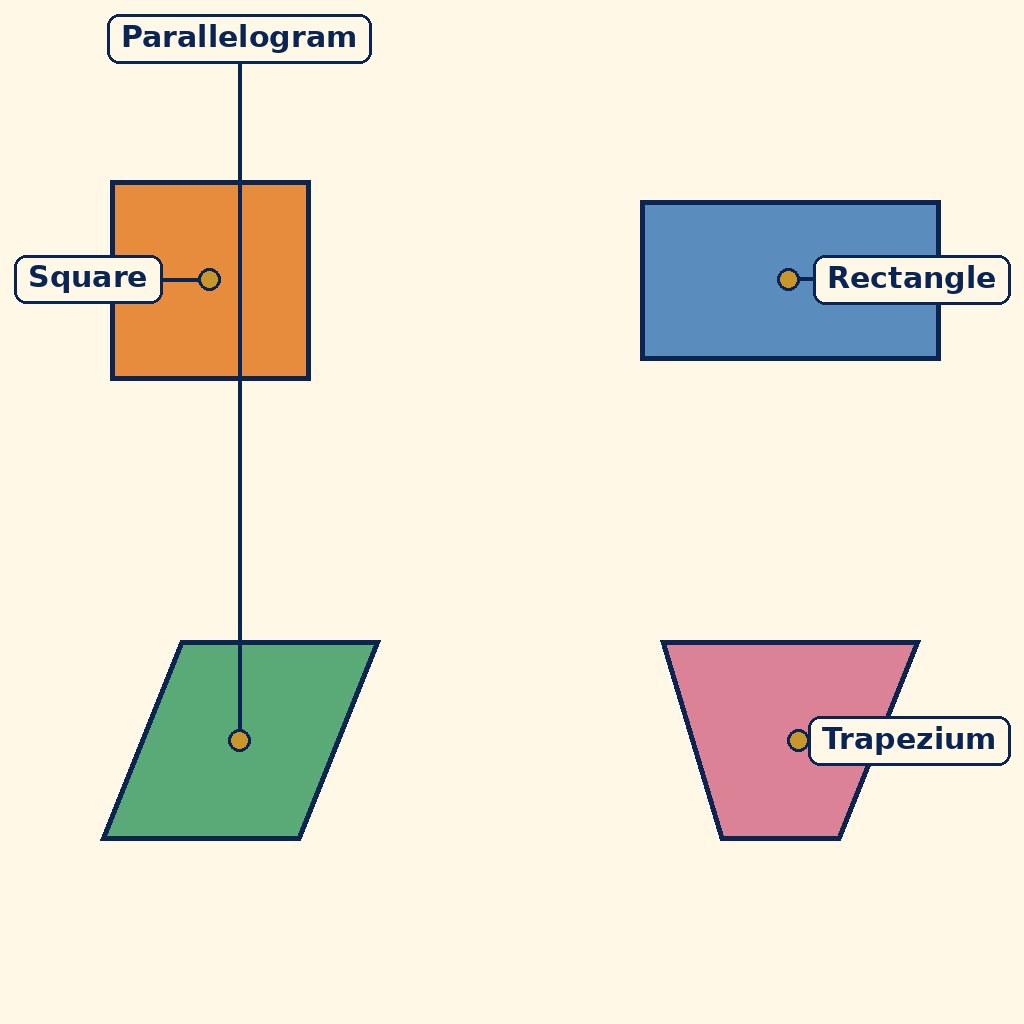
Diagram (labels are printed on the image): Four four-sided shapes — a square, a rectangle, a parallelogram and a trapezium, arranged in two rows. A general picture of quadrilateral types, not a book scene.

Kites and coloured four-sided shapes floating together. A general picture of quadrilaterals around us, not a book scene.
What the chapter is about
A quadrilateral is a closed shape with four sides and four angles. Draw a diagonal and it splits into two triangles, each with angle sum 180°, so the angles of any quadrilateral add to 360°. That one fact finds every missing angle in the chapter: if three angles are 90°, 80° and 70°, the fourth is 360° − 240° = 120°.
The family is sorted by parallel sides and equal lengths. A rectangle has opposite sides equal, all angles 90° and equal diagonals. A square is a rectangle with all sides equal — and also a rhombus with right angles. A parallelogram has both pairs of opposite sides parallel; its opposite sides and opposite angles are equal, consecutive angles add to 180°, and its diagonals bisect each other. A rhombus is a parallelogram with all sides equal, and its diagonals bisect each other at right angles. A kite has two distinct pairs of adjacent equal sides, with one diagonal bisected by the other. A trapezium has exactly one pair of parallel sides.
These relations fit in a Venn diagram: every square is a rectangle and a rhombus, every rectangle and rhombus is a parallelogram, and every parallelogram is a quadrilateral — but the reverse is not true. If a shape has one property, it may or may not have the stronger ones, and exam questions love testing exactly that direction.
What you should learn
- Prove and use the quadrilateral angle sum of 360°.
- List the properties of rectangles, squares, parallelograms and rhombuses.
- Identify kites and trapeziums by their sides and diagonals.
- Place the types in a Venn diagram and read it in the correct direction.
- Find missing angles using supplementary consecutive angles in a parallelogram.
Key Terms
- Quadrilateral — A closed four-sided polygon with four angles summing to 360°.
- Parallelogram — A quadrilateral with both pairs of opposite sides parallel.
- Rhombus — A parallelogram with all four sides equal; diagonals are perpendicular bisectors.
- Kite — A quadrilateral with two distinct pairs of adjacent equal sides.
- Trapezium — A quadrilateral with exactly one pair of parallel sides.
- Bisect — To cut into two equal parts; the diagonals of a parallelogram bisect each other.
Remember
- Angles of a quadrilateral always add to 360°.
- In a parallelogram, opposite angles are equal and consecutive angles add to 180°.
- Rectangle diagonals are equal; rhombus diagonals are perpendicular.
- Square = rectangle + rhombus (all sides equal and all angles 90°).
Exam Tip / Common Mistake
Common mistake: saying "every parallelogram is a rectangle". It is the other way round: every rectangle is a parallelogram, but a parallelogram need not have right angles.
Fold a paper parallelogram along a diagonal: the two triangles match exactly. That is why opposite sides and opposite angles are equal — the diagonal creates two congruent triangles.
Stuck on a "which statement is true" question? Test it against the Venn order: square ⊂ rectangle ⊂ parallelogram ⊂ quadrilateral, and rhombus ⊂ parallelogram.
Chart / Table: The quadrilateral family
| Shape | Parallel sides | Special property |
|---|---|---|
| Parallelogram | Both pairs | Diagonals bisect each other |
| Rectangle | Both pairs | All angles 90°, diagonals equal |
| Rhombus | Both pairs | All sides equal, diagonals perpendicular |
| Square | Both pairs | All sides equal, all angles 90° |
| Kite | None (in general) | Two pairs of adjacent equal sides |
| Trapezium | One pair | Exactly one pair parallel |
Worked method: find a missing angle
- Write the angle-sum rule: the four angles add to 360°.
- Add the three known angles.
- Subtract from 360° to get the fourth angle.
- Check: all four angles must now add to exactly 360°.
Practice set — try it yourself
- Three angles of a quadrilateral are 90°, 80° and 70°. Find the fourth angle.
Hint: The four angles add to 360°. - One angle of a parallelogram is 65°. Find the other three angles.
Hint: Opposite angles are equal; consecutive angles add to 180°. - A quadrilateral has all sides equal and one angle 90°. What is it? Why?
Hint: All sides equal plus a right angle narrows the family to one shape. - State two properties of the diagonals of a rhombus.
Hint: Think about bisecting and about the angle between them. - Is a square a trapezium? Give a reason.
Hint: Count its pairs of parallel sides.
Questions with Answers
- Why do the angles of a quadrilateral add to 360°?
A diagonal divides the quadrilateral into two triangles. Each triangle's angles add to 180°, so the total is 180° + 180° = 360°. - How is a rectangle different from a general parallelogram?
A rectangle is a parallelogram with all angles 90° and diagonals equal in length. A general parallelogram need not have either property. - List three properties of a parallelogram.
Opposite sides are parallel and equal; opposite angles are equal; consecutive angles are supplementary (add to 180°); diagonals bisect each other. - What is a kite?
A quadrilateral with two distinct pairs of adjacent sides equal. One of its diagonals is bisected by the other, and it has one pair of equal opposite angles. - What is a trapezium?
A quadrilateral with exactly one pair of parallel sides.
Extension questions
- A parallelogram has angles 65°, 115°, 65° and 115°. Check the angle sum and the consecutive-angle rule.
Sum: 65 + 115 + 65 + 115 = 360°. Consecutive pairs: 65 + 115 = 180°. Both rules hold. - Why must the diagonals of a rectangle be equal?
Both diagonals join opposite corners of a shape with all right angles and opposite sides equal, so the two right triangles formed are congruent and their hypotenuses (the diagonals) are equal. - Is every rhombus a square? Explain.
No. A rhombus has all sides equal but need not have right angles; only a rhombus with a 90° angle is a square. - In a kite, one pair of opposite angles is 100° and 60°, and one of the other angles is 90°. Find the fourth angle.
360° − (100° + 60° + 90°) = 110°. - Place these in order from most general to most special: square, quadrilateral, parallelogram, rectangle.
Quadrilateral → parallelogram → rectangle → square. Each step adds a condition. - A quadrilateral has two pairs of parallel sides and diagonals that are equal but not perpendicular. What could it be?
A rectangle (or a square, if the sides are also equal). Equal diagonals rule out a general rhombus.
Angle sum 360° comes from two triangles. Parallel sides and equal lengths sort the family, diagonals separate rectangle from rhombus, and a square sits at the meeting point of both.
How to use this page: Read the summary, say the Key Terms in your own words, then try the practice set without looking. Use the Questions with Answers to check yourself afterwards. Ask your teacher or parent to check your answers.