

Chapter 7: Ragas and Talas/Taal
Ragas and Talas — Carnatic sapta talas, Hindustani talas, Raga Bhairavi, and Ustad Zakir Hussain.
Original notes — ready CBSE (NCERT, English Medium) • Class 7 • Arts • Book: Kriti
Ragas and Talas/Taal — EG's own notes, in simple words
Book: Kriti (CBSE, Class 7) | Chapter 7 | Medium: English
Section: Music
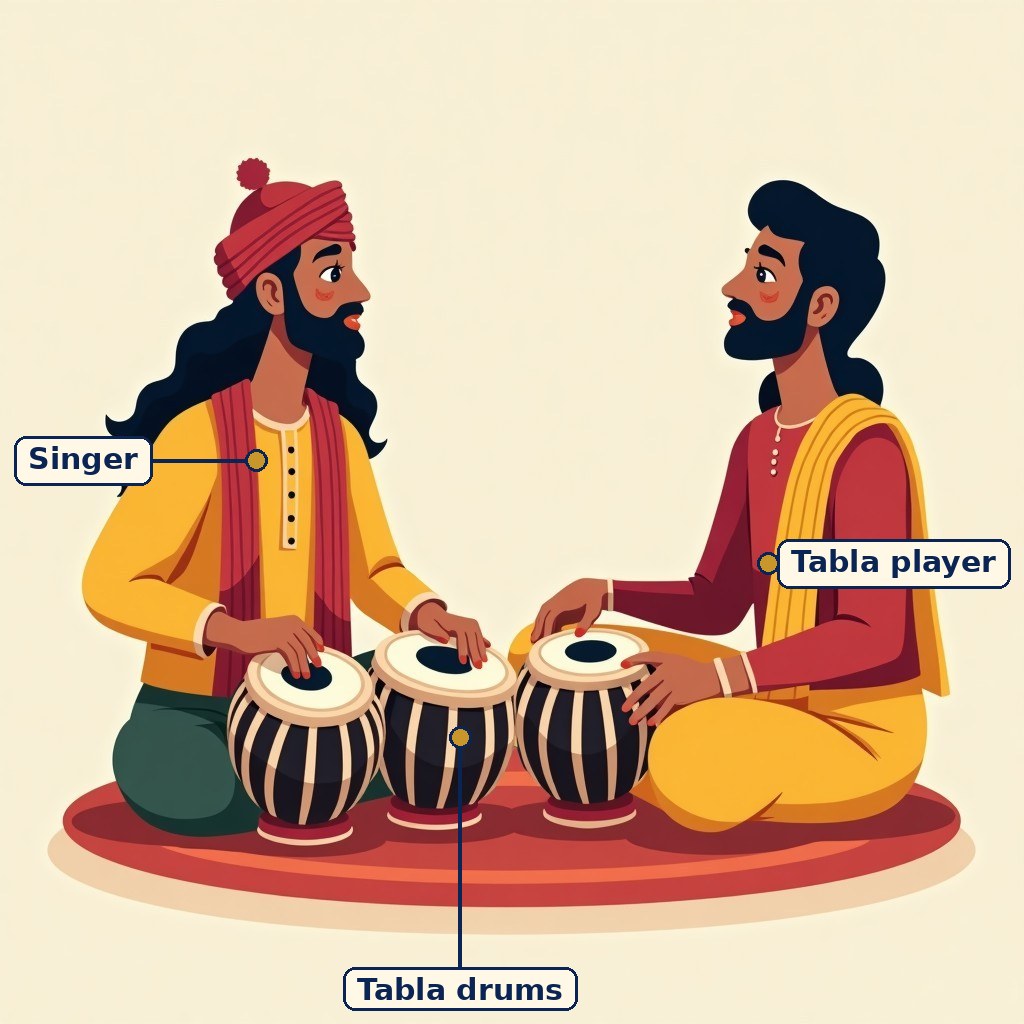
Diagram (labels are printed on the image): Two musicians playing tabla together. A general teaching picture; it is not a picture from the book.

Hands playing tabla in a beat cycle. A general picture about tala; no book picture is copied here.
What the chapter is about
Indian classical music has two main styles, Carnatic and Hindustani, and every year the book builds understanding of both. This year you explore more compositions, ragas and talas, and draw connections between the two styles, and between classical music and the other styles you listen to. The notes themselves evolved from ritual chanting of the Samaveda: at first the Vedas were chanted with three notes — Udatta (normal or medium tone), Anudatta (not raised, or lower note) and Svarita (raised pitch or higher) — which gradually evolved into the seven notes (sapta swara) used in music. The chapter’s opening verse, from the Natyashastra (28.21), names those seven: Shadja, Rishabha, Gandhara, Madhyama, Panchama, Dhaivata and Nishada — Sa, Ri, Ga, Ma, Pa, Dha, Ni.
Carnatic music has seven main talas: Dhruva, Matya, Rupaka, Jhampa, Triputa, Ata and Eka. Every tala is built from three main parts or angas: Laghu, notated I, a clap and finger counts; Drutam, notated O, a clap and wave; and Anudrutam, notated U, a beat. A laghu can have different numbers of beats, called jathi; at this level, each laghu has four beats. A popular set of vocal exercises for building vocal strength and understanding talas is the sapta tala alankaras, and in this chapter you learn to sing the first three alankaras and keep tala: Dhruva, Matya and Rupaka. Alankaras are built on patterns — and the chapter challenges you to try making your own patterns of sargams or notes as vocal exercises.
A swarajati is a very old musical form in Carnatic music, made of swaras and sometimes lyrics. It usually has three parts: pallavi (refrain or chorus), anupallavi (small section after the pallavi) and one or more charanams (verses). Before singing the chapter’s swarajati, sing its Arohana and Avarohana, and try keeping tala as you sing: Adi Tala is a rhythm cycle of 8 beats. The swarajati is “Ra Ra Venu”: Ragam Bilahari, Talam Adi, language Telugu, composer Patnam Subramania Iyer. Its Arohanam is S R2 G3 P D2 Ṡ and its Avarohanam is Ṡ N3 D2 P M1 G3 R2 S.
Hindustani music has 12 notes: seven shuddha — S, R, G, M, P, D, N; four komal — R, G, D, N (the underlined notes indicate komal swaras); and one teevra — M. Its basic talas in this chapter are counted in matras and recited in bols with the teacher’s help. Jhaptala has 10 matras, with the theka Dhee Naa Dhee Dhee Naa Tee Naa Dhee Dhee Naa. Rupak has 7 matras, with the theka Tee Tee Naa Dhee Naa Dhee Naa. Ektaal has 12 matras, with the theka Dhin Dhin Dhage Tirkit Tu Naa Kat Taa Dhage Tirkit Dhi Naa. Teentaal, used in the chapter’s Bhairavi compositions, has 16 beats, with the theka beginning Dha Dhin Dhin Dha Dha Dhin Dhin Dha.
Ragas express emotions and create moods, and in Hindustani music different ragas are sung at different times of the day — this is the Samay Chakra, the time theory of ragas. A pattern of notes sounds effective if you sing it at its particular time: Raga Bhairav is a morning raga, while Raga Yaman is generally sung in the evening. The chapter’s worked raga is Raga Bhairavi: Jati Sampoorn–Sampoorn, Komal Swar R, G, D, N, Vadi Swar Madhyam, Samvadi Swar Shadaj, singing time early morning, Thaat Bhairavi, Aroh S, R, G, M, P, D, N, Ṡ, Avroh Ṡ, N, D, P, M, G, R, S, Pakad M, G, S, R, S, D, N, Ṡ, and no Varjit Swar. Three Bhairavi forms are given: a Sargam Geet in Ektaal; a Chota Khayal in Teentaal, whose Sthayi begins “Kaisi ye bhalai rey kanhai, paniyaa bharat mori gagari girayee kara ke larai” and whose Antara begins “Sanad kahe aiso dheeta bha yo kanhai”; and a Tarana in Teentaal, whose Sthayi begins “Dir Dir Ta Na De Re Na Ta Na Dim Ta Na” and whose Antara begins “Alali Alali Tom Tan de Re Na”.
The chapter closes with Ustad Zakir Hussain (1951–2024), renowned tabla maestro of India and son of the well-known tabla player Ustad Alla Rakha. He started playing tabla at a very young age, in intensive study with his father — “You grow up in a musical atmosphere,” he said, “and you don’t have to do anything else” — began playing at concerts around the age of seven and started touring at twelve. He accompanied legendary Hindustani musicians like Pandit Ravi Shankar, gave solo tabla concerts, was a founding member of the pathbreaking world-music band Shakti, toured with the band for several decades, collaborated with musicians from around the world, and performed in prestigious venues. He received countless awards, including the Padma Vibhushan and the Sangeet Natak Akademi Award from the Government of India, and three Grammy awards. Activity 7.1 asks: if there is a tabla teacher in your school, learn some simple rhythms from them.
What you should learn
- Trace the seven notes from three Vedic chant notes: Udatta, Anudatta, Svarita.
- Name the seven Carnatic talas and their three angas, and sing the first three alankaras keeping tala.
- Explain a swarajati’s three parts and sing “Ra Ra Venu” (Bilahari, Adi) after its Arohana and Avarohana.
- Count Hindustani talas in matras and recite their bols: Jhaptala (10), Rupak (7), Ektaal (12), Teentaal (16).
- Give Raga Bhairavi’s full details and explain the Samay Chakra with Bhairav (morning) and Yaman (evening).
- Describe Ustad Zakir Hussain’s life and contribution.
Key Terms
- Sapta swara — The seven notes of Indian music: Shadja, Rishabha, Gandhara, Madhyama, Panchama, Dhaivata, Nishada (Sa Ri Ga Ma Pa Dha Ni).
- Udatta / Anudatta / Svarita — The three Vedic chant notes: normal or medium tone, not raised or lower note, and raised pitch or higher note.
- Tala / Taal — A rhythm cycle. Carnatic talas are built from angas; Hindustani talas are counted in matras and recited in bols.
- Laghu / Drutam / Anudrutam — The three angas of a Carnatic tala: Laghu (I, clap and finger counts), Drutam (O, clap and wave), Anudrutam (U, beat).
- Jathi — The number of beats in a laghu; at this level each laghu has four beats.
- Alankara — A patterned vocal exercise that builds vocal strength and teaches talas; the sapta tala alankaras cover the seven talas.
- Swarajati — A very old Carnatic musical form of swaras (and sometimes lyrics), in pallavi, anupallavi and charanam(s).
- Pallavi / Anupallavi / Charanam — Refrain or chorus; small section after the pallavi; verse(s) of a composition.
- Adi Tala — A Carnatic rhythm cycle of 8 beats, used for “Ra Ra Venu”.
- Shuddha / Komal / Teevra — In Hindustani music: pure notes (7), flat notes (R, G, D, N), and the sharp note (M).
- Matra — A beat or unit counted in a Hindustani tala.
- Theka / Bol — The standard syllable pattern of a tala, recited to keep its rhythm.
- Samay Chakra — The time theory of Hindustani ragas: different ragas are sung at different times of day.
- Vadi / Samvadi — The most important note of a raga, and its second most important note.
- Pakad — The characteristic note-phrase that identifies a raga.
- Jati — Whether a raga uses all seven notes in ascent and descent (Sampoorn) or fewer.
Udatta, Anudatta and Svarita — medium, lower and higher chant tones — gradually evolved into the sapta swara. Music, in this chapter’s history, grows out of chant.
Before “Ra Ra Venu”, the chapter tells you to sing Bilahari’s Arohanam (S R2 G3 P D2 Ṡ) and Avarohanam (Ṡ N3 D2 P M1 G3 R2 S) and to keep Adi Tala (8 beats) as you sing. The scale first, the song second.
Carnatic Rupaka is one of the seven sapta talas, built from angas. Hindustani Rupak is a 7-matra tala with the theka Tee Tee Naa Dhee Naa Dhee Naa. Same name family, different systems — always say which system you mean.
Try it: Sing the first three Carnatic alankaras
- Learn the three angas and their signs: Laghu I (clap and finger counts), Drutam O (clap and wave), Anudrutam U (beat), with four beats in each laghu at this level.
- Sing the Dhruva, Matya and Rupaka alankaras, keeping tala as you sing.
- Notice that all alankaras are built on patterns — then try making your own patterns of sargams or notes as vocal exercises.
Try it: Sing the swarajati “Ra Ra Venu”
- Sing Bilahari’s Arohanam (S R2 G3 P D2 Ṡ) and Avarohanam (Ṡ N3 D2 P M1 G3 R2 S).
- Keep Adi Tala, a rhythm cycle of 8 beats, as you sing.
- Sing the pallavi, then the anupallavi, then the charanams, noting the Telugu lyrics by Patnam Subramania Iyer.
Try it: Count and recite Hindustani talas; learn tabla rhythms (Activity 7.1)
- With your teacher’s help, count Jhaptala (10 matras: Dhee Naa Dhee Dhee Naa Tee Naa Dhee Dhee Naa), Rupak (7: Tee Tee Naa Dhee Naa Dhee Naa) and Ektaal (12: Dhin Dhin Dhage Tirkit Tu Naa Kat Taa Dhage Tirkit Dhi Naa), and recite their bols.
- Practise Raga Bhairavi’s Sargam Geet in Ektaal, then its Chota Khayal and Tarana in Teentaal.
- If there is a tabla teacher in your school, learn some simple rhythms from them, in the spirit of Ustad Zakir Hussain’s early training.
Chart / Table: Hindustani talas in this chapter
| Tala | Matras | Theka (bols) |
|---|---|---|
| Jhaptala | 10 | Dhee Naa Dhee Dhee Naa Tee Naa Dhee Dhee Naa |
| Rupak | 7 | Tee Tee Naa Dhee Naa Dhee Naa |
| Ektaal | 12 | Dhin Dhin Dhage Tirkit Tu Naa Kat Taa Dhage Tirkit Dhi Naa |
| Teentaal | 16 | Dha Dhin Dhin Dha Dha Dhin Dhin Dha Dha Tin Tin Ta Ta Dhin Dhin Dha |
Remember
- Vedic chant: Udatta, Anudatta, Svarita → sapta swara (Natyashastra 28.21).
- Carnatic seven talas: Dhruva, Matya, Rupaka, Jhampa, Triputa, Ata, Eka; angas Laghu I, Drutam O, Anudrutam U; laghu = 4 beats here.
- First three alankaras: Dhruva, Matya, Rupaka. Swarajati = pallavi + anupallavi + charanam(s); “Ra Ra Venu”: Bilahari, Adi (8 beats), Telugu, Patnam Subramania Iyer.
- Hindustani 12 notes: 7 shuddha, 4 komal (R G D N), 1 teevra (M).
- Bhairavi: Sampoorn–Sampoorn, komal R G D N, vadi Madhyam, samvadi Shadaj, early morning, thaat Bhairavi, pakad M G S R S D N Ṡ, no varjit swar.
- Samay Chakra: Bhairav in the morning, Yaman in the evening.
- Zakir Hussain (1951–2024): son of Alla Rakha, concerts at 7, touring at 12, Shakti founder, Padma Vibhushan, Sangeet Natak Akademi Award, three Grammys.
Exam Tip / Common Mistake
Common mistake: listing Carnatic talas without their angas, or giving a Hindustani theka with the wrong matra count. In answers, pair every tala with its count and its bols or angas, and for Bhairavi always add vadi, samvadi, time and pakad — those four details are what examiners look for.
Practice set — try it yourself
- Name the three Vedic chant notes and the seven notes they became.
Hint: Hint: Medium, lower, higher — then Sa to Ni. - Name the seven Carnatic talas.
Hint: Hint: They start with Dhruva and end with Eka. - What are the three angas of a Carnatic tala, with their signs?
Hint: Hint: I, O and U — clap-counts, clap-wave, beat. - Recite the theka of Rupak and give its matra count.
Hint: Hint: Seven matras, starting Tee Tee Naa. - Give Raga Bhairavi’s vadi, samvadi and singing time.
Hint: Hint: Madhyam, Shadaj, early morning.
Questions with Answers
- How did the seven notes of Indian music evolve?
From ritual chanting of the Samaveda with three notes — Udatta (normal or medium tone), Anudatta (not raised, or lower note) and Svarita (raised pitch or higher) — which gradually evolved into the seven notes, sapta swara, named in the Natyashastra (28.21) as Shadja, Rishabha, Gandhara, Madhyama, Panchama, Dhaivata and Nishada. - Name the seven Carnatic talas and explain their angas.
Dhruva, Matya, Rupaka, Jhampa, Triputa, Ata and Eka. Each tala is built from three angas: Laghu (I, clap and finger counts), Drutam (O, clap and wave) and Anudrutam (U, beat). The number of beats in a laghu is its jathi; at this level each laghu has four beats. - What is a swarajati? Give the chapter’s example in full.
A very old Carnatic musical form comprising swaras and sometimes lyrics, usually in three parts: pallavi (refrain or chorus), anupallavi (small section after the pallavi) and one or more charanams (verses). The chapter’s example is “Ra Ra Venu”: Ragam Bilahari, Talam Adi (8 beats), language Telugu, composer Patnam Subramania Iyer, Arohanam S R2 G3 P D2 Ṡ, Avarohanam Ṡ N3 D2 P M1 G3 R2 S. - Give the Hindustani talas of this chapter with matras and bols.
Jhaptala: 10 matras, Dhee Naa Dhee Dhee Naa Tee Naa Dhee Dhee Naa. Rupak: 7 matras, Tee Tee Naa Dhee Naa Dhee Naa. Ektaal: 12 matras, Dhin Dhin Dhage Tirkit Tu Naa Kat Taa Dhage Tirkit Dhi Naa. Teentaal, used for the Bhairavi Chota Khayal and Tarana, has 16 beats, beginning Dha Dhin Dhin Dha. - Give Raga Bhairavi’s details and explain the Samay Chakra.
Bhairavi: Jati Sampoorn–Sampoorn, Komal Swar R, G, D, N, Vadi Swar Madhyam, Samvadi Swar Shadaj, singing time early morning, Thaat Bhairavi, Aroh S, R, G, M, P, D, N, Ṡ, Avroh Ṡ, N, D, P, M, G, R, S, Pakad M, G, S, R, S, D, N, Ṡ, no Varjit Swar. The Samay Chakra is the time theory of Hindustani ragas: different ragas suit different times of day, so a pattern of notes sounds most effective at its own time — Bhairav in the morning, Yaman generally in the evening.
Extension Questions — for deeper understanding
- Why are alankaras called vocal exercises, and what does the chapter ask you to invent?
Sapta tala alankaras are patterned exercises that build vocal strength while teaching talas; after singing the first three (Dhruva, Matya, Rupaka), the chapter asks students to try making their own patterns of sargams or notes as vocal exercises. - What three forms of Raga Bhairavi does the chapter give, and how do they differ?
A Sargam Geet in Ektaal (notes sung as a song); a Chota Khayal in Teentaal, with lyrics — Sthayi “Kaisi ye bhalai rey kanhai, paniyaa bharat mori gagari girayee kara ke larai”, Antara “Sanad kahe aiso dheeta bha yo kanhai”; and a Tarana in Teentaal, sung to rhythmic syllables — Sthayi “Dir Dir Ta Na De Re Na Ta Na Dim Ta Na”, Antara “Alali Alali Tom Tan de Re Na”. - Unscramble these raga names from the chapter’s exercises (answers in brackets, for practice only): (a) A A Y N M, (b) I L H A A B I R, (c) K J A M A H, (d) A M A O H N.
Answers: (a) Yaman, (b) Bilahari, (c) Khamaj, (d) Mohana. (The chapter’s printed exercise also includes longer anagrams; try those with your teacher, since the printed letter sets are hard to read in extraction.) - Who was Ustad Zakir Hussain, and why does the chapter include him?
A renowned tabla maestro (1951–2024), son of Ustad Alla Rakha, who began concerts around age seven, toured from twelve, accompanied legends like Pandit Ravi Shankar, founded the world-music band Shakti, won the Padma Vibhushan, the Sangeet Natak Akademi Award and three Grammy awards. He shows that rhythm — the tala side of this chapter — is itself a great art, and Activity 7.1 turns that into a task: learn simple rhythms from a tabla teacher in your school. - How do Carnatic and Hindustani music differ in how they count rhythm, from this chapter?
Carnatic talas are built from angas — Laghu, Drutam and Anudrutam, with jathi deciding a laghu’s beats. Hindustani talas are counted in matras and recited as theka bols, such as Jhaptala’s 10 or Ektaal’s 12. Both systems, though, are rhythm cycles that a composition keeps while it is sung. - If a friend sings Raga Yaman at sunrise, what would the Samay Chakra say — and why does it matter?
Yaman is generally an evening raga, while Bhairav suits the morning. Singing a raga at its own time makes its pattern of notes sound most effective; the chapter presents time not as a rule for its own sake but as part of how a raga creates its mood.
- 3 Vedic notes → 7 sapta swara; Carnatic 7 talas from 3 angas; Hindustani 12 notes, talas by matras and bols.
- Alankaras: Dhruva, Matya, Rupaka first; swarajati “Ra Ra Venu” (Bilahari, Adi, Telugu).
- Jhaptala 10, Rupak 7, Ektaal 12, Teentaal 16 — always pair tala with count and bols.
- Bhairavi: vadi Madhyam, samvadi Shadaj, early morning, pakad M G S R S D N Ṡ.
- Samay Chakra: Bhairav morning, Yaman evening; Zakir Hussain (1951–2024), tabla maestro, Shakti founder.
How to use this page: Read the summary, say the Key Terms in your own words, then try the practice set without looking. Check your answers against Questions with Answers, and ask your teacher or parent to check your work.