

Chapter 6: Music, Emotions and Creativity
Music, emotions and creativity — devotional songs, painting into music, and acting what you hear.
Original notes — ready CBSE (NCERT, English Medium) • Class 7 • Arts • Book: Kriti
Music, Emotions and Creativity — EG's own notes, in simple words
Book: Kriti (CBSE, Class 7) | Chapter 6 | Medium: English
Section: Music
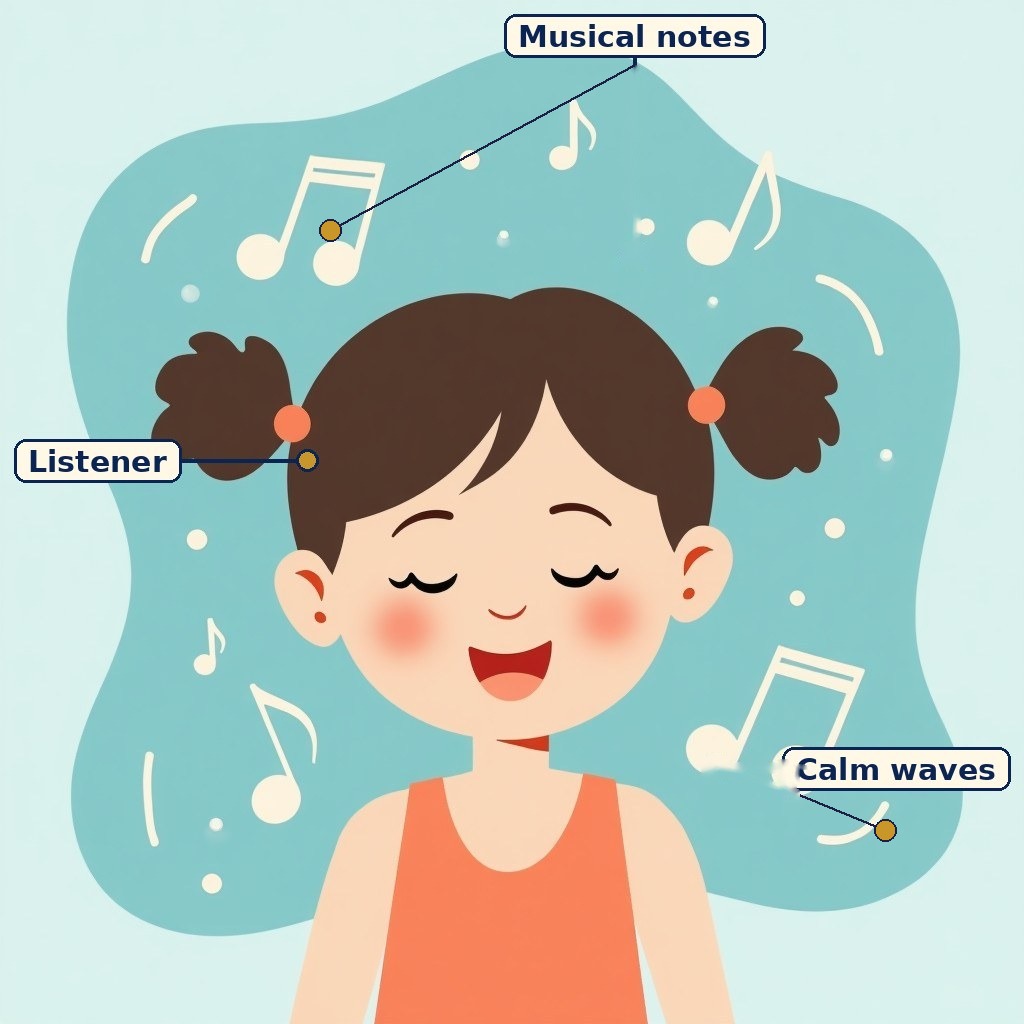
Diagram (labels are printed on the image): A listener feeling music through notes and waves. A general teaching picture; it is not a picture from the book.

A child trying out a tune of their own. A general picture about musical creativity; no book picture is copied here.
What the chapter is about
Music expresses emotions — rasas. When you sing or play music, you are communicating a feeling or an emotion, and in the Indian performing arts that emotion is simultaneously experienced by the artist and the audience. It is this emotion that connects the artist with the audience, so the chapter’s first rule is simple: always sing with passion and expression.
The chapter opens with a line from the Abhinaya Darpana of Nandikeshvara: “sabha kalpataru bhaati”, the audience is like a tree which fulfils your inner wishes. Though written in the context of dance, it applies to all art forms — the audience completes the performance.
Devotional music shows how words, tune and rhythm come together. People pray in different ways, and often come together in groups to sing devotional songs in different styles, using a variety of words, tunes and rhythms. The chapter’s first example is a Shabad: Shabads are musical prayers in the Sikh religion, sung in the Gurudwara. The Shabad taught is “koi boley raam raam koi khudaye, koi sevai gosayya koi alaahey” — we pray with different names such as Rama, Guru and Allah, and the aim is to thank the Almighty for giving us such a beautiful world, whether one visits a teerth or goes on haj, does pooja or bows the head, reads the Veda or the Kateb, or calls oneself Turk or Hindu. The second example is a devotional and patriotic song in Urdu, “Lab Pe Aati Hai Dua Ban Ke Tamanna Meri”: a wish carried on the lips that life should shine brightly like a guiding light, that one’s work should uplift the less fortunate as flowers beautify a garden, and that life should be marked by care and compassion, offering a beacon of hope to companions. Students may learn one or both songs, or choose devotional songs from their own culture or faith.
Creativity turns pictures and history into music. In Activity 6.2, students look carefully at a Phad painting by Prakash Joshi, try to identify its state or region from its style, then create two lines describing the plates one by one — in their native language if they wish — rhythmic and easy to sing, for example “Dekho dekho sakhi dwar pe suj sanwar kay kaun khada” — sing them in groups, observe the next plate, and continue creating lines until the whole composition is sung, documenting and recording the process to understand how words and music work together to evoke emotions. Teachers may use any painting of their choice, or one from their region, and the chapter also suggests looking at Ragamala paintings in museums. In Activity 6.3, a musical narrative, students choose a topic from the history section of Social Science — Chandragupta Maurya and Kautilya, Prabhavati Gupta, Chandragupta II (Vikramaditya) and his nine jewels, or Prithviraj Chauhan — write a paragraph describing a story of that ruler’s empire, draw a picture to illustrate it, describe the scene in a few sentences in any language, and sing those lines in a tune of their choice. That is how musicals and musical storytelling are created, and India has many forms of musical storytelling, including Powada, Kaavad Katha and Alha-Udal.
Active listening (Activity 6.4) means listening carefully and trying to understand. The more you listen to a wide range of music, the more you pick up styles, structures and techniques you would not notice at first, and the more your ear opens to genres, rhythms and nuances of production. Students listen to an instrumental piece or film background music, and to a folk, tribal, modern or contemporary song of their choice, take turns analysing and interpreting it, and ask: what emotions can you recognise, what are the moods of the lyrics and the tune, and what changes when you do the same activity with instrumental music alone? Suggested listening includes instrumental albums by Shakti, Pandit Ravi Shankar and Dr L. Subramaniam, and folk orchestras from different states. In Activity 6.5, Act It Out, students enact the expressions in different compositions, using elements learnt in Theatre and Dance to communicate the emotions and story of the music, and explore how lyrics and tune together tell a story.
What you should learn
- Explain how music communicates rasa, felt simultaneously by artist and audience.
- Describe devotional music through the Shabad and the Urdu dua, in your own words and with their meanings.
- Turn a painting (Phad) and a history topic into sung lines — a musical narrative.
- Practise active listening: recognise emotions, moods, styles and structures in vocal and instrumental music.
- Act out the emotions and story of a piece of music, using Theatre and Dance elements.
Key Terms
- Rasa (in music) — The emotion a piece of music expresses, experienced simultaneously by artist and audience.
- Shabad — A musical prayer in the Sikh religion, sung in the Gurudwara.
- Devotional song — A song expressing devotion, sung in groups in many styles, words, tunes and rhythms.
- Active listening — Listening carefully to understand a piece of music — its emotions, moods, styles, structures and techniques.
- Musical narrative — A story told through song: a paragraph and picture turned into lines sung to a chosen tune.
- Phad painting — A Rajasthani painted storytelling tradition; the chapter uses a Phad painting by Prakash Joshi.
- Ragamala painting — A painting tradition depicting ragas, which the chapter suggests seeing in museums.
- Powada, Alha-Udal — Indian forms of musical storytelling, named alongside Kaavad Katha in this chapter.
The chapter’s standing instruction is not technical but emotional: a song sung without feeling does not connect artist and audience, however correct its notes are.
From the Abhinaya Darpana of Nandikeshvara: “sabha kalpataru bhaati” — the audience is like a tree which fulfils your inner wishes. A performance is completed by those who receive it.
For every devotional song, Activity 6.1 asks three things: what is the emotion in the song, in which language is it sung, and what do its important words mean? Learning the words’ meanings is also how you grow your vocabulary in that language.
Try it: Learn a devotional song properly (Activity 6.1)
- Learn the Shabad “koi boley raam raam koi khudaye” or the Urdu dua “Lab Pe Aati Hai Dua”, or a devotional song from your own culture or faith.
- Ask: what is the emotion in the song you have sung?
- Ask: in which language is it sung?
- Note the important words in the song and understand their meaning — a good way to increase your vocabulary in that language.
Try it: Understand a painting through music (Activity 6.2)
- Observe the Phad painting by Prakash Joshi carefully. From its style, can you identify the state or region it is from?
- Create two lines describing the plates one by one, in your native language if you like, rhythmic and easy to sing.
- Sing them in groups, observe the next plate, and continue creating lines until the whole composition is sung.
- Document and record the entire process, and notice how words and music together evoke emotions.
Try it: Musical narrative + active listening + act it out (Activities 6.3–6.5)
- Choose a history topic — Chandragupta Maurya and Kautilya, Prabhavati Gupta, Chandragupta II and his nine jewels, or Prithviraj Chauhan — write a paragraph about one story of that empire, draw a picture, describe the scene in a few sentences, and sing your lines to a tune of your choice.
- Actively listen to an instrumental piece or film background music and to a folk, tribal, modern or contemporary song; take turns analysing and interpreting each piece.
- Ask for each piece: what emotions can you recognise, what are the moods of the lyrics and the tune, and what changes with instrumental music alone?
- Act out the expressions in the compositions, using Theatre and Dance elements to communicate the music’s emotions and story.
Chart / Table: From a song to a story — the chapter’s three creative steps
| Step | What you do |
|---|---|
| Learn and understand | Learn a devotional song; note its emotion, language and important words and their meanings. |
| Painting into music | Describe Phad plates in rhythmic lines and sing the whole composition in groups. |
| History into music | Turn a history paragraph and picture into sung lines — a musical narrative. |
Remember
- Music = rasa communicated; artist and audience feel it together; sing with passion and expression.
- Audience = wish-fulfilling tree (Abhinaya Darpana, Nandikeshvara).
- Shabad: Sikh musical prayer, sung in the Gurudwara; the chapter’s Shabad thanks the Almighty across all names and faiths.
- Urdu dua “Lab Pe Aati Hai Dua”: wish for a life that shines, uplifts the less fortunate, and offers hope.
- Phad painting by Prakash Joshi → rhythmic lines → full sung composition; history topics → musical narrative (Powada, Kaavad Katha, Alha-Udal).
- Active listening opens the ear to styles, structures, rhythms and production nuances; Act It Out uses Theatre and Dance.
Exam Tip / Common Mistake
Common mistake: naming a song without its emotion, language or meaning. In answers, always give all three — for the Shabad, the oneness of prayer across names; for the Urdu dua, the wish for a shining, compassionate, helpful life — and say how words, tune and rhythm work together.
Practice set — try it yourself
- What does the chapter mean by saying music expresses rasas?
Hint: Hint: Think of a feeling felt by artist and audience at the same time. - What is a Shabad, and where is it sung?
Hint: Hint: Think of Sikh musical prayer and the Gurudwara. - What is the meaning of the Urdu dua “Lab Pe Aati Hai Dua”?
Hint: Hint: Think of a wish, a guiding light, and helping the less fortunate. - Turn two Phad plates into two rhythmic lines. What must the lines be?
Hint: Hint: They must be rhythmic and easy to sing. - What is active listening?
Hint: Hint: Listening carefully to understand, not just hearing.
Questions with Answers
- How does music communicate emotion, according to this chapter?
Music expresses rasas: when you sing or play, you communicate a feeling, and in Indian performing arts that emotion is simultaneously experienced by the artist and the audience. That shared emotion connects them, which is why the chapter says to always sing with passion and expression. - Describe the two devotional songs in this chapter.
The Shabad is a Sikh musical prayer sung in the Gurudwara: “koi boley raam raam koi khudaye” says people pray with different names — Rama, Guru, Allah — whether visiting a teerth or going on haj, doing pooja or bowing the head, reading the Veda or the Kateb, calling oneself Turk or Hindu — all to thank the Almighty for a beautiful world. The Urdu song “Lab Pe Aati Hai Dua Ban Ke Tamanna Meri” is devotional and patriotic: the singer carries a wish on the lips that life should shine like a guiding light, that work should uplift the poor as flowers beautify a garden, and that life should be marked by care, compassion and hope for companions. - How do you turn a painting into music, in Activity 6.2?
Observe the Phad painting by Prakash Joshi carefully and try to identify its state or region from its style. Create two rhythmic, easy-to-sing lines describing the plates one by one, in your native language if you like, sing them in groups, observe the next plate, and continue until the whole composition is sung — documenting the process to see how words and music together evoke emotions. - How do you build a musical narrative in Activity 6.3?
Choose a history topic — Chandragupta Maurya and Kautilya, Prabhavati Gupta, Chandragupta II and his nine jewels, or Prithviraj Chauhan — write a paragraph describing a story of that ruler’s empire, draw a picture to illustrate it, describe the scene in a few sentences in any language, and sing your lines in a tune of your choice. India’s musical storytelling forms include Powada, Kaavad Katha and Alha-Udal. - What is active listening, and what does Act It Out add?
Active listening is listening carefully to understand a piece: its emotions, moods, styles, structures and production nuances, in vocal and instrumental music alike. Act It Out adds the body: students enact the expressions in compositions, using Theatre and Dance elements to communicate the music’s emotions and story, and compare how lyrics-plus-tune and instrumental music differ in mood.
Extension Questions — for deeper understanding
- Why does the chapter quote “sabha kalpataru bhaati” for music, though it comes from dance?
Because the Abhinaya Darpana’s image — the audience as a wish-fulfilling tree — applies to all art forms: a performance is not complete until the audience receives it, and in music the shared rasa is precisely that meeting of artist and audience. - How does learning a devotional song grow your vocabulary?
Activity 6.1 asks students to note the song’s important words and understand their meanings. A song in another language — such as the Urdu dua or the Shabad — thus teaches new words in context, carried by tune and feeling, not by a word list. - What is art integration, in the chapter’s note on Activity 6.3?
Art integration is a cross-curricular approach that uses aspects and forms of art and culture as the basis for learning concepts across subjects. The chapter cites NEP 2020 (4.7): art-integrated education is embedded in classroom transactions to create joyful classrooms and imbibe Indian ethos, strengthening linkages between education and culture — so the musical narrative is planned in collaboration with the History lesson. - Why does the chapter suggest listening to Shakti, Pandit Ravi Shankar and Dr L. Subramaniam?
Because active listening needs a wide range: instrumental albums by these artists, and folk orchestras from different states, expose the ear to styles, structures, rhythms and production nuances that a single familiar song cannot teach. - A friend says a song is only its tune. How would you answer from this chapter?
A song is words, tune and rhythm together, plus its layers — vocals, instruments, melody, harmony and lyrics. Change the words’ meaning or the rhythm, and the rasa changes; the painting-into-music and history-into-music activities prove it, because the same picture or story sung differently feels different. - How would you document the painting-into-music activity, and why?
Record the whole process — the lines created plate by plate, the tunes chosen, the group singing — so you can look back and understand how words and music worked together to evoke emotions, rather than remembering only the final song.
- Music communicates rasa, shared by artist and audience; sing with passion and expression.
- Shabad (Gurudwara) and Urdu dua: devotion across names and faiths; words + tune + rhythm.
- Phad painting → rhythmic lines → sung composition; history paragraph → musical narrative.
- Active listening: emotions, moods, styles, structures — vocal and instrumental.
- Act It Out: Theatre + Dance elements carry the music’s story in the body.
How to use this page: Read the summary, say the Key Terms in your own words, then try the practice set without looking. Check your answers against Questions with Answers, and ask your teacher or parent to check your work.