

Chapter 6: Equilibrium
Original notes — ready CBSE (NCERT, English Medium) • Class 11 • Chemistry • Book: Chemistry — Part II (Part II, Chapter 2)
Chapter 6: Equilibrium — EG's own summary, in simple words
Book: Chemistry — Chemistry — Part II (CBSE, Class 11) | Chapter 6 | Medium: English
Reversible reactions, the equilibrium constant, and how chemists shift a reaction's balance.
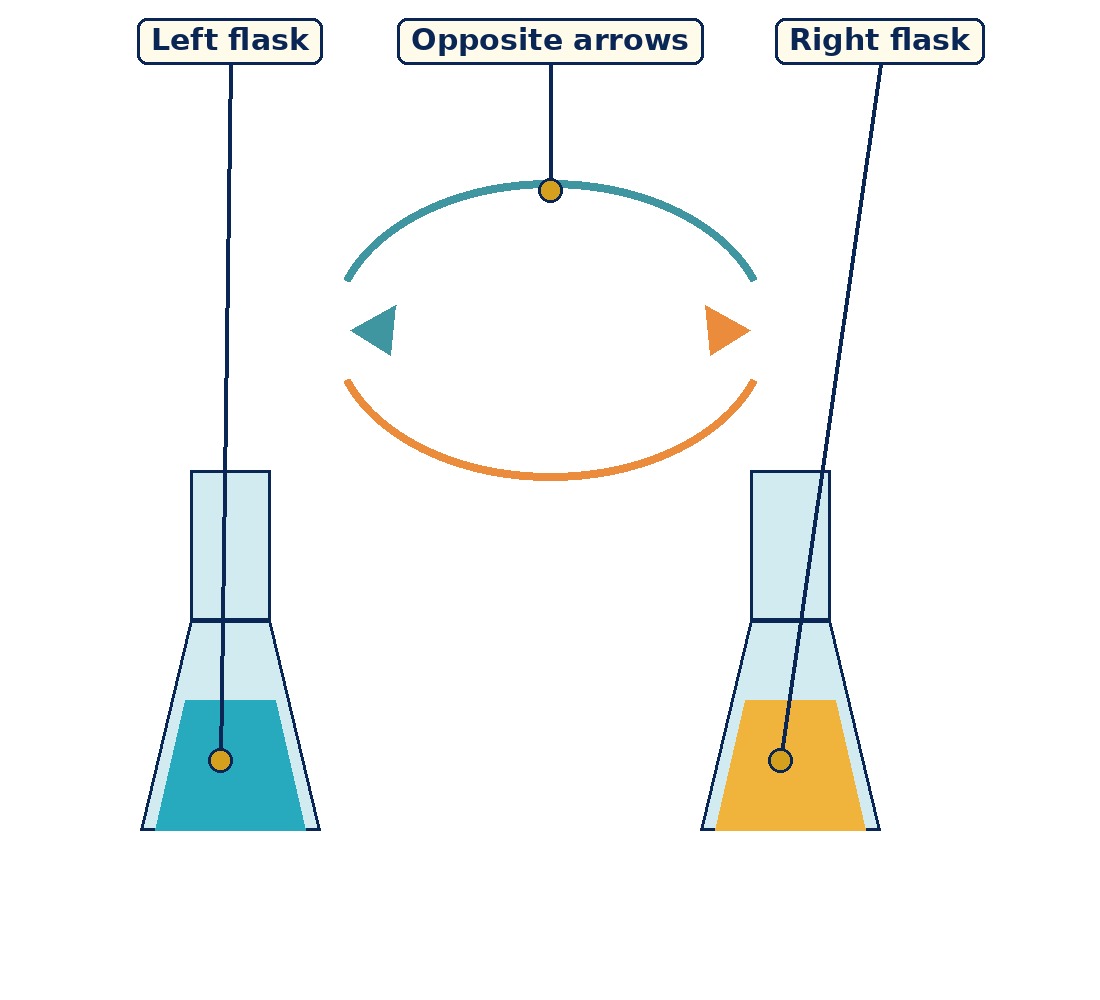
Diagram (labels on the image): Left flask, Opposite arrows, Right flask. This is an Educational Galaxy schematic drawn for this chapter; the second image below is a general illustration, not a textbook figure.
What you should learn
- Explain dynamic equilibrium in physical and chemical processes.
- Write Kc and Kp, convert between them, and use Q to predict direction.
- Apply Le Chatelier's principle to concentration, pressure, temperature and catalysts.
- Use Kw, pH, Ka and Kb for strong and weak acids and bases.
- Explain buffers, salt hydrolysis, solubility products and the common ion effect.
- Link equilibrium to Gibbs energy through ΔG° = −RT ln K.
Coverage map (NCERT): §6.1–§6.2 are the dynamic-equilibrium section; §6.3–§6.4 are the Kc/Kp section; §6.5–§6.7 are Going further 1; §6.8 is the Le Chatelier section; §6.9–§6.11 are the ionic/pH section plus Going further 2; §6.12–§6.13 are the buffer/solubility section. Every numbered section of the rationalised chapter is covered, and nothing here comes from outside it.
1. 1. Equilibrium is dynamic, not still
Many reactions are reversible: products can react back to reactants. At equilibrium the forward and reverse rates are equal, so concentrations stop changing — but the reactions have not stopped. Molecules keep converting in both directions at the same rate. This is dynamic equilibrium.
Equilibrium can be physical (water evaporating and condensing at the same rate in a closed container) or chemical (a reversible reaction reaching constant concentrations). It is reached only in a closed system; in an open container, escaping products prevent it. A catalyst speeds both directions equally, so it helps equilibrium arrive sooner but does not change its position.
2. 2. The law of mass action and Kc, Kp
For aA + bB ⇌ cC + dD, the equilibrium constant Kc = [C]^c [D]^d ÷ ([A]^a [B]^b), using equilibrium concentrations. For gases, Kp uses partial pressures in the same pattern. The two are linked by Kp = Kc (RT)^Δn, where Δn is (moles of gaseous products − moles of gaseous reactants).
The reaction quotient Q has the same form but uses current concentrations, not equilibrium ones. Comparing Q with K tells you the direction: if Q < K, the forward reaction proceeds; if Q > K, the reverse proceeds; if Q = K, the system is at equilibrium. Pure solids and pure liquids are left out of the expression because their concentrations are constant.

Caption: An originally generated illustration for this chapter — a general scene for the topic, not a photograph of a real experiment or a copy of a textbook figure. The labelled diagram above is the one to study for the named parts.
3. 3. Le Chatelier's principle — shifting the balance
Le Chatelier's principle: when a system at equilibrium is disturbed, it shifts to reduce the disturbance. Adding a reactant shifts the equilibrium towards products; removing a product does the same. Adding an inert gas at constant volume has no effect; at constant pressure it increases volume and shifts towards the side with more gas moles.
Pressure changes matter only when gas moles differ: increasing pressure shifts towards the side with fewer gas moles. Temperature is different from the others because it changes K itself: raising temperature favours the endothermic direction, lowering it favours the exothermic direction. The Haber process (exothermic, fewer gas moles on the product side) therefore uses low temperature in principle but a moderate temperature in practice, because too cold means too slow — a compromise between yield and rate.
4. 4. Ionic equilibrium: acids, bases and pH
Water dissociates slightly: Kw = [H+][OH−] = 1.0 × 10^−14 at 25 °C. In pure water [H+] = [OH−] = 10^−7 mol/L, so pH = 7. pH = −log [H+]; each unit of pH is a tenfold change in hydrogen-ion concentration. Acids increase [H+], bases increase [OH−], and pH + pOH = 14 at 25 °C.
Strong acids and bases dissociate completely; weak ones only partly, with their own constants Ka and Kb. The larger Ka, the stronger the acid. For a weak acid, [H+] ≈ √(Ka × concentration) when dissociation is small. Salts of weak acids or bases hydrolyse in water and shift the pH: salts of a strong acid and weak base give acidic solutions, salts of a weak acid and strong base give basic solutions.
5. 5. Buffers, solubility and the common ion effect
A buffer resists pH change. An acidic buffer is a weak acid plus its salt (for example, acetic acid + sodium acetate); a basic buffer is a weak base plus its salt. Added acid is mopped up by the salt's anion, added base by the weak acid, so pH barely moves — until the buffer capacity is exceeded. The Henderson–Hasselbalch equation gives the pH: pH = pKa + log ([salt] ÷ [acid]).
For a sparingly soluble salt, the solubility product Ksp governs how much dissolves: for AgCl, Ksp = [Ag+][Cl−]. Precipitation happens when the ionic product exceeds Ksp. The common ion effect — adding an ion already present — suppresses solubility, which is why, for example, sodium chloride reduces the solubility of silver chloride. This is also why group separations in qualitative analysis work.
Le Chatelier at a glance
| Disturbance | Shift | Effect on K |
|---|---|---|
| Add a reactant / remove a product | Towards products | No change |
| Increase pressure (Δn ≠ 0) | Towards fewer gas moles | No change |
| Increase temperature | Towards endothermic direction | Changes |
| Add a catalyst | None — equilibrium reached faster | No change |
| Add inert gas at constant volume | None | No change |
Going further 1 — Heterogeneous equilibria, the size of K, and ΔG (NCERT §6.5–§6.7)
In a heterogeneous equilibrium the phases differ, but the rule for writing K stays simple: pure solids and pure liquids are omitted because their concentrations are constant. For CaCO3(s) ⇌ CaO(s) + CO2(g), the equilibrium constant is just Kp = pCO2 — the pressure of carbon dioxide alone decides the position, however much solid is present. The same rule applies to any equilibrium with solids or liquids mixed with gases or solutions.
The size of K predicts the extent before any calculation: K far above 1 means products dominate at equilibrium, K far below 1 means reactants dominate, and K near 1 means appreciable amounts of both. The reaction quotient Q is the same ratio at any moment, and Gibbs energy ties them together: ΔG = ΔG° + RT ln Q, which at equilibrium (ΔG = 0, Q = K) gives ΔG° = −RT ln K. A large negative ΔG° therefore means a large K, and a reaction that goes almost to completion.
Exam note: never write a solid or pure liquid into a Kc or Kp expression — but remember it must be present for the equilibrium to exist at all.
Going further 2 — Three definitions of acids and bases, and how weak acids ionise (NCERT §6.10–§6.11)
Three definitions grow wider in turn. Arrhenius: an acid gives H+ in water and a base gives OH−. Brønsted-Lowry: an acid is a proton donor and a base is a proton acceptor, so every acid has a conjugate base and every base a conjugate acid — HCl/Cl− and NH4+/NH3 are conjugate pairs. Lewis: an acid accepts an electron pair and a base donates one, so BF3 is a Lewis acid and NH3 a Lewis base, even though no proton moves. The wider definition never contradicts the narrower ones; it covers reactions the narrower ones cannot.
For a weak acid HA with concentration c and degree of ionisation α, the book derives Ka = cα^2/(1 − α). When α is small, 1 − α is nearly 1, so α = √(Ka/c) and [H+] = √(Ka × c) — the formula already used in the ionic-equilibrium section. It also shows why dilution increases ionisation: as c falls, α rises, because the equilibrium shifts to replace the ions. Strong acids and bases, by contrast, are fully ionised, so α = 1 and no Ka is needed.
Exam note: a conjugate acid–base pair differs by exactly one proton; if two formulas differ by anything else, they are not a conjugate pair.
Practice set — try it yourself
- For N2(g) + 3H2(g) ⇌ 2NH3(g), ΔH is negative. Predict the effect on the yield of ammonia of (a) increasing pressure, (b) increasing temperature, (c) adding a catalyst. Give a reason for each.
- A reaction mixture has Q = 10 and K = 100. In which direction will the reaction proceed, and why?
- Explain why the pH of a 0.01 mol/L hydrochloric acid solution is 2, while a 0.01 mol/L acetic acid solution has a pH well above 2.
- Silver chloride is less soluble in sodium chloride solution than in pure water. Explain using the common ion effect and Ksp.
- What is a buffer? Explain how an acetic acid / sodium acetate buffer deals with a small addition of acid.
Key Terms / Important Terms
- Dynamic equilibrium — State where forward and reverse rates are equal and concentrations are constant.
- Equilibrium constant (Kc / Kp) — Ratio of product to reactant concentrations (or pressures) at equilibrium.
- Reaction quotient (Q) — The same ratio using current, not equilibrium, concentrations.
- Le Chatelier's principle — A disturbed equilibrium shifts to reduce the disturbance.
- Ionic product of water (Kw) — [H+][OH−] = 10^−14 at 25 °C.
- pH — −log [H+]; a tenfold concentration change per unit.
- Buffer solution — A solution that resists pH change on adding small amounts of acid or base.
- Common ion effect — Suppression of dissociation or solubility by an ion already present.
- Solubility product (Ksp) — Product of ion concentrations in a saturated solution, each raised to its coefficient.
- Hydrolysis — Reaction of a salt's ions with water, changing the solution's pH.
- Heterogeneous equilibrium — An equilibrium in which reactants and products are in different phases.
- Conjugate acid–base pair — Two species differing by exactly one proton, such as NH4+ and NH3.
- Degree of ionisation — The fraction of an electrolyte that has ionised, written α.
Remember
- Solids and pure liquids never appear in Kc or Kp expressions.
- Q predicts direction; K gives the final position. Compare them, do not confuse them.
- Only temperature changes K. Concentration and pressure changes shift position but leave K unchanged.
- pH is logarithmic: pH 3 is ten times more acidic than pH 4, not one unit more in any linear sense.
- A catalyst changes the time to equilibrium, never the equilibrium constant or the yield.
- In heterogeneous equilibria, pure solids and liquids are omitted — but their presence is required for the equilibrium to exist.
Exam Tip / Common Mistake
The most persistent error is saying a catalyst increases the yield, or that adding a reactant changes K. Neither is true: catalysts and concentration changes only move the system along to the same K. Only temperature changes K — and the direction depends on whether the reaction is exothermic or endothermic, so state that sign before deciding the shift.
Questions with Answers — full answers
- What is meant by dynamic equilibrium? Answer: Dynamic equilibrium is the state in a reversible process where the forward and reverse reactions continue at equal rates, so concentrations remain constant even though the reactions have not stopped. It is dynamic because molecules keep reacting in both directions.
- State Le Chatelier's principle and apply it to adding more hydrogen to the Haber equilibrium. Answer: When a system at equilibrium is disturbed, it shifts in the direction that reduces the disturbance. Adding hydrogen to N2 + 3H2 ⇌ 2NH3 shifts the equilibrium towards ammonia, using up some of the added hydrogen.
- Why does a catalyst not change the equilibrium constant? Answer: A catalyst lowers the activation energy of the forward and reverse reactions by the same amount, so both rates increase equally. The equilibrium position, which depends on the ratio of the rates, is unchanged; equilibrium is simply reached sooner.
- Define pH and calculate the pH of a solution with [H+] = 10^−4 mol/L. Answer: pH = −log10 [H+]. For [H+] = 10^−4 mol/L, pH = −log10 (10^−4) = 4. The solution is acidic.
- What is a buffer solution? Give one acidic buffer pair. Answer: A buffer solution resists changes in pH when small amounts of acid or base are added. An acidic buffer pairs a weak acid with its salt, for example acetic acid (CH3COOH) with sodium acetate (CH3COONa).
Extension Questions with Answers — going further
- For N2(g) + 3H2(g) ⇌ 2NH3(g), express Kp in terms of Kc. Answer: Δn = 2 − 4 = −2, so Kp = Kc(RT)^Δn = Kc(RT)^−2. Kp and Kc are equal only when Δn = 0.
- Write the Kp expression for CaCO3(s) ⇌ CaO(s) + CO2(g). Answer: Kp = pCO2. The two solids are omitted because their concentrations are constant; only the gas appears.
- An equilibrium constant is 1.0 × 10^10. What does that say about the extent of reaction? Answer: The reaction goes almost to completion: at equilibrium the products dominate overwhelmingly, and the reactants are nearly used up.
- Calculate ΔG° at 298 K for a reaction with K = 10. Answer: ΔG° = −2.303 RT log K = −2.303 × 8.314 × 298 × log 10 = −2.303 × 8.314 × 298 × 1 = −5708 J/mol, about −5.7 kJ/mol. Negative ΔG° matches K > 1.
- Calculate the pH of 0.001 mol/L NaOH solution. Answer: [OH−] = 10^−3, so pOH = 3. At 25 °C, pH + pOH = 14, so pH = 11. The solution is basic.
Board-pattern Questions with Answers
- Why does Kw rise with temperature, and what happens to the pH of neutral water? Answer: Ionisation of water is endothermic, so heating shifts it towards more ions and Kw rises. Neutral water still has [H+] = [OH−], but both are larger, so the neutral pH falls below 7 at higher temperatures.
- An acidic buffer has pKa 4.76 with equal concentrations of acid and salt. What is its pH? Answer: By Henderson–Hasselbalch, pH = pKa + log([salt]/[acid]) = 4.76 + log 1 = 4.76. Equal concentrations always give pH = pKa.
- The solubility product of AgCl is 1.8 × 10^−10. Calculate its solubility in pure water. Answer: For AgCl, Ksp = s^2, so s = √(1.8 × 10^−10) = 1.34 × 10^−5 mol/L. Very little dissolves, which is why AgCl is called sparingly soluble.
- For Ag2CrO4, how is Ksp related to its solubility s? Answer: Ag2CrO4 ⇌ 2Ag+ + CrO4^2− gives [Ag+] = 2s and [CrO4^2−] = s, so Ksp = (2s)^2 × s = 4s^3. The coefficient 2 must be squared — forgetting it is the classic error.
- Why does adding ammonium chloride suppress the ionisation of ammonium hydroxide? Answer: NH4Cl supplies NH4+, the common ion. By Le Chatelier's principle the equilibrium NH4OH ⇌ NH4+ + OH− shifts backwards, so less NH4OH ionises and [OH−] falls.
Recap — the chapter in five lines
- Equilibrium is dynamic: rates equal, concentrations constant.
- Kc, Kp, Q and ΔG° describe the same balance in four languages.
- Only temperature changes K; everything else only shifts position.
- Acids and bases come in three widening definitions, with conjugate pairs.
- Buffers, Ksp and the common ion effect are one principle applied three ways.