

Chapter 5: Thermodynamics
Original notes — ready CBSE (NCERT, English Medium) • Class 11 • Chemistry • Book: Chemistry — Part II (Part II, Chapter 1)
Chapter 5: Thermodynamics — EG's own summary, in simple words
Book: Chemistry — Chemistry — Part II (CBSE, Class 11) | Chapter 5 | Medium: English
Energy, enthalpy, entropy and Gibbs energy — and what decides whether a change happens on its own.
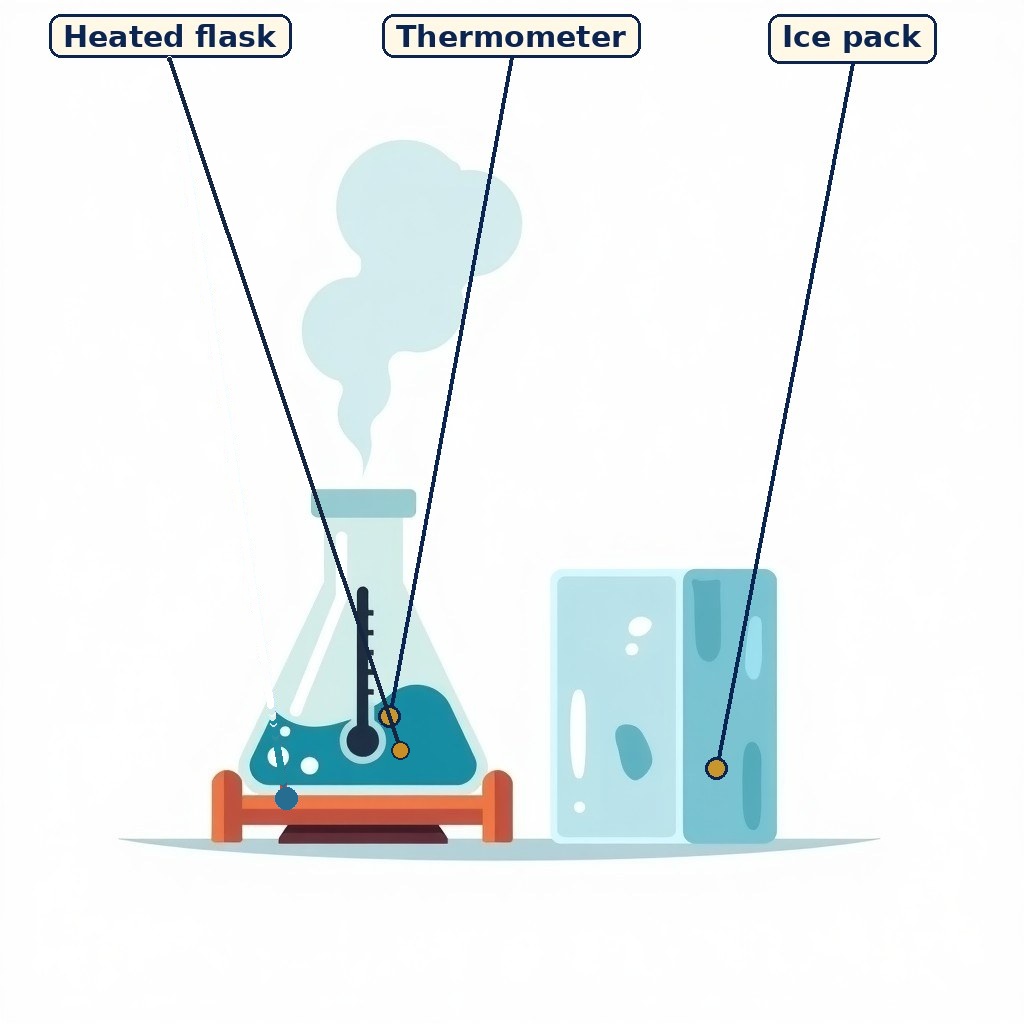
Diagram (labels on the image): Heated flask, Thermometer, Ice pack. Labels were added by Educational Galaxy on an originally generated illustration; see the caption below the second image for an honest note on what the picture shows.
What you should learn
- Classify systems and processes, and tell state functions from path functions.
- Apply the first law, including expansion work and the ΔH–ΔU relation.
- Measure ΔU and ΔH by calorimetry and convert between them.
- Use Hess's law and standard enthalpies to find unknown enthalpy changes.
- Predict the sign of entropy change and use the second and third laws.
- Decide spontaneity from ΔG = ΔH − TΔS, and link ΔG° to the equilibrium constant.
Coverage map (NCERT): §5.1 is the system/surroundings section; §5.2–§5.3 are Going further 1; §5.4–§5.5 are the enthalpy sections plus Going further 2; §5.6 is the entropy section; §5.7 is the Gibbs-energy section. Every numbered section of the rationalised chapter is covered, and nothing here comes from outside it.
1. 1. The system and its surroundings
A system is the part of the world we study; everything else is the surroundings. An open system exchanges matter and energy; a closed system exchanges energy but not matter; an isolated system exchanges neither. A cup of tea in a sealed flask is closed; the same tea in a perfect vacuum flask approaches isolated.
State functions — internal energy (U), enthalpy (H), entropy (S) and Gibbs energy (G) — depend only on the present state, not on how it was reached. Heat (q) and work (w) are path functions: they depend on the route taken. This distinction is why a cycle can return to its starting state (ΔU = 0) even though heat and work were exchanged along the way.
2. 2. The first law: energy is conserved
The first law states that the energy of an isolated system is constant: ΔU = q + w, where q is heat absorbed by the system and w is work done on the system (sign conventions vary by book — state the one you use). In a reaction at constant pressure, the heat exchanged equals the change in enthalpy, ΔH, which is why chemists usually quote ΔH rather than ΔU.
For an ideal gas, expansion work is w = −PΔV. If a reaction produces gas at constant pressure, some energy goes into pushing back the atmosphere, so ΔH and ΔU differ by ΔngRT, where Δng is the change in moles of gas.

Caption: An originally generated illustration for this chapter — a general scene for the topic, not a photograph of a real experiment or a copy of a textbook figure. The labelled diagram above is the one to study for the named parts.
3. 3. Enthalpy changes: Hess's law and standard values
Standard enthalpy of formation (ΔfH°) is the enthalpy change when one mole of a compound forms from its elements in their standard states; for elements in their standard state it is zero by definition. Standard enthalpy of combustion (ΔcH°) is the enthalpy change when one mole burns completely in oxygen.
Hess's law: enthalpy change is independent of the path, because enthalpy is a state function. So a hard-to-measure enthalpy can be built from a cycle of measurable ones: ΔrH° = sum of ΔfH° of products − sum of ΔfH° of reactants. Draw the cycle, keep the signs straight, and the arithmetic does the rest.
Bond enthalpies give an estimate by a different route: ΔrH ≈ (energy to break bonds in reactants) − (energy released forming bonds in products). It is approximate because tabulated bond enthalpies are averages, not values for the exact molecule.
4. 4. Entropy and the second law
Entropy (S) measures disorder, or more precisely the number of ways energy and particles can be arranged. It increases when a solid melts, a liquid vaporises, or a gas expands, and when the number of gas particles increases in a reaction. The second law says the total entropy of the universe (system + surroundings) increases in a spontaneous process.
The third law sets the scale: the entropy of a perfect crystal at absolute zero (0 K) is zero. Standard entropies are therefore absolute values, unlike enthalpies, which are measured relative to elements. The entropy change of a reaction is ΔrS° = sum of S° of products − sum of S° of reactants.
5. 5. Gibbs energy — the deciding quantity
Gibbs energy combines the two tendencies: ΔG = ΔH − TΔS. A process at constant temperature and pressure is spontaneous when ΔG is negative, non-spontaneous when positive, and at equilibrium when ΔG is zero.
The four cases are worth memorising: ΔH negative and ΔS positive — always spontaneous. ΔH positive and ΔS negative — never spontaneous. ΔH negative and ΔS negative — spontaneous only at low temperature. ΔH positive and ΔS positive — spontaneous only at high temperature. This is why some endothermic processes, like ice melting above 0 °C, still happen: the entropy gain wins at high enough temperature.
Gibbs energy also links to equilibrium: ΔG° = −RT ln K. A large negative ΔG° means a large equilibrium constant — the reaction goes almost to completion.
Gibbs energy: when is a process spontaneous?
| ΔH | ΔS | ΔG = ΔH − TΔS | Verdict |
|---|---|---|---|
| Negative (exothermic) | Positive (more disorder) | Always negative | Spontaneous at all temperatures |
| Positive (endothermic) | Negative (more order) | Always positive | Non-spontaneous at all temperatures |
| Negative | Negative | Negative at low T only | Spontaneous at low temperature |
| Positive | Positive | Negative at high T only | Spontaneous at high temperature |
Going further 1 — Processes, calorimetry and the work of expansion (NCERT §5.1–§5.3)
Processes get their names from what is held constant: isothermal means constant temperature, adiabatic means no heat exchanged (q = 0), isobaric means constant pressure and isochoric means constant volume, where no expansion work is done. A reversible process is carried out in infinitely small steps so the system stays in equilibrium throughout; an irreversible process is not. For the reversible isothermal expansion of an ideal gas, the work is w = −2.303 nRT log(Vf/Vi): expanding from 10 L to 20 L at 298 K gives about −1.72 kJ per mole, the negative sign showing work done by the system.
Calorimetry turns heat into a measurable temperature change. A bomb calorimeter works at constant volume, so the heat it measures is qv = ΔU. Most bench chemistry happens at constant pressure, where qp = ΔH, and the two are linked by ΔH = ΔU + ΔngRT, where Δng is the change in moles of gas. If a reaction produces no net gas, ΔH and ΔU are nearly equal; if it produces gas, part of the energy goes into pushing back the atmosphere.
Exam note: free expansion of an ideal gas into a vacuum does no work (w = 0) because there is no opposing pressure — however fast it happens.
Going further 2 — The enthalpy family (NCERT §5.5)
Standard enthalpies have precise meanings, and examiners test the definitions. Enthalpy of fusion is solid to liquid, vaporisation is liquid to gas, and sublimation is solid directly to gas — all for one mole in its standard state. Enthalpy of solution is the change when one mole of a substance dissolves; it is the sum of the lattice enthalpy (breaking the solid apart, endothermic) and the hydration enthalpy (water surrounding the ions, exothermic), which is why some salts cool the water and others warm it.
Two more complete the family: enthalpy of atomisation is the change when one mole of a substance is broken into gaseous atoms (for carbon it is 715.0 kJ/mol, for Cl2 it is 242 kJ/mol), and lattice enthalpy is the change when one mole of an ionic solid forms from its gaseous ions. Bond enthalpies, already used in the enthalpy section, are averages — which is why a Hess-cycle answer from formation enthalpies is more accurate than one from bond enthalpies.
Exam note: 'standard' always means 1 bar and the substance in its most stable form at the stated temperature; elements in their standard states have zero enthalpy of formation by definition.
Practice set — try it yourself
- A reaction has ΔH = −100 kJ/mol and ΔS = −200 J/mol·K. At what temperature does it stop being spontaneous? Explain your working.
- Why does ice melt spontaneously above 0 °C but not below it, even though melting absorbs heat?
- Use Hess's law to explain how the enthalpy of formation of carbon monoxide can be found from the enthalpies of combustion of carbon and carbon monoxide.
- For the reaction N2(g) + 3H2(g) → 2NH3(g), predict the sign of ΔS and justify it without calculation.
- Distinguish a state function from a path function, giving two examples of each.
Key Terms / Important Terms
- System — The part of the universe under study.
- Surroundings — Everything outside the system.
- Internal energy (U) — Total energy stored in a system.
- Enthalpy (H) — Heat content at constant pressure; H = U + PV.
- State function — A quantity depending only on the current state, not the path.
- Hess's law — Enthalpy change is independent of the path taken.
- Entropy (S) — Measure of disorder / number of arrangements available.
- Gibbs energy (G) — Energy available to do useful work; G = H − TS.
- Spontaneous process — A process that occurs on its own, with ΔG < 0.
- Standard state — The reference state: 1 bar pressure and a specified temperature.
- Adiabatic process — A process with no heat exchanged with the surroundings (q = 0).
- Calorimetry — Measuring heat changes through temperature changes in a calorimeter.
- Reversible process — A process carried out in infinitely small steps, staying in equilibrium throughout.
Remember
- ΔH and ΔU differ only when the moles of gas change; for reactions with no gas, they are nearly equal.
- Exothermic does not mean spontaneous, and endothermic does not mean impossible — entropy can overturn enthalpy.
- ΔG = 0 means equilibrium, not that nothing is happening — forward and reverse rates are equal.
- Standard enthalpies of formation of elements in their standard states are zero by definition.
- Entropy of the system alone can decrease in a spontaneous process, as long as total entropy increases.
- q and w are path functions, but q at constant pressure (qp) equals ΔH and q at constant volume (qv) equals ΔU — that is why calorimeters are built at fixed pressure or fixed volume.
Exam Tip / Common Mistake
The most common error is judging spontaneity from ΔH alone. An endothermic reaction can be spontaneous if ΔS is positive and the temperature is high enough, and an exothermic reaction can fail to be spontaneous if ΔS is negative and the temperature is high. Always check both terms in ΔG = ΔH − TΔS, and state the temperature condition when the signs oppose.
Questions with Answers — full answers
- State the first law of thermodynamics and explain ΔU = q + w in words. Answer: Energy cannot be created or destroyed, only transferred or converted. ΔU is the change in a system's internal energy; q is the heat absorbed by the system and w is the work done on the system. Any increase in internal energy must come from heat absorbed or work done on the system.
- What is Hess's law, and why is it true? Answer: Hess's law states that the enthalpy change of a reaction is the same whether it happens in one step or several steps. It is true because enthalpy is a state function: it depends only on the initial and final states, so the path taken cannot change the total.
- When is a process spontaneous in terms of Gibbs energy? Answer: At constant temperature and pressure, a process is spontaneous when ΔG is negative, non-spontaneous when ΔG is positive, and at equilibrium when ΔG is zero. ΔG = ΔH − TΔS combines the enthalpy and entropy tendencies.
- Why can the entropy of a system decrease in a spontaneous process? Answer: The second law requires only that the total entropy of system plus surroundings increases. A system can become more ordered (for example, water freezing) if it releases enough heat to increase the surroundings' entropy by more than the system's decrease.
- A reaction is exothermic but has a negative entropy change. Will it always be spontaneous? Answer: No. ΔG = ΔH − TΔS: with ΔH negative and ΔS negative, the −TΔS term is positive and grows with temperature. The reaction is spontaneous only at low temperatures, where the enthalpy term dominates; at high temperatures ΔG becomes positive.
Extension Questions with Answers — going further
- A reaction has ΔH = −100 kJ/mol and ΔS = −200 J/mol·K. Find ΔG at 298 K and say whether it is spontaneous. Answer: ΔG = ΔH − TΔS = −100 − 298 × (−0.200) = −100 + 59.6 = −40.4 kJ/mol. ΔG is negative, so the reaction is spontaneous at 298 K, even though entropy decreases.
- For 2A + B → C, ΔH = 400 kJ/mol and ΔS = 0.2 kJ/K·mol at 298 K. Calculate ΔG. Answer: ΔG = 400 − 298 × 0.2 = 400 − 59.6 = +340.4 kJ/mol. ΔG is positive, so the reaction is non-spontaneous at 298 K.
- For an isolated system, ΔU = 0. What can be said about ΔS? Answer: For a spontaneous process in an isolated system, ΔS > 0: the total entropy must increase. At equilibrium ΔS = 0. Entropy can never decrease for an isolated system as a whole.
- Calculate the work done when 1 mole of an ideal gas expands reversibly and isothermally from 10 L to 20 L at 298 K. Answer: w = −2.303 nRT log(Vf/Vi) = −2.303 × 1 × 8.314 × 298 × log(20/10) = −2.303 × 8.314 × 298 × 0.3010 = −1717 J, about −1.72 kJ. The negative sign means work is done by the system.
- Why does qp equal ΔH only at constant pressure? Answer: ΔH is defined as ΔU + pΔV. At constant pressure, the heat absorbed is qp = ΔU + pΔV, which is exactly ΔH. If pressure changes during the process, the equality fails.
Board-pattern Questions with Answers
- Classify U, H, q and w as state or path functions, with a reason for each. Answer: U and H are state functions: they depend only on the present state. q and w are path functions: the heat absorbed and work done depend on the route taken between the same two states.
- For 2H2(g) + O2(g) → 2H2O(l), how are ΔH and ΔU related? Answer: Δng = 2 − 3 = −1, so ΔH = ΔU + ΔngRT = ΔU − RT. ΔH is smaller than ΔU because gas moles decrease and the surroundings do work on the system.
- The enthalpy of combustion of carbon is −394 kJ/mol and of carbon monoxide is −283 kJ/mol. Find the enthalpy of formation of carbon monoxide. Answer: By Hess's law: C + O2 → CO2 (−394); CO + ½O2 → CO2 (−283). Subtracting gives C + ½O2 → CO: ΔfH = −394 − (−283) = −111 kJ/mol.
- Predict the sign of ΔS for CaCO3(s) → CaO(s) + CO2(g), with a reason. Answer: Positive. A gas is produced from a solid, so the particles gain freedom of movement and the number of arrangements increases.
- A reaction has ΔH = +100 kJ/mol and ΔS = +200 J/mol·K. Above what temperature does it become spontaneous? Answer: Spontaneous when ΔG < 0, that is when TΔS > ΔH, so T > 100,000 ÷ 200 = 500 K. Below 500 K the enthalpy term wins; above it, entropy wins.
Recap — the chapter in five lines
- Systems and processes are named by what is exchanged or held constant.
- The first law is bookkeeping: ΔU = q + w, with ΔH for constant pressure.
- Calorimetry measures ΔU or ΔH; Hess's law builds what cannot be measured.
- Entropy rises with disorder and gas moles; the third law anchors the scale.
- ΔG = ΔH − TΔS decides spontaneity, and ΔG° = −RT ln K links it to equilibrium.