

Prose 6: The Artist
Story • Author: Shiga Naoya • Original EG notes in simple English
The Artist — EG's own notes, in simple English
Book: Rainbow Bhag-2 (Purani pustak — 2025 se pehle wali) (BSEB, Class 12) | Prose 6 | Type: Story | Author: Shiga Naoya
This page carries Educational Galaxy's own original notes — a theme-level summary in simple English, not a copy of the textbook. No official textbook PDF is given here.
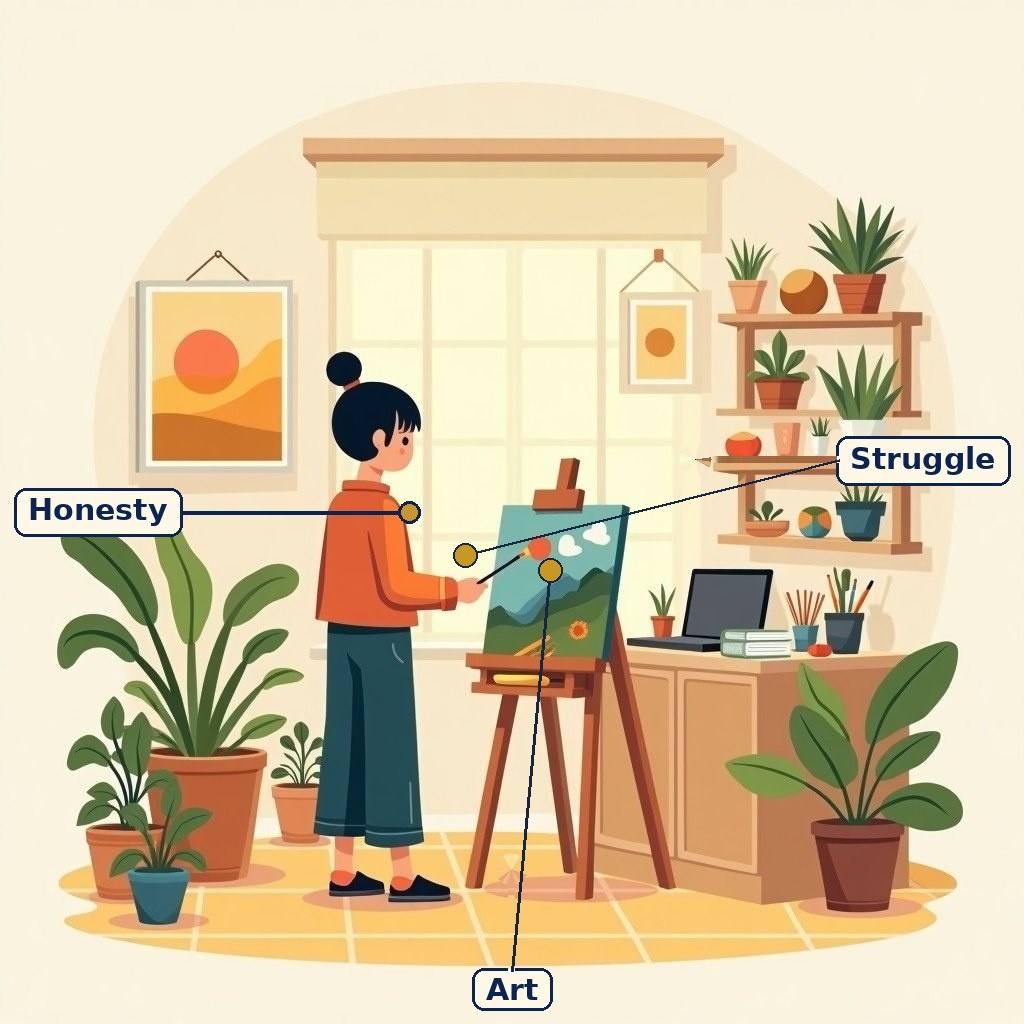
Diagram (labels are printed on the image): A young artist in his poor studio — honesty over fashion.

Brushes and colours by the window — the tools of honest work.
What the chapter is about
This is a Japanese story about a young artist who wants to paint truly. He is poor and unknown, but he refuses to paint what sells. He wants his art to be honest, even if nobody buys it.
The story shows the artist's struggle: hunger, loneliness and doubt. People laugh at him, but he keeps working. In the end, his honesty itself becomes his reward — he may not be rich, but he is true to his art.
The lesson is that true art needs honesty more than fame. An artist who follows fashion may earn money, but only the honest artist creates something lasting.
The story's conflict is not between the artist and one villain, but between two ways of valuing art. The market values what sells quickly; the artist values what is true slowly. Every hunger and every lonely evening in the story is a price he pays for choosing the second way, and the story asks the reader whether that price is worth paying.
Notice the ending's quiet claim. The artist does not become famous or rich, yet the story treats him as successful. Success here is redefined: it is not applause or money, but the knowledge that the work is honest. In exams, that redefinition is the point to stress — otherwise the story looks like a sad tale about failure.
What you should learn
Understand the artist's struggle — honesty in art matters more than fame or money.
Key Terms
- Artist — One who creates art — painting, writing or music.
- Honesty — Being true to what one believes.
- Fashion — What is popular for a short time.
- Struggle — Hard effort against difficulties.
- Reward — What one gains for effort; here, inner truth.
Remember
- The young artist is poor and unknown.
- He refuses to paint what sells.
- He faces hunger, loneliness and doubt.
- His honesty itself becomes his reward.
Exam Tip / Common Mistake
Common mistake: writing only 'a story about painting'. In exams, add the conflict — honesty versus fashion, truth versus money.
Chart / Table
| Point | Detail |
|---|---|
| Author | Shiga Naoya |
| Main character | A young, poor artist |
| Conflict | Honesty versus fashion and money |
| Struggle | Hunger, loneliness, doubt |
| Message | Honesty matters more than fame |
Practice set — try it yourself
- Why does the artist refuse to paint what sells?
Hint: Think about honesty versus money. - What struggles does he face?
Hint: Think about hunger, loneliness and doubt. - What is his real reward?
Hint: Think about being true to his art. - Why is following fashion dangerous for an artist?
Hint: Think about what is popular for a short time. - Give an example of honesty versus popularity from student life.
Hint: Think about copying versus doing your own work.
Core Questions with Answers
- Who is the main character?
A young Japanese artist, poor and unknown, who wants to paint truly. - What does he refuse to do?
To paint what sells — fashionable art that would earn money but be dishonest. - What does he suffer?
Hunger, loneliness and doubt; people laugh at him. - What is his reward?
His honesty itself — he remains true to his art even without wealth. - What is the main message?
True art needs honesty more than fame; only honest art lasts.
Extension Questions with Answers
- Why does the artist refuse to paint what sells?
Because painting for sale would mean painting what buyers want, not what he truly sees. For him, that would be a lie on canvas, and a lie cannot be art. - How do hunger and loneliness function in the story?
They are the costs of honesty. They prove his choice is real: anyone can praise honesty when it is easy, but he keeps it when it hurts. - Is the artist selfish for refusing to earn and support himself?
The story invites this question but answers against it: he harms no one, and his honesty protects art itself. His poverty is a cost he bears himself, not one he forces on others. - What is the difference between fame and success in this story?
Fame is what others give; success is what the artist knows about his own work. He lacks fame but keeps success, because his work stays true. - Apply the story to a student who copies to get marks.
Copying is painting what sells: it earns the reward without the truth. Like the artist's opposite, the copier gains marks but loses the very thing marks are supposed to show — real learning.
Board Exam Questions (board-pattern practice)
These are Educational Galaxy's own board-pattern practice questions, written in the style of board questions. They are not claimed to be real past-year questions.
- Explain the conflict in this story. Answer: Honesty versus fashion — the artist must choose between painting truly and painting what sells for money and fame.
- Why is the artist's poverty important? Answer: It tests his honesty. It is easy to be honest when rich; his poverty proves his art matters more than comfort.
- How is honesty itself a reward? Answer: Because the artist keeps his self-respect and creates work he believes in; that inner truth outlasts money and praise.
- What does fashion do to art? Answer: Fashion makes art follow the market; it may earn money for a season, but it cannot last, because it is not honest.
- What lesson does this story give students? Answer: To do honest work — in study or art — rather than chasing marks or popularity by shortcuts.
How to use this page: First read the summary, say the key terms in your own words, then try the practice set without looking. Finally check yourself with the questions and answers. Get your answers checked by your teacher or parents.
- The young artist is poor and unknown.
- He refuses to paint what sells.
- He faces hunger, loneliness and doubt.
- His honesty itself becomes his reward.