

Chapter 6: How Forces Affect Motion
Original notes — ready CBSE (NCERT, English Medium) • Class 9 • Science • Book: Exploration
Chapter 6: How Forces Affect Motion — EG's own notes, in simple words
Book: Exploration (CBSE, Class 9) | Chapter 6 | Medium: English
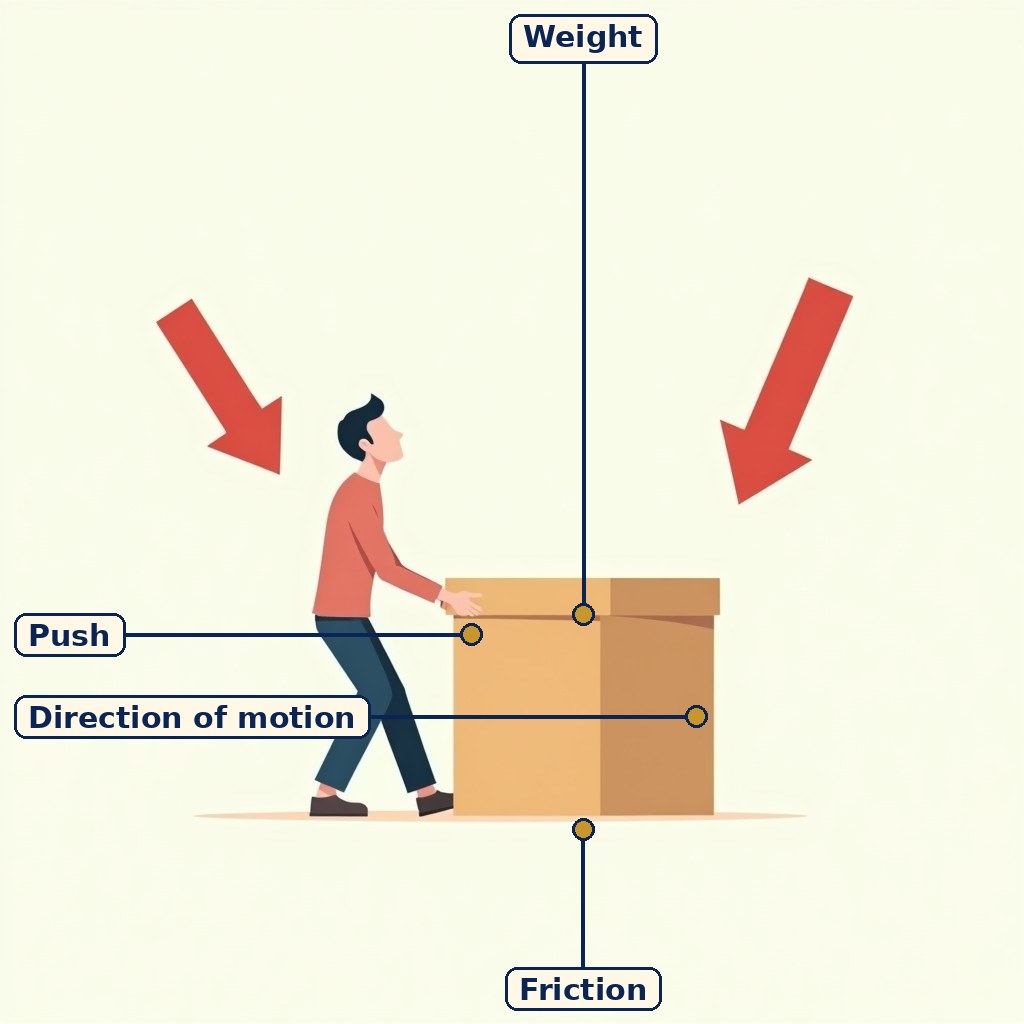
Diagram (labels are printed on the image): Diagram (labels are printed on the image): A person pushing a heavy box — the push, the weight of the box and friction all act on it. A general diagram for study, not a figure copied from the book.

Forces in everyday life — kicking, pulling and falling. A general picture about forces, not a book scene.
What the chapter is about
A force is a push or a pull. Forces can start motion, stop motion, change speed or direction, or change the shape of an object. Every force has a size and a direction, and forces act in pairs: when you push a wall, the wall pushes back on you.
Newton's first law, the law of inertia, says that an object stays at rest or keeps moving in a straight line at steady speed unless an unbalanced force acts on it. Inertia is the tendency of an object to resist a change in its state of motion, and it grows with mass. That is why a heavy truck is harder to stop than a bicycle.
Newton's second law links force, mass and acceleration: a larger force, or a smaller mass, gives a larger acceleration. Newton's third law says that for every action there is an equal and opposite reaction. Momentum, the product of mass and velocity, is conserved when objects collide, and friction is the force that opposes motion between surfaces in contact.
What you should learn
Notice how inertia explains the first law, how force, mass and acceleration connect in the second law, and how action and reaction always appear together.
Key Terms
- Force — A push or a pull that can change the motion or shape of an object.
- Inertia — The tendency of an object to resist a change in its state of rest or uniform motion.
- Momentum — The product of mass and velocity of a moving object.
- Friction — The force that opposes motion between two surfaces in contact.
- Balanced forces — Forces that cancel each other out, so motion does not change.
Remember
- An object keeps its state of motion unless an unbalanced force acts.
- Inertia grows with mass.
- Force = mass × acceleration.
- Every action has an equal and opposite reaction.
Exam Tip / Common Mistake
Common mistake: saying that action and reaction cancel each other out. They act on different objects, so they cannot cancel — the book pushes on the table, and the table pushes back on the book.
Chart / Table: Newton's three laws
| Point | Detail |
|---|---|
| First law (inertia) | An object keeps its state of motion unless an unbalanced force acts |
| Second law | Force = mass × acceleration |
| Third law | Every action has an equal and opposite reaction |
| Momentum | Mass × velocity; conserved in collisions |
Practice set — try it yourself
- Why does a passenger jerk forward when a bus stops suddenly?
Hint: Think about inertia and steady motion. - A force of 10 N acts on a mass of 2 kg. What is the acceleration?
Hint: Think about force divided by mass. - Why is it harder to push a loaded truck than an empty one?
Hint: Think about mass and inertia. - Give one example of action and reaction in daily life.
Hint: Think about pairs of forces on different objects. - Why do car tyres have treads?
Hint: Think about friction and grip.
Questions with Answers
- What is Newton's first law of motion?
Newton's first law states that an object remains at rest or in uniform motion in a straight line unless an unbalanced force acts on it. This property is called inertia. - What is Newton's second law?
Newton's second law states that the acceleration of an object depends on the net force acting on it and on its mass: force = mass × acceleration. A larger force gives a larger acceleration, and a larger mass gives a smaller acceleration for the same force. - What is Newton's third law? Give an example.
Newton's third law states that for every action there is an equal and opposite reaction. For example, when you walk, your foot pushes backwards on the ground, and the ground pushes you forwards. - What is momentum?
Momentum is the product of the mass and velocity of an object. Heavier and faster objects have more momentum, and the total momentum of interacting objects stays conserved when no outside force acts. - What is friction, and is it always unwanted?
Friction is the force that opposes motion between surfaces in contact. It is useful when we walk or when brakes stop a vehicle, but it also causes wear and wastes energy, so it is reduced in machines with lubricants.
How to use this page: Read the summary, say the Key Terms in your own words, then try the practice set without looking. Use the Questions with Answers to check yourself afterwards. Ask your teacher or parent to check your answers.