

Chapter 4: Fitness and its Components
Health-related or skill-related? The two families of fitness, and how to train both.
Original notes — ready CBSE (NCERT, English Medium) • Class 9 • Physical Education • Book: Khel Praveen
Chapter 4: Fitness and its Components — EG's own notes, in simple words
Book: Khel Praveen (CBSE, Class 9) | Chapter 4 | Section: Unit 1: Evolution of Physical Education and Well-being | Medium: English
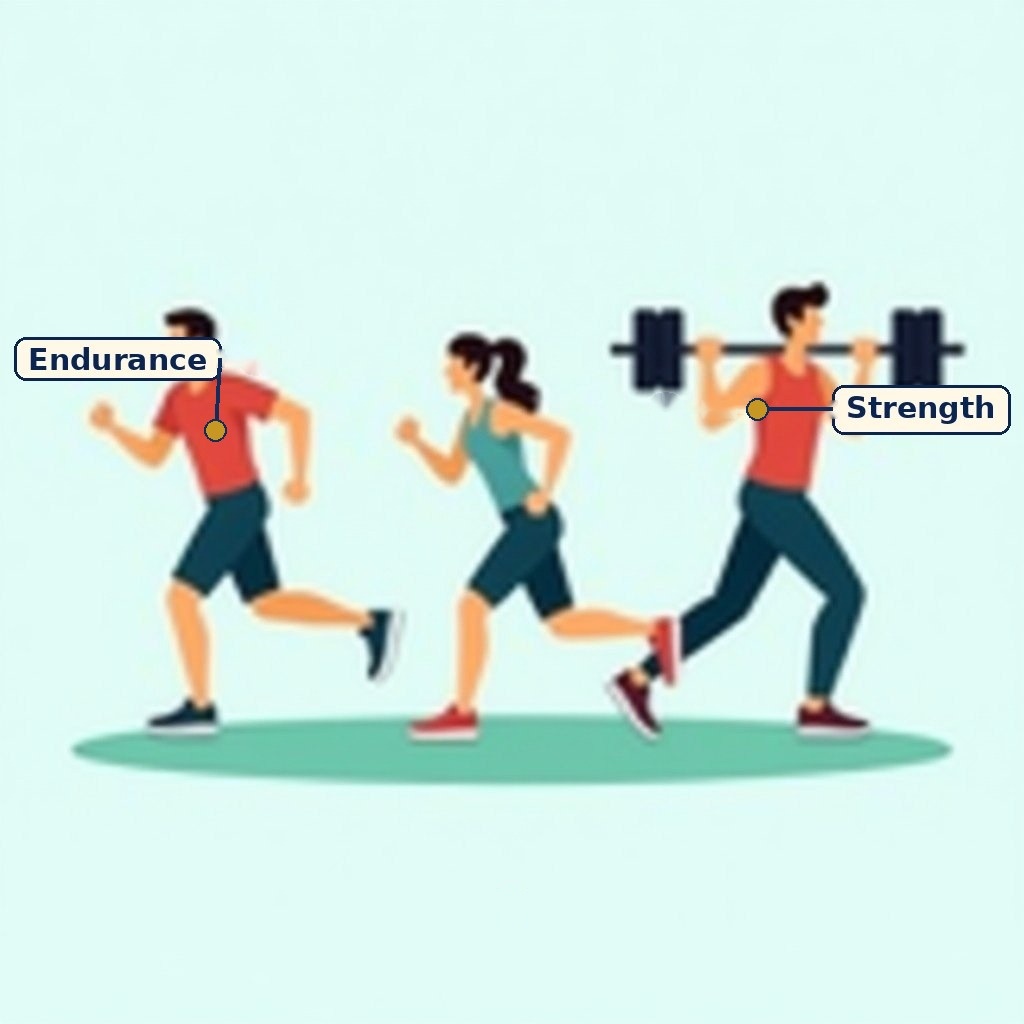
Diagram (labels are printed on the image): Running for endurance, training for strength and stretching for flexibility. A general picture about fitness components; it is not a scene from the book.

Students training different fitness components in one session.

New labelled schematic (labels and gold dots are printed on the image): Two fitness families
What the chapter is about
Fitness is not one thing — it is a set of abilities. Health-related fitness includes endurance, strength, flexibility and body composition. Motor fitness adds speed, agility, balance, coordination, power and reaction time.
Each component can be trained and tested. Running builds endurance, stretching builds flexibility, and jumping builds power. A good programme trains several components, not only one, because real games need all of them.
Fitness also needs rest, food and safety. Training too hard without rest causes injury, and skipping warm-up is a common cause of pulled muscles. Self-directed fitness — setting your own small goals and tracking them — is the modern approach.
Health-related fitness: the base for everyone
Health-related fitness has five components. Cardiovascular endurance is the ability of the heart and lungs to supply oxygen during activity — the reason you can keep running without collapsing. Muscular strength is how much force a muscle can produce once, muscular endurance is how long it can keep producing force, flexibility is the range of movement at a joint, and body composition is the proportion of fat to fat-free mass in the body.
These five matter for daily life, not just sport: climbing stairs, carrying bags and sitting upright all draw on them. The chapter's practical task — a 15-minute routine combining strength, flexibility and endurance, with one benefit of each — is the best revision: if you can design the routine, you understand the components. Body Mass Index (BMI), judged against World Health Organisation guidelines, is the chapter's tool for checking body composition.
Skill-related fitness: the edge for performance
Skill-related fitness has six components: speed, agility, balance, coordination, power and reaction time. Power is a combination of strength and speed — a jump or a throw needs both at once. Agility is changing direction quickly without losing control, coordination is using different body parts together smoothly, and reaction time is how fast you respond to a signal, like a starter's whistle.
The exam trick in this chapter is sorting, not memorising. The exercise gives eleven words — body composition, flexibility, cardiovascular endurance, balance, muscular strength, muscular endurance, speed, agility, power, coordination and reaction time — and asks you to underline the health-related ones and encircle the skill-related ones. Five go in the first group, six in the second. Learn that split and half the chapter's questions are already answered.
What you should learn
Fitness has health-related and motor components, each trainable, and a balanced programme with rest and warm-up builds all of them.
Key Terms
- Endurance — The ability to keep going without tiring quickly.
- Strength — The force muscles can produce.
- Flexibility — How far joints can move freely.
- Agility — Changing direction quickly and safely.
- Balance — Staying steady while still or moving.
Remember
- Fitness has many components, not just strength.
- Endurance, strength, flexibility are health-related.
- Speed, agility, balance, power are motor fitness.
- Warm-up, rest and food are part of training.
Exam Tip / Common Mistake
Common mistake: training only your favourite component. A fast runner who never stretches gets injured; a strong player without endurance tires early.
Chart / Table: Fitness components and how to train them
| Point | Detail |
|---|---|
| Endurance | Running, cycling, swimming |
| Strength | Push-ups, squats, resistance work |
| Flexibility | Stretching, yoga |
| Speed | Short sprints |
| Balance and agility | Beam walking, cone drills |
Fitness splits into five health-related components for daily life and six skill-related components for performance — and a fit person trains both, not just the one their sport rewards.
Practice set — try it yourself
- Test yourself: run, stretch, balance — note your weakest component.
Hint: Hint: Be honest; that is your training target. - Why is warm-up needed before training?
Hint: Hint: Think muscles, blood and injury. - Design a weekly plan covering four components.
Hint: Hint: Give each component one day. - What is the difference between strength and endurance?
Hint: Hint: Think one heavy lift versus long running. - Set a small fitness goal for one month and track it.
Hint: Hint: Make it measurable, like 'run 10 minutes nonstop'.
Questions with Answers
- What are the health-related components of fitness?
Cardiovascular endurance, muscular strength, muscular endurance, flexibility and body composition. - What is motor fitness?
Fitness for skilled movement: speed, agility, balance, coordination, power and reaction time. - How is agility different from speed?
Speed is moving fast in one direction; agility is changing direction quickly and safely, as in dodging in kho-kho. - Why is rest part of fitness training?
Because muscles grow and repair during rest. Training without rest leads to tiredness and injury. - What is self-directed fitness?
Setting your own fitness goals, choosing activities and tracking progress yourself, instead of depending only on tests or coaches.
Questions with Answers — Extension
- Sort these: speed, flexibility, reaction time, body composition, coordination. Which family does each belong to?
Health-related: flexibility, body composition. Skill-related: speed, reaction time, coordination. - Why is power listed under skill-related fitness, not under strength?
Because power is strength applied quickly — strength plus speed together, as in a jump or throw — so it describes performance, not just force. - A student can run far but cannot touch their toes. Which components are strong and weak?
Cardiovascular endurance is strong; flexibility is weak. Fitness is not one thing — a student can be fit in one component and unfit in another. - Design a 15-minute routine with one strength, one flexibility and one endurance activity, and state one benefit of each.
For example: 5 minutes of squats (strength — stronger muscles), 5 minutes of stretching (flexibility — larger joint range, fewer pulls), 5 minutes of jogging (endurance — heart and lungs supply oxygen longer). - Why does the chapter use BMI with WHO guidelines rather than weight alone?
Because weight alone ignores height; BMI relates weight to height, and WHO categories give a standard way to read the result — though it is a screening tool, not a full health verdict.
How to use this page: Read the summary, say the Key Terms in your own words, then try the practice set without looking. Use the Questions with Answers to check yourself afterwards. Ask your teacher or parent to check your answers.